Examining the Certainty and Uncertainty of the 'First Global Large Model Stock' from Zhipu's Debut Performance on Listing Day
 01/08 2026
 715
715
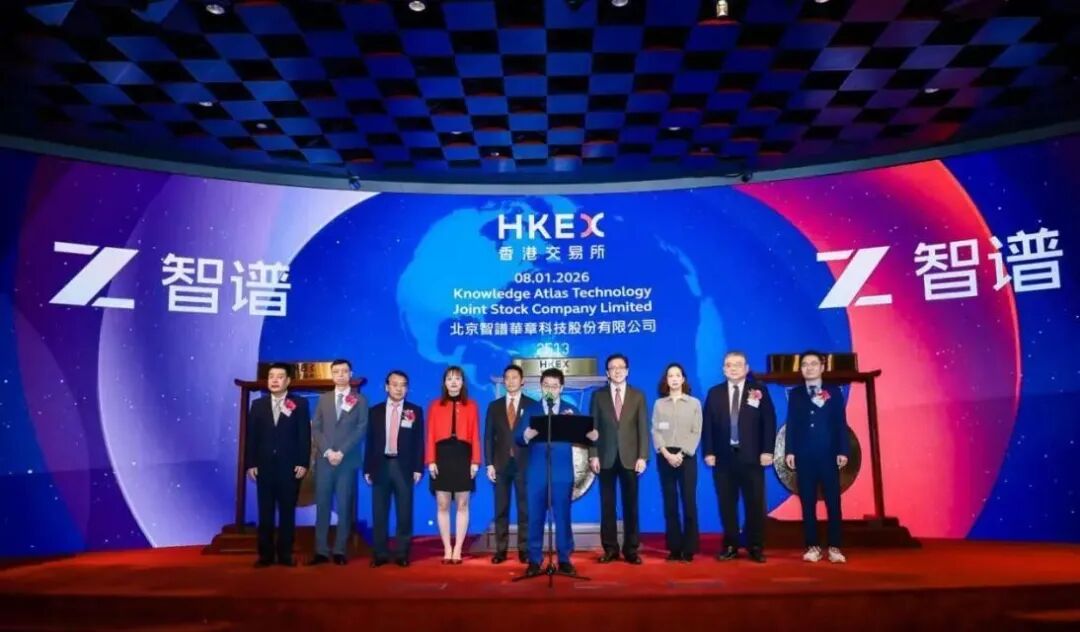
On January 8th, Zhipu Huazhang (02513.HK) made its trading debut as the 'First Global Large Model Stock.' Its first-day performance was highly volatile, characterized by a 'high opening, oscillation (volatility), temporary dip below the issue price, and subsequent recovery':
The stock opened 3.27% higher at HK$120. During intraday trading, it briefly fell below the issue price of HK$116.2. In the afternoon session, it closed at HK$129.8 per share, marking an 11.7% increase from the issue price of HK$116.2.
This volatile trend is widely regarded as a reflection of the market's competition over the pace of large model commercialization.
As the 'First Global Large Model Stock,' Zhipu Huazhang has attracted capital due to its scarcity value. However, it also faces uncertainties regarding commercialization and profitability—a core challenge for all independent large model enterprises.
▌Dual Support from Technological Barriers and Capital Recognition
Zhipu's listing is considered a 'pioneering endeavor' in the capitalization of China's large model industry.
From a capital perspective, the IPO generated substantial market enthusiasm. The public offering witnessed a 1,159.46-fold oversubscription, while the international placement saw a 15.28-fold oversubscription. Eleven cornerstone investors committed HK$2.98 billion, accounting for nearly 70% of the total. Ultimately, the company raised over HK$4.1 billion, providing ample 'ammunition' for subsequent R&D and ecological expansion.
Behind this capital fervor lie Zhipu's technological barriers and industry standing. According to Frost & Sullivan data, based on 2024 revenue, Zhipu is China's largest independent large model vendor and ranks second among all general-purpose large model vendors, with a 6.6% market share. It trails only iFLYTEK and surpasses giants like Alibaba and SenseTime.
Technologically, Zhipu's GLM series models have established core competitiveness. The latest GLM-4.7 model ranked first among open-source models in Code Arena blind testing. It achieved an industry-record 73.8% in SWE-bench-Verified testing, surpassing GPT-5.2. Compared to its predecessor, it improved by 41% in the HLE benchmark test. It set a new open-source record with 87.4 points in the tool invocation τ²-Bench and supports a 200K context, enabling long-text tasks for 150-page documents.
This technological edge has translated into significant ecological effects. Zhipu's MaaS ecosystem covers over 3 million enterprise developers. By Q3 2025, it had served over 12,000 institutional clients across more than 20 industries. Notable applications include Kingsoft Office WPS AI and Mengniu AI Nutritionist, which have adopted its technology. In 2025, MaaS revenue surged by over 900% year-on-year, with programming subscription ARR exceeding RMB 100 million and daily Token invocation reaching 4.6 trillion.
Additionally, Zhipu's overseas expansion has shown initial success. In H1 2025, revenue from the Southeast Asian market accounted for 11.1%, a significant improvement from the 99.5% reliance on the Chinese mainland in 2024.
▌Dual Constraints of Commercialization Bottlenecks and Profitability Pressures
Despite its technological and capital advantages, market doubts persist, as directly reflected in the first-day stock price volatility.
Compared to recently listed domestic GPU stocks like Moore Threads (which surged 425.46% on debut) and MXC (which rose 692.95% on debut), Zhipu's performance was relatively subdued. This can be attributed to the inherent challenge of commercializing software layers, which is more difficult than hardware layers. Moreover, Zhipu's own commercialization bottlenecks and profitability pressures further amplified market concerns.
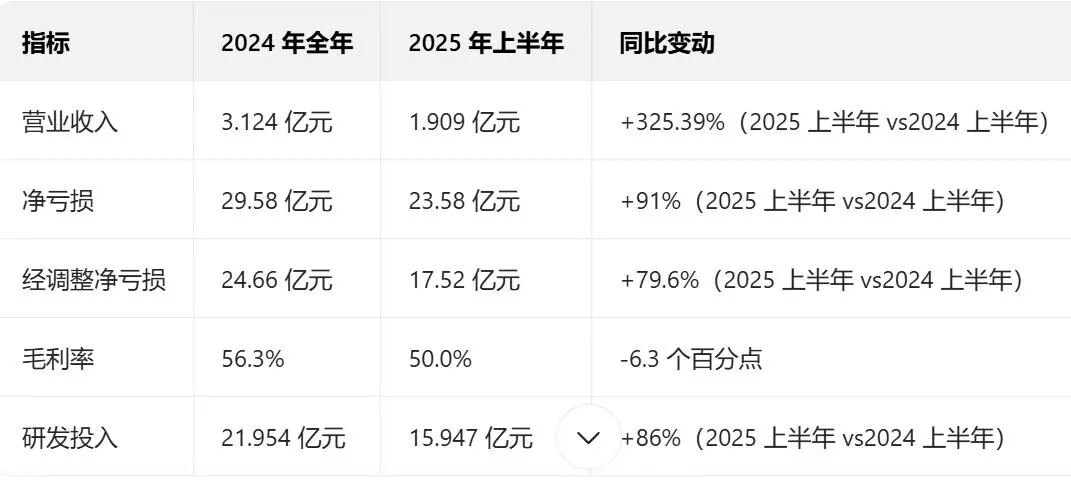
Zhipu's Performance Over the Past Two Years
An imbalance in the commercialization structure is a core weakness for Zhipu. Although MaaS is positioned as the long-term core monetization path, as of 2024, 84.5% of its revenue still relied on localization-deployed 'project-based' business, with cloud API revenue accounting for only 15.5%. While this 'project-based' approach meets government and enterprise clients' data security needs for localization deployment, it suffers from high delivery costs and scalability challenges. This creates a gap with the lightweight SaaS models adopted by overseas leaders like OpenAI.
More critically, the cloud business has yet to achieve profitability. Facing the impact of free API strategies from giants like Alibaba and Tencent, Zhipu's cloud SaaS transformation has been slow. This makes it difficult to boost profitability through scale in the short term. Meanwhile, customer concentration risk remains unresolved. In H1 2025, the top five clients accounted for 40.0% of revenue, which is still high compared to mature industries. This makes business stability dependent on the continuity of core client partnerships.
Escalating losses have intensified market concerns over its profitability timeline. Prospectus data shows net losses of RMB 143 million, RMB 788 million, and RMB 2.958 billion in 2022-2024, respectively. In H1 2025, net losses further widened to RMB 2.358 billion, accumulating over RMB 6.2 billion in losses.
The primary cause of escalating losses is strategic investment in R&D and computing power. In H1 2025, R&D expenditure reached RMB 1.595 billion, accounting for 83.5% of revenue. Meanwhile, computing costs for large model training remain persistently high. Although the company emphasizes that revenue will grow by over 60% year-on-year in Q3 2025, revenue growth still lags behind loss expansion. This makes the timeline for loss reduction and identifying a clear profitability path a core focus for the market.
Furthermore, the competitive landscape is intensifying. Emerging vendors like Deepseek and incursions from internet giants are squeezing the 'AI Six Little Tigers.' Competitors like MiniMax and Yuezhi Aidian are focusing on differentiated paths, such as To C and open-source models, respectively. This puts Zhipu's independent vendor status under dual pressure.
▌Demonstration Effect of the 'First Large Model Stock'
In response to core market concerns over commercialization efficiency, loss pressures, and ecological competition, Zhipu has provided answers in its prospectus and management statements.
To address the ambiguity in commercialization paths, Zhipu has clarified MaaS as the long-term core monetization strategy. It plans to increase API business revenue to 50% of total revenue. It promotes standardized delivery through AutoGLM 2.0 and CoCo platforms, focusing on high-value scenarios like programming, finance, and government services to boost ARPU per client. Meanwhile, it continuously expands into Southeast Asian markets to diversify its client base.
Regarding loss pressures, management attributes them to strategic R&D and computing power investments. It plans to secure 2-3 years of R&D funding through the IPO while strictly controlling non-core costs. It optimizes computing power reuse rates and delivery efficiency to gradually reduce loss ratios.
In ecological competition, Zhipu leverages its 'independent general-purpose large model + domestic adaptation' strategy. It deeply adapts to over 40 domestic GPU models, building differentiated barriers in compliance-sensitive scenarios like government and finance. Meanwhile, it achieves complementary development through ecological partnerships with Meituan, Alibaba Cloud, and others to avoid direct confrontation with giants.
From an industry perspective, Zhipu's listing has accelerated the capitalization of China's domestic large models. It signals that the AI industry has transitioned from the wild growth of shallow waters to the deep waters of competing on technological strength and commercialization capabilities.
Listing is just a new starting point; translating technological advantages into sustained profitability is the answer Zhipu must deliver. The score of this answer will not only determine Zhipu's market position but also profoundly influence the growth trajectory and capitalization process of China's entire domestic large model industry.
-
![]()
Li Bin Claims, 'Denying the Pure EV Trend is Like Ostrichism.' What's Li Xiang's Take?
-
Lenovo: Liu Jun Turns Left, Yang Yuanqing Turns Right
-
Lenovo: Liu Jun Goes Left, Yang Yuanqing Goes Right
-
![]()
MiniMax Shares Unlock: Cornerstone Shareholders Show Long-Term Optimism, Yet Stock Plummets Nearly 30% in Two Days; Zhipu Also Sees Nearly 20% Drop Today
-
![]()
Single-Day Plunge of 40%: The 'First AGI Stock' Faces More Than Just Share Price Concerns
-
![]()
Ricoh and Fuji Hike Prices on Legacy Edge; Insta360 Poised to Disrupt Mirrorless Camera Market
-
![]()
Ricoh and Fujifilm Raise Prices in Tandem, Relying on Established Reputations; Insta360 Poised to Disrupt Mirrorless Camera Market
-
![]()
Strategic Shift in Photoelectric Sensing: Maxvision Secures Controlling Stake in CAS Optotech