Wu Yongming: Have No Fear, Capex Will Yield Returns in Three Years
 08/24 2026
 566
566
Source | Benyuan Finance
Author | Li Youshan
The AI industry race is a capital-intensive endeavor, with computing-related capital expenditures (Capex) expanding exponentially and rapidly depleting the free cash flow of global tech behemoths.
The four major overseas tech giants—Amazon, Google, Microsoft, and Meta—are projected to collectively spend over USD 750 billion on computing-related Capex in 2026, nearly doubling the 2025 total. Domestically, quarterly AI infrastructure investments by Alibaba, Tencent, ByteDance, and Baidu are nearing RMB 200 billion.
Risks and opportunities converge on a pivotal question: How much should be invested in the future, and what tangible returns can be expected?
During the earnings call, Alibaba Group CEO Wu Yongming reassured the market, stating that the return on investment for AI computing Capex is highly predictable, with average gross margins for AI products still on the rise. "Computing investments are anticipated to pay off within three years, potentially even缩短 (shortening) to two and a half or two years." Standing at a historic juncture for AI commercialization, we take the "three-year payback" as a case study to briefly discuss this high-stakes investment.
1. The Cost of Full-Stack AI
For a company that has long prioritized efficiency, embracing change is par for the course. In the first quarter of FY2027 (Q2 2026 in the calendar year), Alibaba implemented new organizational adjustments.
Specifically, the e-commerce businesses under Jiang Fan's leadership were consolidated into a single group (including parts of Hema and Cainiao); Pingtouge was merged into the cloud division to form the "AI Cloud and Computing Services" segment; the Model Lab, Qianwen 2C Business Division, and Qianwen Office were separated from the "All Other" segment to form an independent "AI Lab and Applications" unit; the gaming business Lingxi Huyu from the "Other" segment was divested, leaving businesses such as Alibaba Health, Orca Entertainment, and Gaode.
Prior to this, there were three notable adjustments: In March, the ATH Business Group was established, integrating Tongyi Lab, Qianwen, Wukong, MaaS, and innovative businesses, led by CEO Wu Yongming; in April, Tongyi Lab was upgraded to the Tongyi Large Model Business Division, headed by Zhou Jingren; in June, the Tongyi Large Model Business Division and Future Life Lab were merged to form the Token Foundry Business Division, with Wu Yongming at the helm and Zhou Jingren promoted to Chief Scientist.
Collectively, these moves underscore the significance of the AI business.
Alibaba is among the few domestic players with full-stack AI capabilities. This time, by integrating models, applications, cloud, and chips into its AI ecosystem, the strategy for full-link connectivity and resource allocation has become clearer.
The most comprehensible and impressive aspect of full-stack AI is the "cloud and computing" business.
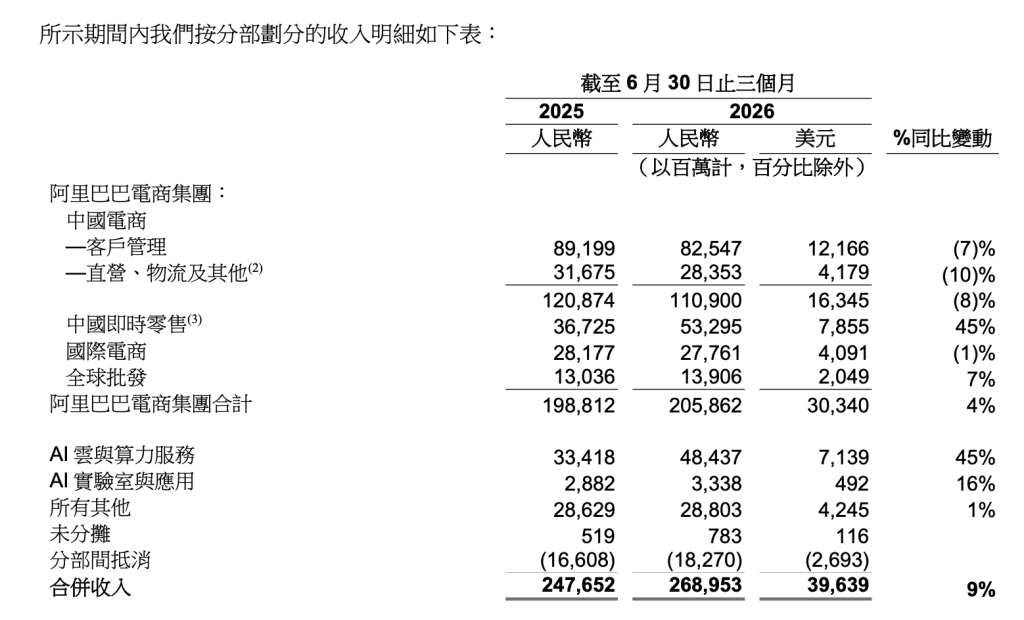
AI cloud and computing services revenue reached RMB 48.437 billion, up 45% year-over-year (YoY), aligning with Morgan Stanley analyst Gary Yu's assessment; on the profit front, adjusted EBITA reached RMB 5.628 billion, up 133% YoY, with the profit margin rising from about 7% in the same period last year to 12%.
In the same quarter, Google Cloud grew by 82%, Azure by 43%, AWS by 37%, and Alibaba by 45%. This data set also addresses some of the market's previous queries about Alibaba's AI investments.

Profit improvement was driven by growth in the high-margin MaaS business, increased penetration of self-developed chips, and operational efficiency optimizations. The Zhenwu series chips are now providing training, fine-tuning, and inference services to over 650 external customers across more than 20 industries via Alibaba Cloud.
AI-related revenue reached RMB 12.4 billion, up over 150% YoY, with annualized ARR exceeding RMB 49.5 billion, indicating robust domestic demand for cloud computing power.
AI infrastructure is closest to monetization, with major players aggressively expanding capacity. Alibaba has also maintained relatively aggressive AI capital expenditures in recent years: Capex in this quarter increased to RMB 67.678 billion, up 75%, far exceeding market expectations of around RMB 36 billion.
Alibaba had previously proposed a spending plan of at least RMB 380 billion over the next three years, with RMB 190 billion already invested by the end of June.
CFO Xu Hong explained the business logic of the full-stack AI platform, stating that whether it's AI software subscriptions, large model API inference, GPU rentals, or software services related to training and inference, AI monetization is built on infrastructure like computing centers. Therefore, "Capex must come first to enable subsequent business growth."
Downstream consumer-facing AI applications are still in a heavy investment phase.
Reflected in the financial data, the AI Lab and Applications segment reported revenue of RMB 3.338 billion this quarter, up 16% YoY, performing averagely; adjusted EBITA widened from a loss of RMB 3.224 billion in the same period last year to a loss of RMB 13.861 billion.
Losses were primarily due to model investments and inference costs for the Qianwen App, indicating that the business model and monetization of AI applications have not yet been established.
Wu Yongming also provided a crucial assessment: Assuming the current average gross margin level of AI products can be sustained, combined with gross margin improvements from increased self-developed chip adoption, "the current Capex investment will pay off within three years." This is the first time Alibaba's management has explicitly provided a payback period for AI investments.
He also stated that computing power shortages will persist until at least 2030; A100s purchased in 2020 are still "nearly fully utilized by customers."
J.P. Morgan also crunched the numbers: Assuming Alibaba invests RMB 100 in AI Capex, mature-stage ROIC is about 20%, with equipment depreciated straight-line over 5 years and after-tax IRR around 22.1%, paying back in about 2.95 years. After that, it's pure profit; the worst-case scenario is that the residual value of B300s drops to zero after 5 years.
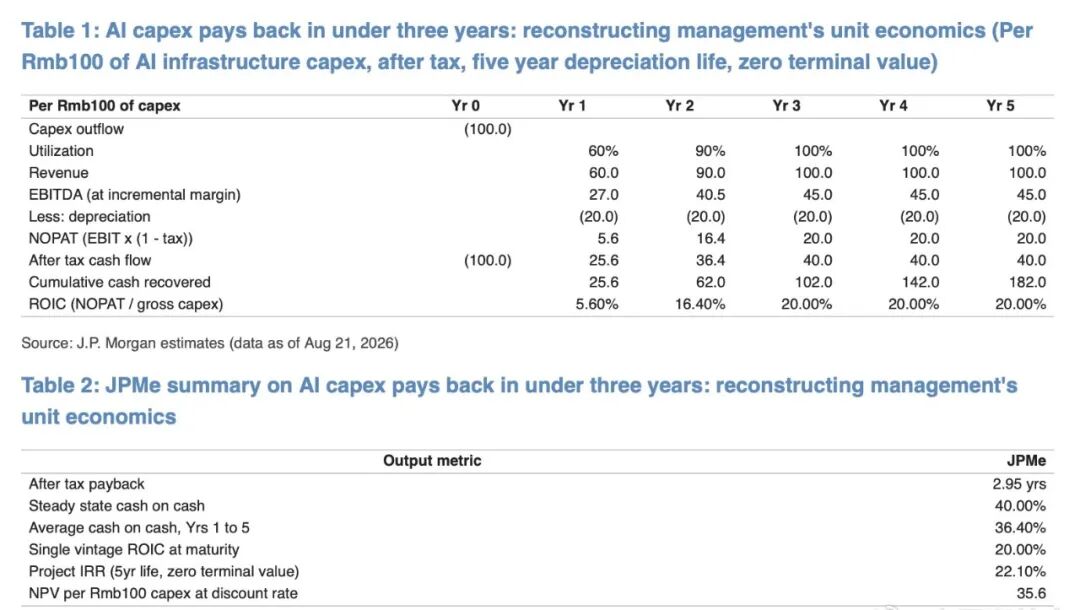
However, the logic for Capex payback is that self-developed chips continue to reduce procurement costs, open-source models continue to drive cloud service demand, and AI applications in turn push up computing consumption, creating a positive feedback loop. Of course, if any link in the chain fails, it will delay the payback period.
Going forward, the three key indicators to watch are: the conversion efficiency of AI cloud revenue to Capex, incremental profit margins, and ROIC of mature assets.
The current computing Capex's impact on free cash flow is already exerting pressure. This quarter, despite a modest 11% YoY increase in operating cash flow, free cash flow dropped to nearly -RMB 45 billion, compared to just RMB 18.815 billion in the same period last year.
2. Persistent Efforts in Logistics
Looking back at Alibaba's overall financials, revenue for the quarter was RMB 268.953 billion, up 9% YoY; operating profit was RMB 15.161 billion, down 57% YoY; adjusted EBITA fell 30% YoY to RMB 27.329 billion, and non-GAAP net profit was RMB 20.715 billion, down 38% from RMB 33.510 billion in the same period in 2025.
Breaking down expenses, operating costs rose 22% YoY, and R&D expenses increased 50% YoY, both due to heightened investments in cloud computing and AI; administrative expenses rose 72% YoY, related to provisions for a EUR 550 million fine imposed by the EU under the Digital Services Act. Selling expenses fell 10% YoY due to a slowdown in food delivery subsidy wars.
While AI takes the lead, logistical support must keep pace. As a supermajor, Alibaba has more advantages.
Google has search, Microsoft has Azure, Meta has social, and Tencent has gaming—each major player has a cash cow business. For Alibaba, e-commerce remains the foundation, ballast, and cash flow source. Chairman Joseph Tsai disclosed this year that Alibaba's core e-commerce business generates about USD 25 billion in free cash flow annually.
The e-commerce trend is clear, so here's a brief overview:
Overall e-commerce revenue for the quarter was RMB 205.9 billion, up 4% YoY; adjusted EBITA was RMB 39.749 billion, down 1% YoY.
Customer management revenue in the Taobao and Tmall segment fell 7% YoY, while China's instant retail business surged 45% YoY, making it the fastest-growing segment within the e-commerce group. International e-commerce revenue dipped slightly by 1%, while global wholesale business grew 7% YoY. AliExpress achieved operational profitability this quarter.
Hema, newly included in the e-commerce group's disclosures, surpassed RMB 107 billion in GMV in FY2026, achieving positive adjusted EBITA for the second consecutive year.
Jiang Fan mentioned, "The instant retail segment is expected to achieve overall profitability by FY2029. In the long term, instant retail could contribute 30% of the platform's total transaction volume, becoming the second growth curve for the e-commerce segment."
Alibaba still has RMB 470 billion in cash reserves. Under the AI capital-intensive model, cloud computing is already seeing commercial returns, while consumer-facing applications and models are still some distance from profitability. E-commerce remains stable.
Don't be too intimidated by the RMB 67.678 billion in capital expenditures—Alibaba's holding in Changxin Storage is already worth over RMB 100 billion. Besides, if Alibaba doesn't spend, who will?
If the three-year payback path proves viable, the "chips, cloud, models, applications" full-stack AI ecosystem will be within reach.
Operations/Yu Shuya Design/Yanweier *All rights reserved. No reproduction without authorization.
end
Thank you for subscribing.
Please contact us first with any suggestions.
-
![]()
Autohome Faces a Shrinking Window of Opportunity
-
![]()
Even a Titan Like Musk Has Faced Setbacks in Fulfilling Promises
-
![]()
AI Office: The End of the Racing Era, Context Becomes the Key to Success
-
![]()
Domestic Vehicle Chassis Revolution ②: The Steering Wheel Remains, But Mechanical Connections in the Steering System Are Decreasing
-
![]()
Exploring MiniMax Design: Can Video Editing Be as Simple as Speaking?
-
![]()
Why Can SenseTime Achieve Profitability While CloudWalk Still Faces Challenges, Despite Both Adopting Large Models?
-
![]()
Domestic Car Chassis Revolution Part 3: Suspension Systems Transform Vehicle Posture, from Vibration Absorption to Active Force
-
![]()
Hainan is Going on a Crazy Satellite-Building Spree