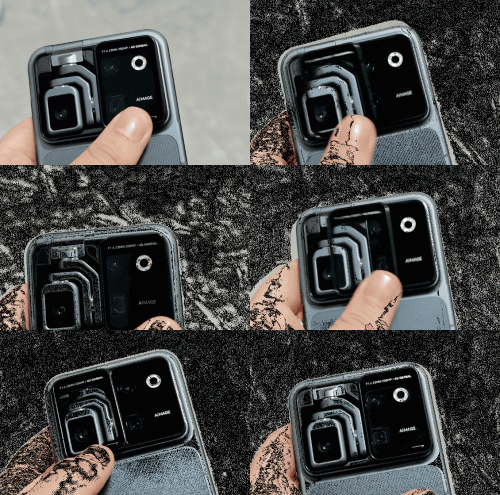
Insta360’s Decade in Panoramic Imaging: Making Cameras ‘Invisible’ and Returning Creation to the Masses
 08/24 2026
 466
466

Produced by | Frontier of Entrepreneurship
Art Editor | Xing Jing
Reviewed by | Song Wen
On August 13, GoPro released its Q2 financials: revenue of $105 million, down 31% year-over-year, with a net loss of $51 million. The sale evaluation initiated in May has entered its 'final stage.' At its peak, GoPro held over 90% of the action camera market; now, it awaits a buyer.
Just the day before, Shenzhen-based Insta360 unveiled its new flagship panoramic camera, the X6, dubbed the 'decade masterpiece.' At a pre-launch closed-door session, founder Liu Jingkang admitted: 'We’ve indeed hit the hardware technology ceiling for current panoramic cameras.'
However, hitting the chip ceiling doesn’t mean hitting the market ceiling. While chips and sensors have peaked, locking in current hardware performance limits, the question of how many people a category can reach, how many scenarios it can enter, and how large its sales scale can grow remains ongoing.
But the new king’s battlefield is far from peaceful. In July last year, DJI entered the panoramic track ( track , shàidào, ' track ' meaning ' track ' or 'market segment') with the Osmo 360. According to IDC data, in Q1 this year, Insta360 held ~68% of the global panoramic camera shipment share, with DJI at ~22%; by sales revenue, Insta360’s market share reached 71%. GoPro and others have become 'others' in the market.
The walls are being torn down further. New players are emerging: Photon Leap, founded by a CTO from Dreame, completed a multi-million-dollar angel round; Looki, founded by a former Meituan executive, released a wearable AI camera. 'AI cameras' seem to be a story anyone can tell now.
Against this backdrop, Insta360’s 2025 annual report shows 'divergence': revenue of RMB 9.741 billion, up 74.76% YoY; net profit attributable to parent company of RMB 929 million, down 6.62% YoY; R&D investment of RMB 1.53 billion, accounting for 15.7% of revenue. The company explains this as 'increased strategic R&D investment.' Liu Jingkang puts it more bluntly: The profit 'lost' from hardware sales can be offset by services derived from AI servers, forming a new business closed loop (business closed loop)—essentially, hedging.
Hardware profits are thinning, while AI services grow. When cameras can already shoot clearly and comprehensively, what else can they do for people? Insta360’s answer: Make cameras 'invisible,' offloading terminal-side issues like image quality and editing to cloud AI.

The story begins in 2015. Liu Jingkang, born in 1991, graduated from Nanjing University’s Software Engineering program. While in school, he created a 'Top Universities Live' product, but due to unclear video quality, he shifted focus to a camera that could shoot panoramic video with one click. A year after graduation, he founded Insta360 with his co-founders.
In 2016, Insta360’s first consumer-grade panoramic camera, the Nano, plugged directly into an iPhone’s port, solving the biggest pain point in panoramic footage transfer. It became a star product at CES, earning praise even from Apple co-founder Steve Wozniak.
But the hit didn’t last long. After sales declined, the team analyzed user data and found that frequent users of panoramic cameras were skiers, cyclists, and surfers—people who couldn’t free their hands to frame shots. Panoramic cameras’ 'shoot first, frame later' nature perfectly solved this.
There was an even more primitive clue: Since the Nano required a connected phone to work, some users glued their phones to the panoramic camera with heavy-duty adhesive, fixed it to helmets or selfie sticks, and shared it in user groups.
From then on, Insta360 stopped cramming the same camera into more markets and instead rebuilt hardware for each scenario.
In 2017, the first 360° panoramic action camera, the ONE, was released, introducing the invisible selfie stick and bullet time, breaking GoPro’s dominance in sports imaging. In 2018, the ONE X brought 5.7K panoramic video and FlowState stabilization.
Later, the Insta360 EVO, Insta360 ONE R, and X series iterated continuously, with resolution climbing from 5.7K to 8K, sensors growing from 1/2.3” to 1/1.28”, and stabilization evolving from algorithms to AI triple-chip architectures. Generation after generation of updates propelled Insta360 from challenger to leader.

By 2025, Insta360 had achieved eight consecutive years of #1 global market share in panoramic cameras, cementing its absolute leadership in the category.
From 2015–2020, Insta360 surpassed 1 million cumulative units sold. By 2022, with the X3’s release, it took just over a year to hit another million. The first million took 5 years, the second 2 years, and subsequent million-unit milestones compressed further—the latest took just six months.
Alongside rising sales, panoramic cameras evolved from geek gear for Everest summits to mass-market tools for family documentation over a decade.
With numbers climbing, Liu Jingkang doesn’t believe they’ve hit the ceiling: 'The day panoramic cameras become as ubiquitous as bottled water, tissues, or phones—that’s when we’ll truly discuss the ceiling.'
2. The Data Moat and a Long-Term Vision
Gavin Qi, head of Insta360 Research Institute, joined in 2024.
On August 12, the day of the X6 launch, he told 『Frontier of Entrepreneurship』 that he left ByteDance’s video generation data team after realizing a problem: 'Mainstream video data is shot from fixed perspectives, inherently lacking information.' 360° all-angle footage, he argued, is a superior data source for the AI era.

What convinced him to join was Insta360’s internal vision, code-named 'Cameraman'—an intelligent system that accurately understands user intent, shoots autonomously, edits automatically, and shares seamlessly.
Gavin recalled his first meeting with Liu Jingkang in a Shanghai teahouse, where they discussed Cameraman’s business and technology for over three hours. 'That’s when it was basically decided,' he said.
According to Gavin, the Cameraman plan was proposed internally as early as 2018–2019. By 2019, Insta360 began stockpiling three technical directions: Imaging, AI, and Robotics—corresponding to eyes, brain, and body, respectively.
By 2023, Liu Jingkang had already shown Gavin the first-generation drone prototype and some unreleased features. The panoramic drone could be seen as an early prototype of Cameraman, 'freeing the shooter’s hands for perception-free filming,' Gavin said.
Thus, Cameraman became clearer. Its core competitiveness lies in integrating Insta360’s decade-long accumulated capabilities in imaging, audio, gimbal, drone, and AI algorithms into a single technical framework—rather than building a general-purpose robot from scratch.
For a hardware company, however, Cameraman still needs time. Closer at hand is data.
Gavin told 『Frontier of Entrepreneurship』 that since 2018, Insta360 has built its own data annotation team, accumulating over 30 scenario categories and 10,000+ hours of panoramic data in seven to eight years. A single depth prediction training set alone contains 2 million images. 'We realized early on that data is the core law for building standards,' he said.

Data also changed the company’s stance on open-source. Gavin didn’t shy away from internal debates: Open-source vs. closed-source ultimately hinges on whether to disclose technology. The company leaned toward open-source, reasoning, 'We hope to build the panoramic ecosystem through industry collaboration, and these capabilities will ultimately return to product competitiveness.'
In January, Insta360 open-sourced its panoramic depth model DAP360. Bad cases from community feedback became fuel for improving self-developed models. Gavin explained: 'If you only have one 'eye' in front, you can’t perform omnidirectional obstacle avoidance when someone approaches from behind.' In Insta360’s vision, this data could also serve robot obstacle avoidance and spatial understanding, positioning the camera company as a potential visual infrastructure provider.
The same pragmatic logic applied to large model selection.
GO Ultra’s AI voice assistant, Kira, uses Alibaba’s QianWen in China and Gemini overseas, but retains self-developed modules for voiceprint recognition and command words. 'For core technologies with Insta360’s signature, we prefer self-development; for general capabilities, we prefer collaboration with external partners,' Gavin told 『Frontier of Entrepreneurship』.
This 'core self-developed + general collaborative' model has kept the hardware company aligned with AI trends.
3. Offloading Editing to AI, Integrating Recording into Life
On August 7, five days before the X6 launch, Kira debuted with GO Ultra’s firmware update. Insta360 defines Kira as a 'pocket AI guide' rather than an all-powerful AI assistant.
The scenario: When users’ hands are occupied (e.g., cycling, surfing), asking for directions or checking the weather disrupts the experience. Kira offers face-to-face translation, image-based Q&A, and voice Q&A, with complex computations handled on the phone and cloud. Only command words, voiceprints, and data collection remain local, keeping the 53g device’s power consumption increment minimal.
Moreover, Insta360’s philosophy is that hardware isn’t finalized at launch: Older models can unlock new features via OTA updates.
Bigger changes came to editing. The biggest pain point of panoramic cameras isn’t capture but the tedious editing afterward. The X6’s zero-editing feature runs on Insta360’s self-developed panoramic AI model, PanoMind. Trained on the aforementioned data, its AI director identifies highlights, generates virtual camera movements, and scores each clip’s editability.
Users plug in the camera to charge, and it automatically selects and edits footage overnight, pushing finished videos to their phones by morning. Liu Jingkang sums it up as 'the user sleeps, the camera works.'

Moment Pro goes further: Users set themes and styles in natural language, and AI selects footage and structures narratives. Insta360’s cloud-based AI editing charges RMB 6 per clip, with an AI export rate of nearly 60%. Users pay for 'auto-generated videos,' not raw compute or storage.
Tasks once reserved for post-production software are now shifting to the cloud.
The path isn’t easy. Gavin admitted to 『Frontier of Entrepreneurship』 that photography is highly subjective—'a thousand faces' pose the biggest challenge for auto-editing, requiring the model to infer aesthetic preferences from user behavior.
He revealed that Insta360’s imaging pipeline has two paths: On-device, constrained by compute power, uses small models or even traditional CV for basic needs; more extreme experiences are offloaded to Insta360’s cloud.
Meanwhile, Insta360 remains deliberate about Cameraman’s ultimate form.
'We won’t make a 'final' Cameraman product,' Gavin said. GO Ultra’s head mount and X6’s auto-tracking are stage-by-stage validations. 'Product vision can’t be achieved overnight—it must follow both technical and commercial logic.'
Six days before the launch, Liu Jingkang spoke at AGI Playground about a broader shift: Future imaging devices will be 'front-light, back-heavy,' with the front handling lightweight recording and the back (AI) managing editing, aesthetics, and delivery.

As stated in the 11th-anniversary letter to all employees, 'We’ve made cameras see more fully; next, we’ll make them move autonomously.' He defines Cameraman as 'an intelligent agent that photographs by itself.'
In a WAIC dialogue, he repeatedly drew AI’s boundaries: 'AI is disruptive for sharing and commercial creation in imaging, but not for recording. The primitive motive to record is that a moment is worth cherishing—that can’t be replaced by AI.'
This may be Insta360’s deepest moat in the AI era: Generative AI can synthesize any image but not 'real memories that happened.'
Though 43% of Insta360’s internal code is now AI-generated and over half of customer service is AI-driven—efficiency is the organizational theme—the company still sells authentic moments belonging to each individual.

As Gavin said, the ideal camera should be 'invisible.'
Over a decade, Insta360 shifted competition from specs to scenarios, from scenarios to data, and now to editing. It has done one thing: Make cameras fade into life and return creation to ordinary people.
-
![]()
Alibaba's AI Offensive: Over Half of Investment Allocated, Time to Reap Returns
-
![]()
Alibaba’s AI Push: Over Half of Investments Made, Time to Harvest Returns
-
![]()
Chinese Enterprises Going Global 3.0: From World Factory to AI Infrastructure Builder
-
![]()
Honor RobotPhone Review: Half Movie Camera, Half Robot
-
![]()
AI-Driven Cheating Surges in Universities! Online Exams Reduced to Mere Formalities, Degree Credibility on the Line
-
Insta360’s Decade in Panoramic Imaging: Making Cameras ‘Invisible’ and Returning Creation to the Masses
-
![]()
Foreign Media Claims Apple is Concentrating Resources on AI Development: Vision Pro and Siri Teams Lay Off 200 People
-
Big News! Huaneng and Huawei Hold Talks in Shenzhen with Ren Zhengfei in Attendance; Huawei Emerging as the 'Second Brain' of China's Energy System