2025: The Year of 'AI Builders' - Why TIME Picks Baidu
 12/16 2025
 774
774

AI Wave: Silicon Valley Dreams Big, China Gets Practical
Author | Jing Xing
Editor | Yang Zhou
Looking back at the global tech and business highlights of 2025, AI clearly stands out as the dominant force.
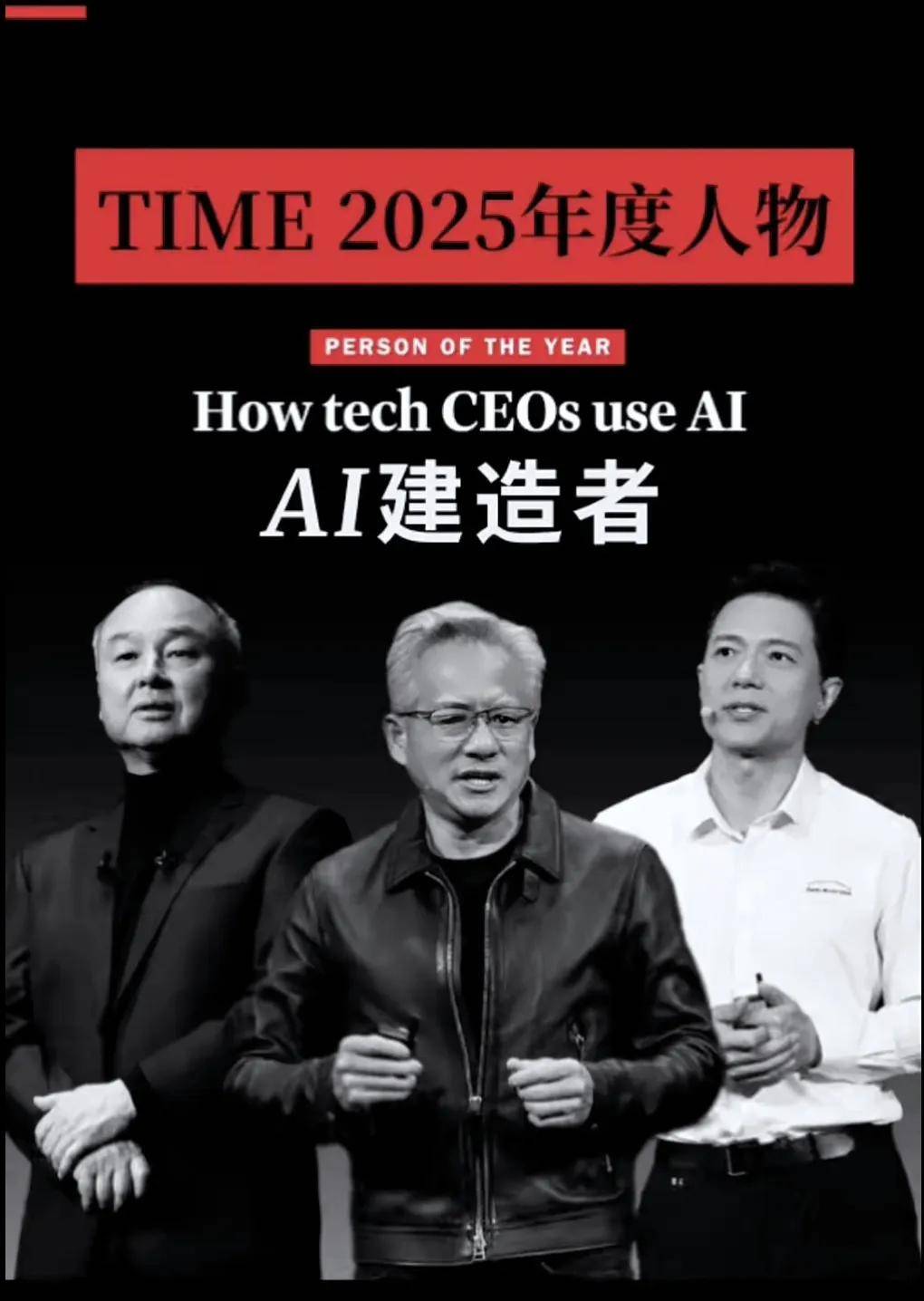
On December 11th, U.S. TIME Magazine unveiled its 2025 'Person of the Year.' This annual tradition, with a century-long history, honored 'The Builders of AI'—a collective of CEOs and tech leaders shaping the future.
In its cover story, TIME interviewed NVIDIA CEO Jensen Huang, SoftBank's Masayoshi Son, and Baidu founder Li Yanhong, each sharing their visions for AI's evolution.
Since OpenAI ignited the era of large-scale models, a global surge of talent, capital, and computational power has flooded the AI sector. NVIDIA, riding this wave, became the first company worldwide to surpass a $5 trillion market valuation. During the TIME interview, Huang expressed unbridled optimism about AI's potential:
"Every industry needs it, every company uses it, every country must build it. This is the most transformative technology of our time."
As a long-standing collaborator with TIME in China's tech landscape, Li Yanhong discussed the diverging AI strategies between China and the U.S. As one of China's earliest AI investors, Li offers unique insights into its current trajectory. He argues that unlike the U.S. pursuit of 'super models,' China leverages richer, more diverse real-world scenarios to translate AI from theory into practical applications. This mirrors the approach of major Chinese tech firms, which prioritize application-driven AI innovation.
Undoubtedly, with generative large models reshaping industries globally, the AI era is accelerating. TIME has consistently demonstrated acute foresight in tracking global tech trends. From naming the 'Person of the Year' after the personal computer in 1983 to predicting in 2005 that 'smartphones will replace PCs as the new internet access terminal' with its list of the world's 50 best websites, TIME has accurately captured the signals of the PC and mobile internet eras.
Indeed, TIME's article portrays a global AI landscape with diverse paths but a clear direction. As TIME commented:
"Humanity is now hurtling toward a highly automated and uncertain future."
01 China's AI Through TIME's Lens
TIME views the AI era with both excitement and caution.
The excitement stems from AI's limitless potential. The article highlights its ability to outsmart chess champions, predict protein structures, write millions of lines of code, assist scientists, create viral songs, and force companies to rethink strategies. OpenAI's ChatGPT, the fastest-growing consumer app in history, now boasts over 800 million weekly active users.
The caution arises from challenges facing the U.S. AI industry, particularly global competition.
TIME contrasts this by spotlighting China's AI breakthroughs—from unknown startup DeepSeek replicating ChatGPT's reasoning capabilities in months using outdated chips, to Huawei's chips outperforming China's most advanced importable NVIDIA alternatives, to Enlighten Robotics becoming a leader in embodied intelligence within years.
Among these, Baidu's Li Yanhong receives the most extensive coverage and quotes in the article.
This is not TIME's first focus on Baidu. In January 2018, Li graced TIME's Asia edition cover as an innovator, with the Chinese headline "Baidu's Li Yanhong is Helping China Win the 21st Century," detailing Baidu's transition from China's largest search engine to an AI pioneer developing autonomous driving. TIME dubbed him "the innovator."
In September 2023, TIME listed Li alongside Elon Musk, Jensen Huang, and Sam Altman as "Global AI Leaders." Last May, Baidu became the only Chinese company at the "Global Leader" level on TIME's "100 Most Influential Companies" list, cited for its decade-plus AI research and robust infrastructure.
This year's article opens with Li's speech at Baidu World 2025 on November 13th, highlighting two products: the latest ERNIE 5.0 foundation model and the no-code development tool Sunda 2.0.
ERNIE 5.0, with 2.4 trillion parameters, rivals Google's Gemini-2.5-Pro and OpenAI's GPT-5-High in evaluations while supporting multimodal understanding and generation of text, images, audio, and video. Sunda 2.0 generates applications through natural language input, having created over 400,000 customized AI apps.
TIME notes Baidu's AI strategy extends further, covering self-developed AI chips, autonomous driving, cloud infrastructure, AI agents, applications, and consumer devices. The company aims to become a "native AI company."
02 The Second AI Path
While AI's future is bright, uncertainties persist—a theme TIME emphasizes, particularly regarding China's distinct AI approach.
Baidu exemplifies this path.
First, Chinese tech firms have deep AI foundations.
Baidu's AI exploration spans over a decade. In 2013, it established the Institute of Deep Learning, recruiting global AI talent through U.S. and China labs to advance semantic and speech recognition.
Today, Baidu achieves full-stack AI self-research capabilities: Kunlun chips and data centers for computing, PaddlePaddle deep learning platform and Baidu Intelligent Cloud for frameworks, and ERNIE for models.
This ensures technological autonomy at every AI tier while continuously exporting innovations.
Second, China prioritizes real-world AI applications.
Backed by the world's most complete industrial system and supply chain, Chinese firms focus on practical AI integration. While U.S. companies excel in foundational research, Chinese firms excel at bridging technology with industry—without lagging in model quality. Even after ChatGPT pioneered large models, Chinese firms remain competitive in AI applications.
In the TIME interview, Li Yanhong emphasized China's focus on application scenarios due to its robust manufacturing system, which enables cost-effective production. The challenge—and opportunity—lies in leveraging AI to enhance production and daily life. He also highlighted unique Chinese scenarios where AI could address unmet demands.
Indeed, solving problems through technology defines Baidu's AI direction. Its ecosystem includes ERNIE-powered products like intelligent search, ERNIE Bot, Baidu Library, and Baidu Netdisk. Expansions into digital humans, intelligent cloud, autonomous driving, and industrial agents demonstrate Baidu's commitment to addressing diverse needs across consumer and enterprise sectors through full-stack self-research.
Finally, and most crucially, no single entity dominates AI yet.
Though TIME highlights NVIDIA's chip dominance, it acknowledges Chinese firms' ability to replicate U.S. models with lower computational power while narrowing the semiconductor gap.
At last month's Baidu World, the company unveiled its next-gen Kunlun chip and Tianchi super-node products, achieving a 95% performance boost per card, a 50% overall improvement for Tianchi 256, and trillion-parameter model training on Tianchi 512.
This follows years of R&D: Baidu launched its first AI chip, Kunlun, in 2018. Since ERNIE Bot's 2023 release, cumulative AI R&D investment has exceeded $15 billion. Recent earnings reports confirm Baidu's evolution into a native AI enterprise. As Li Yanhong stated, when AI becomes innate, intelligence transforms from a cost to a productivity driver for growth.
03 Conclusion
TIME's perspective offers a balanced view of AI's irreversible momentum and inherent uncertainties, framing our entry into a new, unpredictable era from a humanistic standpoint.
As noted, AI's ability to defeat champions, predict structures, write code, assist scientists, create hits, and reshape strategies coexists with unease over its mysteries and the emerging competitive landscape where winners remain unknown.
The article concludes with a quote from Trump and Jensen Huang: "I don't know what you're doing here. I hope you're right."
For China, despite uncertainties, the nation has never lacked courage or vision to forge its own path.
TIME's choice to feature Li Yanhong amplifies China's AI voice globally. While Meta invests billions in AI architectures with limited success, Chinese firms achieve top-tier models with $6-7 million, crafting a unique AI path—scenario-driven, application-focused, efficient, and grounded. This has become indispensable to the global AI ecosystem.
The reason is simple: Chinese firms combine strategic resolve with a vast market, enabling breakthroughs in scenario applications and commercialization. This demand-driven logic may well be China's most valuable contribution to the global AI landscape.
-
![]()
Registered Capital Slashed to 372 Million Yuan! Yutong Optical Finalizes Industrial and Commercial Change Registration
-
![]()
Zhuque-3 Successfully Lands, and 'Time Traveler' Secures Another ¥100 Million in Funding: China's Commercial Space Industry Experiences a 'Dynamic August'
-
![]()
Autohome Faces a Shrinking Window of Opportunity
-
![]()
Even a Titan Like Musk Has Faced Setbacks in Fulfilling Promises
-
![]()
AI Office: The End of the Racing Era, Context Becomes the Key to Success
-
![]()
Domestic Vehicle Chassis Revolution ②: The Steering Wheel Remains, But Mechanical Connections in the Steering System Are Decreasing
-
![]()
Exploring MiniMax Design: Can Video Editing Be as Simple as Speaking?
-
![]()
Why Can SenseTime Achieve Profitability While CloudWalk Still Faces Challenges, Despite Both Adopting Large Models?