The Old and New Kings of Global Social Networking
 05/22 2026
 683
683

ByteDance and Meta are separated by a thin line in terms of revenue. They not only operate in the same primary battlefield but also possess similar capabilities and characteristics. Their competition showcases a 'mirror-like' growth pattern, where each exposes the other's shortcomings and drives mutual evolution.
By Haoran
This article is an original piece from Shangyin Club. For reprints, please contact the background.
 ByteDance and Meta
As an unlisted giant, ByteDance (hereinafter referred to as 'Byte') has garnered significant attention regarding its annual earnings.
Previously, Bloomberg reported that Byte's internal revenue target for 2025 was approximately $186 billion (approximately RMB 1.27 trillion). According to estimates by the U.S. research institution Sacra, Byte's revenue for 2025 was $198.3 billion (approximately RMB 1.35 trillion). In terms of profit, it surpassed Alibaba and Tencent in 2024.
Byte continues to surge ahead, especially overseas. Media reports indicate that its overseas revenue grew by nearly 50% in 2025, far exceeding the domestic growth rate of around 20%. The proportion of overseas business revenue also increased from 25% in 2024 to over 30%.
In the realm of AI, which is crucial for the future, Byte is also making bold moves, with layout (layout) across the entire industry chain, including models, applications, computing power, and hardware. Doubao, a new-generation 'national-level' application, has over 340 million monthly active users, far surpassing other competitors in terms of C-end influence.
Recalling more than two years ago, in our article 'Tencent vs. Byte: Six Years of Offense and Defense Between Two Generations of Internet Dominators,' we reviewed the six-year commercial battle between Byte and Tencent. At that time, Byte had just surpassed Tencent in terms of revenue and profit. After years of entanglement, the boundaries between the two gradually became clear, leading to a transition from competition to a ceasefire.
At the time, many analysts believed that after surpassing Tencent, Byte's primary competitor would be Meta on the other side of the ocean.
Meta's revenue last year was $200.9 billion, placing Byte just a step away from it. The two can be seen as the strongest competitors for years to come, not only because their sizes are gradually approaching and their capabilities are comparable but also because they operate in almost the same primary battlefield.
As the global social networking leader, Meta's core products include platforms like Facebook, Instagram, and WhatsApp. Byte's 'cash cows,' Douyin and TikTok, while not strong relationship-based social software, are still social software in a broad sense: the connection between content and people is essentially the connection between people behind the content. By adding functions such as content interaction, relationship building, and instant communication, they form a unique 'content social' ecosystem.
Both companies' social products are immersive, high-frequency super apps that are, in simple terms, highly time-consuming.
Before TikTok's rise, in regions covered by Meta's social ' family bucket ' (suite of products), except for long-form videos like YouTube, almost no one could compete with it in terms of user time. Meanwhile, Byte surpassed Tencent several years ago to become the enterprise occupying the largest share of total user time on mobile devices in China.
The two social networking giants have formed a strong suction effect on user time in the East and West, respectively.
With TikTok's rise, Meta felt an unprecedented threat and even launched copycat short video apps like Lasso and Reels to counter it.
The competition for user attention directly determines their respective revenues.
Among Meta's over $200 billion in revenue, advertising accounts for a staggering 97%, making it the absolute core revenue source. According to predictions, Meta will surpass Google this year to become the world's largest digital advertising company, finally reaching the pinnacle of global advertising dominance after more than 20 years.
Google's advertising revenue mainly comes from Google Search and the long-form video platform YouTube, with a growth rate of 14% last year, while Meta's growth rate exceeded 20%.
In comparison, TikTok, as a younger platform, has a stronger growth momentum. Multiple institutions estimate that TikTok's advertising revenue exceeded $30 billion in 2025. Adding Douyin's domestic advertising revenue of RMB 420 billion, Byte's advertising revenue also approaches $100 billion in scale.
Apart from advertising, the other half of Byte's revenue comes from e-commerce. TikTok Shop's global GMV reached nearly $100 billion in 2025, nearly doubling year-on-year.
Besides having almost the same current revenue sources, the two companies are often compared because they share similar characteristics.
Their founders, Mark Zuckerberg and Zhang Yiming, are both in their 80s, with only a one-year age difference, and both possess extremely rational personalities.
Zuckerberg is rational to the point of eccentricity, even earning the nickname 'robot.' He believes that people are like 0s and 1s in a computer, and all activities can be quantified. Zhang Yiming also trusts data and logical deduction. He once debugged himself like training an algorithm, dividing his day into small blocks to precisely complete each plan. A colleague admitted, 'He really works like a machine.'

Both have built data-driven organizational systems that extremely advocate growth and adhere to the same strategic aesthetic of violence: in deterministic sectors, using far more resource density than competitors to quickly establish barriers through 'saturation attacks,' ultimately achieving miraculous breakthroughs.
This is known as 'miracles from sheer force' at Byte, while Meta and Zuckerberg also have slogans and expressions like 'move fast and break things' and 'it's better to overinvest than fall behind.' They have implemented this strategy in sectors like short videos, hardware, and AI.
However, even though the two companies can be referred to as 'twins,' their development logics still differ significantly and even form deep complementarity.
Byte, which started with information distribution, has learned from Meta to strengthen social relationship chains, expand graphic content, and borrow from Facebook's mature advertising monetization system. Meta, which started with acquaintance social networking, has imitated Byte by focusing on short videos, improving algorithm recommendation logic, and launching Edits to compete with CapCut (Byte's short video editing app, considered the overseas version of Jianying), lowering the barrier to video production.
This 'mirror-like' growth is the most interesting aspect of business competition and makes their rivalry even more captivating.

Both Role Models and Rivals
Looking at the long term, the rivalry between Byte and Meta can be roughly divided into three stages.
The first stage was before 2017. During this period, Byte was in a strategic learning phase and did not truly compete with Meta (then still called Facebook) but rather imitated it.
In early media interviews, Zhang Yiming repeatedly expressed his admiration and even envy of Facebook.
From the launch of Toutiao, Byte stood 'on the shoulders of giants' and borrowed two major tools explored by Facebook over the years.
The first was to make growth the company's primary goal. Although concepts like 'growth' and 'monthly active users' are now commonplace and even overused, they were not placed at a high strategic level until Facebook established them as key indicators guiding the company forward.
Around 2007, when Facebook reached 90 million users, its growth stalled. Many at the time suspected it could not break through 100 million users.
At this point, Facebook Vice President Chamath Palihapitiya proposed a solution: a highly energetic team with a high degree of freedom, focusing on acquiring and retaining users.
This special forces-like team was the growth team, whose mission was to increase Facebook's 'North Star metric' (i.e., the primary key indicator): monthly active users.
The North Star metric is like a baton for an organization; choosing the right one can rally the entire organization's strength to achieve the goal, while choosing the wrong one will lead in the opposite direction.
Facebook's growth team, driven by data, achieved precise growth optimization through tracking, data analysis, website optimization, paid advertising, A/B testing, and operational promotion.
Their goals were quite aggressive, typically achieving 60%-70% completion by the end of the year. If the completion rate exceeded 80%, it indicated that the goals were set too low.
Byte inherited Facebook's 'growth-first' philosophy but used 'daily active users' and 'usage time' as key indicators, with all growth strategies revolving around these metrics.
Zhang Yiming once explained:
'Facebook has a social relationship chain, and users continue to use it because they don't want to lose contact with friends, making MAU naturally stable. But we don't have a native social relationship chain and must rely on content attractiveness to maintain user activity. Usage time and DAU are our foundations for survival.'
In its early stages, Byte did not divide into business units but instead singled out the user growth department as one of the three core departments alongside the technology and commercialization departments.
The user growth department was responsible for formulating growth strategies for all products across the platform, laying the foundation for Douyin's later rise.
The second tool was information feed advertising.
Facebook first introduced the information feed (News Feed) in 2006, centralized display (centrally displaying) dynamic updates from friends and public content from influencers, celebrities, and media on the homepage. This product form was more like Weibo, but Weibo lacked the acquaintance social network of Facebook and WeChat.
The information feed is now a standard feature of all social software, but it was a huge innovation 20 years ago.
However, Facebook waited a full six years until 2012 to insert ads into the information feed, initiating large-scale monetization of information feed advertising.
The delay was because, during the PC era, Zuckerberg had some attachments to the newly founded Facebook and felt that placing ads in the collection of friends' updates would affect the user experience. Therefore, Facebook's ads were concentrated in the right sidebar.
But in the mobile era, screens became significantly smaller than PCs, and the right sidebar was squeezed out. Additionally, Facebook was slow to transition to mobile, while newcomers like Snapchat, Instagram, and WhatsApp emerged rapidly on mobile platforms, causing great doubt about the newly listed Facebook and leading to a stock price plunge.
Thus, Zuckerberg gave up his stubbornness and earnestly used information feed advertising to make money.
This directly led to an explosion in Facebook's profitability, and information feed advertising began to change the direction of the entire advertising industry.
Facebook had already proven that mobile information feed advertising was a highly profitable business. From the beginning, Byte did not entanglement (dally) between advertising and user experience but viewed ads as 'valuable information.' It used personalized recommendation algorithms to directly push this logic from 'connecting people through social graphs' to 'connecting content with people through interest graphs.'
In 2013, when Toutiao's DAU was still less than 2 million, Zhang Yiming invited Zhang Lidong to build an advertising business team and plan the construction of an information feed advertising system. After Douyin's rise, Byte replicated the information feed advertising ecosystem to Douyin.
As Byte's product portfolio expanded, the Huge Engine (Ocean Engine) was launched to integrate full-link information feed advertising resources, becoming the core pillar of Byte's commercialization.
While Facebook used information feed advertising to challenge search advertising giant Google, Byte was entangled with Baidu and Tencent. In 2016, Byte's advertising revenue was nearly RMB 10 billion, reaching about RMB 50 billion in 2018, and surpassing Baidu and Tencent's advertising revenue in 2019.
In addition to the two points above, Byte's organizational management aspects, such as flat organization, talent recruitment, internal information flow, maintenance of entrepreneurial culture, and increasing talent density, all show the influence of tech giants like Facebook, Google, Amazon, and Netflix.
From its inception, Byte aspired to be a global tech company and launched Toutiao's overseas version, TopBuzz, in markets like North America and Brazil in 2015. Perhaps while learning from Facebook, Byte had already seen it as a inevitable rival in its globalization efforts.
What truly brought the two into direct confrontation was TikTok.

From Passive Observation to Mutual Offense and Defense
From 2017 to 2019, it can be seen as Facebook's strategic assessment period for TikTok.
TikTok's rise began with Byte's $1 billion acquisition of Musical.ly, a leading North American music short video platform. Musical.ly was later merged with Byte's self-built TikTok and retained the TikTok name.
Previously, Facebook and Kuaishou also attempted to acquire Musical.ly and even started negotiations earlier than Byte. The reason Byte ultimately succeeded was largely due to one person—Fu Sheng, the founder of Cheetah Mobile, who was an angel investor in Musical.ly and held veto power.
Fu Sheng set many conditions, such as simultaneously purchasing News Republic, a news platform under Cheetah Mobile, and Live.me, a live streaming platform. Zhang Yiming agreed to all of them, reflecting Byte's determination and vision for short video globalization.
Compared to ByteDance, Facebook, which originated from graphic and text-based social networking, did not show much emphasis on short videos.
In 2016, Facebook conducted research on Musical.ly and concluded that it was 'not as popular as it seemed.' At that time, Musical.ly had already hit a growth bottleneck, with over 65% of its users being teenagers under 20, still appearing to be a niche product.
The underestimation of TikTok also stemmed from Facebook's confidence in thwarting rising competitors.
It spent $1 billion to acquire Instagram in 2012 and a staggering $19 billion to buy WhatsApp in 2014. Companies like Snapchat, which rejected Facebook's high-priced acquisitions, faced pixel-level replication, commonly known as 'copying,' leading to a significant decline in Snapchat's value.
Under Facebook's strategic wait and see (observation), TikTok was infused with Douyin's core recommendation engine, and ByteDance's growth team focused like a laser beam on enhancing TikTok's metrics. Various creators on TikTok also grew crazy (wildly) to form an ecosystem, demonstrating what true 'explosive growth' looks like:
In January 2018, TikTok had 55 million monthly active users worldwide; by the end of the year, this number had surged to 270 million, and a year later, it exceeded 500 million.
Ironically, Facebook significantly contributed to TikTok's explosive growth. ByteDance adopted a 'go big or go home' approach to promote TikTok, investing nearly $1.5 billion in advertising and user acquisition in 2018, primarily through Facebook and Instagram, even becoming Facebook's top advertiser at one point.
Facebook's obsession with advertising and underestimation of the short video business inadvertently contributed many users to its competitor.
By the end of 2018, Facebook had sensed TikTok's threat and decided to counterattack with a replication strategy, launching Lasso, a short video app clone of TikTok.
Although Facebook counterattacked, Zuckerberg did not yet realize TikTok's powerful disruptive potential, merely viewing it as a 'competitor worth watching.' He did not provide much marketing or resource support for Lasso, which was downloaded only 300,000 times after its launch.
In contrast, TikTok had 700 million downloads globally in 2019, ranking as the second most downloaded app worldwide. Only WhatsApp under Facebook remained in the top spot, with all others surpassed.
Zuckerberg could no longer sit idly by and launched a large-scale counterattack, bringing the competition into a strategic stalemate of 'mutual offense and defense.'
Facebook continued to thwart TikTok with a replication strategy, but this time without launching a standalone app. Instead, it embedded a short video feature called 'Reels' in the bottom navigation bar of Instagram.
This is equivalent to WeChat launching a video channel, except Reels is located at the bottom of Ins's homepage, unlike WeChat, which requires swiping to another page to find it. Later, Reels was also embedded in Facebook.
It's worth mentioning that WeChat's video channel also launched almost simultaneously. Both Eastern and Western social giants, Facebook with Lasso and WeChat with Weishi, had launched standalone short video apps, both of which failed, leading them to choose the strategy of embedding short videos within their dominant social networks.
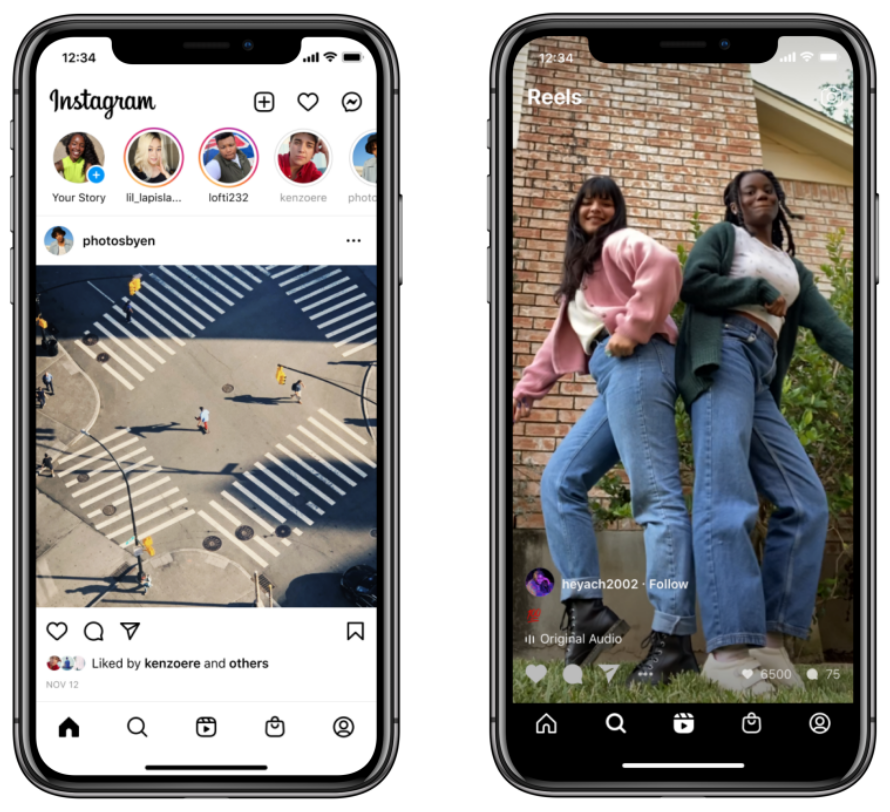 The image shows the Instagram homepage and Reels interface.
This move avoided the switching costs of users having to download, register, and rebuild social relationships separately, enabling rapid cold start by leveraging a vast social network and user base.
Unlike Lasso's fate, Reels became Zuckerberg's new favorite from its inception. Zuckerberg emphasized at an internal meeting in 2022 that 'the company would prioritize Reels service,' even placing his beloved metaverse business after Reels.
Besides almost perfectly replicating TikTok's product form, Reels also imitated TikTok's two core capabilities.
First, the recommendation algorithm based on watch time and interests.
Reels remained lukewarm in its first two years after launch, primarily because Meta's products relied on social relationships, and users mostly saw content from followed acquaintances, celebrities, and institutions. In contrast, TikTok's content was recommended based on user interests, regardless of follow relationships.
Meta 'revolutionized itself' by investing heavily in reconstructing its recommendation algorithm system, shifting from 'social graph priority' to 'interest and watch time priority' recommendation logic. With advancements in AI technology, Meta further enhanced the accuracy of its algorithmic recommendations.
This switch even sparked collective protests from influencers, media, and celebrities on the platform, whose traffic significantly declined, making way for content from more new creators.
Second, the construction of a creator ecosystem.
The creator ecosystem is the source of interest-based recommendations. Meta invested $1 billion to reward creators and even spent heavily to poach popular creators from TikTok. Additionally, Reels introduced various monetization methods, such as ad stickers and tips, to retain and attract more creators.
Imitating TikTok's two core capabilities became a crucial turning point for Reels, with 45% of Instagram users' time spent watching Reels.
Reels also became Meta's new growth engine. According to the latest data, by the beginning of this year, Reels' annualized ad revenue had reached $50 billion, nearly on par with TikTok's revenue for the same period.
Reels' ability to gradually narrow the gap with TikTok, besides its product imitation 'from form to spirit,' is also due to TikTok's 'ban crisis' in the past few years, which significantly disrupted its growth.
Numerous sources indicate that Meta's lobbying efforts were omnipresent in this prolonged whirlpool.

Summary
Today, TikTok has moved past accusations, compliance reviews, and the brink of shutdown, standing on the same starting line as Reels again.
However, compared to Reels, TikTok clearly has greater ambitions.
Reels, embedded within Instagram and Facebook's social ecosystem, emerged as a defensive tool but achieved unexpected results. However, its greatest value still lies in enhancing Meta's ad monetization efficiency. In contrast, TikTok aims to create a super portal integrating entertainment, e-commerce, and local services. TikTok Shop has grown rapidly, becoming half of TikTok's empire.
In this contest, the 'new king' ByteDance is unstoppable, while the 'old king' Meta is cunning and strategic. They expose each other's shortcomings, force each other to evolve, and 'learn from each other across the river.'
ByteDance once sketched out its corporate structure aligned with Meta's model, while Meta imitated ByteDance's short video innovations to break through growth ceilings.
Their vaster horizons lie in AI, with ByteDance's 'Seed' department and Meta's 'Superintelligence' team echoing each other. Both are directly led by their founders, have invested heavily, and are competing for talent globally.
How AI will alter the competitive landscape between these two social giants and who will leverage new technologies to evolve faster is worth our continued attention.
Welcome to exchange and discuss with the author~
-
![]()
Chery's 'Audi Suit Gangster' Makes Waves with Unbeatable Pricing. Netizens React: 'Is This the Aorui A6L?'
-
![]()
AITO Takes a Bold Leap, Forms Joint Venture with BMW and Mercedes-Benz
-
![]()
How Does the Cloud Data Engine Transform Physical Labor into Technical Work for Autonomous Driving Annotators?
-
![]()
Historic Strongest Mercedes-Benz GLE L Faces Intense Competition from Domestic 9 Series
-
![]()
Jeff Dean's First Entrepreneurial Venture After Leaving Google: Why Launch an AI Company 'Not Aiming to Make Money' at This Juncture?
-
![]()
Caught in the Traffic 'Web'
-
![]()
Alibaba's AI Offensive: Over Half of Investment Allocated, Time to Reap Returns
-
![]()
Alibaba’s AI Push: Over Half of Investments Made, Time to Harvest Returns