Second Search War: Buyers Shift from Humans to Models
 11/05 2026
 491

The Search Business in the Age of Agents
Author | Qingyun
Editor | Xiaobai
Images | AI-generated
Produced by | Emphasize Next
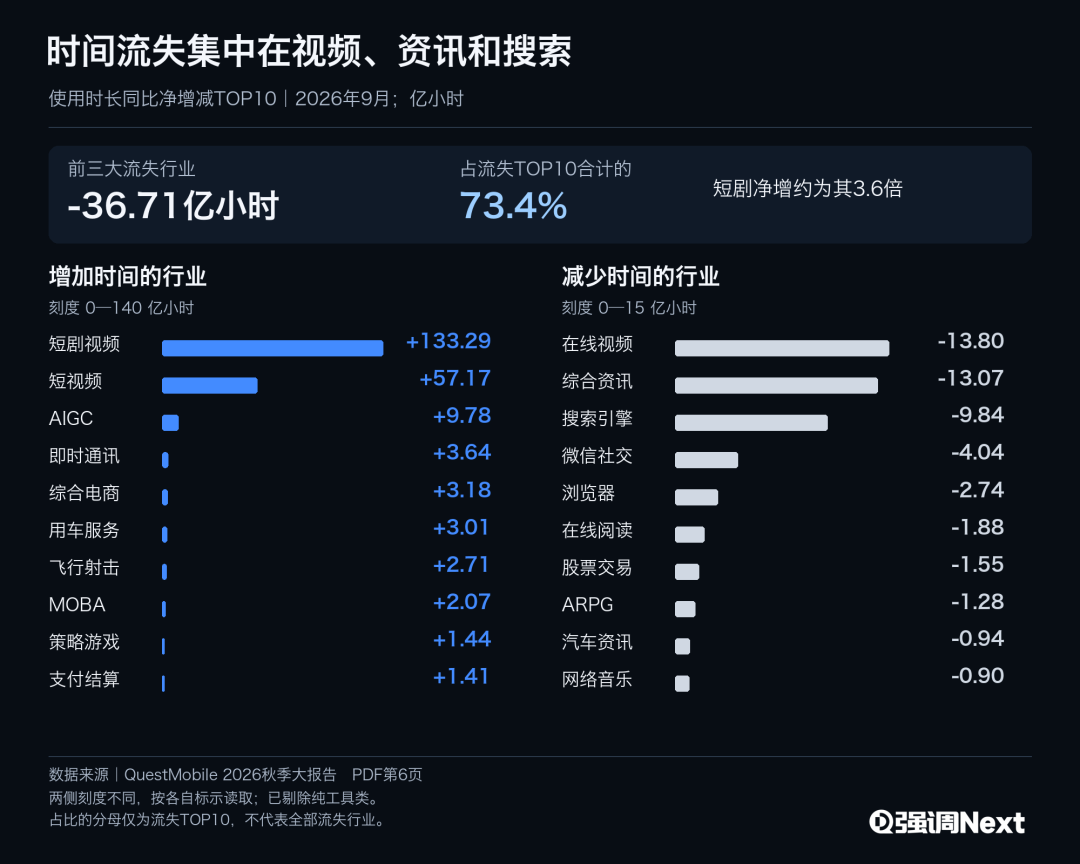
QuestMobile's latest autumn report shows that in September 2026, total monthly usage time in the search engine industry fell by 984 million hours year over year. In the same chart, the AIGC industry added 978 million hours, while browsers and general news each fell by 274 million and 1.307 billion hours.
These two nearly identical figures are easily read as a one-to-one migration. But total industry time does not record where each user came from or where they went, nor can it be used to calculate how much of search AI has replaced. What it shows, first and foremost, is that the information acquisition model organized around search and news is losing a portion of users' time.
Search companies, however, are starting to sell themselves to new buyers.
On October 20, Tencent opened Yuanbao Search through Tencent Cloud. Nine days later, it released Buddy One, with WorkBuddy as the workbench, connecting Tencent Docs, Tencent Meeting and ima, with Yuanbao Search handling real-time retrieval. Baidu AI Cloud launched a search API promotion on October 30, and Alibaba Bailian and ByteDance Volcano Ark have also integrated web search into their model invocation workflows.
A new market around search is taking shape. Users hand questions to assistants, and assistants procure materials. Who owns the user, who finds the information, and who pays for each query are beginning to belong to different parties.
The second search war thus adds a question harder than call volume: when answers are delivered by assistants, how much bargaining power can search retain?
Having Lost User Time, What Does Search Have Left?
Traditional search concentrated several businesses on a single page. Users raised needs, search engines ranked information, websites gained visits, and advertisers bought impressions or clicks. Search companies provided both the technology and the distribution opportunities.
AI assistants have changed this path. An employee asks an assistant to compare the latest situations of three suppliers; the assistant can first find official websites, then check announcements, discover that dates don't match and run additional searches, and finally deliver a table. The user made only one delegation, but the backend may execute multiple queries. The assistant receives the complete task, while the search interface often receives only one sub-question.
This means the information held by both sides is asymmetric. The assistant knows what the user actually wants to procure, whether they continue asking after seeing the answer, and can more easily observe whether the final task was completed. The underlying search service usually sees only the query terms and returned results. Even if retrieval is indispensable, the power to decide who to buy from next time remains in the hands of application developers.
This change is also reflected in user behavior. QuestMobile disclosed that in August 2026, monthly per-capita usage of search engine apps fell 21.7% year over year, while AI-native apps grew 67.1%. September's total time data further shows the search industry under pressure, but neither metric can be directly converted into backend query volume.
Therefore, the most favorable scenario for search companies is that users spend less time finding materials while assistants execute more valuable retrievals on their behalf. The most uncomfortable scenario is bearing the costs of crawling, updating and ranking, being able to quote only per-call prices to a few large customers, while those customers control answer display and subsequent transactions.
It is the same search, but different positions may mean different shares of the money.
Tencent Completes Office, Baidu Expands Search Supply
This explains why Tencent first put search into WorkBuddy.
A salesperson needs to revise a visit outline based on meeting minutes and a customer's new announcement from yesterday. The minutes are inside the enterprise, the announcement outside. Connecting meetings and documents solves where existing materials are; integrating search solves where new information comes from. If employees still have to open a browser, find the original text, and re-upload it, the assistant hands the work back to humans at the most critical step.
Tencent disclosed that WorkBuddy uses Yuanbao Search to find technical documentation and official API descriptions, reducing tool calls and model reasoning rounds. ima combines its knowledge base with public web materials, and after integration effective source recall increased by about 10%. This investment first improves what its own products can accomplish.
Tencent occupies both the application and retrieval layers, giving it the opportunity to use final task completion to improve search in turn. Which material was actually useful and which results made the model repeatedly search again can be fed back within the same product system. Its value may show up in office product retention and payments, not necessarily all recorded as search API revenue. Tencent has not disclosed this revenue, nor separately disclosed WorkBuddy's share of search calls.
Baidu also has an opportunity in this round of change to re-expand the scope of its search services. Which assistant a user initiates a request from and who ultimately completes the retrieval can be separated. In the past, search capabilities reached users mainly through its own entrance; after opening the API, other companies' assistants can also become customers. The more dispersed AI applications become, the more worth observing the value of this cross-application supply becomes.
Baidu has already made web, image and video retrieval, as well as source sites, titles, URLs and original text snippets, into callable capabilities, and provides knowledge base integration and enhanced Q&A based on the Ernie large model. For developers, the practical use of these capabilities is to verify sources and organize answers after obtaining materials. Baidu can therefore both supply retrieval and participate in subsequent generation and enterprise application delivery.
This gives Baidu a chance to apply its search accumulation to a broader customer base. Developers can buy retrieval results by integrating one API. If they decide to build it themselves, they still have to maintain web crawling, index updates and ranking over the long term. As long as outsourced results and costs are suitable, innovation at the application layer may continuously translate into customer demand for Baidu.
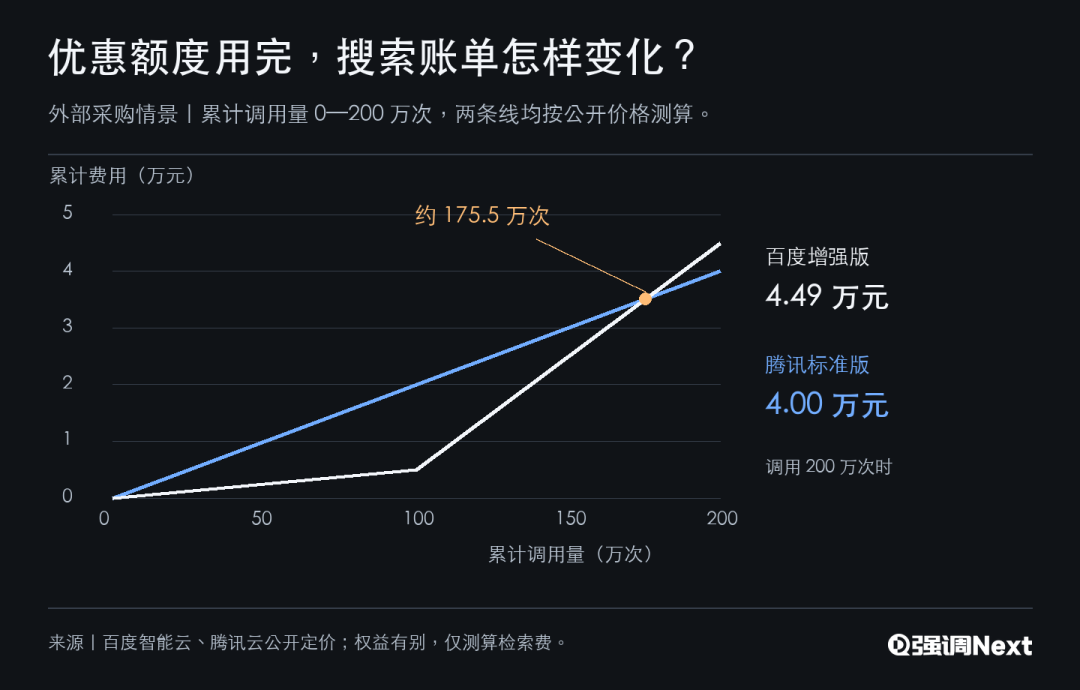
The enhanced version's promotional price of 4.9 yuan per thousand calls first lowers the trial cost of this capability. The cumulative discount quota of 1 million calls means 4,900 yuan can complete a one-million-call test, with excess billed at 40 yuan per thousand calls. Teams can use this to verify whether their applications need web access and which questions are prone to errors, then decide on long-term procurement. The role of the quote is to make existing search capabilities easier to enter new development workflows.
More noteworthy is the incremental demand. An assistant automatically updating research materials for dozens of companies, or continuously verifying technical documentation, may generate retrievals that did not happen in the past due to human time constraints. Once this demand forms, it is a new service opportunity for search suppliers.
Tencent can gain returns from WorkBuddy completing more tasks, while Baidu has the opportunity to benefit simultaneously from its own applications, external retrieval and model services. Both can place search into longer business workflows, and the value a set of capabilities creates internally and the price it charges externally can also be calculated separately.
Model Companies Control a New Default Option
Alibaba's and ByteDance's advantages occur before search procurement.
Developers already using Qwen can enable web search for supported models in Bailian. Volcano Ark has also integrated web tools into its model invocation workflow. To add real-time information to answers, teams can complete integration along existing interfaces. If independent retrieval suppliers want to break in, they must prove that adding another service is worth it.
In the previous round of search competition, the default entrance determined who users encountered first. In this round, the default tools within model platforms play a similar role. Engineers choose the development environment and then decide which search to use; independent suppliers may have to fight even for a chance to enter testing.
Microsoft has already demonstrated a clearer path. It announced in 2025 that Bing Search APIs would retire on August 11 of that year, recommending customers migrate to Grounding with Bing Search in Azure AI Agents, letting Agents use real-time web materials to generate answers. General search interfaces moved into the Agent service system, and search capabilities also became part of attracting developers to use the cloud platform.
From this perspective, a low search unit price is not enough to prove that this business is worthless. For companies selling both models and cloud services, search can help customers complete applications and then bring other paid usage. Large companies able to calculate returns across multiple services and suppliers relying mainly on retrieval fees will withstand price competition differently.
Independent retrieval still has opportunities. If an enterprise uses multiple models simultaneously and wants to retain sources, citations and audit rules when switching models, it has reason to procure search separately. Vertical industries may also pay for more complete and faster-updated materials.
Thus, procurement will see two opposing forces. Model platforms want customers to use built-in tools, while developers want to preserve choice among effectiveness, cost and replaceability. Which side is stronger determines whether search can ultimately be charged long-term as an independent service.

Websites Begin Recalculating the "Content for Traffic" Deal
A deeper change is happening upstream of search.
Search engines were able to obtain large amounts of public content in the past because there was an actual exchange behind it. Websites allowed indexing, search brought readers, and websites then monetized through advertising, subscriptions or transactions. After AI reads content directly and generates answers, the link between content being used and readers visiting has weakened.
A study published by Pew Research Center in July 2025 analyzed browsing data from 900 U.S. adults. In its March 2025 Google search sample, on pages with AI summaries, the share of users clicking traditional result links was 8%; on pages without AI summaries it was 15%. The share clicking source links in summaries was only 1%. This cannot represent all users, but it clearly presents the situation websites face: being cited does not necessarily bring visits.
Content providers have begun trying another exchange. Cloudflare launched a Pay Per Crawl test in 2025, allowing websites to set prices for AI crawler access. Its documentation updated in July 2026 is still labeled a closed test and cannot yet be regarded as a broadly formed paid market, but the direction is clear. In the past they expected search to send readers; now they try to charge directly for machine access.
This will affect the cost structure of retrieval services. Search companies face procurement bargaining from model platforms and developers on one side, and may have to pay licensing or access fees to content providers on the other. If what they mainly provide is public web pages available to everyone, the price pressure they face will be more obvious.
For this reason, content advantages need to be translated into deliverable scope. Tencent's public product specifications list Tencent News, Sogou Baike and Penguin Account, but do not promise that third parties can retrieve the full text of WeChat public accounts. ByteDance's documentation lists Douyin resources including Douyin Baike, which likewise cannot be expanded to all short videos. A group owning content products does not mean external customers can stably call these contents; WeChat public account content, for example, is clearly subject to copyright restrictions.
The more AI needs reliable new information, the more search suppliers must prove their value. Some rely on unique materials, some on update speed, and some on reducing retries and processing costs for developers. The differences that can truly be charged for will land on specific tasks. Whether an announcement is complete, whether a table preserves statistical definitions, and whether a piece of real-time information can be traced to its original source may all change the outcome of a task.
This competition may not quickly grow into a large independent market. Large companies may well first treat search as a supporting capability for office products, models and cloud services, with independent API revenue being only part of it. But the interests are already being rearranged. Assistants want to control users and lower procurement costs, content providers want returns from machine access, and search companies must find reasons to be paid between the two.
Tencent integrating search into WorkBuddy is a concrete landing point of this change. The larger question is: after users hand research to AI, whose accounts will the revenue once concentrated on the search page ultimately remain in?
- END -
-
Can AI Save Television? Only If Manufacturers Dare to Abandon Path Dependence
-
![]()
Works Even Without Power! Musk's New Starlink Product, Battery from China
-
![]()
Yipu Optoelectronics and Neusoft Japan Sign MoU to Jointly Advance Pre-Integrated Vehicle HUD Solutions
-
![]()
Fujian Forecam Optics Posts 84.13 Million Yuan Loss in First Three Quarters as Transformation Stalls in the "Transitional Gap"
-
![]()
Are AI Imaging Features About to Become Paid? Rising Cloud Token Costs for Phone Makers Make On-Device Computing Power the Right Path
-
![]()
Why Is MONA Accelerating Its Split from XPeng—Planning Dedicated Stores for 2027 and Leaving the Door Open to Independence
-
![]()
Apple Is Also Starting to "Save Tokens": The AI Money-Burning Frenzy Has Reached Its Reckoning
-
Behind Musk's Election Campaign Defeat: Who Pays the Bill for AI Expansion?