AI Reshapes Brands, Traffic, and Transactions
 11/24 2026
 354
In 2026, a notable phenomenon has emerged in the GEO market: many enterprises are launching GEO projects, but what they actually solve are different problems.
Projects led by brand departments focus on whether AI mentions their brand and whether descriptions of product features and advantages are accurate; projects led by growth departments track visits and sales leads brought by AI; and projects led by e-commerce departments have begun studying how to drive purchases through AI entry points.
These projects are all called GEO, but the problems they solve are not the same. The reason behind this is that the role AI plays in the user shopping journey is changing.
AI initially answered user questions, then began connecting content and information, advertising, and e-commerce transactions. As the penetration rate of Personal Agents (hereinafter referred to as PA) increases, AI's influence on user decisions will extend from information acquisition to lead generation and transactions.
iAnalysys believes that in 2027, the market boundary of GEO will further expand, and enterprises carrying out GEO will no longer only look at brand mention rates, but will also focus on leads and orders brought by AI.
I. GEO Is Solving Three Types of Business Problems
1.1 AI Cognition Building: Enabling AI to Correctly Understand Brands
When users ask "which brands of a certain type of product are worth considering," AI will provide explanations and suggestions based on multiple sources. Enterprises want their brands to enter the answer, and they also want AI to accurately understand product features and advantages.
Such projects are usually led by brand, public relations, and marketing departments. Enterprises need to organize product knowledge and brand facts, improve public information such as official websites and media reports, and continuously observe how different AI applications describe brands and which sources they cite.
The project mainly examines two issues: whether the brand has entered important answers, and whether AI's description of the brand is accurate.
1.2 AI Traffic Operations: Enabling AI to Bring Leads
After users read AI answers, they may click on sources to enter the brand's official website, or they may directly search for the brand or call consultation hotlines. At this point, AI has become a new traffic entry point.
Enterprises need to identify which user intents can bring subsequent actions, which content receives these visits, and determine whether users brought by AI have formed effective leads.
Such projects are usually handled by marketing growth or sales operations teams, and measurement indicators include visits and leads.
1.3 AI Transaction Conversion: Enabling AI to Drive Purchases
When users express purchase needs to AI, AI can help compare products and bring users to existing mall systems. In some platform ecosystems, users can also complete orders directly in the conversation.
Enterprises need to enable AI to accurately obtain product information and smoothly connect to existing malls. The focus of this stage is to reduce friction between recommendation and purchase and improve the conversion rate brought by AI entry points.
Such projects usually require the participation of e-commerce teams, mainly observing whether users enter product pages and complete purchases.
In summary, when enterprises carry out GEO, they first need to clarify which type of problem the project is solving: enabling AI to correctly understand the brand, converting attention brought by AI into leads, or driving transactions through AI entry points. These three types of business can be advanced gradually and do not need to be launched simultaneously at the initial stage of the project.
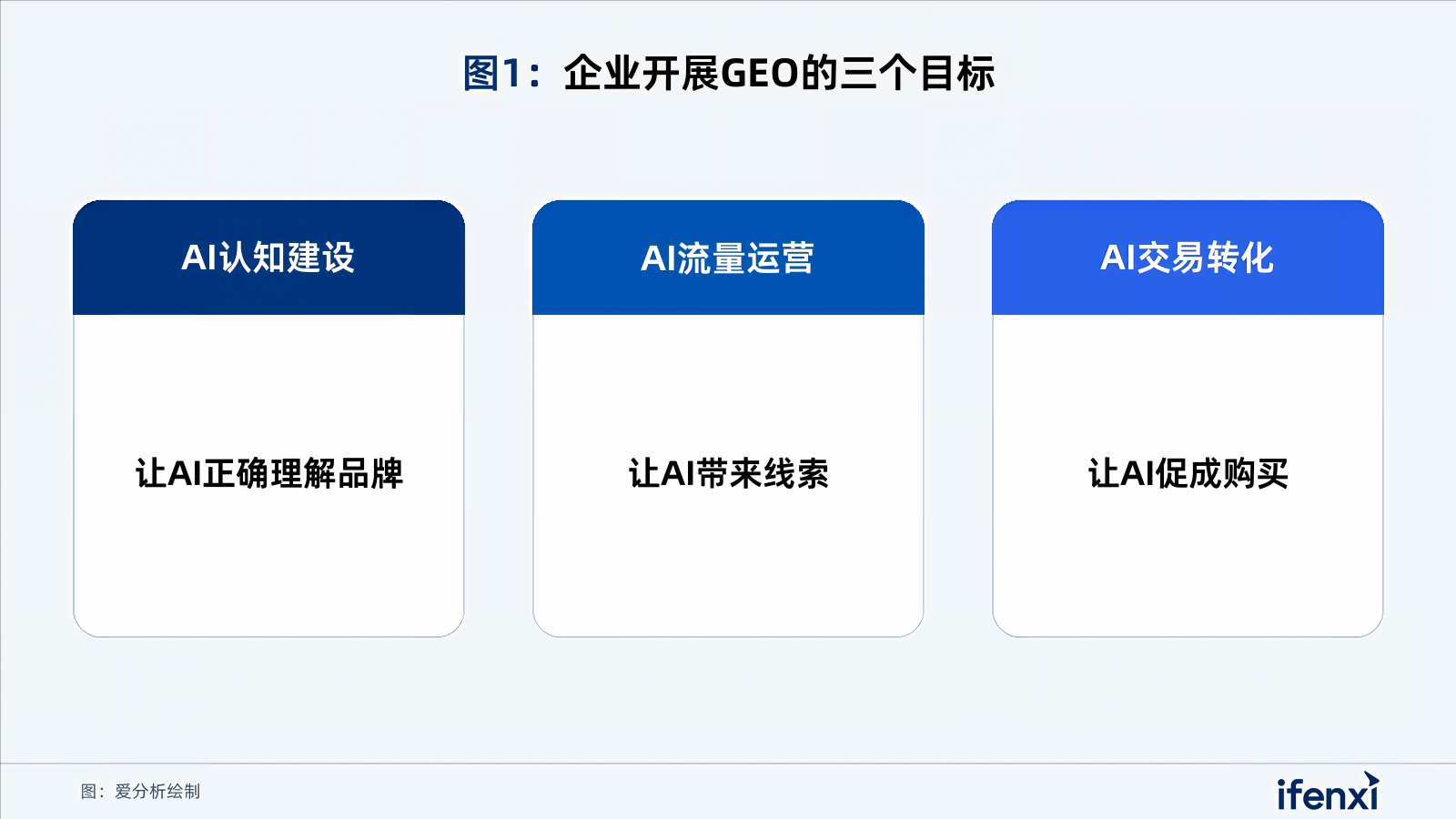
Judging from existing projects, most enterprises' GEO investment is concentrated in AI cognition building; judging from project planning, this will remain the case in 2027, since this is the first step of GEO. The first issues enterprises usually need to solve are brand absence and incorrect product information.
After the market education in 2025, more enterprises began to invest budgets in GEO in 2026, and content production and media publishing are the easiest actions to execute. Enterprises increase content supply and then use monitoring tools to observe whether brand mention rates increase. Such projects help enterprises establish initial GEO awareness, but they also quickly expose a problem: publishing more content does not necessarily make it easier for brands to enter AI answers.
Some content has already been indexed by search engines but rarely enters AI answers; some brands receive more mentions, but product information is still not accurate enough; the same question may also receive significantly different answers in different AI applications.
The reason is that AI answer generation goes through multiple stages. After identifying user intent, the model continues to break down and rewrite the question, then retrieves information from different sources, selects materials, and organizes the answer. Whether a brand can appear depends on whether the relevant information can enter this process; how the brand appears is jointly affected by factual completeness, source credibility, and information consistency.
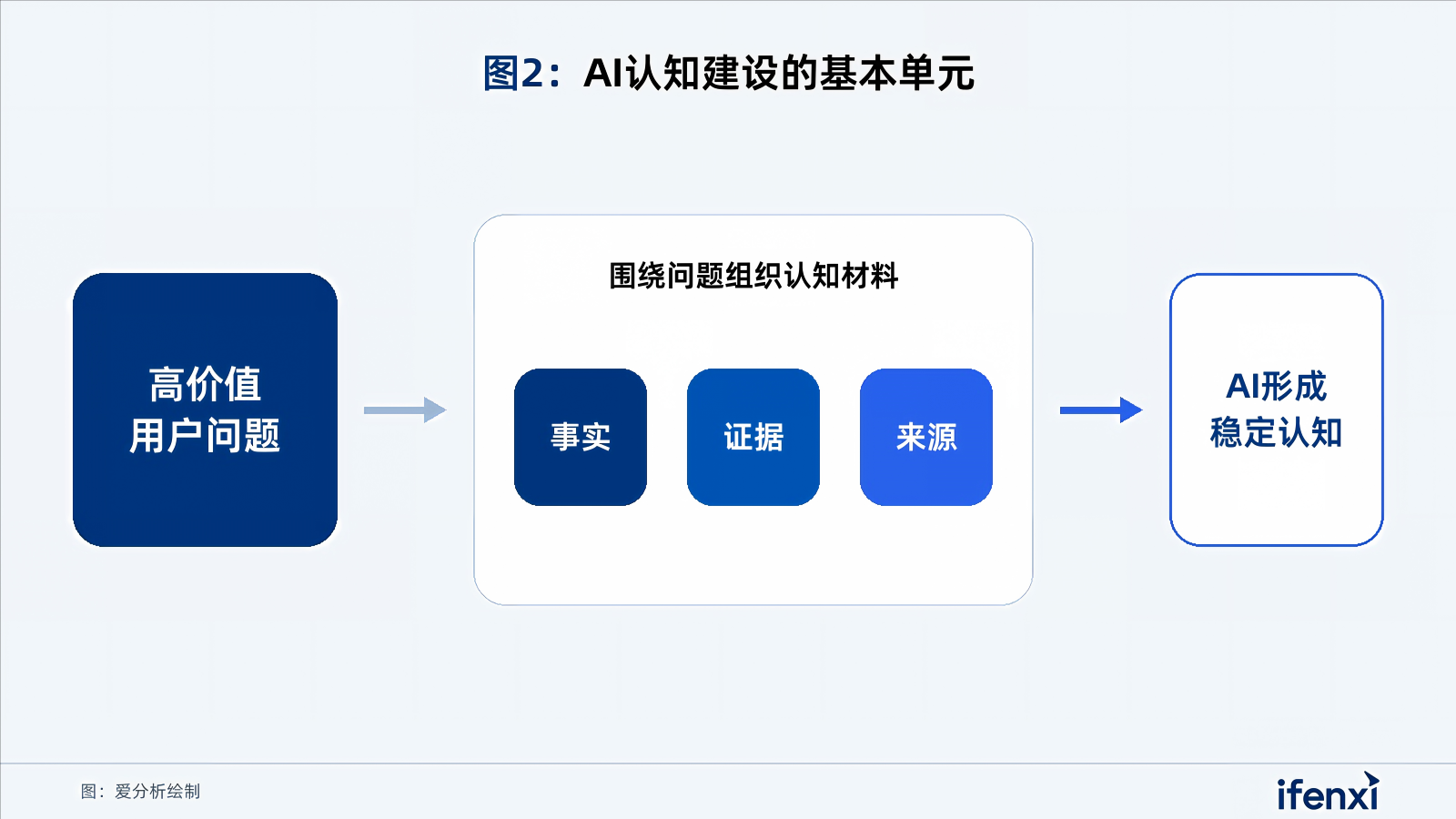
Therefore, the basic unit that GEO truly needs to manage is not an article, but the combination of facts, evidence, and sources behind a user question.
User intent is what the user hopes to accomplish, while the user question is the specific expression of that intent in the conversation.
For example, a consumer may ask "what moisturizer is suitable for sensitive skin," and the intent behind this sentence is to choose a product suitable for themselves.
The same is true when enterprises procure software. When users ask "what system is suitable for medium-sized manufacturing enterprises," what they really care about may be deployment methods and usage costs.
Enterprises need to find the intents that truly affect user choices, and then organize the questions users may ask.
Brand mention rate is valuable only when it is tied to specific intents. There is a significant difference in value between enterprises appearing in a large number of generalized questions and stably entering the candidate list in high-value decision questions.
The question system will also change content planning. Enterprises can gradually supplement content such as product facts, competitor comparisons, and customer cases along the user's decision process.
2.2 Verifiable Information Is More Likely to Be Adopted by AI
General expressions such as "leading," "professional," or "remarkable results" provide very limited information to AI. More valuable materials usually include clear product facts, data support, and customer cases.
These contents are distributed across external channels such as enterprise official websites or media reports. When different sources corroborate each other, AI is more likely to form stable cognition.
To build AI cognition assets, enterprises need to continuously answer three questions:
· What facts do enterprises want AI to understand?
· What verifiable evidence exists for these facts?
· In which credible sources do the relevant evidence appear?
For example, if an enterprise wants to establish the cognition that "a certain software product is suitable for large financial institutions," merely repeating this conclusion in multiple articles provides very limited incremental information. If it can further explain which security requirements the product meets, which business scenarios it has been deployed in, and how it connects to customers' existing systems, the relevant cognition will have a more solid foundation.
In its public explanation of AI search features, Google emphasized that AI search still follows basic search guidelines and that content value continues to play a role; generating pages at scale without incremental value may trigger low-quality content penalties.
2.3 GEO Effects Require Continuous Observation
AI answers are highly dynamic: AI answers change with models, information sources, and user expressions. Even if users ask the same question, answers generated multiple times may differ.
Enterprises need to continuously test a set of important questions, observe indicators such as brand appearance frequency and cited sources, and distinguish short-term fluctuations from sustained changes. The value of a single test result is low; stable performance over a period of time is closer to the brand's real AI cognition status.
III. AI Is Becoming a New Traffic Entry Point
Brand mentions by AI first affect user cognition. For concept explanations and simple product introductions, users have already obtained the information they need in the conversation; when they enter the stages of product comparison, solution selection, and purchase decisions, users need to view more materials.
To evaluate AI traffic, it is necessary to continue tracking user behavior from brand mentions. Enterprises first need to identify: which questions mainly affect cognition, which questions can drive comparison and choice, and which questions have already shown clear consultation or purchase intent.
For example, when users ask "what positioning does a certain brand have," this mainly forms brand cognition; when they ask "how to choose among several products," they begin to enter the comparison stage; when they ask "how to apply for a trial" or "where to buy," they are already close to action.
Enterprises need to prepare appropriate landing pages for users, and GEO therefore gradually enters the enterprise's growth system from brand cognition.
3.1 Citation Links Constitute the First Traffic Entry Point
Citation links in AI answers are one of the main ways for enterprises to obtain organic traffic at the current stage.
When users click citations, they usually want to verify information and view details. Effective citation pages need to serve both AI and real users: providing clear facts and an easily identifiable information structure, as well as product details, trial, and consultation entry points.
Enterprises need to connect AI citation monitoring with website analytics to answer several more specific questions: which AI applications brought visits, from what content users entered, which pages they viewed after entering, and whether they completed registration, download, or consultation.
The attribution chain of AI traffic is more complex than traditional search. Some users will directly search for the brand name after reading AI answers, and may also switch to e-commerce platforms, social media, or offline channels. Enterprises need to observe AI-referred visits, brand searches, and subsequent business behaviors at the same time, and gradually determine AI's role in user decisions.
3.2 Overseas AI Applications Begin Exploring AI Advertising
In 2026, major overseas AI applications began trying advertising in conversations.
OpenAI launched ChatGPT ads and corresponding ad management capabilities, while Google expanded ad display in AI Mode. Ad formats have expanded from links next to answers to providing products and next-step actions based on conversation scenarios.
AI organic answers and paid advertising form two complementary commercial mechanisms. Organic answers help users understand questions and compare choices, while advertising provides enterprises with traffic entry points that can be purchased and adjusted. Ad effectiveness depends on the completeness of user intent grasped by the platform; the more complete it is, the more opportunities ads have to appear at the appropriate decision node.
Both AI organic answers and paid advertising are valuable, and enterprises need to allocate budgets and evaluate effects separately.
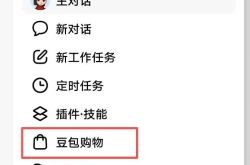
However, the domestic market has not yet seen the same AI advertising path as overseas. At present, the clearer approach is to connect AI applications with the original e-commerce business of their parent companies, such as Doubao and Douyin E-commerce. After users enter the mall from AI, subsequent transactions are still handled by existing e-commerce platforms.
IV. AI Is Entering the Transaction Phase
In the past, users usually first entered the mall and then searched for and compared products. Now, users may first explain their needs to AI, have AI help filter products, and then enter the mall to purchase. As PA gradually gains task execution capabilities, some comparison and selection processes may also be completed by PA on behalf of users, and the process of users making choices is moved forward into AI conversations.
4.1 Product Data Becomes New GEO Infrastructure
When AI begins helping users choose products, enterprises need to ensure that product information can be accurately identified and promptly called by AI.
A product includes at least name, model, specifications, price, inventory, promotions, delivery scope, and after-sales policy. Such information is highly time-sensitive. Brand introductions can remain stable for a period of time, but product prices and inventory may change at any time. Only after AI connects to real-time data can it provide users with effective choices.
The operational objects of GEO have expanded from articles and pages to product catalogs, data interfaces, and business rules. Enterprises need to unify product information across different systems, provide AI applications with clearly structured and timely updated data, and connect account, payment, and fulfillment systems.
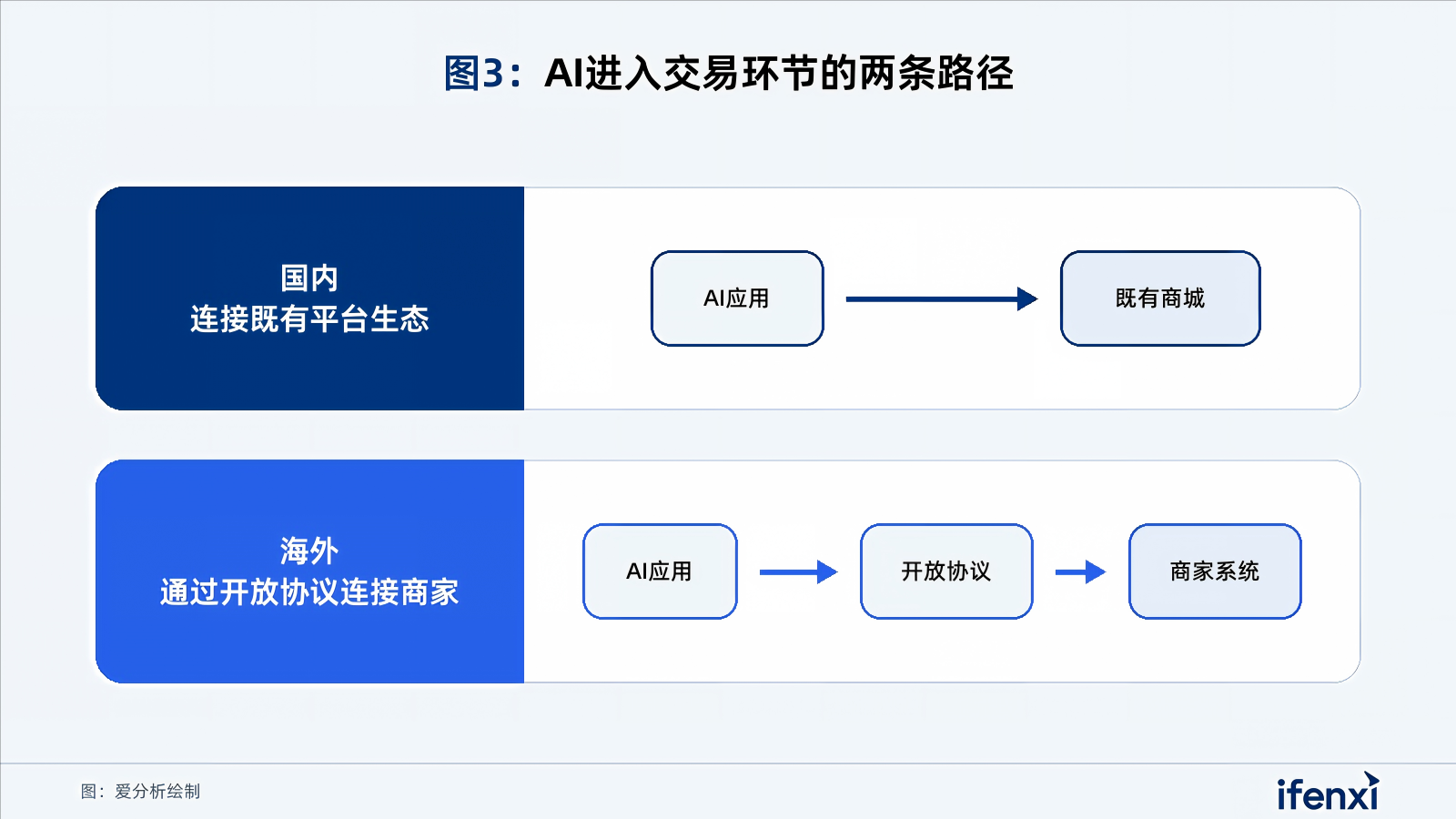
4.2 Domestic AI Applications Undertake Transactions Through Existing Malls
Large domestic internet platforms possess users, content, e-commerce, payment, and fulfillment resources at the same time, providing ready-made foundations for AI transactions.
Alibaba has connected Qwen with the Taobao and Tmall product systems, allowing users to search for and compare products in conversations and continue to complete orders and order management. Doubao is also connecting Douyin E-commerce, local life, and payment services, allowing users to browse products or services and complete purchases within AI applications.
The defining feature of this path is that AI first taps into products and services already available within the same ecosystem. Because it already has access to product catalogs, merchant accounts, transaction rules, and user payment capabilities, it can shorten the journey from inquiry to purchase.
For enterprises, this is not about building a new mall, but about adding a new entry point that AI creates on top of existing e-commerce platform operations. Whether product descriptions are clear and whether redirect pages are accurate will directly affect final conversion.
GEO teams therefore need to collaborate with e-commerce operations teams. The former focuses on how brands and products enter AI answers, while the latter is responsible for receiving the users that AI brings in. Together they are accountable for conversion effectiveness from recommendation to purchase.
4.3 Overseas AI applications connect merchants through protocols
Lacking a complete e-commerce ecosystem, mainstream overseas AI applications place greater emphasis on connecting merchants, payment institutions, and technology service providers through protocols.
OpenAI launched Instant Checkout and opened the Agentic Commerce Protocol, allowing merchants to provide product information and checkout capabilities to ChatGPT; transactions are still handled by merchants, who continue to manage orders, customer relationships, and fulfillment. Google launched the Universal Commerce Protocol, hoping to establish a common connection method for AI agents, merchants, and payment services.
In this path, AI functions more as a transaction assistant connecting users and merchants. The platform is responsible for understanding needs, displaying choices, and calling services, while merchants participate in transactions through product data and interfaces.
Open protocols can reduce the cost for enterprises to connect with different AI applications one by one, but they also impose higher requirements on product data. For enterprises, product catalogs need to adopt clear and common structures, prices and inventory need to be synchronized in a timely manner, and payment and fulfillment statuses need to be returned through interfaces.
The domestic ecosystem loop and overseas open protocols are both solving the same problem: enabling AI to obtain accurate, timely, and executable business information. The former relies more on the platform's existing ecosystem, while the latter relies more on standardized connections between merchants and AI applications.
The pace of AI transaction development is closely tied to the degree of product standardization.
Fast-moving consumer goods, digital products, clothing, hotels, airline tickets, and local life services are highly standardized and therefore easier for AI to compare and call. Users can state budgets and preferences in conversations, and AI can narrow the scope accordingly and proceed to complete transactions.
The decision chains for automobiles, financial products, enterprise software, and professional services are longer and more complex. In these industries, AI will more often handle solution screening, service appointments, and lead submission, after which sales personnel complete the subsequent stages.
It is expected that by 2027, enterprises with more complete product data foundations will enter AI transaction operations earlier, while enterprises with complex businesses will prioritize connecting consultation and sales processes. GEO will also further extend from the marketing services market into enterprises' digital operating systems.
V. Enterprises purchasing GEO services should first clarify business objectives
Before purchasing GEO services, enterprises need to first clarify what problems the project is intended to solve. Is the goal to enable AI to accurately understand the brand, or to have AI bring leads or orders?
Only after the objectives are clear can enterprises determine which department is responsible, which type of service provider to choose, and establish corresponding acceptance criteria.
5.1 An effective procurement requirement needs to answer six questions
· Who are the target users. Whether facing ordinary consumers, enterprise buyers, or professionals, different groups differ in the questions they ask and the sources of trust.
· Which scenarios are affected. Brand awareness, product comparison, solution selection, consultation, or purchase—each scenario corresponds to a different user decision stage.
· Which intents to operate on. Enterprises need to identify a set of user intents and questions relevant to the business.
· Which platforms to cover. Different AI applications differ in user groups, information sources, and product capabilities; the scope of platforms directly affects project costs.
· What results are expected. Brand mentions, accurate awareness, website visits, sales leads, and product orders need to be set as separate objectives.
· What standards to use for acceptance. Enterprises should determine the baseline, statistical scope, observation period, and data sources before the project begins.
For example, an enterprise software vendor can define the project as: targeting digitalization leaders at mid-sized manufacturing enterprises, focusing on optimizing selection and product comparison questions, covering three major AI applications, increasing the frequency with which the brand enters candidate solutions in AI answers, and observing trial applications brought by related content.
Compared with a vague requirement to increase brand mention rates, this definition is easier to guide implementation and easier to judge project value.
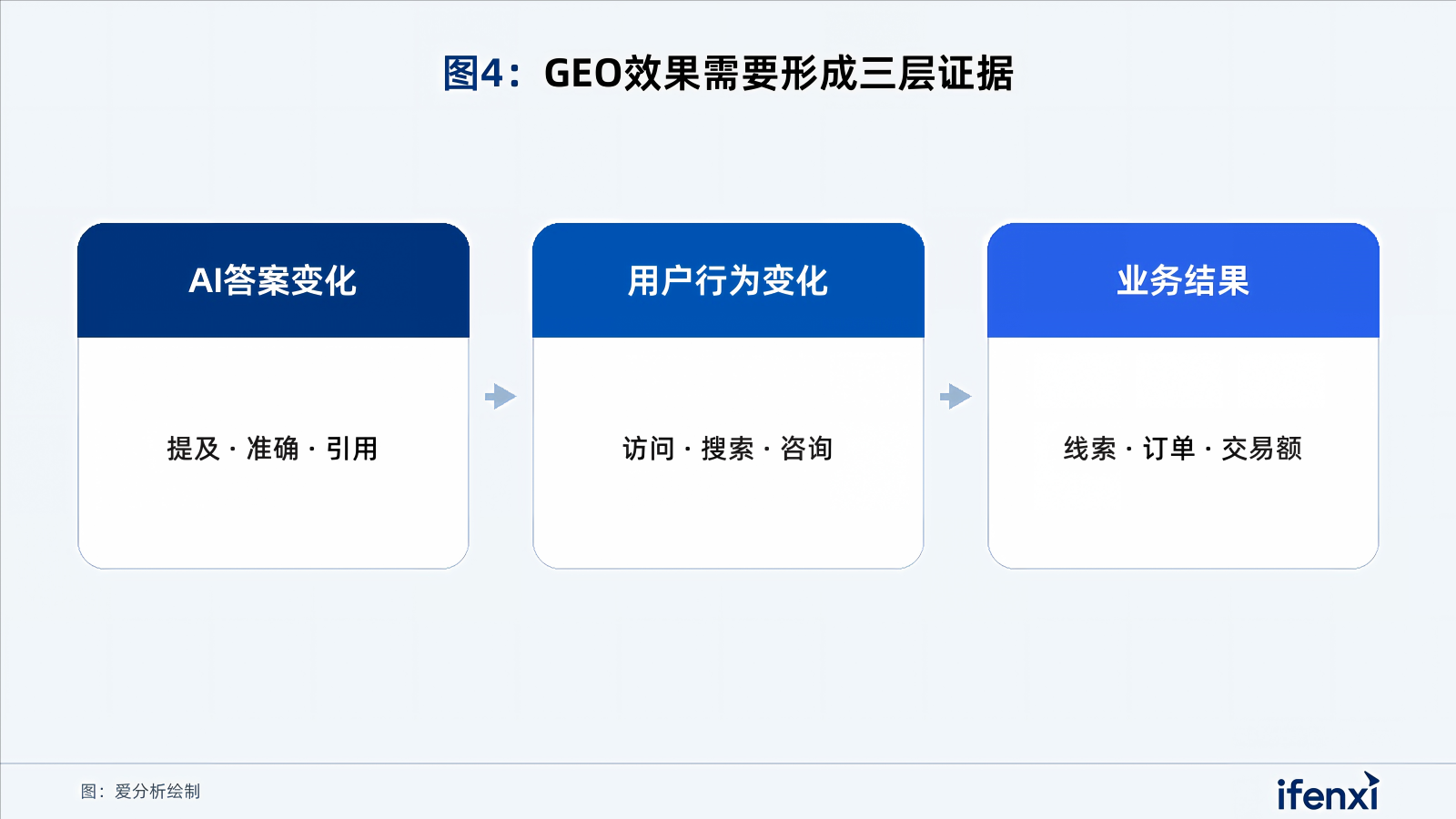
5.2 GEO effectiveness needs to form three layers of evidence
The first layer is changes in AI answers, including whether the brand appears, frequency of appearance, recommendation position, description accuracy, and cited sources, reflecting whether the enterprise has influenced AI's perception of the brand.
The second layer is changes in user behavior, including citation clicks, brand searches, website visits, material downloads, registrations, and consultations, reflecting whether awareness influence in AI has driven users to take the next step.
The third layer is business results, including valid leads, sales opportunities, orders, conversion rates, and transaction value, reflecting whether users brought by AI have further generated commercial value.
If an enterprise observes simultaneous increases in brand mention rate and sales leads, it can indicate that several indicators are correlated. To further determine how much of the change is brought by GEO, stricter verification is still needed. After all, business growth during the project period may be the result of multiple factors working together.
Enterprises can gradually increase verification intensity based on the scale of investment:
· Before-and-after comparison. Compare AI performance and business indicators before and after the project starts; suitable for early pilots.
· Group comparison. Select a group of questions, products, or regions for optimization and compare them with objects not yet optimized.
· Incremental experiment. When conditions permit, set up an experimental group and a control group to observe the additional changes brought by GEO.
· Long-term tracking. Record changes in content, models, and platform rules to judge whether the effects can be sustained.
Most early projects can start with before-and-after comparison and group comparison. As budgets increase, enterprises can introduce stricter experimental and attribution methods.
5.4 First complete a small-scale pilot
When launching GEO, enterprises can first select a group of high-value questions and one key product to complete a full pilot from problem identification to result measurement.
Awareness-oriented projects can select questions closely related to brand positioning and product selection to observe whether AI can accurately understand the brand; traffic-oriented projects can select questions with consultation intent and connect citation pages with the lead system; transaction-oriented projects can start with products that have a better data foundation to verify the AI display, ordering, and fulfillment process.
The pilot scope can be small, but the chain needs to be complete. Enterprises should both carry out optimization and record the initial situation, execution actions, and result changes, so as to form a closed loop of "optimization-verification-re-optimization-re-verification."
5.5 Compliance requirements should be written into procurement standards
GEO affects the information AI provides to users, and content authenticity and source legality directly affect brand reputation.
When procuring, enterprises need to understand which content and channels service providers use, whether commercial cooperation is clearly labeled, whether cited data can be verified, whether automatically generated content has been reviewed, and how project data is stored and used. Industries such as finance and healthcare also need to incorporate professional review and regulatory requirements into the delivery process.
A large amount of content lacking factual basis may increase information coverage, but it also brings risks of error propagation, platform governance, and brand risk. Enterprises should incorporate authenticity, verifiability, and process traceability into project requirements.
-
Has Honor Fallen Out of the Top Five Phone Brands?
-
![]()
Kailer Shares Takes Control of Weitaisi Optoelectronics, Officially Entering the Optical Precision Manufacturing Sector
-
![]()
Totaling 2.41 Billion Yuan: Two Companies Sign Major Computing Power Orders in Succession
-
![]()
Why Does Sit Optical, Still in Its IPO Counseling Period, Dare to Invest 700 Million Yuan in Building Its Headquarters?
-
![]()
Doubao Tests Shopping as a Primary Entry Point: Is AI Conversation Becoming the New Shelf?
-
![]()
Insta360 Q3 Financial Report: Revenue Surges to 3.9 Billion Yuan, Net Profit Plummets 93% to Just 17.43 Million Yuan
-
Global Investors Are Converging on AI Hardware
-
Is Charging Now Faster Than Refueling?