Domestic Android Needs a New Benchmark
 11/05 2026
 418

Over the next two years, only those who can sell high-end flagships at a premium while protecting profit and cash flow will be eligible to compete in the next round.
Author | Zhang Xiansen
Editor | Yang Ming
Domestic Android brands are entering their coldest moment yet.
According to data from three major research firms—Omdia, Counterpoint, and IDC—global smartphone shipments fell 20% to 22% year-on-year in Q3 2026, the largest single-quarter decline on record.
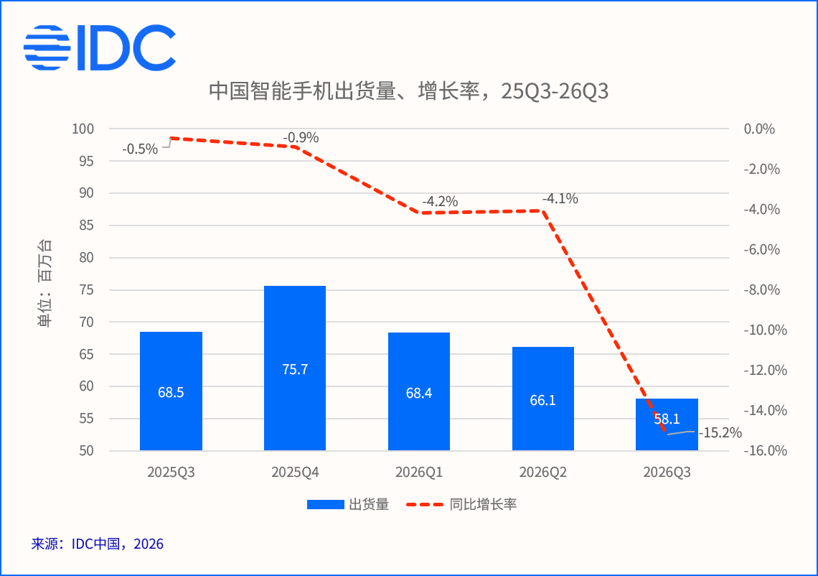
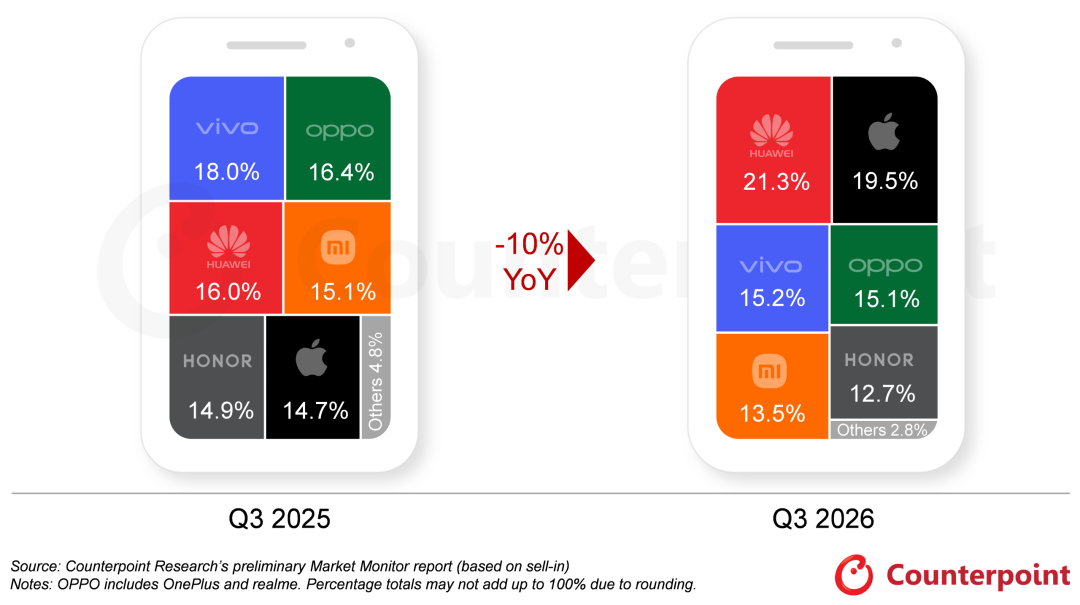
The decline in the Chinese market also widened significantly. IDC said China's smartphone shipments in the quarter were about 58.06 million units, down 15.2% year-on-year; Omdia counted about 59.3 million units, down 12% year-on-year, the lowest for the period since 2013; Counterpoint's measure showed a 10% year-on-year decline, the lowest for the period since 2012. The three firms' figures differ slightly, but all agree this is the coldest season in more than a decade.
Vendor shares also shifted. Apple's global share in Q3 was 22%, the first time it has exceeded 20% in a third quarter; its China shipments slipped slightly by 4.3% year-on-year, while its share rose to 17.8%. Huawei, the only leading vendor to achieve double-digit growth, saw China shipments rise 17.3% year-on-year, with its share reaching 21.1%. Domestic Android brands OPPO, vivo, Xiaomi, and Honor all generally fell by around 20%.
The good news is that average selling price (ASP) and high-end market share both rose. IDC data shows that in Q3, the share of the $600-and-above price segment increased 7.1 percentage points year-on-year, and the $400–$600 segment increased 4.6 percentage points year-on-year. Among them, vivo not only ranked first in China's $400–$600 price segment, but also ranked first among Android players in the $600-and-above high-end market. Under the pattern of falling volumes and rising prices, looking only at shipment rankings makes it difficult to accurately judge a manufacturer's true business health.
Some observers believe that although domestic Android brands generally declined, the situations vary greatly: some are passive contractions caused by weak demand, some are manufacturers actively cutting unprofitable product lines, and others are hit hardest by rising costs because of an overly high low-end mix. Various complex situations are mixed into the same shipment number, so rankings are naturally becoming increasingly distorted.
"The smartphone market is increasingly facing a trade-off between 'volume' and 'price,'" Counterpoint Research senior analyst Shilpi Jain said. For OEMs, the bigger challenge in the future is not only defending shipments, but also how to keep product prices affordable while safeguarding profit.
This means that what domestic Android brands need to answer right now is not who sold an extra 500,000 units this quarter, but who is keeping cards for the next replacement cycle. Among them, as low-priced phone profits are continuously eroded by memory costs, high-end has become the biggest trump card: it offers brand premium and gross margin buffer, and is also the culmination of imaging, foldables, AI, and system capabilities.
1 In the Wave of Price Increases, Who Is Holding On, and Who Is Actively Contracting
This round of price increases did not originate inside the phone industry. AI infrastructure continues to drive demand for high-performance memory, and upstream players such as Samsung, SK Hynix, and Micron are more willing to allocate capacity to CSPs with greater bargaining space, tightening the supply of memory chips used in phones and PCs. With supply falling short of demand, consumer memory chip prices remain persistently high.
According to a seasoned memory industry source interviewed by 21st Century Business Herald, memory makers' quotes for specific-specification chips for first-tier phone brands have risen by as much as about four times. Faced with high prices, phone makers are unwilling to stockpile large volumes and are purchasing more based on end demand, "holding on as long as they can." The time for large-scale concentrated stocking has passed, with risks too high and the amounts involved too large.
Besides memory, SoCs are also rising in price. Qualcomm President and CEO Cristiano Amon acknowledged at an earnings call that the company is implementing double-digit price increases across different end markets. Memory and SoCs are the two core component categories with the most obvious cost increases for phones today. Some industry practitioners estimate that for "Qualcomm 8-series flagship SoC + 12GB DRAM + 256GB NAND," the core configuration cost is about $500, and with screens and other materials added, the whole-device BOM cost will go even higher.
The domestic market faces additional pressure. IDC noted that the pull-through effect of various subsidy policies that previously boosted phone consumption is weakening; under the combined impact of memory price increases and subsidy rollback, overall domestic smartphone sales during the 618 promotion fell nearly 15% year-on-year. Channel and manufacturer adjustments have further amplified shipment volatility: some manufacturers shipped early ahead of price increases, but after new product prices were raised, end sales fell short of expectations, forcing channels to readjust inventory and production plans, cut orders, and control inventory—all of which ultimately showed up in shipment data.
But the impact of price increases is not equal across price segments. For an $80 entry-level phone and a $1,200 flagship, facing the same magnitude of memory cost increase, the former is a survival issue, while the latter is merely a thinner profit. That is why global shipments of phones priced below $100 shrank sharply year-on-year in Q3, while Samsung used price increases to noticeably raise its share in the $200–$299 segment. Under the same price increases, brands with strong brand premium held their base, while those relying on cost-effectiveness for volume lost ground.
Apple and Huawei bucked the trend, while OPPO, vivo, Xiaomi, and Honor came under pressure. It cannot simply be described as "domestic users collectively switching to Apple"; the more direct reason is who has a thicker cushion in the face of cost shocks. Apple used its supply chain bargaining power to lock in long-term supply in advance, with stable memory procurement scale, absorbing part of the cost shock internally; Huawei relied on self-developed chips and the depth of the domestic supply chain to keep part of the cost pressure outside. Most domestic Android brands have neither Apple's procurement scale nor Huawei's self-development depth, so cost pressure can only be passed down the industrial chain, terminal prices rise, and demand contracts accordingly.
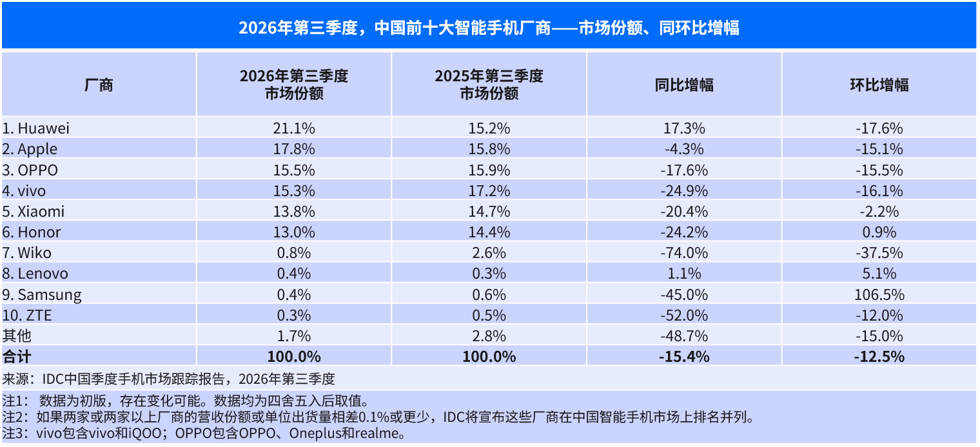
But the shipment decline is not entirely passive suffering. Counterpoint noted in its Q3 report that Xiaomi's shipments fell more than 30% because it was "avoiding selling products at thin or no profit," actively reducing investment in low-priced models and tightening shipment plans; OPPO was also consolidating product lines and sub-brands, compressing low-margin products, and shifting supply to markets with higher returns, with its shipment decline "including a certain degree of active trade-off." Some numbers worsened because manufacturers made active choices between profit and share, not because they could not defend them.
Huawei's counter-trend growth in Q3 relied to some extent on a restrained pricing rhythm—raising prices as little as possible, as late as possible, and in batches, using time windows to gain shipment space. Honor's strategy appears similar on the surface, but the underlying constraints differ: Huawei was previously limited by chip capacity supply, while Honor operates in a fully competitive general-purpose supply chain system and simply chose a similar operating rhythm. Against the backdrop of broad memory cost increases and widespread flagship price hikes, the Magic9 series starts at 4,499 yuan. The two companies face different situations, but the logic is similar: do not pass all the cost onto users at the peak, use rhythm to gain scale, and use restraint to gain windows.
2 Beyond Rankings, Profit and Cash Flow Are More Honest Than Share
The competitive logic of domestic phones over the past decade was essentially ranking-driven. Shipments, online sales, first-sale reports—a higher ranking meant channels were willing to hold inventory, the supply chain was willing to extend payment terms, and marketing had material to use. In a growth market, this logic was self-consistent: the market was rising, a higher ranking meant capturing more incremental growth, scale diluted costs, and profit followed.
In a stock-market cycle, the same logic runs in reverse. The market is not growing, so a higher ranking can only come from grabbing share; the most direct means of grabbing share are price cuts, subsidies, and pushing inventory onto channels. Short-term data looks better, at the cost of thinner profit, tighter cash flow, and squeezed R&D investment.
The wave of price increases has laid the cost bare. Xiaomi's phone ASP rose 25.9% year-on-year in Q2, a record high, but phone gross margin fell from 11.5% to 8.5%, and gross profit per phone fell from about 123 yuan to 115 yuan—selling at a higher price, yet making less money per phone. The situation for thousand-yuan phones is even more direct: a thousand-yuan phone originally had a gross margin of only 6% to 10%; if memory rises by two or three hundred yuan, profit drops to zero or even turns negative.
Transsion is another sample: net profit in the first three quarters was 2.63 billion yuan, but operating cash flow was a net outflow of 9.873 billion yuan, and inventory increased by 8.4 billion yuan from the beginning of the year. The income statement was still profitable, but the cash flow statement was already feeling the pressure first. Other manufacturers are seeking syndicated loans to cope with the cycle; on-paper share and off-paper funding costs are completely different matters.
The entire industry is shifting from volume to price. Counterpoint data shows that, affected by the higher revenue contribution from high-end models and terminal price adjustments brought by memory cost increases, the global smartphone ASP rose 27% year-on-year to $442, a quarterly record high.
The operating logic of domestic Android will also change accordingly. In this cycle, three indicators are more worth watching than share rankings—profit, cash flow, and operating rhythm. Profit determines whether a company can continue investing in R&D; without money to invest in chips, imaging, and systems, product competitiveness will fall behind in the next round. Cash flow determines whether a company can withstand volatility; if payment terms tighten and inventory slows, it can only clear stock at low prices and cut orders. Operating rhythm determines timing judgments—when to raise prices, by how much, and which product line to protect first—and says more about a manufacturer's judgment of its own situation than a single-quarter ranking.
The three indicators point to the same thing: whether a manufacturer is willing to endure short-term pain for the next replacement cycle. Those who blindly compress long-term R&D investment will have no cards to play when demand recovers; those who grit their teeth and protect long-term capability building will have a chance to catch the restarted replacement demand. One of Huawei's core lessons during its earlier difficult period under sanctions was to continuously direct resources toward bottom-layer capability building with longer return cycles.
What domestic Android faces now is not sanctions, but the logic is similar: when external conditions are no longer favorable, resources can only be turned toward internal capabilities. Different manufacturers give different answers, but the direction is already the same—treat high-end flagships as the most important breakthrough track, use flagships to set benchmarks, and use mid-range products to capture dividends. Low-end phones are most sensitive to memory costs and have the least room for price increases; high-end flagships have brand premium and gross margin buffers, and are the culmination of imaging, foldables, AI, and system capabilities, turning technology investment into user-perceivable experience and brand perception.
OPPO is betting on product structure. It is consolidating product lines and sub-brands, compressing low-margin product lines, shifting supply to markets with higher returns, and using the Find series and AI capabilities to push toward higher unit prices and thicker gross margins. Shipment numbers look bad, but what it gets in return is a contraction in organizational and channel costs.
vivo is betting on a tiered matrix across price segments. For the past four years, vivo has ranked first in China's phone market by shipments. This year shipments are under short-term pressure, but the pressure comes more from the time lag between low-end models contracting faster than high-end volume ramps up.

In the high-end market, vivo has already secured a place. An IDC report shows that vivo (including iQOO) ranks first among Android players in the $600-and-above high-end market; the S60 series helped it take first place in the $400–$600 segment; and its foldable share has steadily risen in the first three quarters, firmly placing it in the first tier of domestic Android foldables. High-end provides mindshare and gross margin, mid-range provides scale and channel turnover, and foldables provide form-factor differentiation and brand narrative. Actively giving up part of low-priced volume in exchange for a continued upward shift in product structure—whether this trade is worthwhile still depends on the product competitiveness of the next-generation X series and the pace of channel inventory digestion.
Honor is betting on pricing restraint—limiting price hikes to protect its volume base while waiting for scale effects to return. Xiaomi is betting on profit discipline, preferring to sacrifice shipments rather than tough it out at loss-making prices.
What these companies share is not that short-term share looks better, but that they are each preserving optionality for the next cycle in their own way. Some are safeguarding profit; some, cash flow; others, high-end mindshare. High-end flagships are the most concentrated bet of all: they carry gross margin, technology iteration, and brand perception simultaneously, and are the deep water that domestic Android cannot avoid.
Longer replacement cycles do not mean consumers stop upgrading; they simply concentrate purchase decisions on products they believe are worth upgrading to. This also explains why OPPO and vivo are shifting resources toward higher-margin products and markets, and why share in the $600-and-above and $400–$600 segments rose against the overall decline. For a business like phones—asset-heavy with a long supply chain—actively reducing channel inventory and cutting unprofitable models is sometimes more worthwhile than propping up market share. IDC expects cost pressure to persist for most of the period through 2027, and a market recovery may not come until 2028–2029; replacement demand is only delayed, not gone.
3. High-end flagships are hard to win, but unavoidable
The gap between domestic Android and Apple in the high-end segment remains. Brand strength, ecosystem synergy, and global channels cannot be closed in a year or two. In this cycle, these are not the most urgent issues either. The more realistic challenge is that competition in high-end flagships has shifted from single-point specification comparisons to contests over scenario experience and long-term capability accumulation.
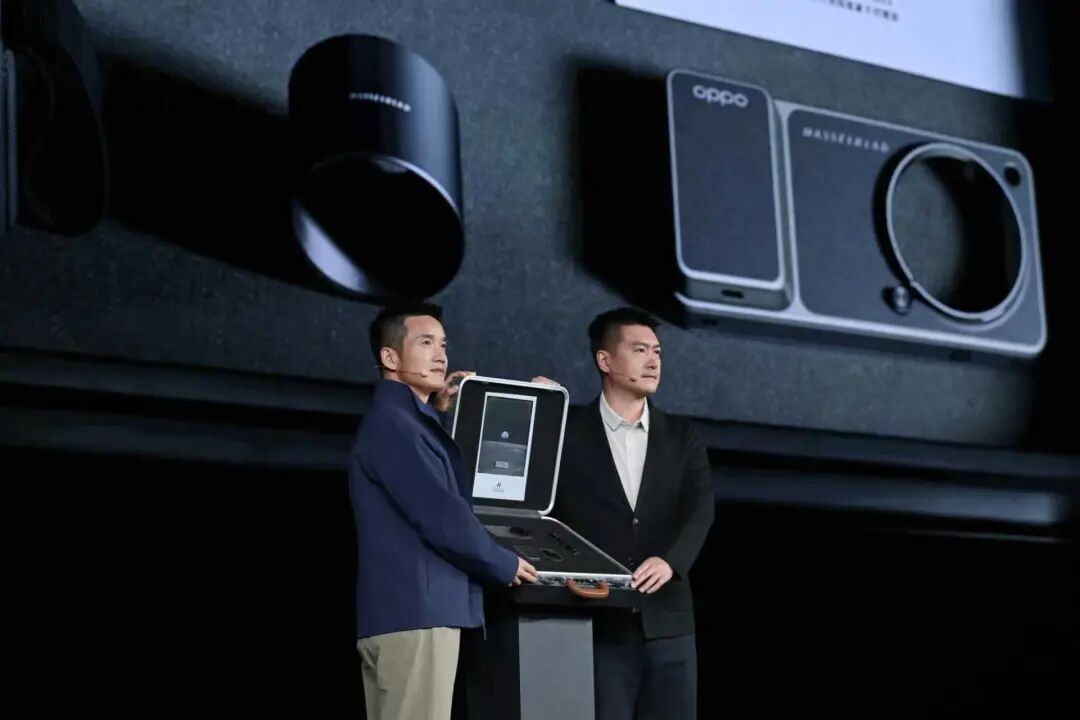
Imaging is the most solid accumulation of domestic Android. vivo's Zeiss imaging, OPPO's Hasselblad color, and Xiaomi's Leica co-branding are already on par with—or even locally ahead of—competitors in hardware and algorithms. But competition has long moved past comparing pixels and sensor sizes. vivo has anchored telephoto, stabilization, and night-scene algorithms to the specific scenario of "watching concerts"—when users can't capture the stage clearly at a concert, the first brand they think of is vivo; OPPO binds to portraits, Xiaomi to street photography, with the same logic.
Sensors are generic supply-chain commodities; scenario understanding and implementation algorithms are the real voice that brands hold in their own hands. Against the backdrop of cost-definition power being hard to reclaim in the short term, the power to define imaging scenarios is the most solid card.
Foldables are another card—one of the few tracks where form-factor differentiation is still possible, and a touchstone for high-end mindshare. Domestic brands have real accumulation in hinges, displays, slimness, and software adaptation; the weakness is not whether they can build them, but whether they can keep selling them at a premium once built. In a cycle of high costs, foldable investment needs focus—penetrating scenarios with one or two premium products is more pragmatic than casting a wide net.
Gaming and young users are the third long line. iQOO and OnePlus are doubling down on esports and targeting university groups—in the short term grabbing segmented markets, in the long term cultivating users. The continued hot sales of iQOO 15 and iQOO 16 show that the performance track cannot be held by a single price war, but by the product power accumulated across generations that cements the mindshare of "professional esports flagship." Such investment contributes little profit in the short term, but it occupies mindshare. When these young users' spending power rises and they enter their main phone-replacement cycle, the first brand they will think of is the one that accompanied them.
The changes in the AI track are also representative. For Apple, AI is the core strategy defining the next generation of interaction; for domestic Android, AI is rapidly becoming a basic capability. Users take AI features on phones for granted, just as they assume fingerprint unlock and fast charging—having them adds little, missing them directly costs points. The contradiction is that manufacturers all know they don't need to compete on large-model parameters, yet the launch-event public-opinion arena and the marketing competition environment force brands to keep stacking parameters and running benchmarks.
Therefore, the right direction for domestic Android AI competition is not model names and parameter scales, but embedding AI into their own ecosystems: imaging AI optimizing shooting and post-processing, gaming AI scheduling frame rates and thermals, cross-device AI connecting phones, tablets, car units, and smart homes. The reason vivo emphasizes its self-developed BlueHeart large model every time is actually the hope that AI's differentiated implementation can be perceived by more users.
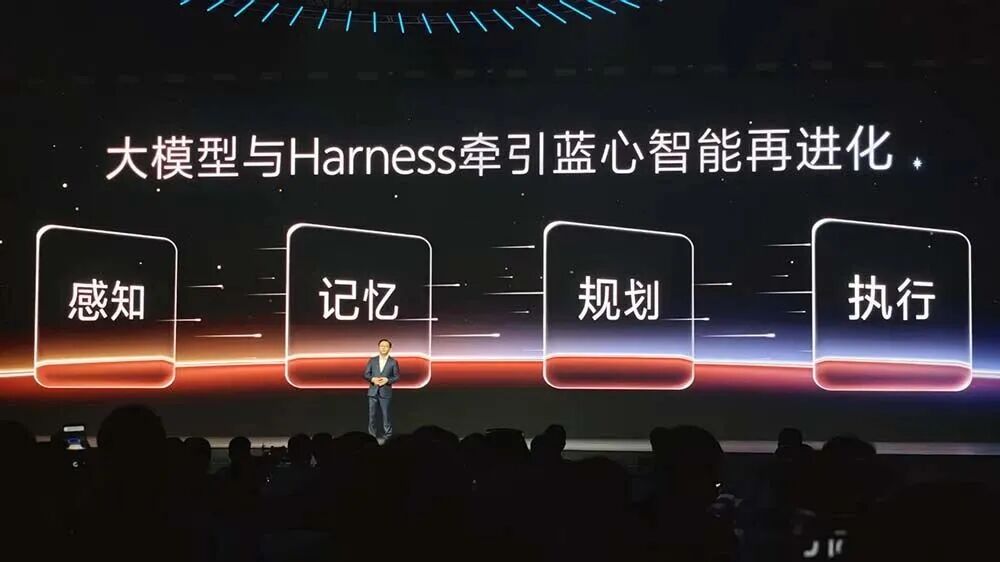
Imaging, high-end, gaming, and AI—the playbook of domestic Android brands can be summarized in two lines: building user mindshare based on scenarios, and relying on multi-generational product iteration to exchange for growth space. High-end flagships are exactly the intersection of these two routes: using flagships to set benchmarks, mid-range to capture market dividends, and continuous iteration to turn technology into experience and then solidify experience into brand perception.
Whether this can bring a new spring to domestic Android brands has no conclusion yet. The cost pressure brought by storage is still fermenting, and high-priced materials are likely to be the norm for the next few years. In the next two years, whoever can sell high-end flagships at a premium while safeguarding profit and cash flow will be qualified to participate in the next round of competition. In the elimination rounds of a stock market, those who don't contend for the moment are the ones who can contend for the next moment.
END
Producer: Huang Qiangqiang
-
Can AI Save Television? Only If Manufacturers Dare to Abandon Path Dependence
-
![]()
Works Even Without Power! Musk's New Starlink Product, Battery from China
-
![]()
Yipu Optoelectronics and Neusoft Japan Sign MoU to Jointly Advance Pre-Integrated Vehicle HUD Solutions
-
![]()
Fujian Forecam Optics Posts 84.13 Million Yuan Loss in First Three Quarters as Transformation Stalls in the "Transitional Gap"
-
![]()
Are AI Imaging Features About to Become Paid? Rising Cloud Token Costs for Phone Makers Make On-Device Computing Power the Right Path
-
![]()
Why Is MONA Accelerating Its Split from XPeng—Planning Dedicated Stores for 2027 and Leaving the Door Open to Independence
-
![]()
Apple Is Also Starting to "Save Tokens": The AI Money-Burning Frenzy Has Reached Its Reckoning
-
Behind Musk's Election Campaign Defeat: Who Pays the Bill for AI Expansion?