A $500 Million Company Lasted Only Three Months: Former Feishu VP Shi Kaiwen Resigns and Joins StepFun
 11/05 2026
 577

Embodied Emergence has learned that on November 4, multiple media outlets confirmed that former Feishu Product Vice President Shi Kaiwen has joined the large-model company StepFun. The on-device Agent startup "Above the Interface," which he founded on June 25, had a first-round valuation of $500 million, with investors including Sequoia China and JinQiu Fund—and the project was terminated in September.
What really made Shi Kaiwen recognizable to the general public, however, was something else entirely. A photo of a late-night walk spread across social networks; in it, one person was holding another's arm, casually captured by a passerby and then recognized. By evening, "Yang Tianzhen reveals the reason she doesn't marry" had surged onto Weibo's trending topics, with 7.457 million views.
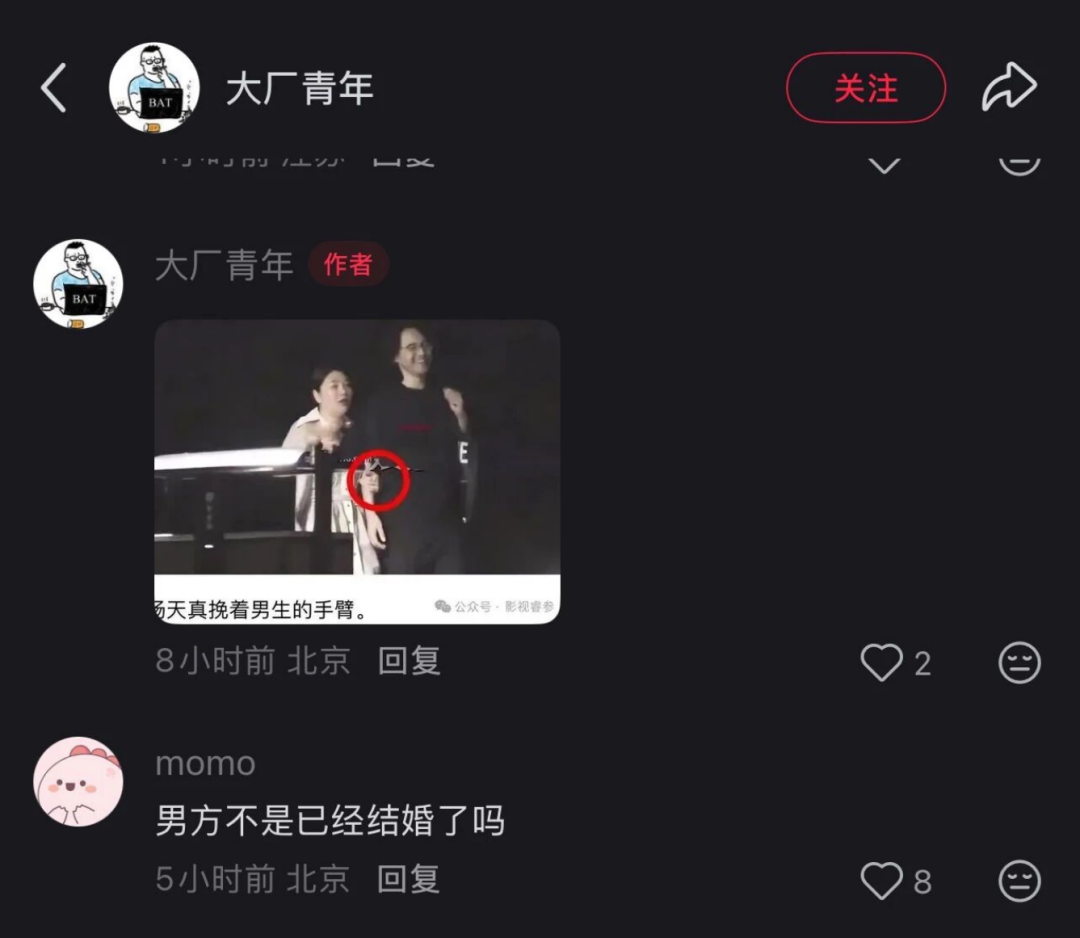
An AI company valued at $500 million quietly came to an end, leaving barely a ripple. A blurry night photo, meanwhile, dominated public attention that day. According to observations by Embodied Emergence, this is no coincidence: the pace of technological evolution is measured in months, the pace of public attention in seconds—and attention only recognizes faces, not matters.
01
Why can't a good valuation keep people?
This is not Shi Kaiwen's first startup. He graduated from the Central Conservatory of Music and in his early years ran the music website Koocu and the social app Blink, the latter of which raised a $16 million Series A led by Sequoia in 2014. In 2019 he joined ByteDance, rising to Product Vice President at Feishu and serving as the core person behind Bitable, turning a spreadsheet into a "Work OS" with over 10 million monthly active users.
"Above the Interface" therefore started from a high point. Co-founder Zhang Zhuosheng is a tenure-track assistant professor at Shanghai Jiao Tong University, researching multimodal large models and agent interaction, and has published over a hundred papers in top conferences and journals. They wanted to pursue Agent innovation on the interaction side—a next-generation personal assistant OS that can truly do work for people, rather than yet another wrapper chatbot.
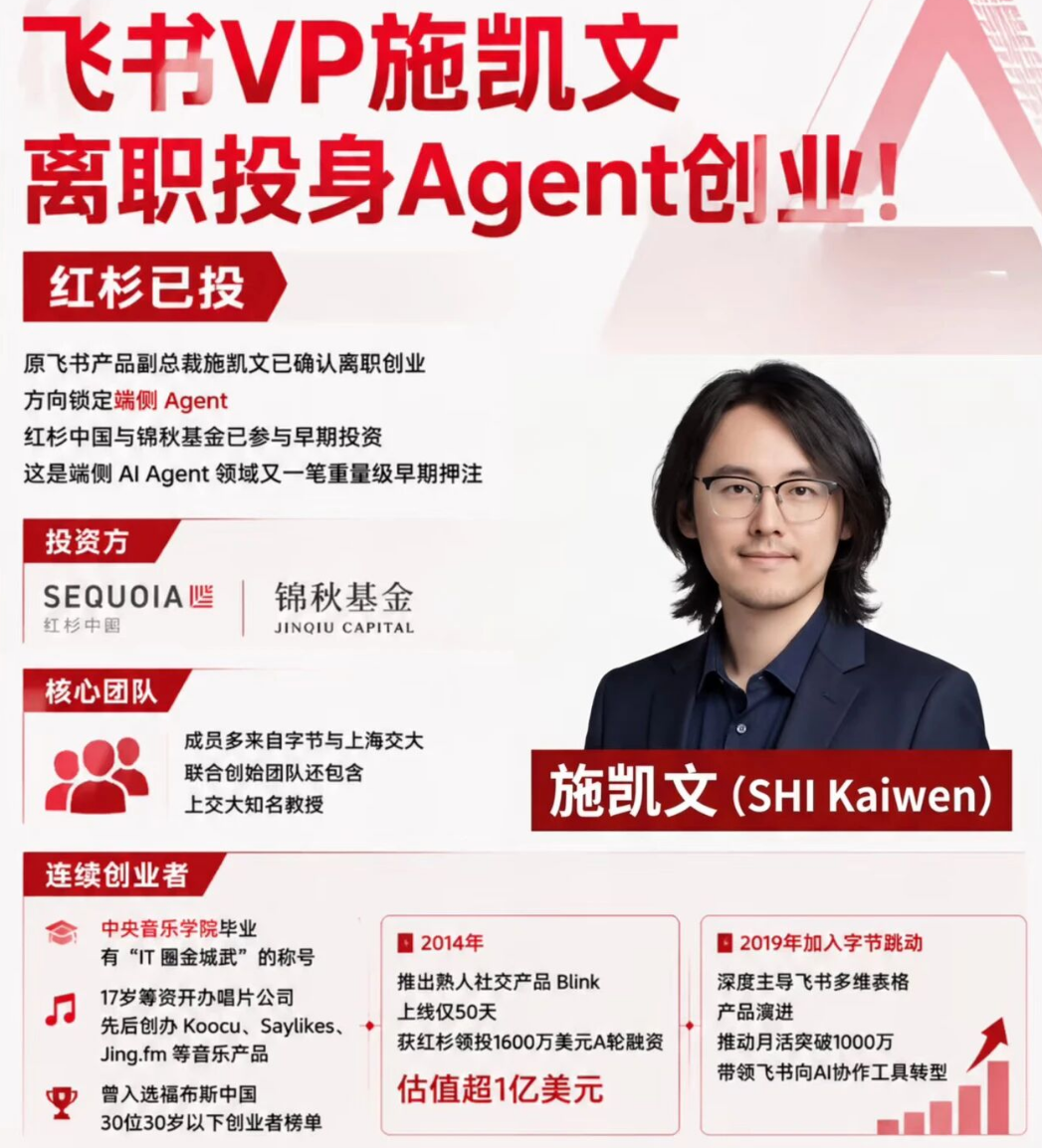
Such a valuation belongs to the first tier this year, showing that capital recognizes this team's ability to see accurately. But between seeing accurately and achieving success lies a distance that belongs to others.
Shi Kaiwen's greatest strength is packaging technologies users do not care about at all—databases, collaboration, permissions, workflows—into an interface that feels effortless to use. This capability was valuable in the mobile internet era, because product differentiation then grew out of interaction. In the AI era, the back wall of assistant products has become the model; the pace of model iteration, training compute, and inference costs are not things a startup can arrange on its own. Zhang Zhuosheng can guarantee the frontier nature of technical judgment, but cannot guarantee that the model moves forward one notch every week.
According to observations by Embodied Emergence, the termination of "Above the Interface" should not simply be read as failure; it is more like a calibration. Product capability has not depreciated; it is just no longer the only valuable thing at this layer. When compute and models become the entry ticket, companies that purely do interaction stand in a very narrow middle ground—above are model companies, below are hardware manufacturers, and both ends are pushing forward.
02
Once the phone is built, who is still missing?
The company Shi Kaiwen joined happens to lack nothing, and also happens to lack one thing.
StepFun completed over 5 billion yuan in B+ round financing in January this year, with Megvii founder Yin Qi serving as chairman. In May, the company dismantled its red-chip structure, completed nearly $2.5 billion in financing, and its move toward a Hong Kong IPO has already been put on the table. It does not lack hardware talent either; Economic Observer reported in July that StepFun had assembled a hardware team of over 500 people, and terminal president Ni Jiayue previously served as Vice President of Huawei Terminal China and President of Honor China.
What it lacks is another matter. StepFun's most beautiful numbers have always come from the B-end. As of the end of 2025, its models covered about 60% of leading domestic phone brands, with preinstallations exceeding 42 million units. But these phones are not StepFun's phones, and these users are first and foremost users of phone manufacturers; StepFun here is more like a behind-the-scenes supplier than a brand. Its own C-end products have never been impressive; after "Yuewen" was renamed "StepFun AI," it ranked 33rd on the domestic AI product app overall list in June 2026, with about 506,000 monthly active users.
Yin Qi said in July this year: if any model company does not have an application capable enough of sustaining it, it will be difficult to survive in the long run. Read in reverse, this means what StepFun has always lacked is never the model, nor the supply chain, but the person who can turn complex technology into something ordinary people are willing to open every day. What Shi Kaiwen did at Feishu was exactly this: Bitable lets people who cannot write code manage data, processes, and collaboration. This ability to translate engineering capability into human language happens to be the segment model companies are least good at.
According to observations by Embodied Emergence, the significance of this personnel change is not in poaching an executive, but in that what StepFun is filling is the product link. It has placed all four puzzle pieces—model, system, Agent, and hardware—on the table, lacking only someone who knows how to make the puzzle look like a product.
03
Who will open the door for agents?
To understand why Shi Kaiwen had to enter a model company, one must first look at what happened to another route.
On September 14, the consumer version of Doubao Phone Assistant was officially released, along with the "Screen Automation Operation Statement Agreement," giving third-party applications a 30-day publicity period. On September 16, the first Nubia NaviXUltra equipped with this capability went on sale, starting at 5,999 yuan, hailed in the industry as the world's first commercial AI agent phone.
When the publicity period ended on October 14, the published rejection list contained 155 applications. There were 66 from the Tencent ecosystem, 23 from the Alibaba ecosystem, 11 from Meituan, 14 from Kuaishou, and even products in the same track such as Kimi and DeepSeek chose to close permissions. This list covers almost half of China's internet landscape, and for the first time it brought an unspeakable matter onto the table.
According to observations by Embodied Emergence, what truly blocks on-device Agents has never been whether the model is smart enough, but that every simulated click takes place on someone else's turf. What super apps guard is not technical interfaces, but traffic sovereignty. At the moment an agent completes a task across applications on behalf of the user, the definition of the entrance is rewritten, and no one is willing to let others rewrite their own entrance.
This also explains why StepFun must make phones. By building its own system and hardware, and issuing permissions from the bottom layer, it does not have to go door to door asking people to open up. On July 13, StepFun released the terminal brand STEPX, the agent-native operating system Step AOS, and its first phone STEPX Neo. On October 13, STEPX Neo announced full-stack pricing of 3,999 yuan and opened preorders. This path is heavy and expensive, but it is currently the only path that does not require looking at others' faces. For Shi Kaiwen to build AgentOS, he must stand in a position where he can speak from the system layer; this is the most realistic and least romantic reason for his choice of a model company.
Putting these matters together reveals a clue more important than the personnel change.
According to observations by Embodied Emergence, the stratification of China's AI industry was basically completed this year. The model layer holds compute and iteration pace, the system layer holds permissions and entrances, and the application layer holds scenarios and user understanding. The pricing power of the three layers is completely different, and the price of talent follows pricing power. Therefore, the flow of top product talent from the application layer to the model layer should not be read as talent drain; it is more like industrial division of labor converging.
We also want to offer a sharper judgment. The winning factor in the AI phone battle is not on the spec sheet, but in authorization. The most expensive ticket over the next two years is the ability to simultaneously hold models, systems, hardware, and ecosystem; missing any one piece means agents can only remain in demo videos. This has already been verified by that rejection list of 155 applications.
The final layer of significance falls on entrepreneurs. A $500 million valuation proves that capital recognizes your judgment, but it cannot buy a cycle of model iteration. The real question this generation of AI entrepreneurs must answer is not whether to be absorbed, but by whom and in what position. This sounds undignified, but it is closer to today's truth than the words "independent entrepreneurship."
Shi Kaiwen's choice deserves respect. A person who does products has placed his strongest capability where it is most needed; this itself is a rational and honest judgment. China's AI industry is shifting from telling stories to competing on delivery. This road is hard to walk and not much to look at, but it is the only road that can reach the endpoint. Five hundred million dollars, three months, and one walking photo—stacked together, these three things are exactly the side profile of this industry in 2026.
On which device did you last truly feel that AI completed a task for you from beginning to end?
-
Can AI Save Television? Only If Manufacturers Dare to Abandon Path Dependence
-
![]()
Works Even Without Power! Musk's New Starlink Product, Battery from China
-
![]()
Yipu Optoelectronics and Neusoft Japan Sign MoU to Jointly Advance Pre-Integrated Vehicle HUD Solutions
-
![]()
Fujian Forecam Optics Posts 84.13 Million Yuan Loss in First Three Quarters as Transformation Stalls in the "Transitional Gap"
-
![]()
Are AI Imaging Features About to Become Paid? Rising Cloud Token Costs for Phone Makers Make On-Device Computing Power the Right Path
-
![]()
Why Is MONA Accelerating Its Split from XPeng—Planning Dedicated Stores for 2027 and Leaving the Door Open to Independence
-
![]()
Apple Is Also Starting to "Save Tokens": The AI Money-Burning Frenzy Has Reached Its Reckoning
-
Behind Musk's Election Campaign Defeat: Who Pays the Bill for AI Expansion?