Auto Electronics Leader Posts Consecutive Earnings Growth, Nearly 9.5 Billion Yuan Invested in R&D Over Five Years
 11/05 2026
 387
Tap "Short, Flat and Quick Interpretation" to follow us, and @ the editor for tips
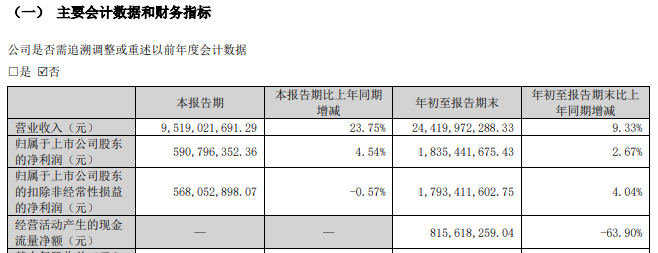
As a leader in domestic automotive electronics, Desay SV has delivered consecutive earnings growth in recent years. In the first three quarters of 2026, it reported operating revenue and net profit attributable to parent company of 24.42 billion yuan and 1.835 billion yuan, respectively. However, year-on-year growth further slowed to 9.33% and 2.67%, respectively—both below double digits. Whether full-year growth will improve remains to be seen.
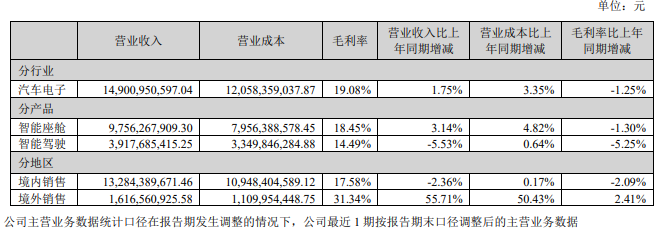
Desay SV focuses deeply on smart cockpits, intelligent driving and connected services. Smart cockpits are the core business, with revenue share once exceeding 70%; revenue growth in the first half of the year was 3.14%. Intelligent driving has grown rapidly over the past three years, with its revenue share continuing to rise, but revenue turned to a decline in the first half of the year, down 5.53%.
Behind consecutive earnings growth, growth in the two core businesses is slowing
Consecutive growth in earnings, but slowing growth. From 2021 to 2025, Desay SV achieved consecutive earnings growth, with operating revenue of 9.569 billion yuan, 14.933 billion yuan, 21.908 billion yuan, 27.618 billion yuan and 32.557 billion yuan, respectively—a compound annual growth rate of about 36%. Net profit attributable to parent company was 833 million yuan, 1.185 billion yuan, 1.547 billion yuan, 2.005 billion yuan and 2.454 billion yuan, respectively—a compound annual growth rate of about 31%.
Although the company has maintained earnings growth in recent years, the growth rate has been slowing. From 2022 to 2025, revenue growth rates were 56.05%, 46.71%, 26.06% and 17.88%, respectively, while net profit attributable to parent company growth rates were 42.22%, 30.57%, 29.62% and 22.38%, respectively. In other words, growth momentum has weakened year by year.
Entering 2026, the company's earnings have continued to grow. In the first three quarters, it reported operating revenue and net profit attributable to parent company of 24.42 billion yuan and 1.835 billion yuan, respectively. However, year-on-year growth further slowed to 9.33% and 2.67%, respectively—both below double digits.
Smart cockpit revenue growth is slowing. Desay SV belongs to the automotive manufacturing industry, mainly engaged in the R&D, production and sales of automotive electronic products. It focuses deeply on the full-stack integration of smart cockpits, intelligent driving and connected services, continuously developing highly integrated intelligent hardware and leading software algorithms, and providing global customers with safe, enjoyable and green overall mobility solutions and services. It has been listed for six consecutive years in the Global Top 100 Automotive Suppliers published by Automotive News, ranking 54th in 2026.
Smart cockpit is the core business. The company offers a series of EEA platform product solutions for AI-defined vehicles, including one-stop central computing platform–end-cloud integrated AI cockpit solutions and vehicle tool platforms–SOA development tools, which can provide automakers with full-chain empowerment from computing foundation and system middleware to AI agent applications. Supported by the dual capabilities of full-stack smart cockpit solutions and AI full-process platforms, it works with automakers to build a deployable and sustainably iterable smart cockpit ecosystem.
In addition, the company maintains a leading position in smart cockpit domain controllers, infotainment systems and interactive device products. In the display business, products such as integrated screens, MiniLed and overhead screens have won designations from multiple key customers, and the new business of intelligent power amplifiers has also achieved breakthroughs.
From 2023 to 2025, the smart cockpit business achieved operating revenue of 15.802 billion yuan, 18.23 billion yuan and 20.585 billion yuan, respectively, with growth showing a slowing trend—increasing by 34.42%, 15.36% and 12.92%, respectively. Gross margins showed a declining trend, at 20.58%, 19.11% and 18.83%, respectively. In addition, the revenue share of this business fell from 72.13% to 63.23%.
Entering 2026, the smart cockpit business continued to grow, achieving operating revenue of 9.756 billion yuan in the first half of the year. The company mainly achieved dual breakthroughs in new customers and new markets by enriching its product matrix and deepening market layout, driving continued steady growth in business scale. However, the growth rate further slowed, with a year-on-year growth rate of only 3.14%.
Intelligent driving revenue turned to decline. Desay SV's full-stack delivery capability has been iteratively upgraded, and it has formed a complete delivery capability for a full intelligent driving system integrating domain controllers, sensors and algorithms. It can provide diversified solutions for domestic and international markets and fully match the differentiated customization requirements of different customers. At present, the full series of intelligent driving platforms have achieved large-scale mass production, building a diversified product matrix, among which the high-computing flagship platform, high-cost-performance mainstream platform and domestically produced chip platform have all been delivered and installed on vehicles in batches.
At present, the company is developing a new generation of intelligent driving solutions, using a hardware-level collaborative architecture to break the traditional multi-chip communication barriers and achieve leaps in key performance parameters such as computing power and bandwidth. It has now obtained designations from multiple customers. Subsequently, the company will continue to accelerate the mass production transformation of cutting-edge technologies and work with more ecosystem partners to promote the rapid popularization of L3/L4 autonomous driving.
From 2023 to 2025, the intelligent driving business achieved operating revenue of 4.485 billion yuan, 7.314 billion yuan and 9.7 billion yuan, respectively, increasing by 34.42%, 63.06% and 32.63% year on year, respectively. Gross margins fluctuated, at 16.22%, 19.91% and 16.36%, respectively.
Entering 2026, the intelligent driving business revenue turned to decline, achieving revenue of 3.918 billion yuan in the first half of the year, down 5.53% year on year. At the same time, profitability also declined slightly, with a gross margin of 14.49%, down 5.25 percentage points year on year.
Domestic automobile production and sales declined, while the export market developed rapidly. It can be seen that Desay SV's smart cockpit and intelligent driving performed poorly in the first half of the year, with the latter even declining, which is directly related to the poor performance of the automotive industry. According to data from the China Association of Automobile Manufacturers, in the first half of 2026, China's automobile production and sales completed 14.993 million and 15.017 million vehicles, respectively, down 4% and 4.1% year on year, respectively, highlighting structural differentiation in the market.
However, sales of new energy vehicles grew steadily. In the first half of the year, production and sales of new energy vehicles were 7.438 million and 7.446 million, respectively, up 6.7% and 7.3% year on year, respectively. Sales of new energy vehicles reached 49.6% of total new vehicle sales. In addition, against the backdrop of pressure on domestic sales, vehicle exports achieved leapfrog growth. In the first half of the year, China's automobile exports reached 5.096 million vehicles, up 65.3% year on year, setting a new high for the same period in history, among which exports of new energy vehicles were 2.355 million, up 120% year on year, becoming the core driving force for going global.
The company's sales have always been concentrated in the domestic market. In the first half of the year, domestic revenue was 13.284 billion yuan, down 2.36% year on year, accounting for as much as 89.15%, while overseas sales were 1.617 billion yuan, up significantly by 55.71% year on year, with the share rising to 10.85%. Clearly, the rapid development of vehicle exports has played a certain positive role in performance.
Nearly 9.5 billion yuan invested over five years, serving more than 80 automakers
Desay SV attaches great importance to independent R&D and innovation capabilities. It has R&D branches in Singapore, Germany, Japan, Nanjing, Chengdu, Shanghai, Shenzhen, Guangzhou, Beijing, Taiwan and Changsha in China. At present, it has independently mastered capabilities such as full-stack design of smart cockpits and intelligent driving, and its application of artificial intelligence in the in-vehicle intelligent driving field is at the industry's advanced level. At the same time, technologies such as autonomous driving algorithms, in-vehicle display optical technology, in-vehicle network communication technology, cybersecurity technology and OTA are all at the domestic leading level.
Strong R&D, nearly 9.5 billion yuan invested over five years. From 2021 to 2025, Desay SV's R&D expenses increased consecutively, at 977 million yuan, 1.613 billion yuan, 1.982 billion yuan, 2.256 billion yuan and 2.642 billion yuan, respectively, with cumulative investment of nearly 9.5 billion yuan over five years. The R&D expense ratio showed a declining trend, at 10.21%, 10.8%, 9.05%, 8.17% and 8.12%, respectively.
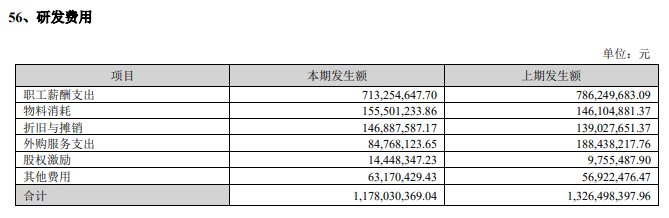
Entering 2026, R&D expenses declined slightly, at 1.97 billion yuan in the first three quarters, down 1.65% year on year, with an R&D expense ratio of 8.07%, basically flat compared with the beginning of the year. The main component of R&D expenses is employee compensation, amounting to 713 million yuan in the interim report, accounting for 60.55%.
As of the end of 2025, the company had 5,063 R&D personnel, an increase of 739 year on year, accounting for 42.4% of employees, among whom 3,444 had bachelor's degrees and 1,094 had master's degrees. By establishing a sound R&D talent training mechanism and innovation incentive mechanism, and designing a R&D process system that keeps pace with the times, R&D efficiency has continued to improve, further consolidating the company's technological leadership in the industry.
The other side of the large R&D team scale is abundant R&D results. As of the end of 2025, the company had cumulatively applied for more than 4,100 patents, and serves as a member of the National Technical Committee of Auto Standardization, the Standards and Regulations Working Committee of China Association of Automobile Manufacturers and the National Information Security Standardization Technical Committee, leading or participating in the release of more than 120 domestic and international technical standards cumulatively.
Cooperation with more than 80 automakers. According to disclosures, Desay SV has established long-term and stable cooperative relationships with more than 80 domestic and international automakers. Its customer groups mainly include domestic independent brand customers, joint venture brand customers and overseas customers. Among them, independent brand customers include Li Auto, Chery Automobile, Geely Automobile, Great Wall Motor, GAC Aion, XPeng Motors, BYD, GAC Passenger Vehicle and SAIC Passenger Vehicle, etc. Domestic joint venture brand customers include FAW-Volkswagen, FAW-Toyota, GAC-Toyota, SAIC Volkswagen, Changan Ford and SAIC General Motors, etc. Overseas customers include MAZDA, TOYOTA, STELLANTIS, DAF, SKODA, VOLKSWAGEN, CATERPILLAR, SUZUKI, AUDI, LEXUS and SCANIA, etc.
The company's product quality has been recognized by multiple customers. Taking 2025 as an example, the company won GAC-Toyota's "Model Project Award", "Quality Improvement Pioneer Award" and "Shining Quality Person Award (Quality MVP)", the Volvo Group's global top ten "Quality Excellence Supplier" and "Sustainable Long-term Partner Award", Changan Ford Q1 certification, as well as local brands Great Wall's "Best Partner Award" and Geely's "Outstanding Contribution Award", among others. In addition, the company's quality control level has also been recognized by multiple parties, having won multiple honors such as Ford Q1 quality certification, ICQCC International Gold Award, the 8th Guangdong Provincial Government Quality Award and the 2025 Volkswagen Group Award.
Operating cash flow turned to decline. Although Desay SV's performance has grown significantly in recent years, operating quality has fluctuated. From 2021 to 2025, operating cash flow was 843 million yuan, 610 million yuan, 1.141 billion yuan, 1.494 billion yuan and 2.884 billion yuan, respectively, and the cash content of net profit was 101.2%, 51.46%, 73.77%, 74.49% and 117.53%, respectively.
In the first three quarters of 2026, the company's operating cash flow was 816 million yuan, down significantly by 63.9% year on year, and the cash content of net profit was only 44.44%, mainly due to increased spending on raw material stocking. According to the interim report, the book value of raw materials was as high as 3.96 billion yuan, a significant increase of 2.25 billion yuan from the beginning of the year.
Stock price has fallen significantly. In the secondary market, Desay SV's stock price has generally shown a downward trend during the year. After reaching a high of 141.54 yuan/share in January (pre-adjusted, the same below), it continued to decline to a low of 71.4 yuan/share. The closing price on November 4 was 79.92 yuan/share, a drop of more than 40% from the high, with a total market value of 47.7 billion yuan and a TTM price-earnings ratio of 19.07 times.
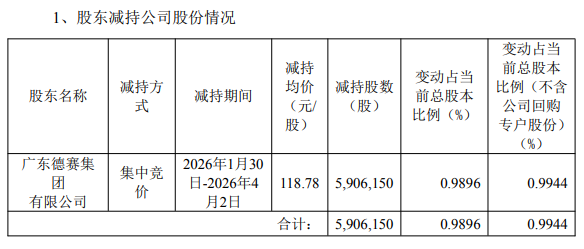
An examination of the details reveals that shareholder reduction announcements adversely affected the stock price. On January 7, the largest shareholder, Guangdong Desay Group Co., Ltd. (Desay Group), announced plans to reduce its holdings due to its own funding needs, with the number of shares to be reduced not exceeding 7,106,250. On April 2, Desay Group terminated the reduction plan ahead of schedule. During the period, it reduced 5,906,150 shares at an average price of 118.78 yuan per share, cashing out approximately 702 million yuan.
On May 22, major shareholder Huizhou Innovation Investment Co., Ltd. (Huichuangtou) announced plans to reduce its holdings due to its own funding needs, with the number of shares to be reduced not exceeding 17,880,000. However, as the stock price continued to decline, Huichuangtou was unable to proceed with the reduction and terminated the plan ahead of schedule on September 7.
(Short, Flat and Quick Interpretation — original work. Please do not reprint without permission! PS: If this manuscript infringes upon any rights or contains inaccurate data, please contact us promptly for correction.)

-
Can AI Save Television? Only If Manufacturers Dare to Abandon Path Dependence
-
![]()
Works Even Without Power! Musk's New Starlink Product, Battery from China
-
![]()
Yipu Optoelectronics and Neusoft Japan Sign MoU to Jointly Advance Pre-Integrated Vehicle HUD Solutions
-
![]()
Fujian Forecam Optics Posts 84.13 Million Yuan Loss in First Three Quarters as Transformation Stalls in the "Transitional Gap"
-
![]()
Are AI Imaging Features About to Become Paid? Rising Cloud Token Costs for Phone Makers Make On-Device Computing Power the Right Path
-
![]()
Why Is MONA Accelerating Its Split from XPeng—Planning Dedicated Stores for 2027 and Leaving the Door Open to Independence
-
![]()
Apple Is Also Starting to "Save Tokens": The AI Money-Burning Frenzy Has Reached Its Reckoning
-
Behind Musk's Election Campaign Defeat: Who Pays the Bill for AI Expansion?