Aerospace and Aviation Lead Cities: An Analysis of the Industrial Structure of Beijing, Shanghai, Chengdu, Xi'an and Shenyang
 11/05 2026
 515
On November 3, the National Development and Reform Commission held the first press conference in its "Striving for the 15th Five-Year Plan" series. According to the briefing, China's emerging pillar industries—integrated circuits, aerospace, biomedicine and others—have already reached considerable scale. Last year's output value approached 6 trillion yuan, and by the end of the 15th Five-Year Plan period it is expected to double to more than 10 trillion yuan.
Which cities have already staked out positions in the six major emerging pillar industries? In our previous issue, drawing on the desktop version of the Huoshi Xinglan Industrial Intelligence Agent, we analyzed the leading cities in the integrated circuit industry ("China's First Tier of Integrated Circuits: A Development Comparison of Shanghai, Beijing and Shenzhen"). This time we turn to aerospace and analyze the industrial structure of five leading cities: Beijing, Shanghai, Chengdu, Xi'an and Shenyang.
01 The Overall Landscape
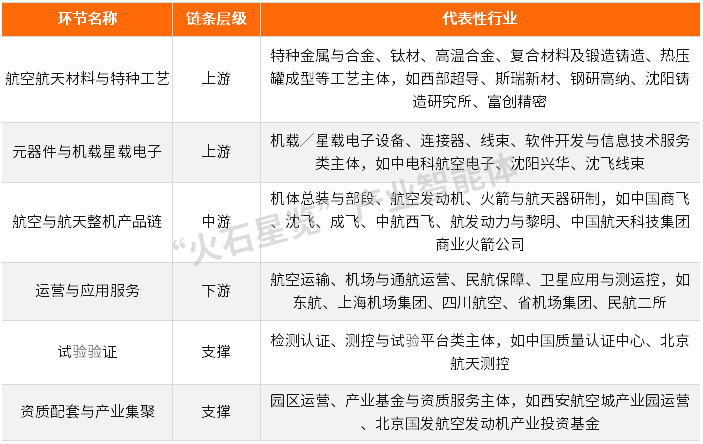
This article draws on the aerospace industry chain map from the Huoshi Xinglan Industry Chain Atlas Center, which covers 71 nodes and 52 relationships, and analyzes the third-level nodes:
Source: Huoshi Xinglan Industrial Intelligence Agent
Because a single enterprise may be linked to multiple segments, the figures for each segment cannot simply be added together. The city totals are deduplicated across segments based on the unified social credit code. This measure reflects the breadth of factor coverage—not output value, production capacity or market share.
On this measure, the deduplicated totals of on-chain enterprises in the five cities rank as follows: Beijing, Xi'an, Shanghai, Chengdu and Shenyang. More than half of Beijing's enterprises are R&D service entities.
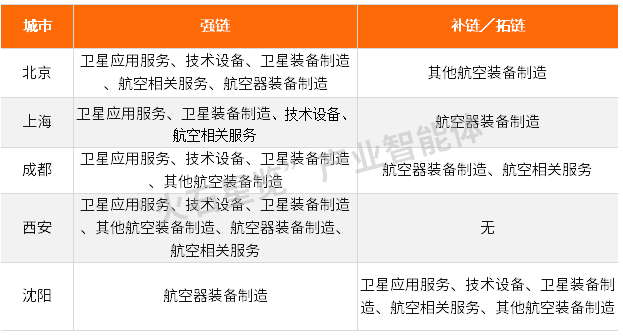
Across the six segments, Shanghai's resources are concentrated at both ends—complete vehicles and operations—with the middle relatively thin. Xi'an ranks among the top in both upstream segments of materials and components. Chengdu is highly concentrated in three segments: operations and application services, the aviation and aerospace complete-product chain, and materials and special processes. Shenyang has the narrowest coverage but a relatively high manufacturing concentration.
Table: Strong and Weak Chain Segments by City
 Source: Huoshi Xinglan Industrial Intelligence Agent
02 Industrial Structure Characteristics
Beijing: The Organizing Hub for Development, Testing and Capital
Judging from enterprise concentration across the six segments, Beijing's structural feature is a highly concentrated "brain." The headquarters of groups such as AVIC, AECC and CETC are registered at midstream complete-vehicle and upstream component nodes; supporting entities such as Beijing Aerospace Measurement and Control and the China Quality Certification Center are fully in place; and the Beijing Guofa Aero-Engine Industry Investment Fund sits alongside AECC, forming a nearby "chain leader + fund" configuration.
Commercial space is Beijing's most active growth pole. The "Beijing Action Plan for Accelerating Innovation and Development in Commercial Space (2024–2028)" established the "southern rockets, northern satellites" pattern. Data show that more than 70% of the country's commercial rocket full-vehicle development enterprises are concentrated in the Beijing Economic-Technological Development Area. Another aspect of Beijing worth noting is its structural shortcomings: the materials segment accounts for only 8.4% of the national total, lower than Xi'an's 10.4%, and there are relatively few registered entities in aircraft manufacturing.
Shanghai: A System-Oriented City Driven by Main Manufacturers
Shanghai's resource allocation is dumbbell-shaped: the midstream complete-vehicle and downstream operations segments are relatively thick, while the number of enterprises in upstream components and test verification is relatively small. The driving end is substantial: COMAC, Shanghai Aircraft Manufacturing and AECC Commercial Aircraft Engine form the mainstay of civil aircraft; the Shanghai Airport Authority and China Eastern Airlines add operational gateways; and China Aerospace Science and Technology Corporation's Commercial Rocket Co., Ltd. has settled in Minhang. Shanghai is now strengthening its second growth curve. The "Shanghai Action Plan for Innovation and Development in the Satellite Internet Industry (2027–2030)" proposes that by 2030 the total number of satellites in orbit will reach 3,000 and the scale of the core industry will exceed 80 billion yuan.
Xi'an: Leading in Both Upstream Depth and Full-Chain Completeness
Among the five cities, Xi'an is the one that ranks among the top in both upstream segments: its share of materials enterprises ranks first among the five, and the proportion of high-tech enterprises among them is also the highest; its share of component enterprises ranks second. AVIC Xi'an Aircraft Commercial Aircraft, AECC Xi'an Aero-Engine, AECC Aviation Power, AECC Xi'an Power Control, Qing'an Group and Western Superconducting are all located in the same city. The three main pillars—airframe, power and electromechanical control—are all in place, and the industrial chain is relatively complete. Its relative weaknesses lie downstream and in supporting segments: there are relatively few enterprises in operations and application services and in test verification. Xi'an's challenge is how to transform its supply advantage in upstream materials and components into application traction oriented toward in-orbit and in-flight demand.
Chengdu: A Concise "Manned–Unmanned" Parallel Sample
Chengdu's industrial agglomeration is characterized by high quality density. In the components segment, for example, of Chengdu's more than 50 enterprises, 25 are specialized and sophisticated SMEs and 9 are "little giants," with specialized and sophisticated SMEs accounting for nearly half. On the product side, a parallel pattern of "manned aircraft–unmanned aircraft–airborne electronics" has taken shape among Chengdu Aircraft Industry, AECC Chengdu Engine, CETC Avionics, Tengden and Zongheng.
Shenyang: An Old Base with Narrower Coverage but Thicker Manufacturing
Shenyang's six segments show a steeply declining structure: materials > operations > complete vehicles > components > qualification support > test verification. The number of enterprises in each segment is smaller than in the other four cities, but manufacturing concentration is the highest: the complete-vehicle chain includes SAC and SAC Commercial Aircraft, the power end includes Liming Aero-Engine, and the upstream includes Fortune Precision and the Shenyang Research Institute of Foundry. The share of high-tech enterprises in the materials segment is 75.5%, second only to Xi'an. In the industry structure, the proportion of substantive manufacturing items such as steel rolling processing, aircraft manufacturing and aerospace vehicle manufacturing ranks first among the five cities.
The issue Shenyang must confront squarely is the local supporting rate. In March this year, the SAC Commercial Aircraft Supplier Conference set a goal of raising the local supporting rate from 40% to more than 50%.
The comparison of the five cities ultimately comes down to one judgment: the first tier of China's aerospace industry is not five homogeneous competitors but five functional nodes on a complete chain—Beijing's organizing and capital function, Shanghai's complete-vehicle traction function, Xi'an's upstream supply function, Chengdu's productization parallel function and Shenyang's manufacturing foundation function. Each corresponds to different factor endowments and historical paths rather than to a simple ranking. For these five cities, the real competition lies in whether they can make the segment that belongs to them on the chain thicker and connect it more smoothly.
-
Can AI Save Television? Only If Manufacturers Dare to Abandon Path Dependence
-
![]()
Works Even Without Power! Musk's New Starlink Product, Battery from China
-
![]()
Yipu Optoelectronics and Neusoft Japan Sign MoU to Jointly Advance Pre-Integrated Vehicle HUD Solutions
-
![]()
Fujian Forecam Optics Posts 84.13 Million Yuan Loss in First Three Quarters as Transformation Stalls in the "Transitional Gap"
-
![]()
Are AI Imaging Features About to Become Paid? Rising Cloud Token Costs for Phone Makers Make On-Device Computing Power the Right Path
-
![]()
Why Is MONA Accelerating Its Split from XPeng—Planning Dedicated Stores for 2027 and Leaving the Door Open to Independence
-
![]()
Apple Is Also Starting to "Save Tokens": The AI Money-Burning Frenzy Has Reached Its Reckoning
-
Behind Musk's Election Campaign Defeat: Who Pays the Bill for AI Expansion?