AI Illustrations in Financial Reports of Tech Giants: Revenue Breakdown, Leveraging, and Commercial Hype
 04/03 2026
 483
483
LAIKA
2026/04/02
The Fundamentals Behind the Diverging Stock Price Fluctuations
The past March saw Chinese tech giants one after another (this Chinese phrase is left as is due to its contextual specificity, but for pure English, it would be 'successively') release their latest quarterly and annual reports.
Flipping through these financial reports, 'AI' stands out as a common keyword with the highest frequency. Through this, we can glimpse the progress of AI businesses of these tech giants over the past year, as well as their AI layout (layout) and strategies for the current year. The most significant change is that AI is no longer just a 'story' in financial report conference calls but has started to tangibly contribute to revenue and profit.
Through the financial reports, we can also see a new illustration of AI businesses among tech giants. Some are eager to prove themselves with AI revenue, some want to catch up by increasing investment, and some are starting to release their future business goals. For example, Baidu's AI business was listed separately for the first time, accounting for 43% of general business revenue in the fourth quarter; Tencent Cloud achieved full-year scalable profitability for the first time driven by AI; Kuaishou's Kling AI monthly revenue exceeded $20 million; Alibaba Cloud's AI-related product revenue has seen triple-digit growth for ten consecutive quarters, with annual revenue from cloud and AI commercialization expected to grow to $100 billion within five years; JD.com uses AI to drive the digital and intelligent transformation of its super supply chain; Meituan's AI assistant 'Xiaotuan' embedded in its APP has been fully opened to all users, aiming to become the gateway for life services in the AI era...
However, the capital market's reaction has been exceptionally complex—some stock prices plummeted after the financial reports were released, while others rose against the trend. Behind this is a fundamental shift in the valuation logic of the internet industry from 'focusing on investment' to 'focusing on delivery.'
01
Tech Giants' Financial Reports on AI Commercialization
A common point in the latest quarterly or annual reports of tech giants in 2025 is the emphasis on the effect of AI on overall revenue and business growth, with the commercial value of AI continuously being validated.
According to Baidu's financial report, starting from the fourth quarter of last year, Baidu redefined its core business as Baidu's general business, which includes Baidu's core AI new businesses, traditional businesses, and others. Further looking, Baidu's AI business covers intelligent cloud infrastructure, AI applications such as Baidu Wenku and Baidu Netdisk, future autonomous driving services, and native AI marketing services such as digital humans and intelligent agents.
This financial report also shows that Baidu's total revenue reached 129.1 billion yuan in 2025, with AI business revenue reaching 40 billion yuan; in Q4 2025, total revenue was 32.7 billion yuan, with AI business revenue accounting for 43% of Baidu's general business revenue at 11.3 billion yuan. Moreover, this proportion has been rapidly increasing in recent quarters, with the AI business becoming the core engine for Baidu's overall revenue growth.
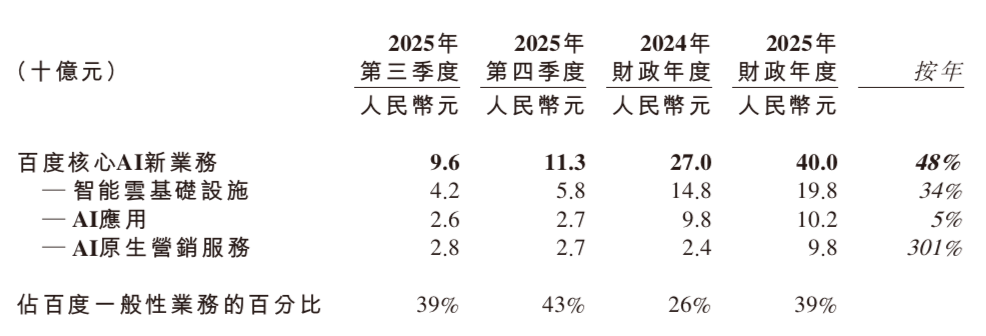
【Photo/Baidu Financial Report】
Compared to Baidu's established AI business, Kuaishou's AI is 'even a small fly has meat,' using it to demonstrate the commercial potential of its AI products. Kuaishou's financial report shows that with the continuous upgrading of Kling AI in model capabilities and product functions, Kling AI's operating revenue reached 340 million yuan in Q4 2025, with annual revenue of about 1.04 billion yuan. In December 2025, monthly revenue exceeded $20 million, with an annualized revenue run rate (ARR) reaching $240 million. Kuaishou CEO Cheng Yixiao expressed strong confidence in achieving over 100% year-on-year growth in Kling's revenue this year.
Not only that, but Kuaishou also stated that AI technology has deeply empowered its core businesses such as online marketing, live streaming, e-commerce, and content ecosystem. For example, in the fourth quarter, the consumption amount of online marketing services brought by AIGC marketing materials reached 4 billion yuan. Generative recommendation large models and intelligent bidding models boosted domestic online marketing service revenue by about 5%. Additionally, the continuous iteration and upgrading of the end-to-end generative retrieval architecture OneSearch drove a about 3% increase in mall search order volume. Capabilities such as recommendation, retrieval, content generation, long-term interest understanding, and order AI diagnosis continued to be implemented, helping merchants improve cross-domain operational capabilities, optimize conversion efficiency, and operational quality.
In the latest financial reports, although Tencent and Alibaba's AI businesses have not been listed as separate items, the impact of AI on the growth of their various business lines is more evident.
For example, in Tencent's financial report, almost all sectors such as gaming, advertising, and cloud services mentioned the impact of AI on their businesses. Especially driven by enterprise AI demand, Tencent Cloud achieved scalable profitability for the first time. Tencent stated that gaming AI is effectively accelerating content production, improving user experience, and enhancing marketing efficiency; advertising unit prices have benefited from AI-driven precise ad targeting, advertisers using AI to create more ads, and the continuous increase in the proportion of closed-loop ads; AI has also driven increased activity in WeChat ecosystem products.
For Alibaba, AI is also one of the main growth engines for the group's core businesses. In Q4 2025, Alibaba Cloud's revenue grew strongly by 36%, with AI-related product revenue achieving triple-digit growth for the tenth consecutive quarter; Qianwen App's integration with various application scenarios in Alibaba's consumer ecosystem significantly drove new user growth and transaction activity. Qianwen's MAU across all platforms has exceeded 300 million, with AI agents entering the era of scalable services.
Currently, with the establishment of the ATH business group, Alibaba has formed a complete chain from chips, cloud infrastructure to models and then to applications. By integrating full-stack AI capabilities with its own business ecosystem, it is making efforts in both AI to B and AI to C directions.
Unlike Baidu, Alibaba, and Tencent, whose AI businesses are mainly external, JD.com and Meituan's businesses are more internal and pragmatic. For example, JD.com's realization of AI industry value can be described as 'combining horizontal and vertical approaches.' Horizontally, it deeply penetrates into the four core businesses of retail, logistics, health, and industry, while vertically, it deeply integrates into JD.com's 'super supply chain,' including R&D, production, marketing, customer service, and internal work.
Data shows that in 2025, JD.com's AI agent had over 150 million annual active users, with a user penetration rate exceeding 20%, and it is expected to double this user base by 2026. The JoyAI large model has been deeply implemented in over 2,000 business scenarios at JD.com, achieving full-link intelligence.
Meituan also continued to increase its AI investment in 2025, building an AI foundation and operational capabilities for the physical world. The company's full-year R&D investment was 26 billion yuan, a year-on-year increase of 23%. On the one hand, Meituan continued to invest in R&D of logistics, robotics, and other related technologies, including drones and autonomous vehicles. By the end of 2025, Meituan drones had opened 70 routes in multiple cities domestically and internationally, completing over 780,000 orders. On the other hand, Meituan combined its years of accumulated service scenario advantages and data advantages in the physical world to enhance user experience through AI technological innovation, helping every merchant have their own AI assistant. Based on its self-developed multimodal LongCat series large language models and open-source models, Meituan launched the AI assistants 'Xiaomei' and 'Xiaotuan' for users, realizing the implementation of AI technology in users' real consumption scenarios.
Overall, whether it is the AI business itself or AI's empowering effect on other businesses, it is driving revenue growth for tech giants to varying degrees. The difference lies in each company's focus. For example, Baidu focuses more on basic technology R&D and full-stack layout in AI technology, such as the application of Wenxin Yiyan and intelligent cloud; Tencent relies on its vast social and content ecosystem to deeply integrate AI to enhance user experience and commercial value; Alibaba has a more comprehensive layout in the AI field, involving models, applications, and chips; JD.com focuses on applying AI technology to supply chain management to improve efficiency; Kuaishou drives content creation and community operations through AI technology; Meituan focuses on applying AI in the local life services field. Tech giants have taken different paths in the development of AI businesses based on their own business characteristics and strengths.
02
A New Round of AI Preparation Roadmap
With the disclosure of financial reports and executives' interpretations of them, while tech giants are handing in their 2025 AI business reports, their AI preparation roadmaps for this year and the future are also gradually emerging.
Baidu CEO Robin Li mentioned that they recently released the 2025 upgraded version of the Wenxin large model and proactively adjusted their organizational structure to adapt to the rapidly changing market environment. For example, the large model R&D team was split according to different directions: one team continues to tackle the cutting-edge capabilities of basic large models, maintaining technological leadership and driving continuous model iteration and optimization; the other team is closer to specific business needs and application scenarios, focusing on cost reduction, efficiency improvement, and speed enhancement, or selecting the most suitable models for specific scenarios, with the core goal of helping enterprises better implement AI according to actual needs.
Currently, from B-end industry empowerment to C-end super apps, and then to Robotaxi linking the virtual and physical worlds, the cross-scenario reuse of Baidu's core AI capabilities is demonstrating amazing (astonishing, but for a more natural flow in English, 'remarkable') leverage effects, promising (expected to) be converted into more sustainable business growth momentum. In the future, revenue from core AI businesses will become half of Baidu's main business.
To sustain high AI investment and support business growth, Baidu is also exploring diversified financing methods to meet funding needs, such as operating leases and finance leases, while also obtaining low-cost bank loans, with some loan and lease interest rates below 2%.
For JD.com, it also emphasizes that it will continue to increase investment in AI technology, continuously deepen its supply chain, and gradually build itself into a leading end-to-end AI e-commerce enterprise from supply chain to consumers. Specifically, this includes: on the demand side, AI-driven search and recommendation refactor (reconstruct) the shopping link; on the supply side, AI helps the procurement and sales team continuously improve efficiency in pricing, inventory management, and other links, significantly replacing manual work; in logistics scenarios, there is huge potential for logistics fulfillment automation, but large-scale application still takes time; on the after-sales service side, AI customer service has been widely applied. Additionally, AI and new technologies have brought a large number of innovation and new category opportunities. JD.com will also launch more innovative products through operational efforts, accelerating from thousands of industries to thousands of households, achieving C-end AI product affordability through the intelligent upgrading of traditional products.
Facing the AI technology wave, Wang Xing stated that Meituan positions it as a core strategic opportunity, focusing on local service implementation rather than blindly chasing concepts. He clearly stated that Meituan is not in a hurry to build a 'token factory' but uses AI to improve and innovate its core businesses, enhancing operational efficiency and user experience. Specifically, Meituan will firmly advance the R&D of its self-developed large language model LongCat and upgrade the Meituan APP to an AI-powered APP in the future, becoming the AI gateway for future local life needs.
Kuaishou also expects its overall capital expenditure investment in 2026 to reach about 26 billion yuan, an increase of about 11 billion yuan compared to 2025. These investments include computing power investment in the Kling large model and other basic large models, as well as regular server procurement expenses such as offline data storage and processing, and data and computing power center construction engineering investments.
During the financial report conference call, Cheng Yixiao also gave two clearer judgments: on the one hand, Kling's competitiveness lies not only in model effectiveness but also in its acceleration from a single-point capability to a more integrated, professional, and industry-demand-adapted creation system; on the other hand, Kuaishou will continue to increase investment in basic models, agents, and computing power foundations in 2026, driving AI to release deeper operational value in scenarios such as advertising, e-commerce, and content ecosystem.
Compared to short-term goals, Tencent and Alibaba have a more systematic and long-term approach to AI layout. Tencent President Martin Lau disclosed on the financial report conference call that Tencent has formulated a clear AI strategic plan, with multiple key actions to be implemented in the next two to three quarters, and subsequent quantifiable business progress will be released. At the large model level, Tencent has completed intensive team adjustments and upgrades in the past few months, reconstructing its organizational structure and workflow to make organizational operation efficiency more suitable for the AI R&D rhythm; at the same time, it has rebuilt the infrastructure for pre-training and reinforcement learning, comprehensively improving data quality. Based on these layouts, Tencent is confident in creating a more intelligent large model in the future and further accelerating its overall iteration speed. Additionally, Tencent will continue to deepen its efforts in the fields of video models and world models.
In terms of capital investment, Tencent is also continuously increasing its investment in the AI field. Tencent's investment in AI new product R&D reached 18 billion yuan in 2025, and this figure will at least double in 2026, even to the extent of appropriately reducing its repurchase scale for this purpose.
Notably, Tencent also clearly mentioned that one of the core plans for AI's next step is to build a dedicated AI agent within WeChat. This agent will rely on the WeChat ecosystem to form a deep connection with users, connect through (connect) the full-link capabilities of mini-programs, social networking, and payments. It will not only enable natural conversations with users but also complete various complex scenario-based tasks.
Currently, Alibaba is also rapidly reconstructing its AI landscape, elevating its AI business to the status of a main business line. Alibaba CEO Eddie Wu also elaborated on Alibaba's full-stack AI layout—with chips and cloud computing as the AI infrastructure layer; with Token Hub as the main line, composed of large models, MaaS businesses, and 'to B + to C' applications as the AI model and application layer, together forming a complete capability from AI Infra to applications. Meanwhile, Alibaba has also proposed commercial goals for its AI strategy, that is, within five years, the annual revenue from cloud and AI commercialization will grow significantly from over 100 billion yuan this year to $100 billion (about 690 billion yuan), with a compound annual growth rate of about 47%. This means that cloud and AI are expected to become Alibaba's largest revenue engine in five years.
From this financial report, a new round of AI rally has sounded, and tech giants' AI investments are shifting from early model competitions to in-depth efforts in computing power infrastructure, full-scenario penetration, and commercialization. Regardless of their previous investment intensity and development rhythm, they are now simultaneously clarifying their determination and speed to increase investment, truly entering a comprehensive AI competition.
03
The Harsh Reality Behind the Diverging Stock Price Fluctuations
While tech giants are taking big strides towards AI, the market is concerned about the time lag and uncertainty between 'investment' and 'return.' During this critical period of transition from old to new growth drivers, capital has given different reactions, leading to significant diverging fluctuations in tech giants' stock prices.",
Alibaba, on the other hand, was affected by its own financial report showing 'revenue growth without profit growth' and a sharp 71% decline in free cash flow. Moreover, facing the dual challenges of AI and retail in the future, the situation will be even more severe, with massive capital burning and no profit turning point visible in the short term. Although management explained that 'we are spending money to buy the future,' investors have serious disagreements over the payback period and certainty of this high-stakes gamble.
Kuaishou's situation is even more unique. It neither has a solid gaming foundation like Tencent nor possesses the technological and ecological advantages of Baidu and Alibaba. It can only bet everything on AI, even directly leveraging up. For example, if Kuaishou earns 20.6 billion in profit in 2025 but spends 26 billion this year on an uncertain AI venture—this expectation of 'not earning enough to cover the burn' can only lead investors to choose to exit first.
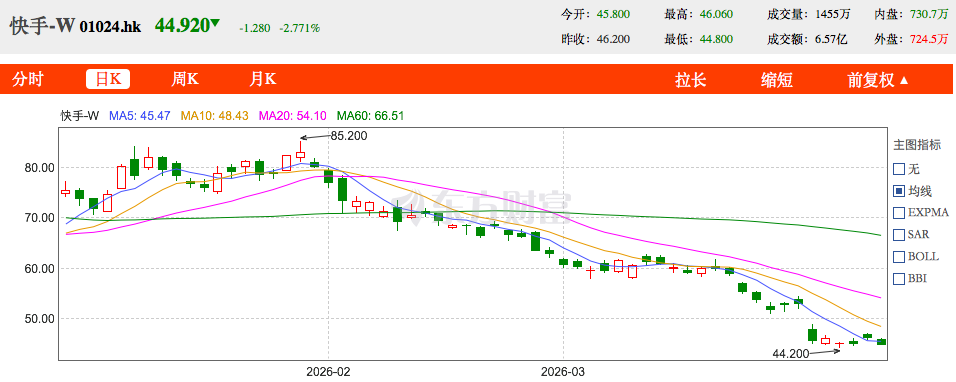
[Figure/Kuaishou's Stock Price]
Now, let's look at Meituan. After the financial report was released, its stock price experienced a slight decline but remained stable overall, forming a stark contrast to the sharp drops seen in companies like Baidu, Alibaba, and Kuaishou. The core reason is that the market is not focusing on the bad news of a '23.4 billion loss' itself but rather on the certain signal that 'the worst period has passed'—regulation has put the brakes on price wars, losses are narrowing, and new businesses and AI are already building momentum for the next phase.
In this round of stock price fluctuations among the major players, the most surprising performer might be JD.com. Before the financial report was released, JD.com's stock price had been on a downward trend, even hitting an 18-month low during the period. However, after the report, JD.com's stock price reversed its decline and began to gradually rise, heading back toward this year's highs.
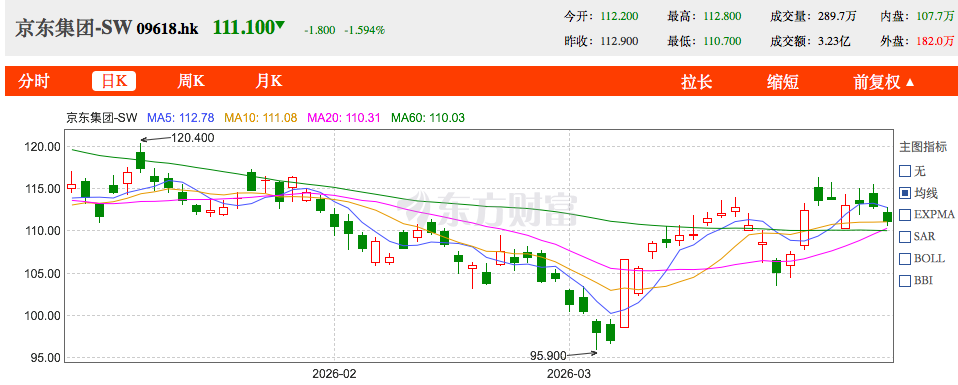
[Figure/JD.com's Stock Price]
Analyzing JD.com's upward reversal in stock price, it can be seen that the market does not care much about JD.com's quarterly book losses but rather that the 'trump card' of its strategic investments has become clear—losses have peaked, core businesses are stable, the value of AI is beginning to materialize, and management has provided a clear path to reduce losses. Compared to Baidu, which makes the market worry about 'AI being a bottomless money pit,' JD.com makes the market believe that 'burning money is to make money faster.'
The capital market's reactions to the AI answers from these major players show significant divergence, reflecting investors' different judgments on the pace of AI value realization. However, a harsh and clear fact remains: AI is no longer just 'storytelling' but a 'report card' backed by real money. Investors demand AI revenue, AI profit, and AI-driven growth.
Conclusion
The 2025 financial report marks the full transition of major players' AI from the 'preparation' stage to the 'actual combat' stage. However, AI is not a lifesaver or narrative enhancement for these major players but a new arena. In this arena, old kings may fall, and new giants may rise. Each company will choose a differentiated development path based on its own business characteristics and advantages. Whether they can deliver satisfactory answers to the market will determine their status and fate in the AI era.
- END -
-
![]()
Model Giant Jieyue Xingchen Steps into Smartphone Arena: A Strategic Alliance with Huaqin Technology
-
![]()
Big Model Firm Dives into Phone Market: StepFun and Wingtech Forge a ‘Dynamic Duo’
-
![]()
Zhongrun Optics Makes a Bold Move with 1 Billion Yuan Investment: Is a Turning Point on the Horizon for the Precision Optics Industry?
-
![]()
Deploy CLBO Crystals and YIG Single Crystals! Erythritol Leader Invests 30 Million in Youwei Optoelectronics
-
CXMT’s July 16 Subscription: Leading Domestic Memory Manufacturer—What’s the Earning Potential per Lot?
-
![]()
Rhythm Discrepancy and Premium Value Erosion: Foreign Luxury Brands Must Re-evaluate Their China Strategy
-
![]()
Half-Year, 1 Billion Yuan Financing, 7 Billion Yuan Valuation: A New Dark Horse Emerges in the Embodied AI Sector
-
![]()
Strong Rebound for Tech Stocks in Hong Kong Stock Market: Is It Time to Bottom-Fish?