The Ultimate Landscape of the Robot Industry: Not Oligopoly, but Ecosystem
 04/03 2026
 535
535
Editor: Lv Xinyi
In the future, there may only be three to five robot manufacturers left.
This vision of an embodied AI future has been mentioned by multiple industry insiders, a result attributable to the “Matthew Effect.”
Currently, leading companies are continuously breaking funding records, with their valuations soaring as capital, talent, and data concentrate among a few top players. From a certain perspective, large firms will gradually encroach upon the market space of smaller ones, with general-purpose humanoid robots potentially taking over most human living scenarios.
However, viewing the issue from another angle suggests that the question itself may be misleading.
Is the robot industry truly headed toward oligopoly? Or are we mistakenly equating competition among giant corporations with the industry’s ultimate fate?
Under the shadow of large corporations, small manufacturers face dual pressures of capital and data. Yet, this does not mean they will be entirely eliminated. Instead, they are more likely to integrate into the industry in another way, forming a complementary and differentiated relationship with large firms in specific scenarios.
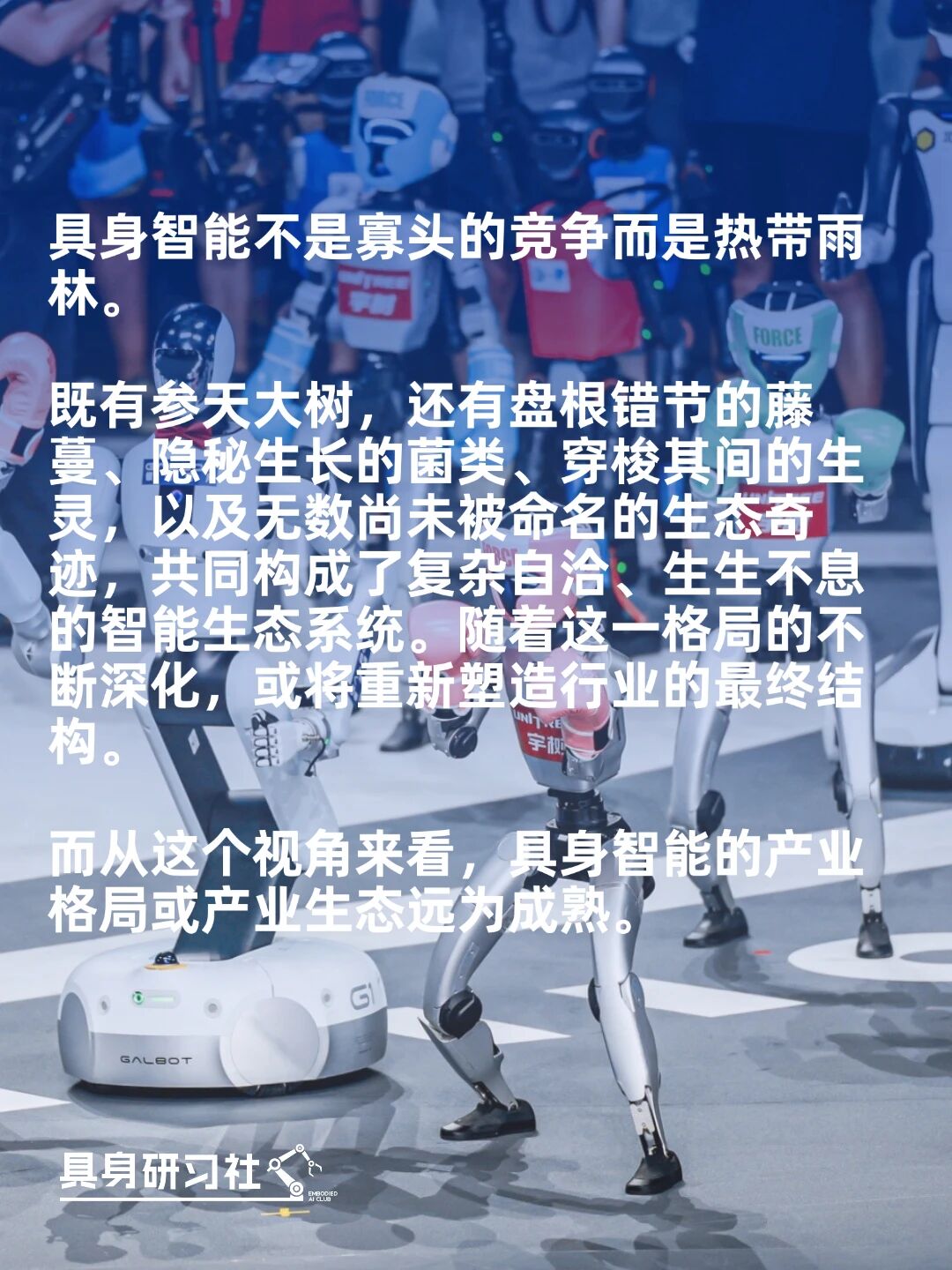
It is important to clarify that embodied AI resembles a rainforest—featuring not only towering trees but also intertwining vines, hidden fungi, Creatures shuttling between them (Note: retained as-is for poetic effect; could translate as " Shuttle through it creatures" if needed), and countless unnamed ecological wonders. Together, they form a complex, self-sustaining, and ever-evolving intelligent ecosystem.
Small manufacturers can embed themselves not only in underexplored vertical scenarios and upstream general-purpose components but also in bridging the gap between large firms and real-world implementation. As GGV Capital Managing Partner Frank Wu once noted, embodied AI startups can choose to excel in a specific niche, building barriers through deep operational involvement and highly integrated supply chains. For hardware-focused companies, their focus can be on product innovation or service excellence.
As this landscape deepens, it may reshape the industry’s final structure. From this perspective, the industrial landscape or ecosystem of embodied AI is far more mature.

Since the beginning of this year, financing in the embodied AI sector has continued to heat up, with top robot manufacturers securing the majority of resources. These companies generally share several common traits: emphasizing full-stack capabilities, targeting humanoid forms, deploying multiple product lines, and attempting to build general-purpose AI platforms.
This is an highly appealing narrative—a single robot capable of performing all tasks.
However, the premise of this narrative requires simultaneous maturity in technology, cost, and application scenarios. Currently, none of these three factors have truly reached a tipping point. General-purpose AI remains at the stage of capability demonstration rather than large-scale application.
In contrast, there is another, more pragmatic path: specialized robots emerging from specific scenarios. These robots typically focus on excelling in one task, effectively filling gaps in real-world applications until general-purpose robots arrive.
Even if general-purpose AI achieves breakthroughs, enabling robots to operate across multiple scenarios, it does not imply that a single form will dominate all use cases. In commercial settings, cost, efficiency, and reliability are often prioritized.
While general-purpose AI can adapt to more scenarios, it may not always offer the best return on investment (ROI) in specific contexts. For example, a factory material-handling robot does not require advanced conversational abilities, nor does a home care robot need industrial-grade load-bearing capacity.
Historically, monopolies in the internet industry arose because marginal network costs approached zero. In contrast, the robot industry inherently requires interaction with the physical world. All scenarios demand redeployment and debugging, and covering all scenarios leads to exploding complexity.
Thus, a trend emerges: the robot industry’s ultimate landscape may not be uniformity but differentiation.
Drawing on a natural metaphor, like ecosystems inherently possessing diversity, with different species occupying unique niches, the future market is more likely to resemble a natural ecological structure. Different types of robots will dominate distinct scenarios, with companies forming advantages in their respective domains, coexisting through both competition and complementarity.
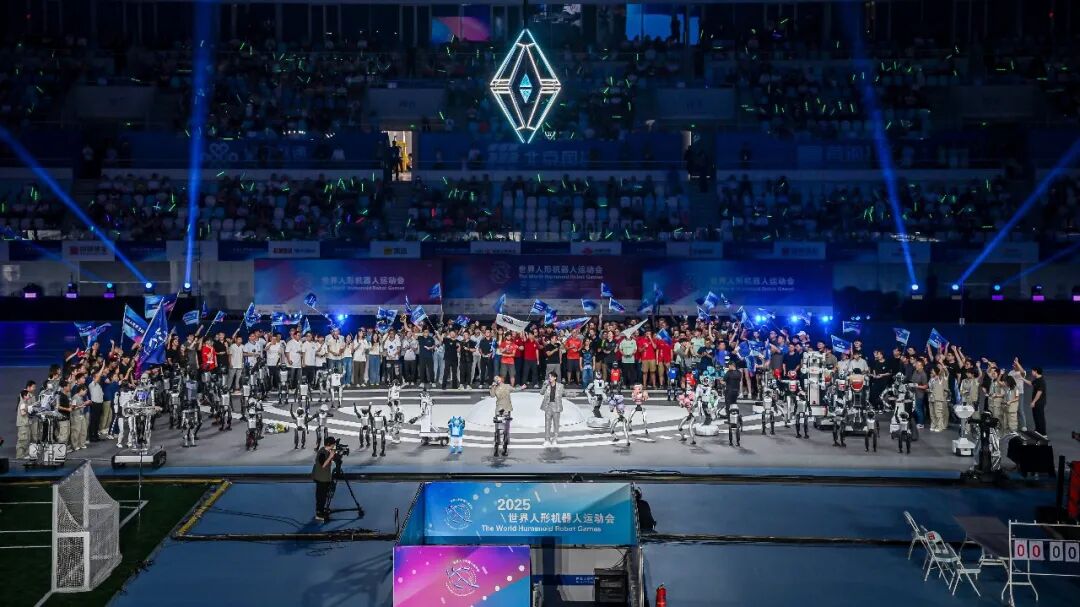
Under this structure, similarity breeds danger. If all players rush into the same direction, fierce resource competition will ensue. Only through differentiation can a truly resilient industrial ecosystem be built.
For late-entering small manufacturers, rather than attempting to replicate the paths of large firms, it is wiser to seek underexplored niche gaps. The corners that large firms dismiss or cannot reach often hide untapped blue oceans.

If the robot financing market in 2025 was characterized by “storytelling,” this year has entered a more sober and pragmatic phase.
Current capital investment directions have shifted away from grand narratives, instead filtering out the most viable players from the outset and emphasizing real-world certainty. Capital increasingly focuses on whether companies have genuine use cases, mass-production capabilities, and profitability.
However, this is not necessarily a bad thing for small companies. Observing capital’s early-stage bets reveals three types of opportunities emerging for smaller players.
The first category consists of deep vertical scenario players. These companies refine a specific scenario, such as agricultural picking, cleaning services, or elderly care. Examples include Zhiyou Wujie, which targets logistics handling and ship painting, and Hexin Power, which specializes in agricultural robots.

Their common traits include addressing real, rigid demand (Note: retained as-is for precision; could translate as "rigid demands" if needed), heavily relying on manual labor, and offering clear ROI through automation.
For a long time, these companies’ growth was constrained by a key variable: labor supply. However, with demographic shifts, this constraint has become increasingly significant. The robot boom now offers a new solution.
Take pool-cleaning and lawn-mowing robots as examples. Their rapid overseas growth stems from capturing genuine demand gaps, amplified by high local labor costs. According to RoboSense, a LiDAR company, lawn-mowing robots have become a major order source. For instance, Ninebot, a leading lawn-mowing robot company, shipped 140,000 units in 2024, with cumulative sales exceeding 240,000, demonstrating the enormous potential of niche markets.
The second category comprises “shovel sellers” in the supply chain—core component manufacturers.
In uncertain industries, infrastructure tends to be the most reliable bet. Regardless of which company ultimately prevails, robots cannot function without core components like actuators, sensors, and control systems.
For example, the dexterous hand, a critical robot component, saw multiple domestic and international companies secure large financings early this year, including Lingxin Qiaoshou, Zhiyuan’s Critical Point, and Hungarian firm Allonic, which revolutionized robot dexterous hands with bionic weaving technology.
Investing in these areas essentially bets on the industry’s overall growth rather than the success of a single company—a “anti-fragile” strategy.
Additionally, software companies developing embodied AI brains have become a major investment direction since the start of the year. These firms gain capital favor as physical robot capabilities peak while cognitive challenges remain. However, once these small companies build genuine embodied large models, they quickly partner with major robot manufacturers and ascend to giant status, thus falling outside the scope of small-company discussions.
The final category, often overlooked, plays a pivotal role in commercialization: robot service providers. The robot industry’s development relies not only on hardware and software innovation but also on deep coordination across service segments.
These service providers handle data collection and annotation, scenario deployment and debugging, system integration, and maintenance, ensuring stable robot operation in complex real-world environments and enabling commercialization. They accelerate the transition of robot technology from labs to markets.
Recent financings in this category include Mifeng Technology, specializing in embodied AI data services; Tianxingyuan, a general-purpose industrial embodied AI platform; and Annu Intelligence, which facilitates humanoid robot engineering deployment.
They are helping robots truly enter the real world. Especially in industrial scenarios, where robots are deploying fastest, significant engineering gaps exist between labs and factories, prototypes and large-scale rollouts.
Deploying humanoid robots in factories typically requires 6–8 months, involving calibration of motion strategies, stability, and safety verification.
Traditional industrial robotics relies on integrators who not only connect products to real-world scenarios but also provide implementation services. Today’s robot service providers are filling these gaps, bridging the “last mile” for robots to become productive solutions.

As seen above, small companies can achieve leapfrogging in certain domains under specific conditions.
First, selecting an appropriate scenario is critical. Small firms should target markets underserved by large manufacturers, with clear substitutable demands and transparent ROI. Scenarios requiring less intensive operations and lower safety risks often achieve faster deployment and profitability.
Second, in many vertical industries, technological paths lack consensus, market competition is not yet solidified, and industry standards remain undefined. This technological uncertainty provides small firms with valuable trial-and-error space. They can compete through depth rather than scale.
Small manufacturers can conduct independent R&D rooted in scenarios or collaborate with leading university labs or research institutions to accumulate patented technologies. This not only builds technical barriers but also gradually reduces R&D costs, creating sustainable competitive advantages.
Facing pressure from large firms, small companies can adopt open-platform strategies to build their own ecosystems. By partnering with other robot companies, software developers, and system integrators, they leverage resources and channels to rapidly expand markets.
Meanwhile, the power of service should not be underestimated. Small manufacturers can enhance customer stickiness through flexible service strategies and differentiated operations, offering one-stop solutions and even addressing cold-start challenges to some extent.
However, robot R&D is a marathon. From technological development to safety and reliability verification, time and funding are unavoidable challenges. For resource-constrained small firms, balancing R&D investment with operating costs and choosing feasible technological paths are key to winning this race.
As the industry evolves further, a new trend is taking shape: the robot market may evolve into a “dumbbell structure.”
At one end are a few Top platform companies (Note: retained as-is for precision; could translate as "leading platform companies" if needed) driving general-purpose capabilities and controlling core technologies and data. At the other end are numerous vertical players and service providers excelling in specific scenarios and building local barriers, also achieving stable commercial returns.
The most vulnerable are mid-tier players. These companies often suffer from product homogenization, unfocused scenarios, and inadequate technical specialization, lacking both scale advantages and clear positioning. In an environment of capital tightening and intensifying competition, they face severe elimination pressures.
The robot industry is undergoing structural reshaping. The notion of “only three to five companies remaining” essentially exaggerates fears of platform competition while overlooking that robots are not merely products but more likely ecosystems.
Within this ecosystem, there will be giants and countless small-but-beautiful species; unified platforms and highly differentiated solutions. By finding their niche, companies can stand firm in a market dominated by strong players.
Like in a forest, towering trees aim to grow upward, stretching their branches to capture more sunlight and rain. Meanwhile, low-lying shrubs at their feet can thrive by take root (Note: retained for poetic effect; could translate as "sending roots deep" if needed) underground to absorb nutrients, carving out their own territory.
-
![]()
Model Giant Jieyue Xingchen Steps into Smartphone Arena: A Strategic Alliance with Huaqin Technology
-
![]()
Big Model Firm Dives into Phone Market: StepFun and Wingtech Forge a ‘Dynamic Duo’
-
![]()
Zhongrun Optics Makes a Bold Move with 1 Billion Yuan Investment: Is a Turning Point on the Horizon for the Precision Optics Industry?
-
![]()
Deploy CLBO Crystals and YIG Single Crystals! Erythritol Leader Invests 30 Million in Youwei Optoelectronics
-
CXMT’s July 16 Subscription: Leading Domestic Memory Manufacturer—What’s the Earning Potential per Lot?
-
![]()
Rhythm Discrepancy and Premium Value Erosion: Foreign Luxury Brands Must Re-evaluate Their China Strategy
-
![]()
Half-Year, 1 Billion Yuan Financing, 7 Billion Yuan Valuation: A New Dark Horse Emerges in the Embodied AI Sector
-
![]()
Strong Rebound for Tech Stocks in Hong Kong Stock Market: Is It Time to Bottom-Fish?