The Legend of Peter Steinberger, the 'Father of Lobster': After 43 Failed Projects, He Took Down Silicon Valley Giants Overnight 丨AI Pioneer
 04/03 2026
 534
534
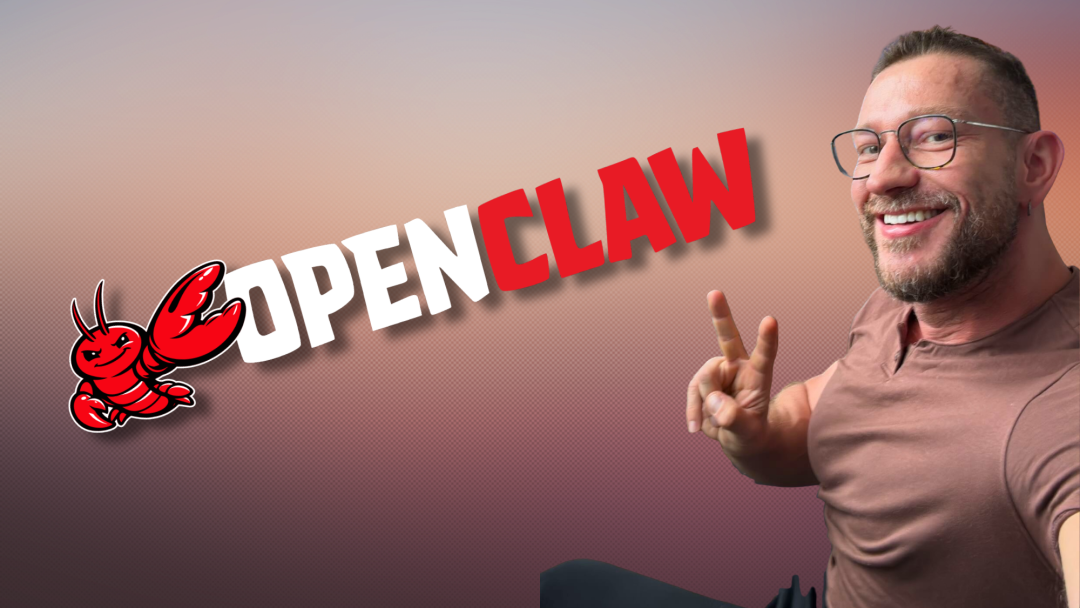
In an era where AI was monopolized by tech giants, an Austrian used a one-hour code prototype to garner over 250,000 stars on GitHub within 60 days, surpassing milestones that took Linux 12 years and React 8 years to achieve. He made Zuckerberg and Sam Altman both extend olive branches on Valentine's Day and single-handedly rewrote the industry rules for open-source AI agents.
He is Peter Steinberger, the creator of OpenClaw (Lobster), a code craftsman who rose from farm soil, a tech geek who fell into the abyss of burnout after achieving financial freedom and was reborn through pure passion. He is the most irreplaceable legend in the global AI agent wave of 2026.
I. Farm Boy: A Code Journey Begun with a Computer at 14
Born in 1988 on a remote farm in Upper Austria, Peter grew up without Silicon Valley's entrepreneurial atmosphere or privileged family conditions. Raised in a single-parent household, his childhood was filled with the silence of farmland and mountains—until the summer he turned 14, when a visitor to the farm brought a computer that completely rewrote the trajectory of this teenager's life.
It was his first encounter with a machine that could be controlled by logic and commands. Teenage Peter was almost instantly captivated by the charm of programming—in an era without Stack Overflow, GitHub, or even systematic online tutorials, he relied on thick manuals to grope for the laws of code in the dark. 
His first 'commercial project' carried the cunning and talent unique to a teenager: copying DOS games from the school computer lab, writing his own floppy disk copy-protection program, and selling it to classmates. In just a few months, he earned $10,000—his first pot of gold.
This sensitivity to code and the intuition to 'solve real problems with technology' were engraved in his bones from his youth. During high school, he studied electrical engineering and computer science at HTL Braunau, where he developed a home automation network protocol that modulated signals through the power grid, gaining local industrial recognition. After entering the Vienna University of Technology, he directly pushed for the establishment of the school's first Mac/iOS development course, served as a mentor for over two years, and collaborated with Apple Austria to build the region's earliest mobile development ecosystem. At just over 20 years old, he had already become a central figure in Austria's developer community.
What truly set him on the path of independent development was an accident on the Vienna subway. In 2009, he was editing a long message on his iPhone when the train entered a tunnel, cutting off the network. The app's send button was disabled, preventing him from copying the content or taking a screenshot. The long text he had painstakingly typed vanished instantly. In fury, he downloaded Xcode when he got home, hacked together an iOS-compatible app, priced it at $5, and uploaded it to the App Store. In the first month, he earned $10,000.
At that moment, he realized with utmost clarity: Code was never just theory on paper—it was a weapon to solve real pain points. And this realization planted the most critical seed for his legendary entrepreneurial journey over the next decade.
II. The Lone Craftsman in the PDF World: A Decade of Grinding, from a Solo Project to an Industry Benchmark
In 2010, Peter, already a seasoned iOS developer, received an order to develop a PDF magazine app. He spent eight weeks completing the iOS version. After delivery, a colleague's question—'Can we reuse this PDF rendering engine?'—instantly captured a massive pain point in the mobile internet era: After the release of the first iPad, the digital document wave swept in, but PDF handling on mobile devices faced persistent industry challenges—slow loading, poor rendering, missing features, and high crash rates. Enterprise self-research had high technical barriers, yet it was unavoidable.
In 2011, Peter officially launched the PSPDFKit project, with a name that was straightforward and resolute: P for his name Peter, PDF for the track (track/field), and Kit representing a ready-to-use developer toolkit. At the time, he had just received a high-paying job offer from Silicon Valley's Scribd but, due to a nine-month H1-B visa approval window, unexpectedly gained a period of completely free creative time. 
He built an official website with an online store in one day and released the first version of PSPDFKit. The first sale was completed in the first week, and the project was profitable from birth. By the time his visa was approved and he headed to Silicon Valley, the monthly revenue of this solo project already exceeded his Silicon Valley salary.
Balancing a 40-hour full-time job with a rapidly growing personal project pushed him to the brink of exhaustion, ultimately leading to a choice. At the 2012 NSConference developer conference, he officially announced his resignation from his Silicon Valley job to return to Vienna and focus full-time on PSPDFKit's operations.
This commitment lasted a full decade.
In an era where VC-driven, burn-money-for-growth became the entrepreneurial norm, Peter took the 'clumsiest' yet most robust (steady) path—bootstrapping. For ten years, he rejected all external financing, relying solely on the product's profitability for steady growth.
He served as the company's CEO, chief architect, product manager, top customer support, and the core engineer always immersed in code. His blog was filled with in-depth articles on iOS runtime, memory management, and API design. With ultimate stability and smooth rendering, PSPDFKit slowly built a reputation as the 'developer's developer.'
Over a decade, PSPDFKit grew from a solo project into an industry benchmark serving thousands of global enterprises, including Apple, Disney, Dropbox, IBM, and Volkswagen, with products covering over 1 billion devices. It became the invisible champion in mobile internet-era PDF processing. In 2021, U.S. private equity giant Insight Partners completed a strategic investment in PSPDFKit for over €100 million—the first external funding the company accepted in its ten-year history.
At 33, Peter achieved what most people never accomplish in a lifetime: from a farm boy to a financially free successful entrepreneur, the brightest legend in Austria's tech circle.
But the winner in others' eyes had already burned himself out internally.
III. Burnout and Rebirth: The Lost Three Years and 43 Failed Attempts
'I invested 200% of my time, energy, and heart into that company—it became my identity,' Peter later described his relationship with PSPDFKit in an interview. 'For over a decade, I had no hobbies, no social life. Every day when I woke up and went to bed, all I thought about was this company.'""After Insight Partners' funding, the company entered a new phase of scaling (scaled) expansion. Peter's role shifted from 'making the product great' to 'growing the organization.' He began to feel like a cog in a massive machine, no longer finding the pure, creative joy of writing code.
In 2022, he stepped down as CEO and exited the company he had founded. Then, he did something that surprised the entire European tech circle—he disappeared completely.
For three full years, this geek who had annually appeared at Apple's WWDC, frequently updated his tech blog, and was active in developer communities vanished from public view. No tweets, no conference appearances, no new open-source projects. For several months, he didn't even open his computer.
Rumors circulated that he was traveling the world, enjoying retirement. But only Peter knew he was experiencing the most severe founder burnout. He described his state with a line from Austin Powers: 'My mojo's been stolen.' It wasn't just fatigue from late-night coding—it was the emptiness of 'waking up and not knowing who I am.'"He later admitted on a podcast that what truly drained him wasn't the hardship of coding late at night but the endless partner conflicts, client pressures, complex interpersonal dynamics, and management inefficiencies over a decade of entrepreneurship. He had thought early retirement and financial freedom were life's ultimate goals, only to realize that without worthy goals and challenges, life fell into greater emptiness and traps.
During those three years, he traveled, exercised, and underwent psychotherapy, slowly repairing himself. By 2025, when the generative AI wave swept the globe, the emergence of Claude Code reignited his long-dormant passion for coding.
After his return, Peter's work style completely changed. He no longer clung to building a commercial company but returned to his 14-year-old self's original intention—writing code purely for fun, to solve his own needs. Like a tireless child, he Crazy tinkering (madly experimented) in the AI world, launching 43 projects—from utility apps to AI plugins—all diverse yet failing to make a big splash. All ended in failure.
But he didn't stop. For Peter at this point, failure was no longer something to avoid—the creative process itself was meaningful enough.
And fate's gifts often hid in these seemingly useless attempts.
IV. The Rise of a Lobster: A One-Hour Prototype Rewrites AI Open-Source History
One weekend in November 2025, while playing with Claude Code, Peter had a spontaneous idea: Could he connect WhatsApp's messaging interface with Claude Code to let AI execute computer tasks directly in a chat window? 
He acted on it immediately, completing the prototype in just one hour. He casually uploaded the code to GitHub, naming it Clawdbot—Claw for lobster's claw, a pun on Claude, with the programmer's signature humor.
'I just did it for fun, to see if it could work,' he later repeatedly explained when asked about the project's origin. No business plan, no PRD, no KPIs, no investor expectations, not even a grand vision to change the world—just a programmer writing code for fun.
And this one-hour prototype became the starting point of OpenClaw, which later swept the globe.
This project precisely hit the biggest pain point in the AI industry at the time: All large models were 'all talk, no action'—they could chat and give advice but couldn't truly integrate into users' daily workflows to execute specific, closed-loop tasks. Clawdbot achieved this—you didn't need to open your computer or log into complex websites. Just send a message in your everyday chat app, and AI could help you research, process files, clear your inbox, book flights and hotels, complete check-ins, or even autonomously write code to expand new features.
The developer community instantly ignited. Wasn't this the ideal form of an AI agent? Not making users adapt to tools, but making tools adapt to users' already-ingrained habits.
Less than two months after launch, the project surpassed 100,000 GitHub stars—a milestone that took Linux 12 years and React 8 years to reach. But with fame came trouble.
On January 27, 2026, Anthropic's trademark complaint landed in Peter's hands, alleging that 'Clawdbot' sounded too similar to their Claude, infringing on trademarks. Peter renamed the project the same day to Moltbot—Molt referring to a lobster's molting. He joked on X: 'Same lobster soul, new shell.'""But he didn't expect the renaming window to become a crypto scammer's carnival. Shortly after releasing the @clawdbot account ID, scammers grabbed it within 10 seconds, using the original brand name to launch a fake token, which once surged to a $16 million market cap. Countless users were defrauded. Peter hurriedly issued a statement, cutting ties with the old account.
Three days later, on January 30, 2026, he finalized the project's name as OpenClaw. The name avoided trademark disputes while clarifying the project's core open-source identity. This red lobster finally had its definitive name.
After the renaming controversy, OpenClaw's growth spiraled out of control. GitHub gained 25,000 stars in a single day. By mid-February 2026, stars surpassed 250,000, surpassing React's decade-long accumulation. By March, the number exceeded 310,000, making it the fastest-growing open-source project in GitHub history, period.
From a one-hour playful prototype to a global AI phenomenon, Peter completed a 'dimensional strike' against AI giants with pure passion.
V. Olive Branches from Giants: The Valentine's Day Scramble and Final Choice
OpenClaw's explosion instantly thrust Peter into the global tech giants' spotlight.
On February 14, 2026, Valentine's Day, Peter received two calls that could reshape the industry. One came from Meta CEO Mark Zuckerberg; the other from OpenAI CEO Sam Altman. The two most powerful figures in tech extended the highest-level olive branches to the same person on the same day.
Not limited to that, offers poured in from giants like Google, Anthropic, and Microsoft. Zuckerberg even personally reached out to him via WhatsApp, offering a multi-billion-dollar acquisition deal. Meanwhile, Altman promised him full leadership over the development of OpenAI's next-generation personal AI agents—and, crucially, support to keep OpenClaw open-source by transferring the project to an independent open-source foundation, ensuring it would never become private property of any single company.
Peter directly rejected all offers that demanded project privatization or closed-source commercialization. 'I didn’t create OpenClaw to build a billion-dollar company. My goal is to make AI truly benefit ordinary people, so everyone can have their own controllable AI agent,' he said in an exclusive interview with MIT Technology Review.
Ultimately, he chose OpenAI.
On February 15, 2026, Sam Altman officially announced on X: 'Peter Steinberg has joined OpenAI to drive the development of next-generation personal AI agents. Peter is a genius with astonishing visions for how agents can provide genuinely practical services to humanity.'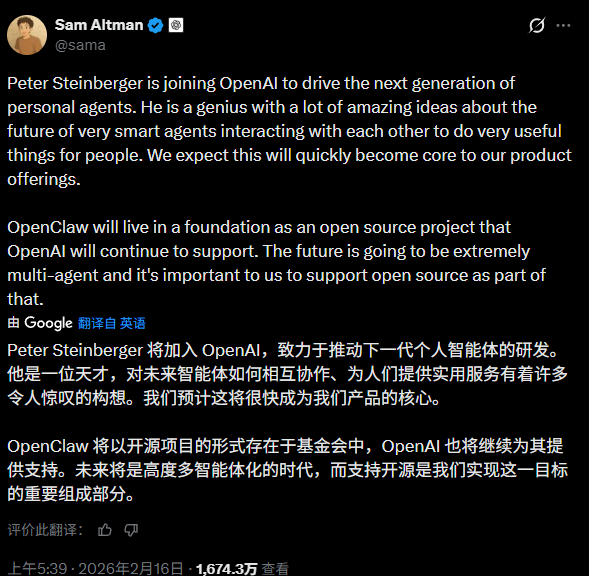
On the same day, Peter released his own statement: 'My next mission is to build an agent so simple even my mother could use it effortlessly. This requires grander innovation, deeper safety considerations, and access to cutting-edge models and research. OpenAI offers the fastest path to realize this vision.'
After joining OpenAI, Peter will report directly to Sam Altman, leading full-scale R&D for next-generation personal AI agents. Meanwhile, OpenClaw will continue as an independent open-source foundation, with OpenAI providing ongoing support as its core sponsor—forever preserving its open-source ethos.
From the Austrian farm boy who first encountered a computer to the central figure now spearheading the next-generation AI agent revolution at the global pinnacle of AI, Peter completed a 30-year odyssey of passion and perseverance.
Epilogue: The Power of Pure Code
Today, Peter still maintains a programmer’s most authentic habits. He spends time on GitHub responding to user issues and iterating OpenClaw’s code alongside community developers. He also openly shares his burnout, failures, and moments of confusion on podcasts.
'The hardest part isn’t writing code,' he says. 'It’s maintaining creative integrity amid commercial pressures. You can’t compete with someone who does things purely for fun—while you’re stressing over business plans, KPIs, and investor returns, they’ve already poured all their energy into creation itself.'
OpenClaw’s story was never about overnight startup success. Behind it lies a 14-year-old’s instant love for coding, a decade of relentless product refinement, three years of unwavering passion through burnout, and the purity of writing code for fun even after 43 failures.
In an era where AI is hijacked by capital, giants, valuations, and hype, Peter Steinberg’s life proves: the greatest code springs from passion, and the mightiest revolutions begin with the purest intentions.
AI Capital Watch is a professional platform dedicated to observing and analyzing capital market dynamics in the artificial intelligence sector. We closely track financing, IPOs, mergers, and acquisitions of AI and embodied intelligence companies, providing in-depth analysis of industry and enterprise trends to offer valuable insights for participants. We strive to bridge AI innovation with capital markets, empowering China’s hard-tech companies to achieve value discovery and growth.
-
![]()
Model Giant Jieyue Xingchen Steps into Smartphone Arena: A Strategic Alliance with Huaqin Technology
-
![]()
Big Model Firm Dives into Phone Market: StepFun and Wingtech Forge a ‘Dynamic Duo’
-
![]()
Zhongrun Optics Makes a Bold Move with 1 Billion Yuan Investment: Is a Turning Point on the Horizon for the Precision Optics Industry?
-
![]()
Deploy CLBO Crystals and YIG Single Crystals! Erythritol Leader Invests 30 Million in Youwei Optoelectronics
-
CXMT’s July 16 Subscription: Leading Domestic Memory Manufacturer—What’s the Earning Potential per Lot?
-
![]()
Rhythm Discrepancy and Premium Value Erosion: Foreign Luxury Brands Must Re-evaluate Their China Strategy
-
![]()
Half-Year, 1 Billion Yuan Financing, 7 Billion Yuan Valuation: A New Dark Horse Emerges in the Embodied AI Sector
-
![]()
Strong Rebound for Tech Stocks in Hong Kong Stock Market: Is It Time to Bottom-Fish?