Only Alipay Is Positioned to Blaze a Trail for WeChat
 06/18 2026
 538
538
Bloomberg has reported that Ant Group is discreetly conducting internal trials for an "AI-enhanced version of Alipay."
The revamped version will overhaul the current user interface, enabling users to seamlessly switch to a native AI dialogue box, tentatively dubbed "Abao," thus creating a 'sibling duo' alongside "Afu."
"Abao" will remain focused on AI-driven services, encompassing a comprehensive array of "lifestyle + financial" scenarios. While there's little to elaborate on the lifestyle aspects—akin to Alibaba's QianWen, it will facilitate ride-hailing, food delivery, and utility bill payments—the financial dimension is where it shines.
Notably, reports suggest that Abao's AI interaction capabilities will extend to wealth management operations. If true, this would mark one of the most sensitive permissions ever granted to an AI agent.
The tech industry often discusses 'corporate DNA'—a concept that elucidates both triumphs and setbacks.
ByteDance thrives on data and algorithms, which explains its success with Toutiao and Douyin, yet struggles in gaming. Tencent excels in social networking and gaming but appears less dominant in technical prowess.
When it comes to DNA, Ant Group's forte lies in pioneering groundbreaking product paradigms.
From pioneering third-party escrow payments to later innovations like Sesame Credit, Huabei, and Yu'ebao, to integrating utility bill payments and healthcare services, and even introducing the 'bump payment' feature in recent years, Ant Group has consistently introduced novel concepts that deliver immense value to users.
Amidst the current AI frenzy, we've witnessed the evolution of chatbots, Claude Code, and even "Lobster." However, product models in established sectors like e-commerce, gaming, payments, and content have yet to undergo significant transformation. Given Alipay's trajectory, I'm eager to see what new innovations it will unveil.
Today's Alipay has become overly bloated.
The homepage is cluttered with Tmall 618 promotions, Taobao flash sales, and Gaode group-buying entries, alongside a plethora of graphic, textual, and video content. AI can not only amplify Alipay's capabilities but also streamline its bloated complexity.
More importantly, with WeChat's AI agent yet to launch on a large scale and WeChat maintaining a relatively cautious pace, Alipay might once again assume a familiar role: forging ahead to pave the way for WeChat and the entire industry.

Ant Group's Product Innovation Instinct
Let's rewind to 2003 when Taobao was in its infancy. The primary hurdle was trust: buyers were hesitant to pay without receiving goods, while sellers feared shipping without payment.
The subsequent launch of Alipay resolved this deadlock by introducing escrow transactions, where funds were held until the buyer confirmed receipt. This innovation made online commerce between strangers feasible, laying the foundation for China's e-commerce boom.
Without Alipay, China's e-commerce landscape would look vastly different today—or at least wouldn't have evolved as rapidly. This marked Ant Group's first "groundbreaking" innovation.
Numerous such innovations followed.
Sesame Credit, launched in early 2015, transformed an intangible 'credit' score into a tangible asset for deposit waivers and direct use. Over time, it seamlessly integrated utility bill payments, social security, healthcare, and government services, evolving from a mere 'payment tool' into a 'life infrastructure.'
By July 2024, the 'bump payment' feature exemplified this product innovation instinct.
Isn't scanning QR codes convenient enough? Alipay insisted it could be even more streamlined: unlock your phone, gently tap it against the payment device, and the transaction is complete.
Alipay boasts some truly exceptional product managers—otherwise, they wouldn't have conceived something like 'bump payment.'
A clear continuity is evident from escrow transactions, Sesame Credit, and utility bill payments to bump payment and now this AI-powered Alipay.
Speaking of AI, "Abao" didn't emerge overnight. Over the past two years, Ant Group has been actively deploying AI strategies.
First came "Afu." Originally named AQ, an AI health application, its name—reportedly chosen by Jack Ma—was meant to signify 'possessing both AI and IQ and EQ.' Unfortunately, few could pronounce it correctly, so it was later renamed "Afu."
But the product itself was robust: by February this year, Afu had surpassed 100 million users. For a vertical AI health assistant to reach this scale is no small achievement.
At the 2025 Bund Conference, Alipay introduced "AI Pay," enabling users to place orders and make payments through a single dialogue with an AI agent without leaving the chat.
It debuted with Luckin Coffee's "Lucky AI": say 'a latte' and 'place order,' verify your identity, and the payment is done.
Six months later, both the transaction volume and user count for AI Pay exceeded 100 million. Then in April this year, it launched "AI Collect," allowing merchants and individual developers to have agents handle payments on demand, offering zero fees.
After "Lobster" gained popularity, Ant Group swiftly integrated "Alipay AI Pay" as a one-click installable skill for Lobster.
Simply say 'enable Alipay payment' to Lobster, authorize it, and it can handle payments, buy Tokens, and make purchases during conversations. Whether it's Alibaba Cloud's JVS Claw, Ant Group's own DTClaw, or third-party options like Claude Code and Hermes, all can be equipped.
So, where did "Abao" originate? It's not entirely novel.
As early as 2024, Ant Group launched a standalone app called "Zhixiaobao," positioned as an AI life assistant capable of handling ride-hailing, ticket booking, food ordering, and bill payments with a single voice command—almost a preview of today's "Abao."
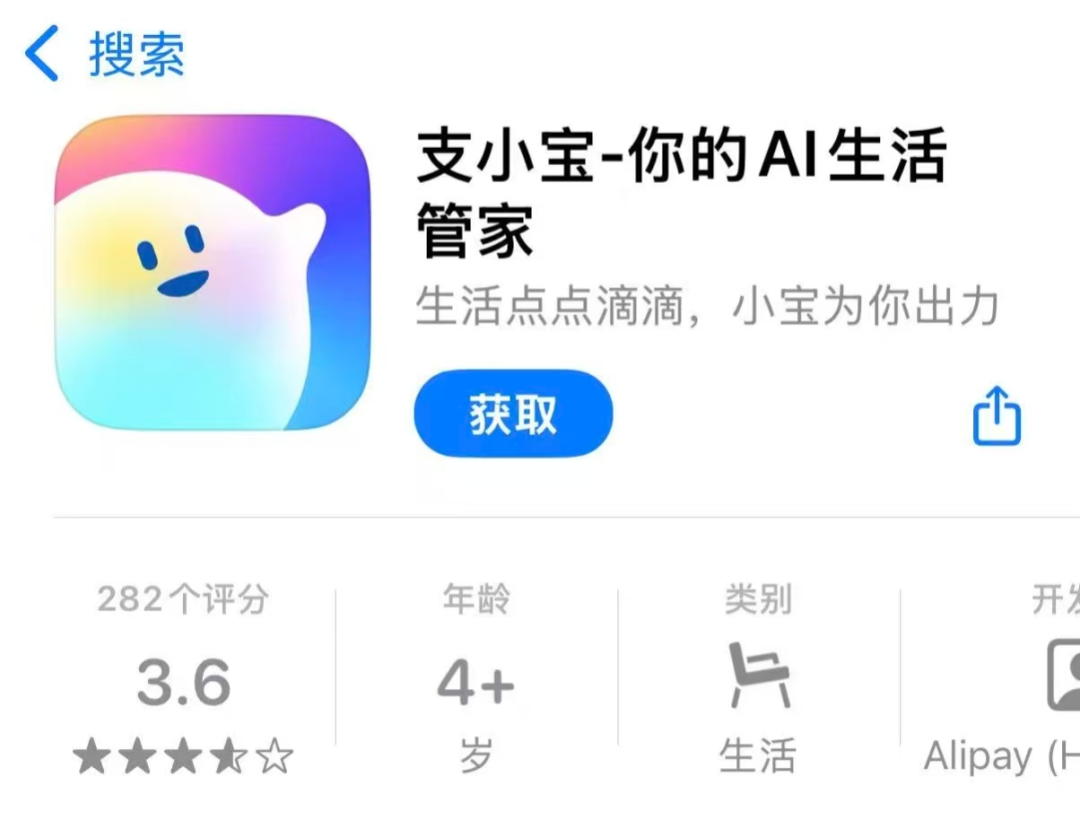
However, as a standalone app, Zhixiaobao failed to gain traction. After initial excitement, it faded into obscurity.
In retrospect, Zhixiaobao served more as a testing ground. Releasing it as a separate app didn't resonate with users. Why download a new app to do what Alipay already does?
Thus emerged "Abao." It essentially integrates the vertical experience pioneered by Afu, the payment capabilities laid out by AI Pay, and the assistant model tested by Zhixiaobao back into Alipay's billion-user ecosystem for a comprehensive integration.
"Abao" Compels WeChat to Act
The core dilemma Alipay faces long-term is that while it offers numerous features, users don't come to 'browse.'
Users open Alipay to accomplish specific tasks: payments, bill payments, checking statements, accessing healthcare insurance, buying funds, repaying credit cards, claiming coupons, ordering food, riding bikes, or booking appointments. Once the task is done, they leave.
When these features are no longer essential—especially when WeChat can substitute them—users have less reason to open Alipay.
Today, the only feature I can think of that's uniquely Alipay is drug traceability codes.
This reflects Alipay's operational strategy: to occupy user scenarios by offering as comprehensive a feature set as possible. However, adding features inevitably complicates the product, especially as Alipay transitions toward content video and Alibaba stuffs it with affiliated services.
AI can resolve this issue because no matter how complex the features are, AI can understand user intent and complete the functional integration on their behalf.
Alipay's greatest asset is its vast array of executable services. Creating a truly functional entry point within Alipay holds significant potential.
While QianWen and Doubao need to cultivate user habits for task completion—I've tried ordering food delivery through them a few times but still prefer Meituan or Taobao Flash Sales for traditional ordering—Alipay already has established user habits. If it can further enhance these habits to demonstrate convenience, it could drive high-frequency usage.
Coincidentally, around the time "Abao" emerged, WeChat's long-anticipated agent finally showed signs of progress. WeChat recently released developer guidelines to provide easy access to its AI ecosystem.
We might soon witness another chapter in the rivalry between the two.
Tencent previously explored native AI entry points and AI-driven social features through Yuanbao, seemingly paving the way for WeChat's agent.
But today, the only entity truly positioned to pave the way for WeChat's agent—to stand on equal footing—is Alipay.
For daily utilities like bill payments or healthcare insurance at hospitals, the mainstream choices are basically WeChat and Alipay. In financial scenarios like wealth management and funds, Alipay's ecosystem is even richer than WeChat's. Both have millions of mini-programs serving as execution mediums for user needs.
In other words, when it comes to 'letting an AI agent manage your daily life and wallet,' WeChat and Alipay are the closest competitors on the same track.
Currently, WeChat remains exceedingly cautious. Its AI agent has been hyped for a while but hasn't officially launched yet.
This makes sense: WeChat's scale is enormous, and its social relationship chains are too intricate. The main interface is the lifeblood for a billion users—any change carries immense risk and cost. For WeChat, holding back and observing is the most prudent choice.
On the other side is Alipay—lighter in baggage and renowned for its product innovation. During this window where even 'what an AI agent should look like' remains undefined, being aggressive, willing to overhaul the entire app, and daring to experiment offers greater opportunities.
Putting these two developments together, a familiar script emerges: Alipay is likely to pave the way for WeChat once again.
This wouldn't be the first time. Alipay excels at groundbreaking innovations, though often it's Alipay that pioneers and validates them—whether it's mobile payment habits or specific product formats—only for WeChat to follow at a leisurely pace, leveraging its social and traffic ecosystem to reap most of the rewards.
The difference this time is that if WeChat remains cautious, Alipay will have a longer head start to solidify its foundation.
Alternatively, if Alipay develops agent capabilities to a level that satisfies WeChat (or 'Long Ge,' as Tencent's Pony Ma is known), then "Abao" could become the strongest catalyst for WeChat to finally launch its agent.
-
![]()
Registered Capital Slashed to 372 Million Yuan! Yutong Optical Finalizes Industrial and Commercial Change Registration
-
![]()
Zhuque-3 Successfully Lands, and 'Time Traveler' Secures Another ¥100 Million in Funding: China's Commercial Space Industry Experiences a 'Dynamic August'
-
![]()
Autohome Faces a Shrinking Window of Opportunity
-
![]()
Even a Titan Like Musk Has Faced Setbacks in Fulfilling Promises
-
![]()
AI Office: The End of the Racing Era, Context Becomes the Key to Success
-
![]()
Domestic Vehicle Chassis Revolution ②: The Steering Wheel Remains, But Mechanical Connections in the Steering System Are Decreasing
-
![]()
Exploring MiniMax Design: Can Video Editing Be as Simple as Speaking?
-
![]()
Why Can SenseTime Achieve Profitability While CloudWalk Still Faces Challenges, Despite Both Adopting Large Models?