Annual Salary of 700 Million Fails to Retain Him! AI Genius Jiahui Yu Departs Meta to Launch His Own Startup
 08/14 2026
 444
444
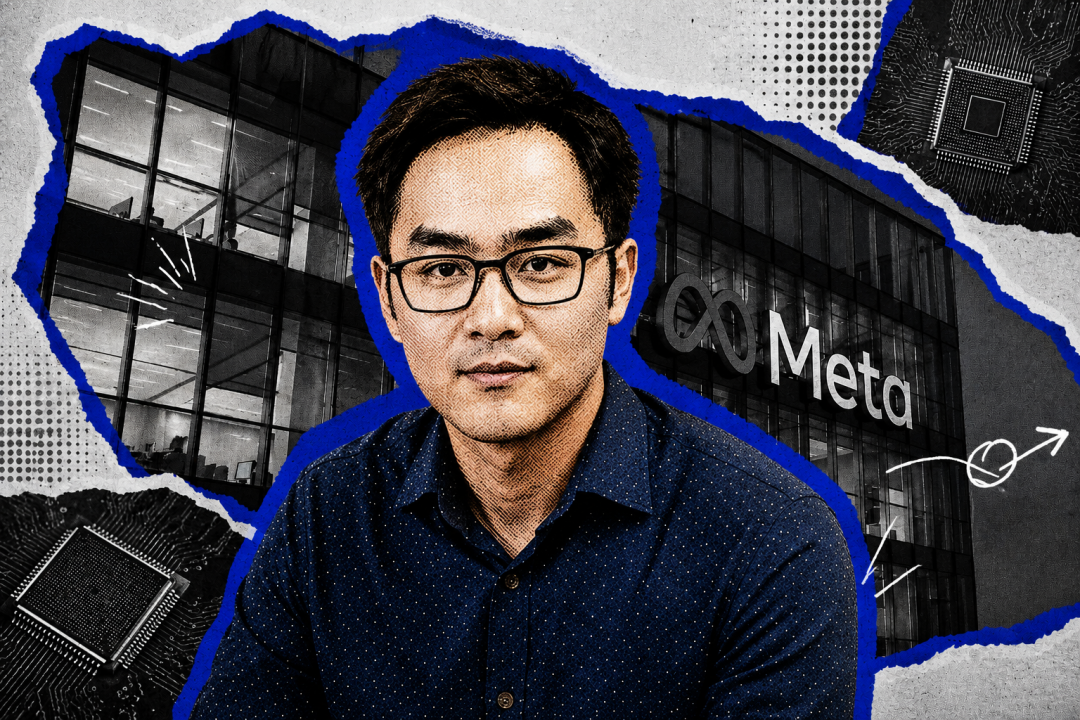
Jiahui Yu Resigns from Meta to Pursue Entrepreneurial Venture.

A year ago, Mark Zuckerberg lured Jiahui Yu away from OpenAI with an eye-watering salary package. Yet, a year later, even that couldn't keep him at Meta.
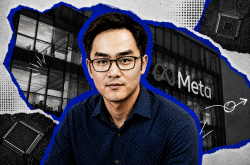
On August 14, Jiahui Yu, a pivotal researcher at Meta's Superintelligence Lab (MSL), announced his resignation on the social platform X, signaling his intent to establish a new company.
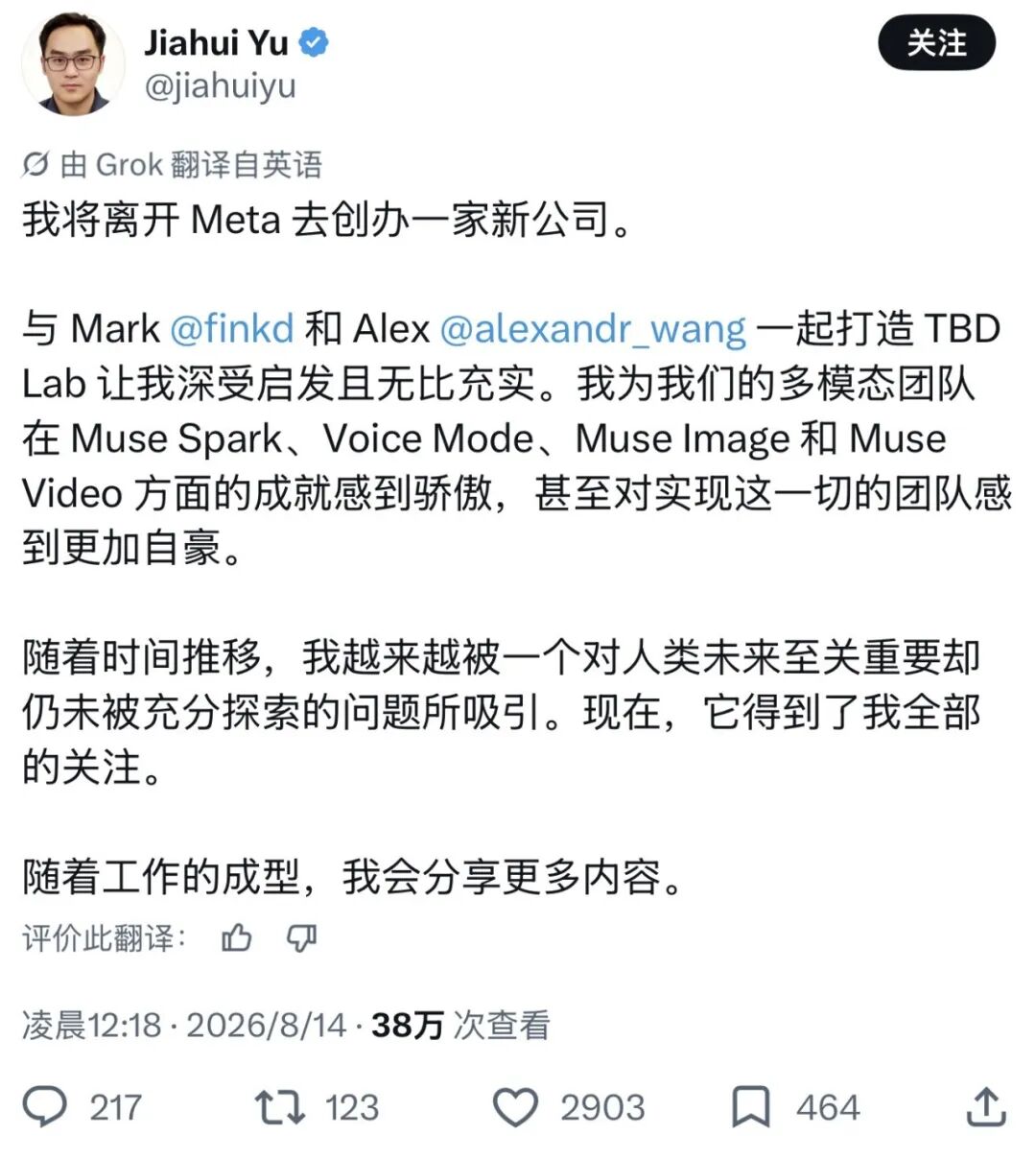
From joining Meta in late June 2025 to declaring his departure on August 14, 2026, his tenure spanned just over a year and a month. Just days prior to his resignation, the multimodal model Muse Spark, which he spearheaded, was upgraded to version 1.2. Yu's exit coincided with a period of intense deliverables from Meta's new team.
When Jiahui Yu first joined Meta, Zuckerberg himself intervened, offering a compensation package rumored to reach up to $100 million annually. OpenAI CEO Sam Altman even publicly criticized Meta's aggressive recruitment tactics.
Now, this individual, once seen as Meta's high-stakes bet on Artificial General Intelligence (AGI), is leaving after delivering impressive results. Despite offering exorbitant salaries, top-tier computing power, and resources, why couldn't Meta retain Jiahui Yu?

Jiahui Yu's Year at Meta
Jiahui Yu achieved significant milestones during his year at Meta.
In late June 2025, Jiahui Yu, along with former OpenAI researchers such as Shengjia Zhao, Shuchao Bi, and Hongyu Ren, joined Meta's newly formed superintelligence team.
Just days later, Zuckerberg officially announced the establishment of Meta Superintelligence Labs (MSL), led by Scale AI's former CEO, Alexandr Wang. Meta also began aggressively recruiting top AI talent from companies like OpenAI, Google DeepMind, and Apple.
Yu joined TBD Lab, one of MSL's core model research teams, tasked with developing Meta's next-generation frontier models. As a founding member, he also led the multimodal research direction.
The team's mission was ambitious: to rebuild a technical framework for next-generation frontier models, despite Meta already possessing the Llama series models.
Within months, results began to materialize.
In April 2026, the team launched Muse Spark, the first foundational model released after MSL's establishment. Subsequently, Voice Mode, Muse Image, and Muse Video were unveiled, extending the product line from text to voice, image, and video.
Muse Image, officially released in July, secured second place in three tests—Arena text-to-image, single-image editing, and multi-image editing—outperforming Google's Nano Banana and trailing only OpenAI's GPT Image 2. The video model, Muse Video, simultaneously opened for preview, ranking third in text-to-video benchmarks, placing it in the first tier.
Just days before Yu's resignation announcement, Muse Spark was updated to version 1.2, further enhancing its programming, long-range agent tasks, and multimodal capabilities.
From team formation to consecutive model launches, Jiahui Yu's year at Meta essentially encompassed the entire process of this new team's establishment and delivery.
More importantly, these achievements were hard-won.
When Jiahui Yu joined Meta, the company's AI business was under significant pressure: Llama 4's market performance fell short of expectations, and Meta urgently needed to reestablish its frontier model capabilities. The establishment of MSL itself marked a major move by Meta to redouble its efforts in superintelligence.
Against this backdrop, Yu's high-profile recruitment stood out. For Meta, hiring Yu wasn't just about securing a top researcher—it was like acquiring a ticket to AGI.
Now, with the ticket holder choosing to leave, it raises renewed curiosity: what kind of resume does a researcher command such attention from Meta?

From USTC's Gifted Class to Top Labs
Born in 1995 in Cixi, Zhejiang, Jiahui Yu was admitted to the University of Science and Technology of China's Gifted Class in 2012 while still in his sophomore year of high school, studying computer science.
During his undergraduate years, Yu won several awards, including the championship in the National Parallel Application Challenge. After graduating in 2016, he pursued a Ph.D. in computer science at the University of Illinois at Urbana-Champaign under the mentorship of Thomas Huang, a renowned scholar in computer vision. Huang, who trained AI leaders such as CloudWalk's founder Zhou Xi and WeRide's founder Han Xu, provided Yu with a solid academic foundation.
During his Ph.D., Yu interned at institutions like Microsoft Research Asia, Adobe, Snap, and NVIDIA. In 2017, while at Adobe, he participated in developing DeepFill, an image inpainting technology that became one of his earliest and most representative achievements.
After earning his Ph.D. in 2019, Yu joined Google, where he stayed for over four years.
There, he met another key technical mentor: Google Fellow scientist Yonghui Wu. Together, they developed the Conformer model, an improvement on the Transformer architecture, marking a significant advancement in speech recognition technology. Their collaboration on the CoCa vision-language foundational model also drove progress in multimodal AI.
If DeepFill established Yu's reputation in computer vision, Conformer and CoCa expanded his research scope from single-modal vision to broader multimodal fields.
In late 2022, Yu joined Google DeepMind to participate in Gemini's development, eventually becoming the co-lead of the multimodal vision direction.
By this point, his research experience had evolved from early image generation and visual understanding to encompass speech, image, and text modalities. This experience laid the groundwork for his later role at OpenAI, where he oversaw perception research.
In October 2023, Yu joined OpenAI to lead perception research, contributing to models like GPT-4o.
By then, Yu had already worked at two of AI's top institutions—Google and OpenAI—with his research expanding from traditional computer vision to multimodal large models.
This resume made Yu the focal point of Silicon Valley's high-profile compensation battle in 2025.
At the time, Altman publicly stated that Meta was offering signing bonuses as high as $100 million to some OpenAI employees, along with higher annual salaries. WIRED later reported that Meta's packages for a few top AI talents could reach up to $300 million over four years, with first-year total compensation potentially exceeding $100 million.
For Meta, which urgently needed to strengthen its frontier model capabilities, Yu's resume seemed tailor-made.
Now, a year after that internet sensation "talent war," the highly recruited individual has decided to start his own venture.

Scientists Leaving Meta to Start Ventures
According to alphaXiv, a research paper platform, over 200 well-known researchers had left Meta before Jiahui Yu. If we count those who once worked at Meta but have since departed, the number reaches 929.
Among this lengthy list, Yu is far from the only core scientist to choose entrepreneurship.
In October 2025, Yuan Dong Tian, a Chinese scientist who had worked at Meta for a decade and amassed over 18,000 paper citations, was laid off during team optimizations.
In May 2026, Tian officially announced his venture, Recursive_SI, co-founded with Richard Socher (as CEO), Tim Rocktäschel, Jeff Clune, and other scientists who previously held leadership roles at OpenAI, DeepMind, and Google Brain. The company aims to build AI capable of autonomous experimentation and continuous self-improvement.
The startup quickly raised $650 million in funding, reaching a valuation of $4.65 billion, led by GV (Google Ventures) and Greycroft, with participation from AMD and NVIDIA.
Also in November 2025, Yann LeCun, Meta's chief AI scientist and a Turing Award winner who had served at Meta for 12 years, left the company.
After departing Meta, LeCun founded Advanced Machine Intelligence (AMI), betting on open-source world models. Even without any products, the company's valuation reached approximately 24.7 billion yuan.
LeCun has long believed that AI will ultimately become a platform, and platforms rely on open-source systems. This was the core of his ideological clash with his former employer, Meta: he had publicly expressed dissatisfaction with decisions like Meta's disbandment of its robotics team.
From Jiahui Yu to Yuan Dong Tian, and now Yann LeCun, this list of departures covers Meta AI's core team members across foundational research and multimodal applications.
For Meta, the issue may no longer be just about attracting top talent with high salaries—it's about retaining them. A recruiter close to Meta noted that while Meta can offer Silicon Valley's most expensive compensation packages, money can buy people but not stability or consensus.
Just over a year after the Superintelligence Lab's establishment, its product lead and star researcher have already come and gone.
References:
"After Joining Meta for a Year, Chinese AI Researcher Jiahui Yu Resigns to Start His Own Venture, Having Participated in Gemini, GPT-4o, and Muse Development," DeepTech;
"Who Is Jiahui Yu? The ' $100 Million Annual Salary' AI Researcher, USTC Gifted Class Genius, and Direct Disciple of Yonghui Wu," QbitAI;
"Annual Salary of 700 Million Fails to Retain Him! Jiahui Yu Resigns from Meta to Launch His Own Startup," QbitAI;
"After Leaving Meta, Yuan Dong Tian Officially Announces His Venture," Synced;
"Exclusive Analysis | With 'Only' 700 Million Left, Why Has Meta Become the Most Disappointed AI Giant?" Lei Feng Network;
"LeCun's Venture Valued at 24.7 Billion Without Any Products, Responds to Xie Saining Joining," QbitAI;
"Another AI General from Meta Follows LeCun Away," QbitAI.
THE END
Copyright and Disclaimer
1. Content Copyright: Except for quoted public data, policies, and cases, this article is original. Professional data is sourced from authorized databases and government websites, while cases are compiled from real events.
2. Image Licensing: Some images are proprietary or officially licensed, while others are AI-generated. For network images with unclear copyright, ownership remains with the original authors, and we will remove them upon request.
3. Republication Guidelines: Unauthorized reproduction is prohibited. Republished content must retain the full source and author information.
4. Liability Disclaimer: This article is a business figure observation and industry commentary based on publicly available information. The content is for reference only and does not constitute professional advice. Risks arising from its use are the reader's responsibility. Xinzhikedong reserves the final interpretation rights to this article.
-
![]()
Samsung Galaxy Z Fold 8 Review: Ultra-Slim Dual Design Shines, but Telephoto Absence is a Bummer
-
![]()
Dongfeng VOYAH’s New Car Makes a Splash, Targeting More Than Just the 30s and 40s Crowd
-
![]()
Annual Salary of 700 Million Fails to Retain Him! AI Genius Jiahui Yu Departs Meta to Launch His Own Startup
-
Qianwen Seeks to Move Beyond Its 'Alibaba Identity'
-
![]()
How Can We Comprehensively Resolve Ctrip's Monopoly Issue?
-
![]()
From Computing Power Supply-Demand Dynamics to Capital Integration: Jin Jing New Energy Embarks on a New Business Phase
-
![]()
Top Domestic Computing Power Supplier Exceeds Net Profit Forecasts for First Half of the Year
-
![]()
Wanwei Advanced Materials Plans to Raise 2.3 Billion Yuan through Private Placement to Boost PVA Optical Film Production!