The AI Version of 'PayPal Mafia' Has Arrived: 20 AI Startups Raise Over $4.6 Billion in Funding
 08/23 2026
 435
435
Can you imagine?
In today's AI startup scene, the most valuable 'asset' might not be a product or revenue—but an employee badge from OpenAI or Anthropic.
According to incomplete statistics, from 2025 to the present, 20 AI companies founded by former employees and core collaborators of OpenAI and Anthropic have secured $4.6 billion in funding.
Even more striking, at least seven of these companies have raised nearly $900 million without officially launching a product.
This naturally brings to mind the legendary 'PayPal Mafia.'
PayPal was more than just a payment company; it fostered a vast entrepreneurial network. Alumni went on to found or join Tesla, SpaceX, LinkedIn, YouTube, Yelp, and Palantir.
OpenAI and Anthropic are becoming similar entities: both top-tier AI companies and 'crucibles' for entrepreneurial talent.
Next, Silicon-Based Insider will break down these 20 companies one by one.
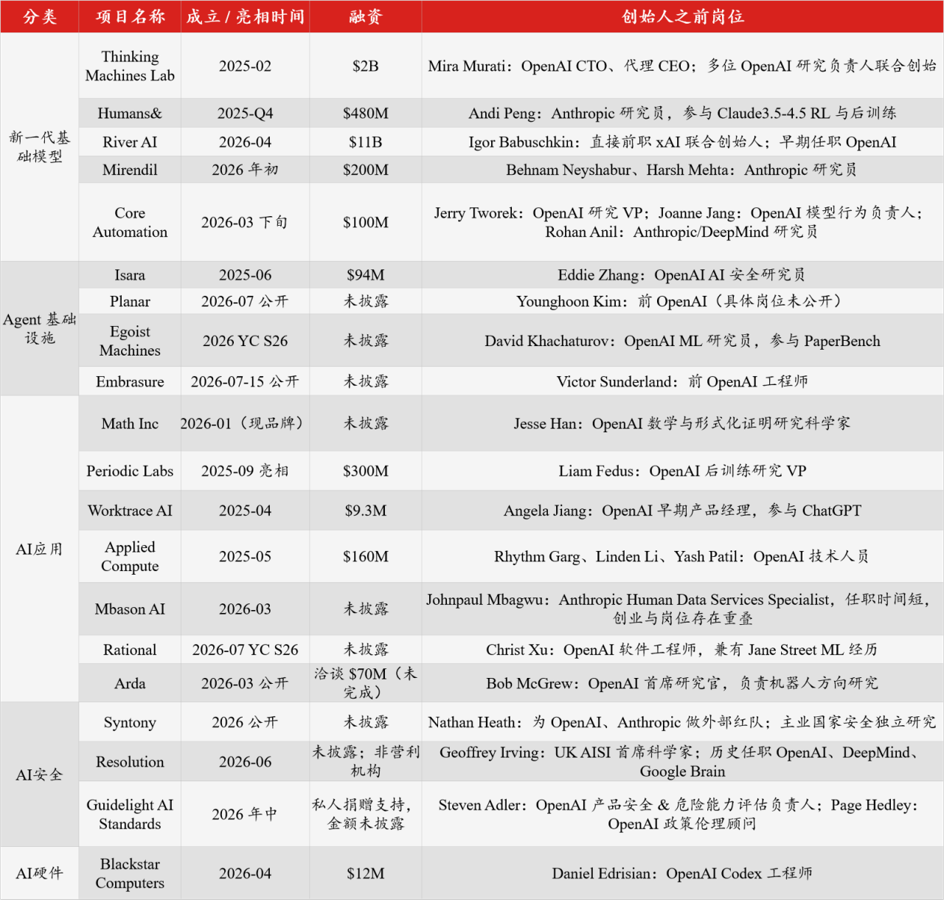
/ 01 / Thinking Machines Lab: Building a 'Model Customization Engine' with $2 Billion
Founded in February 2025, Thinking Machines Lab was established by Mira Murati, former CTO and interim CEO of OpenAI, who directly led the development of core products like DALL-E and GPT-4. The company has also attracted several former OpenAI research and product leaders.
In July 2025, the company completed a $2 billion seed round led by a16z, with participation from NVIDIA and other institutions, reaching a valuation of $12 billion—one of the largest seed rounds in recent years.
Thinking Machines' main product, Tinker, is a model fine-tuning platform. Simply put, enterprises don’t need to spend heavily on GPUs or build systems themselves. By uploading business data to Tinker’s cloud platform, they can use its tools to 'feed' their data into existing open-source models like Llama or Qwen, training them into specialized models for finance, programming, or scientific research.
According to IT Home, hedge fund Bridgewater has already customized a Qwen model via Tinker. In published tests, this specialized model achieved 84.7% accuracy in financial information screening tasks, outperforming frontier models like GPT (78.2%) while reducing inference costs to roughly one-fourteenth.
/ 02 / Humans&: Equipping AI with 'Team Memory'
Founded in the second half of 2025, Humans& was co-founded by Andi Peng, a former Anthropic researcher who worked on reinforcement learning and post-training for Claude models.
In January 2026, the company announced a $480 million seed round, reaching a valuation of $4.48 billion, with investors including NVIDIA and SV Angel.
Humans& aims to build a next-generation foundational model architecture for 'social intelligence.'
Its goal isn’t just a chatbot serving individual users but an AI designed for team collaboration. It wants AI to remember how an organization works long-term, what different members are responsible for, and why past decisions were made—then proactively assist in meetings, communication, and project execution.
In short, while current AI acts like an 'on-demand temporary assistant,' Humans& envisions it becoming a team member aware of organizational history, capable of long-term collaboration with multiple people.
/ 03 / Mirendil: Enabling AI to Build the Next Generation of AI
Mirendil was founded by former Anthropic researchers Behnam Neyshabur, Harsh Mehta, and others. The founders left Anthropic in late 2025 and officially launched the company in early 2026.
Shortly after its founding, the company secured $200 million in funding, led by Andreessen Horowitz (a16z) and Kleiner Perkins, with participation from NVIDIA and others, reaching a valuation of $1 billion.
Mirendil’s core goal is to achieve 'AI self-improvement.' Currently, researchers manually propose improvements, design training experiments, compare results, and decide adjustments for the next round. Mirendil aims to automate this cumbersome process entirely, letting AI run experiments, analyze results, and directly produce stronger next-generation models—ultimately enabling 'AI to build AI.'
The company has already signed a multi-year Google Cloud agreement worth over $100 million to prepare computational power for large-scale training and experiments.
/ 04 / Core Automation: Enabling Models to 'Learn While Working'
Founded in March 2026, Core Automation was established by Jerry Tworek, former VP of Research at OpenAI, who long oversaw reinforcement learning and reasoning model research.
Co-founder Joanne Jang previously managed OpenAI model behavior, while Rohan Anil has research experience at Anthropic and Google DeepMind.
Core Automation secured $100 million in funding just weeks after its founding, reaching a valuation of $1 billion. It was later reported to be in talks for $300 million to $500 million in additional funding, targeting a valuation of around $4 billion, though negotiations are ongoing.
Unlike Mirendil’s focus on 'AI building AI,' Core Automation emphasizes 'continuous learning.' Today’s large models have fixed capabilities after training; adapting to new knowledge requires costly retraining. Core aims to create an automated AI lab where models can continuously learn and grow from new tasks and feedback after deployment, rather than starting from scratch each time.
/ 05 / River AI: Training Fully User-Controlled Private AI
Founded in April 2026, River AI was established by Igor Babuschkin, co-founder of xAI and former employee at OpenAI and Google DeepMind.
River AI aims to create 'personalized private foundational models.' Current large models like ChatGPT are essentially 'public brains' running in the cloud, with users’ data, memories, and preferences stored on corporate servers, subject to platform security rules and uniform censorship.
River AI wants to return models, personal data, and usage rights entirely to users, building a localized, fully user-controlled private AI.
On August 11, 2026, River AI announced $1.1 billion in funding, led by General Catalyst and AMP PBC, with participation from NVIDIA, AMD Ventures, Y Combinator, and Temasek.
/ 06 / Isara: Enabling 2,000 Agents to Work Together
Founded in June 2025, Isara was co-founded by Eddie Zhang, who conducted AI safety research at OpenAI, and Henry Gasztowtt from Oxford University.
The company aims to build large-scale Agent clusters, enabling hundreds or even thousands of Agents to work simultaneously toward a complex goal, exchange information, and correct each other’s conclusions.
Isara’s early demo simultaneously deployed around 2,000 Agents to predict gold prices. Currently, the company targets investment firms, with plans to expand into biopharmaceuticals and geopolitical analysis—fields with extreme variability.
The company has secured $94 million in funding, reaching a valuation of $650 million, with OpenAI among its investors.
/ 07 / Planar: Building a 'Shared Office' for Humans and Agents
Founded in May 2026, Planar was co-founded by Younghoon Kim, a former OpenAI software engineer specializing in protection and security.
Planar identified the issue that while employees use ChatGPT and Claude for many tasks, the processes and conclusions often remain trapped in individual chat boxes. When someone else takes over a project, they must restart the search for materials, understand the context, and confirm progress—limiting the efficiency gains from AI across teams.
Planar aims to create a shared workspace for humans and Agents, consolidating project decisions, task progress, responsible parties, handover records, and related materials. Whether work is assigned to a colleague or another Agent, it can resume from the same context instead of starting over.
Currently, Planar is refining its product with a small group of teams already using Agents and AI workflows.
/ 08 / Egoist Machines: Issuing 'Passports' for AI Memory
Egoist Machines is part of Y Combinator’s Summer 2026 cohort. Co-founder David Khachaturov was a machine learning researcher at OpenAI, working on projects like PaperBench.
The company developed AI Passport, essentially a 'user-controlled AI profile.'
Currently, ChatGPT, Claude, and other AI apps remember fragments of user preferences, but these memories are siloed. AI Passport centralizes user-approved habits, experiences, and preferences; when a new app needs this information, users decide what to share and can revoke access anytime.
This way, users don’t need to repeatedly introduce themselves when switching AI tools or permanently surrender all personal information to each platform.
AI Passport is currently in pre-order, with Egoist promising permanent free use for individual users.
/ 09 / Embrasure: Maintaining Data Pipelines with AI
Embrasure went public in July 2026, founded by former OpenAI engineer Victor Sunderland and ex-Palantir engineer Jacob Kieser, with support from a16z Speedrun.
It addresses the issue of enterprise data appearing normal on the surface but containing errors internally.
For example, if an upstream system suddenly renames a field, data tasks might still run normally, but downstream reports and AI Agents could receive incorrect results—a problem that grows harder to detect manually as data scales.
Embrasure’s Scout continuously maintains data pipelines: it tracks where each field originates, where it flows, which reports and models use it, identifies responsible parties, generates repair code, and rechecks after modifications.
Currently, Embrasure has opened product demos and enterprise trial access, with integrations for Agent tools like Claude Code, Codex, and Cursor.
/ 10 / Periodic Labs: Putting AI Scientists in Real Labs
Periodic Labs officially debuted in September 2025. Co-founder Liam Fedus was VP of Post-Training Research at OpenAI and a core researcher on early ChatGPT versions.
Periodic’s 'AI scientists' don’t just read papers—they enter real labs to experiment.
AI first proposes a materials or chemical hypothesis, then controls automated equipment to synthesize samples, measure performance, and decide adjustments based on results, forming a closed loop of 'idea generation—experimentation—result analysis—continuous improvement.'
At launch, the company secured $300 million in seed funding, led by Andreessen Horowitz with participation from Felicis, Accel, and NVIDIA, reaching a valuation of around $1.3 billion.
According to third-party research firm Contrary, Periodic has already acquired early customers in the semiconductor industry and begun generating revenue.
/ 11 / Worktrace AI: Identifying a Company’s Best Automation Opportunities First
Founded in 2025, Worktrace AI was established by Angela Jiang and Deepak Vasisht. Jiang was an early product manager at OpenAI, working on GPT-3.5 and GPT-4.
Worktrace AI is essentially an 'AI process mining and automation discovery platform.'
Many enterprises buy AI tools without knowing which tasks are most worth automating. Worktrace observes employees’ real operations across software via a desktop app, automatically mapping workflows—including steps taken, systems switched between, and where delays or rework occur—then precisely identifies link (segments) suitable for AI takeover.
The company has secured $9.3 million in seed funding, led by Conviction and 8VC, with participation from the OpenAI Startup Fund and Mira Murati.
According to its BukuWarung case study, Worktrace reduced process hours by about 90% for certain roles, with human-reviewed automation accuracy reaching 96–99%.
/ 12 / Applied Compute: Training a 'Private Brain' for Every Company
Founded in 2025, Applied Compute was established by former OpenAI technologists Rhythm Garg, Linden Li, and Yash Patil.
Applied Compute’s core product is an enterprise-exclusive platform for AI training, deployment, and continuous iteration. Instead of selling a fixed customer service or legal AI, it trains a company’s proprietary data, work experience, and judgment criteria into open-source models, creating Customized Model (exclusive models) serving only that firm.
The company has raised $160 million in total funding, most recently completing an $80 million round at a $1.3 billion valuation; it is now in talks for new funding at a ~$3 billion valuation. Clients and partners include Microsoft, NTT Data, Harvey, DoorDash, Cognition, and Bridge.
"The Information" revealed that Applied Compute's current annualized revenue is approximately $50 million, representing a nearly fourfold increase from previous levels.
/ 13 / Math Inc: Making Mathematical Proofs Subject to Quality Inspections Like Code
Math Inc made its debut under its current brand in January 2026, having evolved from Morph Labs, which was established in 2023. Founder Jesse Han previously conducted research on mathematical reasoning and formal proofs at OpenAI.
The Gauss developed by Math Inc is essentially a “compiler plus quality inspector” for the mathematical community. It translates proofs written by mathematicians in natural language into code that can be read by the Lean proof assistant, which then checks the reasoning step-by-step, much like inspecting software.
In a public project, Gauss generated approximately 25,000 lines of Lean code in three weeks, encompassing over 1,000 theorems and definitions, and completed the formalization challenge of the strong prime number theorem proposed by Terence Tao and Alex Kontorovich.
/ 14 / Mbason AI: Turning Job Hunting into an AI Assembly Line
Mbason AI was established in March 2026. Founder Johnpaul Mbagwu previously participated in work related to human data services at Anthropic.
Mbason is a one-stop AI job-hunting platform. It first matches positions based on experience, then tailors resumes and generates cover letters for specific roles. After that, it provides mock interviews and feedback, and tracks the progress of each application. On the corporate side, it allows companies to post jobs, screen candidates, and communicate directly.
Mbason has launched web and mobile products and has begun experimenting with subscription fees: the Gold service is available for a 3-day trial at $4.99, followed by $14.99 per month.
/ 15 / Rational: Recruiting a Team of “Digital Employees” for Accounting Firms
Rational is a project from YC's Summer 2026 batch, with co-founder Christ Xu having previously served as a software engineer at OpenAI.
Rational provides “AI digital accounting employees.” These can integrate with existing software at accounting firms, follow up with clients for documents, verify invoices and payment statuses, perform reconciliations, coordinate month-end closings, and hand over tasks requiring signatures and professional judgment to accountants.
Unlike ordinary chatbots, Rational first understands an organization's division of labor, approval paths, and client communication methods before handling tasks according to these rules. The company claims to serve clients ranging from individual practitioners to Fortune Global 500 teams.
In a corporate finance case, Rational processed five-digit-scale invoices per closing cycle, with clients reporting a roughly 50% reduction in related review processes; at another accounting firm, around 50 users each saved approximately 20 hours of coordination work per week on average.
/ 16 / Arda: Installing an AI Chief Scheduler in Factories
Arda was founded by Bob McGrew, former Chief Research Officer at OpenAI. He previously led research directions such as OpenAI's robotics and later shifted his focus to industrial settings after leaving the company.
Arda does not directly manufacture robots but aims to become an intelligent coordination layer connecting factory videos, production software, robots, and on-site personnel.
The system analyzes production line videos to understand what workers, equipment, and robots are doing, identifies bottlenecks in processes, unused equipment, and issues in human-machine collaboration, and then uses this information to adjust production processes and train robots.
According to "The Wall Street Journal," Arda is in talks to raise approximately $70 million in financing, targeting a valuation of $700 million, though the financing has not yet been completed.
/ 17 / Guidelight AI Standards: Creating a “Safety Report Card” for AI Companies
Guidelight was established in May 2026 by Steven Adler, former Head of Safety at OpenAI, and Page Hedley, a policy and ethics advisor.
It is an independent non-profit organization that aims to transform the slogan of “developing AI responsibly” into specific, checkable standards: clear requirements should exist for what tests must be completed before model release, what risk information must be disclosed, and what safeguards must be established.
Guidelight invites independent experts to participate in standard-setting, then evaluates AI companies item by item based on public information and corporate disclosures, publishing the results. It hopes to use public ratings and market pressure to encourage companies to truly implement safety measures.
To avoid both acting as a referee and accepting funding from those being evaluated, Guidelight does not accept funds from AI companies or their employees and is currently supported by private donations.
/ 18 / Resolution: Researching How to Keep Superintelligent AI “Obedient to Humans”
Resolution was founded in June 2026 by Geoffrey Irving, former Chief Scientist at the UK's AI Safety Institute, who also conducted research at OpenAI, DeepMind, and Google Brain.
Resolution is also a non-profit AI alignment research institution. It does not focus on intercepting a single erroneous response but on ensuring that as model capabilities grow stronger, it will still act according to genuine human intentions.
Resolution hopes to use mathematical theory and reproducible experiments to clarify which training and supervision methods remain effective over the long term and under what conditions they fail, while using AI to assist in finding proofs and designing experiments to accelerate safety research itself.
In July 2026, Resolution received $160 million in funding from Coefficient Giving, with $108 million as base funding and $52 million tied to recruitment and computing needs.
/ 19 / Syntony: Conducting “Attack and Defense Drills” for AI Agents
Syntony was founded by Nathan Heath. Heath is not a direct employee of OpenAI or Anthropic but has long conducted external red team testing for both companies.
What Syntony does is proactively “attack” AI before it goes live.
The team deliberately inputs Inducibility (inductive) content to prompt the Agent to invoke tools, access sensitive information, and observe whether it can be tricked by prompt injection, bypass permissions, or perform dangerous operations.
After identifying issues, Syntony does not merely submit a test report but continues to clarify who is responsible for fixes, what control measures need to be added, and how to retest after repairs.
The company is also developing tools for security issue tracking, risk relationship mapping, and red team process management, with some products already in public preview or design partner testing.
/ 20 / Blackstar Computers: Not Building an AI Assistant but Directly Creating an AI Computer
Blackstar Computers made its debut in April 2026, with founder Daniel Edrisian having previously served as an engineer on OpenAI's Codex.
Blackstar argues that today's computers still require humans to constantly open applications, search for files, and click menus; even with the addition of an AI assistant, the underlying interaction method remains unchanged.
Therefore, it aims to transform both hardware and operating systems to enable computers to continuously understand what users are doing and directly invoke different software to complete tasks, rather than confining AI to a chat window within existing computers.
The company has completed a $12 million seed funding round led by Abstract, with participation from SV Angel, Naval Ravikant, Chapter One, and others. In its funding announcement, Blackstar stated that achieving true human-computer interaction breakthroughs requires “a new computer.”
Text/Yuanyuan
-
![]()
Raking in Big Profits Overseas! Chery’s Overseas Revenue Makes Up 70% in H1, with Gross Margin Climbing to 16.1%
-
![]()
Alibaba’s New Fiscal Quarter: 45% Revenue Surge in Alibaba Cloud, Enhanced Profitability in AI Cloud, but Widening Losses in the Application Layer
-
![]()
The AI Version of 'PayPal Mafia' Has Arrived: 20 AI Startups Raise Over $4.6 Billion in Funding
-
![]()
Wang Jian's Vision: Paving a Pathway for Alibaba Through AI
-
![]()
Hyundai Motor Workers Strike Today, Fearing Job Losses to Robots
-
![]()
Embracing 'Light': O-film Unveils Its 'Illuminating the Future' Strategy
-
![]()
SenseTime’s SenseNova U1.5 Lite Goes Open Source: Ushering in a New Era of Predictable AI Image Generation
-
![]()
Collaboration Initiated! Tesla Officially Welcomes Doubao Onboard