Ali (Summary): AI CAPEX Recouped in 3 Years
 08/25 2026
 352
352
Below is a summary of Alibaba's (BABA.US) FY27Q1 earnings call, curated by Dolphin Research. For the earnings report analysis, please refer to 'Alibaba's Aggressive Investments: Pursuing a 'Chinese Version of Google?'
I. Review of Key Earnings Information
1. Shareholder Returns: During the quarter ending June 30, 2026, Alibaba repurchased 13.4 million ordinary shares (approximately 1.7 million ADS) totaling $162 million.
The company will continue disciplined capital allocation among AI + cloud business growth investments, share buybacks, and dividends, adjusting priorities based on market conditions and strategic needs.
2. Capital Expenditures, Three-Year Budget, and ROI Metrics
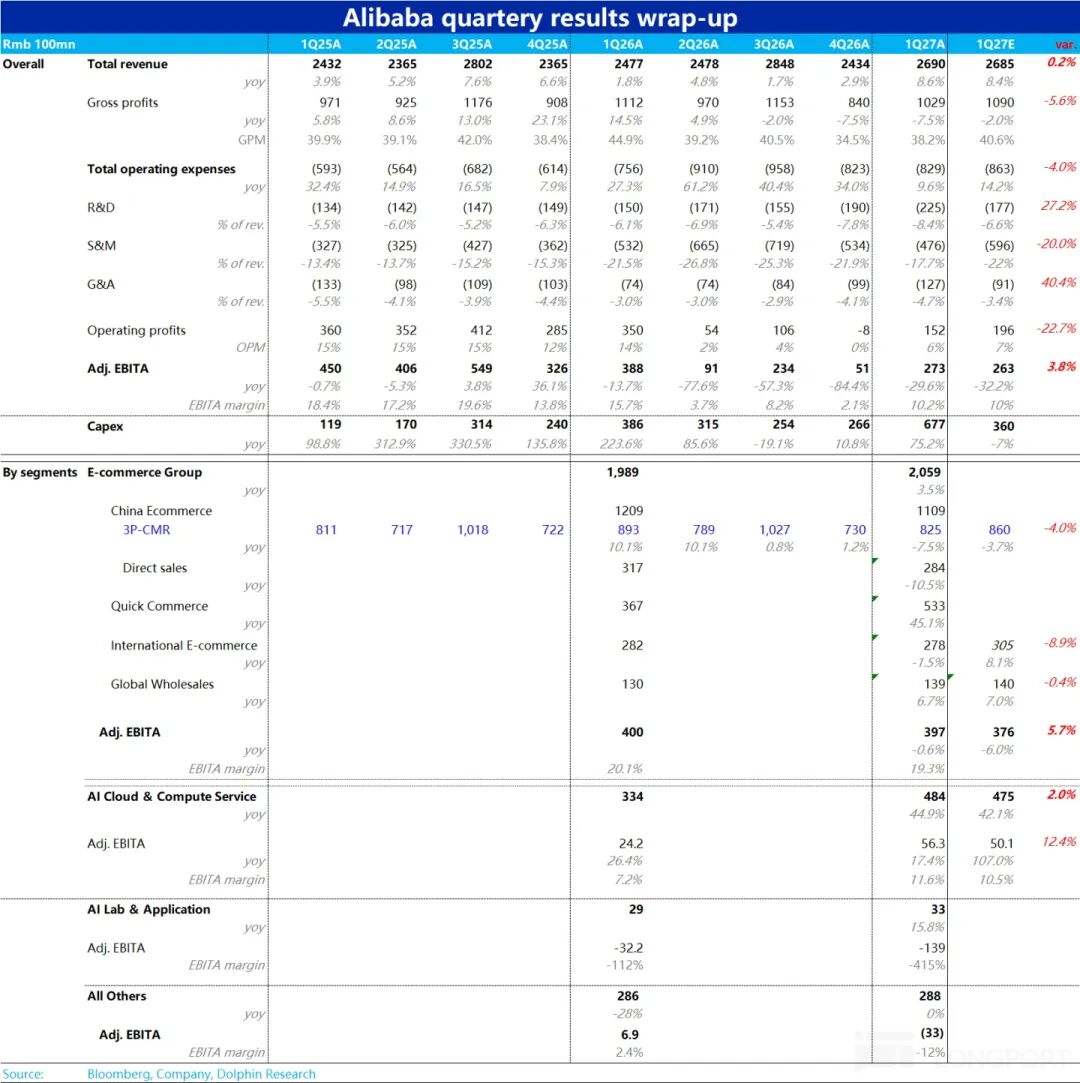
a. QoQ CapEx reached RMB 67.7 billion ($9.98 billion), up 75% YoY (RMB 38.7 billion in the same period last year). Growth stemmed from procurement cycle fluctuations, increased CPU capacity to address rising AI agent adoption, and rising prices for various chip components.
b. As of the end of the June quarter, RMB 190 billion has been invested in the three-year, RMB 380 billion investment plan, largely in line with expectations. Management clarified that this quarter's spending should not be simply annualized by multiplying by four, nor should linear progression be expected.
c. ROI Metrics: Servers equipped with chips typically recoup costs within three years. Assuming a five-year service life, they generate positive free cash flow for at least two additional years after cost recovery. With improving gross margins and rising substitution rates of self-developed chips, the payback period can be shortened to 2.5 or even 2 years.
3. Key Financial Metrics for the Quarter
a. Totals: Total revenue reached RMB 269 billion, up 9% YoY, driven by strong momentum in cloud services and instant retail. Adjusted EBITA was RMB 27.3 billion, down 30% YoY, primarily due to increased technology investments, partially offset by improved cloud business operations and enhanced operational efficiency across businesses.
b. E-commerce Group: Revenue was RMB 205.862 billion (+4%), including RMB 53.295 billion (+45%) from China's instant retail (driven by Hema and Taobao Flash Sales). Adjusted EBITA was RMB 39.749 billion, slightly down YoY. Customer management revenue decreased by 7% YoY, but would have increased by 1% YoY excluding the impact of metric changes.
c. AI and Technology Segment: AI cloud and computing services revenue was RMB 48.5 billion, with both total revenue and external customer revenue growth accelerating to +45%. Adjusted EBITA was RMB 5.63 billion, with a profit margin of 11.6%.
- AI-related product revenue was RMB 12.4 billion ($1.82 billion), accounting for 35% of Alibaba Cloud's external revenue. AI Labs and applications revenue was RMB 3.34 billion, with an adjusted EBITA loss of RMB 1.39 billion. All other revenue was RMB 28.8 billion (flat), with an adjusted EBITA loss of RMB 334 million.
d. Cash Flow and Balance Sheet: Operating cash flow was RMB 22.95 billion, up 11% YoY (RMB 20.7 billion in the same period last year). Net free cash flow outflow was RMB 44.67 billion (RMB 18.8 billion net outflow in the same period last year), primarily due to cloud infrastructure investments.
- As of June 30, 2026, net cash was approximately $30.7 billion. Excluding debt maturing in more than five years, net cash was approximately $46.5 billion.
II. Detailed Earnings Call Content
2.1 Key Information from Executive Statements
1. AI and Cloud Commercialization
a. External cloud revenue growth accelerated to 45%, a 22-quarter high. Alibaba Cloud's EBITDA increased by 133% YoY, and the segment's adjusted EBITA margin reached 11.6%, up 4.4 percentage points YoY.
b. The 45% growth was broad-based, driven by computing power, storage, MaaS, and AI applications. The company also proactively contracted low-margin businesses to continuously improve growth quality.
c. AI-related product revenue was RMB 12.8 billion, with annualized revenue run rate exceeding RMB 49.5 billion (~$7.3 billion), marking 12 consecutive quarters of triple-digit growth. Its share of cloud external revenue rose to 35%, with a significantly higher gross margin than the average for the cloud business portfolio.
d. AI revenue spans multiple layers, including AI computing power, MaaS, and AI applications. Demand growth from customers at any layer can directly translate into business opportunities. This structural advantage will support sustained rapid growth in recurring AI product revenue.
e. The explosion of AI agents directly drives demand for tokens and GPU computing power while significantly boosting demand for traditional cloud products such as CPU computing power, storage, databases, and networking. Alibaba Cloud is comprehensively upgrading to become an Agentic Cloud.
f. According to the latest data, ARR for model and application services including MaaS has exceeded RMB 16 billion. Based on current market feedback and contract backlog, demand for computing power will continue to outstrip supply. As supply ramps up, AI and cloud revenue growth will further accelerate in the coming quarters, with synchronization improvements in profitability.
2. Full-Stack AI Capabilities: Self-Developed Chips and Data Centers
a. The synergy between self-developed T-Head chips and self-developed foundational models further enhances AI commercialization efficiency. T-Head has established a fully self-developed product line covering GPUs, CPUs, and networking chips.
b. As of early August, the Zhenwu series chips have served over 650 clients on Alibaba Cloud.
c. Super-node instances equipped with T-Head's next-generation Zhenwu M890 AI processors recently went live at commercial scale on Alibaba Cloud. Supply will continue to ramp up in the second half of the year to meet strong demand.
d. The Zhenwu M890 super-node can efficiently handle inference workloads for foundational models with over 2 trillion parameters. Models such as Qwen3.8-Max now offer MaaS services on this platform.
e. At the data center level, the delivery cycle for hyperscale AI data centers has been compressed to 100 days, a global leading level, significantly accelerating the global rollout of computing power infrastructure.
3. Model Iterations and Open-Source Ecosystem
a. The pace of model releases significantly increased over the past month. Language, image, audio, video, and music models have all undergone major iterations, with performance ranking among the global top tier.
b. Last week, the model weights for Qwen3.8-Max, with 2.4 trillion parameters, and the Qwen3.8-27B model series were released.
c. The Qwen series has accumulated over 3 billion downloads globally, with over 300,000 derivative models built upon it. A thriving open-source model ecosystem will inversely drive cloud computing demand, creating a virtuous cycle.
4. AI-Native Applications
a. For enterprises, QwenWork, an AI productivity product for enterprise office scenarios, has been launched to deliver agentic capabilities at scale. Productivity agents are expected to become another growth engine for ARR.
b. On the consumer side, the user base of the Qwen App has grown steadily, with an expanding range of value-added services. Since its launch, 250 million users have completed their first AI-driven shopping experience through the Qwen App's e-commerce and other service features.
c. Through close collaboration between Alibaba Token Hub and Alibaba Cloud, the company has established an efficient commercial flywheel spanning computing power, models, tokens, applications, and monetization.
d. The AI Labs and Applications segment saw a significant sequential narrowing of losses this quarter, primarily due to decreased marketing expenses for the Qwen App. Losses are expected to continue narrowing in the coming quarters as model training efficiency improves and Qwen App marketing spending is optimized.
5. E-commerce and Instant Retail
a. The instant retail business scale grew by 45%, with a significant reduction in losses and sequential improvement in unit economics. Drivers included increased average order value and optimized fulfillment logistics efficiency, while maintaining market share.
b. The goal for traditional e-commerce is to maintain stable profits, while instant retail continues to drive profitability improvements. AliExpress achieved operating profit this quarter.
c. The e-commerce group's adjusted EBITA remained largely flat YoY this quarter, achieved against the backdrop of enhanced user experience and increased technology investments, reflecting cost discipline.
6. Strategic Direction
a. The inflection point for AI commercialization was crossed last quarter. This quarter, we have seen accelerated growth and margin expansion. The self-sustaining capability of the AI business is strengthening, giving the company confidence to further increase investments.
b. AI has become Alibaba's most certain growth engine. AI has transitioned from the incubation stage to large-scale commercialization. The company possesses greater strategic and financial flexibility at both ends of the full-stack AI capabilities and consumer opportunity spectrum.
2.2 Q&A Session
Q: What were the reasons for the significant increase in CapEx this quarter? What is the CapEx trend for the coming quarters? Has there been any update to the previous three-year budget of RMB 380 billion?
A: In February last year, we announced a three-year capital investment plan totaling RMB 380 billion. As of the end of the June quarter this year, RMB 190 billion has been invested, largely in line with expectations.
Spending was higher this quarter because hardware deliveries follow different procurement cycles, and delivery schedules inherently fluctuate and are not evenly distributed across quarters. Therefore, the increase this quarter mainly reflects fluctuations in equipment delivery timelines.
At the same time, we increased CPU procurement this quarter due to a substantial surge in demand driven by the agent era. Rising prices for semiconductor components also contributed.
Thus, this quarter's spending should not be directly multiplied by four to annualize it for the full year, nor should it be expected to progress linearly and steadily. Overall construction has been advancing at a stable pace.
Q: Why is the full-stack AI model capital-intensive and requires upfront investments?
A: This is a capital-intensive business model. All forms of AI monetization—software subscriptions, API calls, MaaS, training, and inference—require computing power centers to operate and support at every stage. Only after computing capacity is in place can monetization occur. This means we must make upfront investments to scale up businesses and generate revenue in these various directions.
This is also why we entered a period of heavy hardware investments starting in 2025: To capture future growth, we must first make these CapEx investments to build the necessary computing capacity.
The industry consensus is that AI computing power shortages are unlikely to see significant relief before 2030. Against this industry backdrop, we now see very high certainty in the ROI of AI computing power CapEx investments.
Q: Why is the ROI of AI-related CapEx highly certain? What measures can be taken to improve ROIC and shorten the payback period?
A: There is industry consensus that the current shortage of AI computing power is unlikely to ease until at least 2030. From an industry-wide perspective, investments in AI computing power should therefore offer high certainty.
Based on current average gross margins, AI-related CapEx can be recouped within three years. With average gross margins continuously rising, we expect to shorten the payback period to around 2.5 years.
After recouping costs within three years, these AI assets can generate very substantial and stable cash flows. To give a direct example, A100s purchased in 2020 and even V100s purchased in 2018 are still operating at full capacity today.
We also have three levers to further improve gross margins and ROIC:
First, we will continue to develop cutting-edge models, improve the gross margins of AI products themselves, and further expand the higher-margin MaaS business. We will also adjust the product mix between hardware and software to raise overall portfolio gross margins.
The effects of margin improvements are already evident—Alibaba Cloud's overall segment profit margin increased by 4.4 percentage points to 11.6% this quarter, serving as initial validation of this logic.
Second, and crucially, we can deploy self-developed chips at scale. T-Head's self-developed chips cover GPUs, CPUs, and networking chips—the key chips for AI. The most expensive components in AI data centers are precisely chips and storage. As self-developed chips account for a larger share in data centers, replacing externally procured commercial chips, gross margins and profitability will rise significantly.
Third, we have ways to enhance the efficiency of our own cash flow usage, such as co-building data centers with partners and adopting prepayment and advance receipt models for computing power services.
Through these three approaches, the payback period for AI CapEx can be shortened to 2.5 or even 2 years. A simple framework helps understand this: Given current AI product gross margin levels and assuming a three-year CapEx payback period, theoretically, as long as growth is kept below 33%, cash flow can already turn positive.
However, this is not our strategic choice at this stage—AI is still in its very early stages, and we have decided to actively invest in CapEx and proactively scale up to drive rapid business expansion. As product gross margins improve and self-developed chip substitution rates rise, shortening the payback period to 2.5 years or less, we can maintain positive cash flow while pursuing growth rates above 40%. This is our long-term strategic direction.
Q: What are the latest developments in instant retail? What are the future strategic priorities for the various business lines reorganized under Alibaba's e-commerce group after the restructuring?
A: In the new fiscal year, we have reorganized our e-commerce segment and will provide updates on progress around four core areas: China e-commerce, instant retail, international e-commerce, and global B2B (wholesale).
Let's start with China e-commerce. Domestic e-commerce faces short-term macroeconomic pressures. Our long-term strategy focuses on strengthening core supply capabilities while leveraging AI to enhance the overall shopping experience and comprehensively improve operational efficiency. During the 618 shopping festival last quarter, despite macroeconomic pressures, results met our expectations, with core merchants achieving steady growth.
AI presents significant opportunities on both the supply and demand sides of e-commerce. On the consumer side, we will continue to roll out AI-driven new experiences and scenarios, such as multimodal search and virtual try-ons, with two objectives:
- First, to enhance the experience and efficiency of existing shopping scenarios using AI—we have already observed significant efficiency gains in product recommendations driven by AI.
- Second, to drive new forms of AI-powered interactions.
On the merchant side, we see merchants already widely using AI in their operations. We are exploring ways to apply AI across various operational links to amplify merchant capabilities, particularly in data analysis, advertising and marketing, and customer service—areas where merchants can clearly benefit. Later, we will also collaborate with QwenWork to launch AI agents specifically designed for e-commerce scenarios.
In instant retail, after more than a year of investment and development, Taobao Flash Sales has undergone substantial changes in both scale and market share, with significant improvements in user mindset, supply richness, logistics experience, and order volume. While users and orders continued to grow last quarter, UE improved substantially and losses narrowed significantly.
Building on this foundation, we will accelerate the integration of businesses such as Hema and Tmall Supermarket to develop non-food categories in instant retail, with a particular focus on the expansion of micro-fulfillment centers. Over the past year, Hema has accelerated the development of micro-fulfillment centers, driving a year-over-year increase in GMV.
Instant retail will continue to expand category coverage and innovate in key areas to enhance consumer experience. We expect that in the next fiscal year, the transaction volume of non-food categories in instant retail will surpass that of food categories, driving growth across multiple physical goods categories in our overall e-commerce business. The instant retail business is expected to achieve overall profitability by FY29. In the long term, we believe it has the potential to contribute 30% of the platform's total GMV, becoming the second growth curve of our e-commerce business.
The third area is international e-commerce. In the short term, growth is indeed under pressure due to tariff policies and geopolitical environments. However, amid complex market conditions, our cross-border business has significantly improved profitability while maintaining transaction volume growth.
From the perspectives of transaction scale and profitability, we believe the cross-border business has long-term growth potential. Additionally, our local e-commerce platforms in international markets such as Turkey and the Middle East are growing rapidly, while operational efficiency in Southeast Asian markets continues to improve.
The fourth area is global B2B. B2B businesses such as 1688 and Alibaba.com have sustained growth over the past two decades. We believe AI will bring profound changes to B2B platforms, potentially reshaping existing business models from the ground up, with models playing an increasingly important role in B2B transactions.
We have launched an AI agent for cross-border merchants, which has attracted over 50,000 paying merchants shortly after its launch. AI is comprehensively transforming the operating methods of B2B merchants, especially cross-border ones. Leveraging two decades of industry accumulation, we have the opportunity to create entirely new business models and opportunities in B2B and cross-border trade in the AI era.
Overall, over the past few years, we have completed the new strategic positioning of our e-commerce business in several key areas. Going forward, we will continue to leverage the advantages of supply chain collaboration and AI technology to unlock greater growth potential for our e-commerce division in the AI era, while building a more diversified revenue and profit structure to ensure more stable development of the entire division.
Q: What is the expected growth pace of the cloud business over the next few quarters? What are the core drivers supporting sustained acceleration?
A: Let's first look at current business and key metrics. External revenue from the AI and cloud division has accelerated for nine consecutive quarters, with this quarter's growth rate accelerating to 45%. Customer demand remains very strong, and our products have clear competitive advantages over other cloud providers. Therefore, we expect revenue growth to continue accelerating over the next few quarters.
AI-related product revenue reached RMB 12.4 billion this quarter, annualizing to approximately US$7.3 billion. For next quarter, our own forecast is that this annualized revenue will approach US$10 billion, maintaining very strong growth. Meanwhile, we expect EBITDA margin to improve sequentially quarter by quarter over the next few quarters.
Another critical point for the cloud business is the growth in MaaS demand. MaaS demand saw very significant growth this quarter, and combined with continuous improvements in inference efficiency, the ARR of the MaaS business has exceeded RMB 16 billion—to clarify, this is the latest data as of August.
From the perspective of business model growth drivers, Alibaba's AI investment model fundamentally differs from that of pure AI companies: we make full-stack intensive investments in the three most critical areas—chips, AI cloud infrastructure, and models—while maintaining industry leadership across all three.
We believe AI and technological development across the industry is still in its early stages. As technology evolves, the core commercial value of the AI industry may shift between different layers such as chips, cloud computing, models, and applications. Full-stack investment ensures we can provide optimal service capabilities and cost-effectiveness while maintaining competitiveness and sustained growth at every technological development stage.
Q: From a longer-term perspective, what are the fundamental growth drivers for the cloud business? How do they differ from short-term drivers?
A: Let's start with the most important short-term drivers for the next one to two years. Since late 2025, demand for commercialized inference services has grown exponentially, marking a fundamental shift—computing power has become the core asset driving AI revenue, with all AI-related revenue models today centered around AI computing power. Meanwhile, the industry consensus is that computing power will remain in short supply for quite some time.
Additionally, the higher gross margins of MaaS inference services have brought about important changes: computing power, once a cost center, has now transformed into a core productive asset where value creation positively correlates with revenue. While GPUs are widely used in diverse scenarios, high-priced computing power remains scarce across the industry, causing pricing models to converge toward the highest-margin, most profitable monetization methods. This is driving pricing models for nearly all GPU-related products.
Alibaba possesses comprehensive multimodal model capabilities, with our models at the forefront of the industry. This gives us clear advantages in realizing the value of computing power and provides a solid anchor for our pricing strategies—whether pricing for new customers or renegotiating contracts with existing customers, we can adopt healthier pricing models. This is a very positive short-term driver for margin improvement over the next year.
The long-term drivers are scale effects and network effects. Over the past two years, many have asked what the killer app for AI will be. The answer is: the real killer app is AI computing power itself based on the cloud—all these workloads must run on full-stack AI cloud computing power, including training, inference, AI software, and agents, requiring GPUs, CPUs, storage, databases, virtualization, and various toolchains.
AI cloud is like a mega-city, with workloads as residents and continuously iterating full-stack AI cloud services as urban infrastructure. This infrastructure in turn attracts more new residents and increases the stickiness of existing ones, creating strong network effects and scale effects.
We operate the largest number of data centers among Asian cloud providers, giving us the strongest economies of scale. Large-scale deployment of our self-developed T-Head AI chips allows us to avoid the high premiums of purchasing expensive commercial GPUs, preventing margin erosion. The cutting-edge performance of our self-developed models also gives us strong pricing power over computing resources.
From industry trends and our product advantages, we see very strong long-term trends for both revenue growth and margin expansion. Therefore, we have high confidence in achieving our goal of US$100 billion in external cloud revenue by 2030 and have good visibility into reaching 20% profit margins.
Q: MaaS ARR has exceeded RMB 16 billion as of August. Will the previously mentioned year-end target of RMB 30 billion be adjusted?
A: MaaS business growth has indeed been very rapid, with ARR exceeding RMB 16 billion in August. Given the current growth momentum, plus the new models scheduled for release, we remain confident in achieving the RMB 30 billion ARR target by the end of the year.
Q: What are the revenue proportions of self-developed models versus third-party models in the MaaS business? How will increased model competition and more open-source models affect MaaS gross margins and profitability?
A: On our MaaS platform, self-developed models still account for the majority of revenue, but third-party models also contribute a significant portion.
Regarding differences in model capabilities: many customers often need and prefer to use multiple different models simultaneously in their AI applications, as different models have distinct characteristics and capability focuses. Therefore, having more open-source models available for inference calls on our platform is beneficial for us.
From a gross margin perspective, on platforms like Bailian, the gross margin levels achievable from hosting self-developed models versus third-party models are actually very close and highly comparable.
We develop self-developed models to continuously improve model intelligence and as part of our pursuit of AGI. However, purely from the perspective of the MaaS business, the gross margin levels of the two types of models are indeed very close.
Overall, a vibrant open ecosystem with abundant open-source models is highly advantageous for cloud providers like Alibaba Cloud.
Q: In a full-stack ecosystem, where will value accumulation and monetization be most concentrated?
A: This is a long-term judgment question that inherently carries high uncertainty. What I can say is that we invest in the full stack—regardless of which layer represents the greatest value or how value migrates between layers at different times, all these layers exist within our ecosystem.
Sharing my personal short-term view: in the short term, I believe most value will be in chips and AI cloud infrastructure. This pattern is observable not just in China but globally among many companies—when a technology is in its early stages, especially when supply is constrained, value tends to concentrate in infrastructure and core hardware, which in this case are chips and storage.
Therefore, at Alibaba, we have integrated computing power, cloud infrastructure, and AI capabilities into the same core business.
Q: What will be the ultimate business model for large models? Is current API monetization the final state?
A: There's much debate on this topic within the industry, and we also have different views internally. Here's my personal perspective. I believe current monetization of large language models through APIs is only a short-term, transitional approach and certainly not the ultimate business model. The massive computing power we've invested across our platforms aims for more than just generating such short-term API revenue.
I believe when we achieve AGI or approach that stage, the ultimate business model will involve delivering actual products and results that customers truly want—conducting R&D that can truly produce products and operational outcomes.
The reason why AI model companies are making such heavy investments and engaging in an arms race today isn't just to compete in API services but because they're targeting that ultimate state. I believe monetization at that stage will be significantly, orders of magnitude higher than today's API call-based service models.
Q: If value remains concentrated in the hardware and computing power layers long-term, considering that allocation of much hardware and computing capacity involves government-led processes, how should we view the subsequent competitive landscape?
A: Let me first provide some additional information about T-Head's self-developed chips, a topic we haven't communicated much about with investors before. We've manufactured and shipped over 500,000 units of our previous-generation T-Head chips, with the latest generation deployed on Alibaba Cloud in the form of super nodes since August. I believe we are one of the very few companies capable of large-scale deployment of such self-developed domestic chips.
A unique feature of T-Head chips is their design based on GPU architecture as the core technical foundation, enabling excellent support for both training and inference workloads. Hundreds of companies currently use these chips via Alibaba Cloud for inference and model training across fields including embodied AI, autonomous driving, and large model companies.
We will begin R&D on our second-generation chips in the second half of this year, which are expected to deliver extremely high computing power and strong interconnect bandwidth, making them fully capable of directly replacing existing chips.
Therefore, we believe we are in a very unique position in the chip field, especially for large-scale model training. I don't believe any government-led computing power supply allocation mechanism can produce chips with such genuine competitiveness.
As a critical core component of Alibaba Cloud, T-Head has highly certain prospects, and we maintain strong confidence in our core competitiveness in this area. I've discussed these chips with many domestic engineers, and they have broad appeal among engineering communities across various fields.
In summary, we believe T-Head chips provide the best domestic support for cross-industry training and inference—we are truly industry-leading. Regarding future production capacity and deployment scale, we can confidently say we will be among the top two.
Moreover, when it comes to truly delivering AI chips to customers, Alibaba Cloud holds the largest market share in China's cloud and AI markets, giving us strong advantages in channel distribution.
From this perspective, I have very high confidence in the long-term commercial value of T-Head chips.
- END -
// Reprint Authorization
This article is an original work by Dolphin Research. Reproduction requires authorization.
// Disclaimer and General Disclosure
This report is for general comprehensive data purposes only, intended for general reading and data reference by users of Dolphin Research and its affiliated institutions. It does not consider the specific investment objectives, product preferences, risk tolerance, financial situation, or special needs of any individual receiving this report. Investors must consult independent professional advisors before making investment decisions based on this report. Any person making investment decisions using or referring to the content or information in this report does so at their own risk. Dolphin Research shall not be liable for any direct or indirect responsibilities or losses that may arise from using the data contained in this report. The information and data in this report are based on publicly available materials and are for reference purposes only. Dolphin Research strives to but does not guarantee the reliability, accuracy, or completeness of this information and data.
The information or viewpoints mentioned in this report may not be used or construed in any jurisdiction as an offer to sell securities or an invitation to buy or sell securities, nor do they constitute recommendations, inquiries, or endorsements of relevant securities or related financial instruments. The information, tools, and materials in this report are not intended for or designed for distribution to jurisdictions where such distribution, publication, provision, or use would contravene applicable laws or regulations, or would require Dolphin Research and/or its affiliates or associated companies to comply with any registration or licensing requirements in such jurisdictions, nor for citizens or residents of such jurisdictions.
This report merely reflects the personal viewpoints, insights, and analytical methods of the relevant creators and does not represent the stance of Dolphin Research and/or its affiliated institutions.
This report is produced by Dolphin Research, with copyright solely owned by Dolphin Research. No institution or individual may, without prior written consent from Dolphin Research, (i) make, copy, reproduce, duplicate, forward, or create any form of copies or reproductions in any manner whatsoever, and/or (ii) directly or indirectly redistribute or transfer to any other unauthorized persons. Dolphin Research reserves all related rights.
-
![]()
DPCA Technology Launched, Pioneering a New Era for Joint Ventures: Taking 'Chinese Heritage' Global
-
![]()
Spring in the Rack: UCloud Rides High, Yet Fundamentals Impose Limits
-
![]()
Why Has the 'Urban Bulk Commodity Boom' Intensified Over the Past Two Years?
-
Is Another Joint Venture Brand on Its Way Out?
-
![]()
Doing the Math for Kuaishou and Kling
-
![]()
From Elusive to Aggressively Priced: Lexus Sheds Its 'Standoffish' Image
-
![]()
China Initiates Satellite IoT Operations, with Geely Satellite Networks Poised for 6G
-
![]()
Is China's Auto Industry Heading into the 'Fiercest Final Showdown'? Li Bin Says It's Not a Simple Elimination, But the Grand Finale