The 2026 National Subsidies for Home Appliances Are Here: More Targeted, But Are the Subsidies Less?
 04/07 2026
 613
613
Source | Home Appliance Post (jiadpai) Author | Xiaoxiao

After a long wait, the 2026 national subsidy policy for home appliances has finally been officially implemented.
As soon as the news broke, many in the home appliance industry began discussing: What are the changes in this year's policy compared to 2025? Have the subsidies decreased? Will the market be affected?
In fact, when comparing the policies of the two years, a very noticeable change emerges: the subsidy intensity seems to have decreased slightly, but the direction is clearer and more precise. Simply put, the funds are less dispersed and are concentrated on the most core home appliance products.

Fewer Subsidized Products, but More FocusedLet's start with the most obvious change: the variety of subsidized products has decreased.
In 2025, the home appliance subsidy covered a wide range, totaling 12 categories. However, in 2026, this number has been directly reduced to 6 categories. The remaining products are primarily the large appliances most commonly used in daily life: refrigerators, washing machines, televisions, air conditioners, computers, and water heaters.
On the other hand, products such as range hoods, household stoves, rice cookers, cleaning appliances, water purifiers, and dishwashers are no longer eligible for subsidies this year. Many people may see this change and think: Have the subsidies been reduced? From a policy perspective, this is more like concentrating resources to achieve greater results.
The home appliances that remain are generally the most core, expensive, and long-replacement-cycle products in households. In other words, if the goal is to stimulate consumption, these large appliances have a more pronounced effect.

Adjustments to Subsidy Rates
In addition to the reduction in the number of products, there have also been some adjustments to the subsidy intensity.
The 2025 policy provided a maximum subsidy of 20% for first-tier energy efficiency products.
The 2026 policy, however, has reduced this to a 15% subsidy for first-tier energy efficiency products.
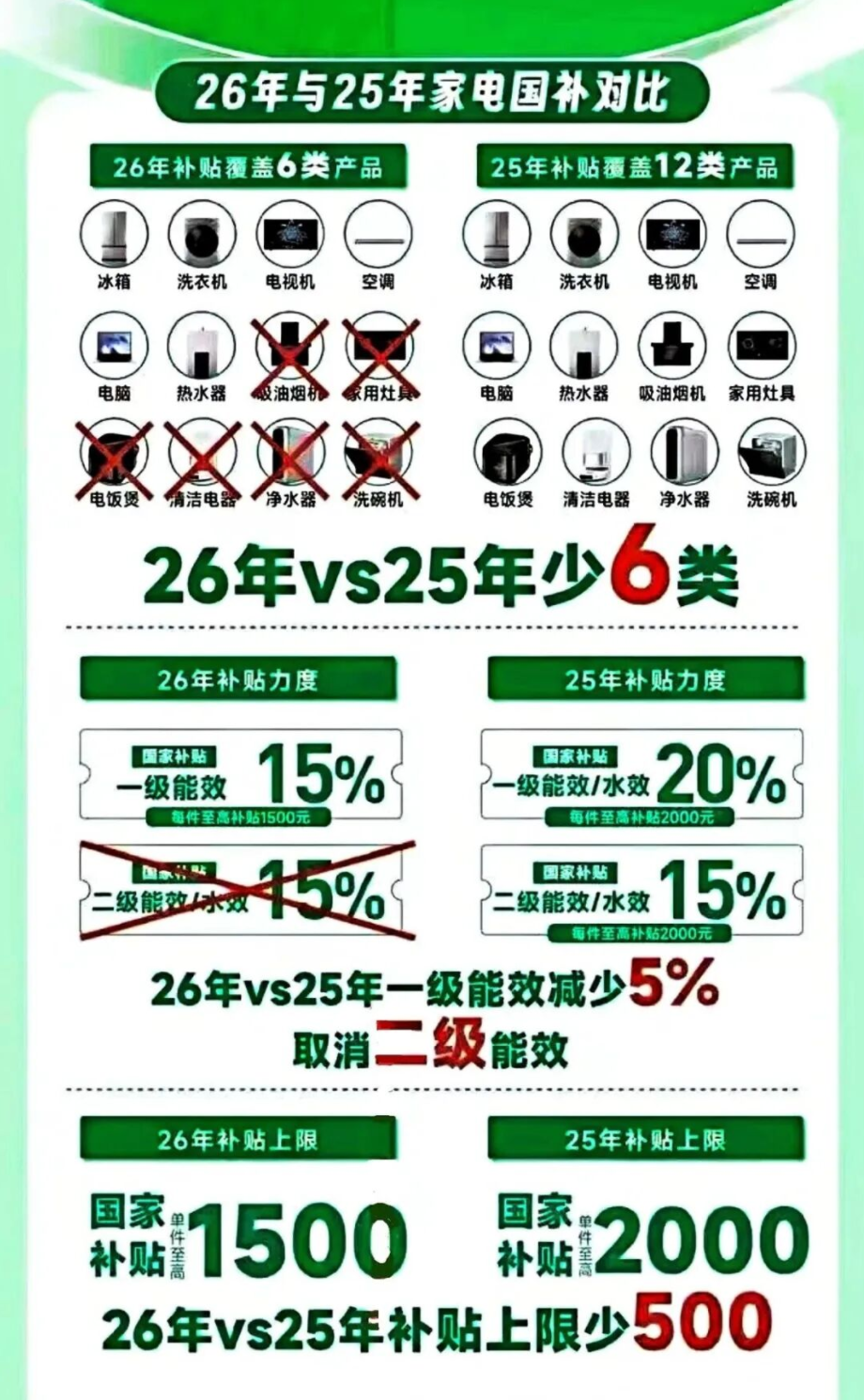
Another change is the elimination of subsidies for second-tier energy efficiency products. Previously, many second-tier energy efficiency appliances were also eligible for subsidies, but now support is primarily for first-tier energy efficiency products. The logic behind this is clear: the state aims to encourage the purchase of more energy-efficient and environmentally friendly products.
Simply put, it's better to concentrate subsidies on more advanced and energy-efficient products rather than providing small subsidies for many products.

Lower Cap on Individual Subsidies
Another change that many consumers and businesses are concerned about is the cap on subsidy amounts.
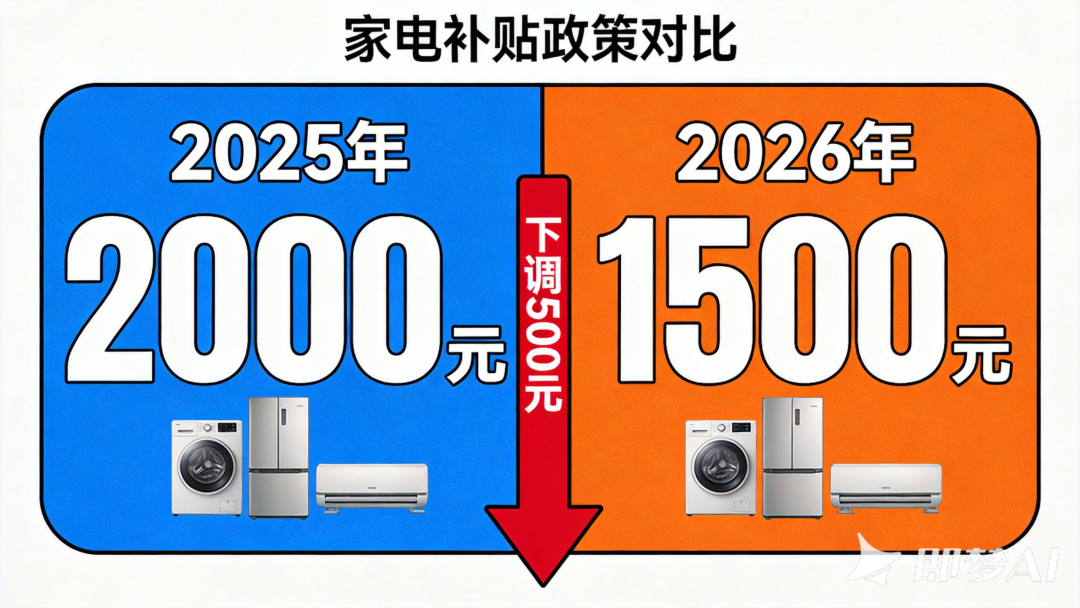
The 2025 policy set a maximum subsidy of 2,000 yuan per appliance.
The 2026 policy has adjusted this to a maximum subsidy of 1,500 yuan per appliance.
On the surface, this seems like a reduction of 500 yuan, but when considering overall consumption, the impact is not as significant as imagined. This is because, for many home appliances, the subsidy amount rarely reaches the 2,000 yuan cap given their price ranges.
Although there have been adjustments to subsidy rates and amounts, the overall funding remains substantial. According to the National Development and Reform Commission, the first batch of subsidy funds for 2026 has already been allocated, totaling 62.5 billion yuan. This funding primarily supports trade-ins for old consumer goods. If this pace continues, the annual subsidy funding is estimated to be around 250 billion yuan.
For comparison, the total subsidy funding for home appliances in 2025 was approximately 300 billion yuan. This means there has been a reduction of about 50 billion yuan this year, but the decrease is not significant. From a macro perspective, this funding scale remains very substantial.

Two Key Concerns for Businesses
Besides the subsidies themselves, many home appliance businesses are more concerned about two other issues.
1. Participation ThresholdsThe policy documents clearly state that both online and offline businesses, regardless of size, should be treated equally in participating in subsidy activities. This means that small businesses can theoretically participate. However, in practice, some regions still set relatively high thresholds, such as requiring general taxpayer status, annual sales exceeding 5 million yuan, and inclusion in statistical systems. These conditions have left many small and medium-sized businesses out.
Many home appliance retailers are also calling on local governments to strictly implement central policies and avoid setting excessively high thresholds.
2. Subsidy Funding AdvancesMany businesses also face the practical pressure of funding advances. Simply put, consumers purchase appliances at subsidized prices, but the subsidy funds often take some time to be returned to businesses. If sales volumes are high, businesses need to advance significant funds. In response to this issue, this year's policy explicitly proposes establishing a subsidy fund pre-allocation system. This means the government will advance a portion of the funds to businesses or platforms to alleviate their financial pressure. For many dealers, this is an important improvement.
Rural Market to Become a Focus
Another key direction of this year's policy is the rural market.
The policy explicitly states that efforts will be made to increase offline stores in rural areas and encourage e-commerce channels to expand into these regions, making it more convenient for rural residents to purchase home appliances. In recent years, the rural market has become an important growth point for the home appliance industry.
Many households are undergoing their first or second round of appliance upgrades, such as replacing old refrigerators with energy-efficient ones, old washing machines with smart ones, and old televisions with large-screen models. The combined demand in these areas presents significant market potential.
This year also sees a noticeable increase in regulatory strictness. There is a particular emphasis on cracking down on various illegal activities, such as fraudulently obtaining subsidies, Cover up (which seems to refer to a form of subsidy abuse), and "raising prices before applying subsidies."
For example, if a business first increases the price of a product and then uses subsidies to attract consumers, such behavior is explicitly prohibited. The policy requires all participating businesses to register prices, make price information public, and accept regulatory inspections.
Once violation (violations) are detected, businesses may face disqualification from participation, fines, or even legal liability. It can be said that the management of subsidy funds will be much stricter this year.

What Does This Mean for the Industry?
Overall, the 2026 home appliance subsidy policy has a very clear characteristic: funds are used more concentrically, and regulations are stricter. Although subsidy rates and amounts have decreased, the overall direction is clearer.
- Focus on supporting core home appliance products.
- Encourage the purchase of high-efficiency products.
- Promote trade-ins for old appliances.
- Stimulate consumption in the rural market.
For large home appliance enterprises, such policies remain favorable. However, for some small brands and small and medium-sized businesses that rely on subsidies, competition may become more intense.
The national subsidy policy for home appliances has been continuously adjusted over the years, shifting from initial large-scale consumption stimulation to the current targeted subsidies. This reflects a trend where policies are moving from "quantitative stimulation" to "quality upgrading." Subsidies may not be as abundant as before, but they are more targeted.
For consumers, if there is a need to replace home appliances, now is still a good time. For businesses, what truly matters may not be the amount of subsidies but whether their products are competitive enough.
After all, subsidies are just one way to promote consumption. Ultimately, it is the products and services themselves that determine the market.
END
-
![]()
Registered Capital Slashed to 372 Million Yuan! Yutong Optical Finalizes Industrial and Commercial Change Registration
-
![]()
Zhuque-3 Successfully Lands, and 'Time Traveler' Secures Another ¥100 Million in Funding: China's Commercial Space Industry Experiences a 'Dynamic August'
-
![]()
Autohome Faces a Shrinking Window of Opportunity
-
![]()
Even a Titan Like Musk Has Faced Setbacks in Fulfilling Promises
-
![]()
AI Office: The End of the Racing Era, Context Becomes the Key to Success
-
![]()
Domestic Vehicle Chassis Revolution ②: The Steering Wheel Remains, But Mechanical Connections in the Steering System Are Decreasing
-
![]()
Exploring MiniMax Design: Can Video Editing Be as Simple as Speaking?
-
![]()
Why Can SenseTime Achieve Profitability While CloudWalk Still Faces Challenges, Despite Both Adopting Large Models?