Vivo and Doubao Pause, Huawei Steps Forward with 2499 Yuan ‘AI Glasses’ Ambitions
 04/21 2026
 520
520
Leading the Charge in AI+AR Integration
By VR Gyroscope’s Ran Qixing
On April 20th, Huawei hosted its much-anticipated “HUAWEI Pura Series and Full-Scene New Product Launch” event. A major highlight was He Gang, CEO of Huawei Terminal BG, personally unveiling and wearing the company’s debut AI photography glasses, with prices starting at 2499 yuan. By 21:00 on the same day, JD.com data revealed that pre-sales for the product had quickly surpassed 900 units.
This marks Huawei’s first flagship hardware entry in the XR sector during the AI large model era. Interestingly, just a week prior to Huawei’s announcement, design sketches of Apple’s AI glasses surfaced, while domestic AI glasses frontrunner Thunderbird Innovation revealed plans to launch its next-gen AI photography glasses, the Thunderbird V4, next month. With tech giants stepping into the arena and startups accelerating their pace, the entire AI glasses industry is rapidly entering a high-growth phase.
01
Ultra-Lightweight Design at 35.5g, Featuring a 1/2.8-Inch Large-Bottom CMOS
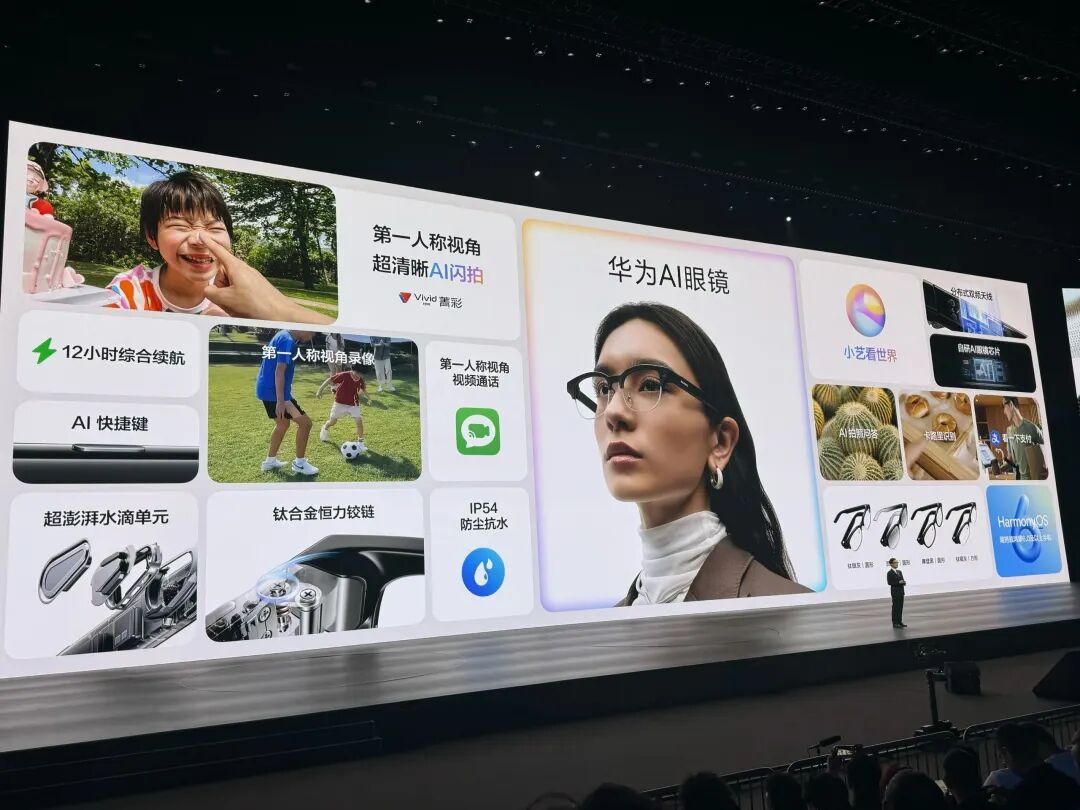
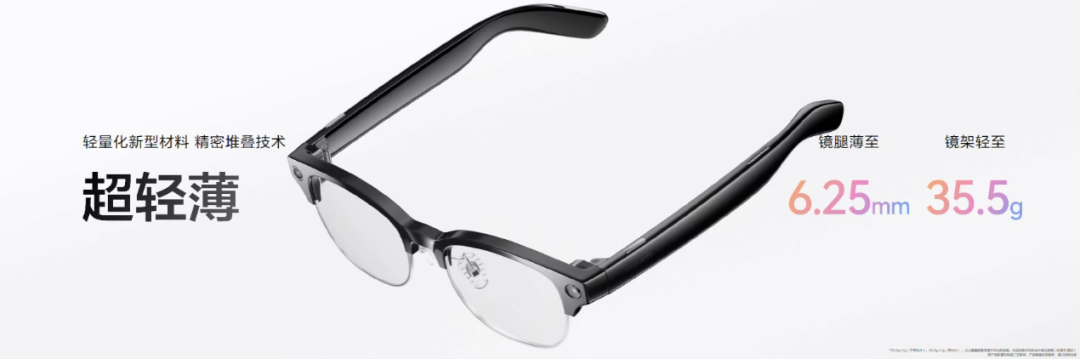
In terms of design, Huawei’s AI glasses employ innovative lightweight materials, with temple thickness reduced to just 6.25mm and a total weight of only 35.5g (excluding lenses), making them lighter than most AI photography glasses currently available.
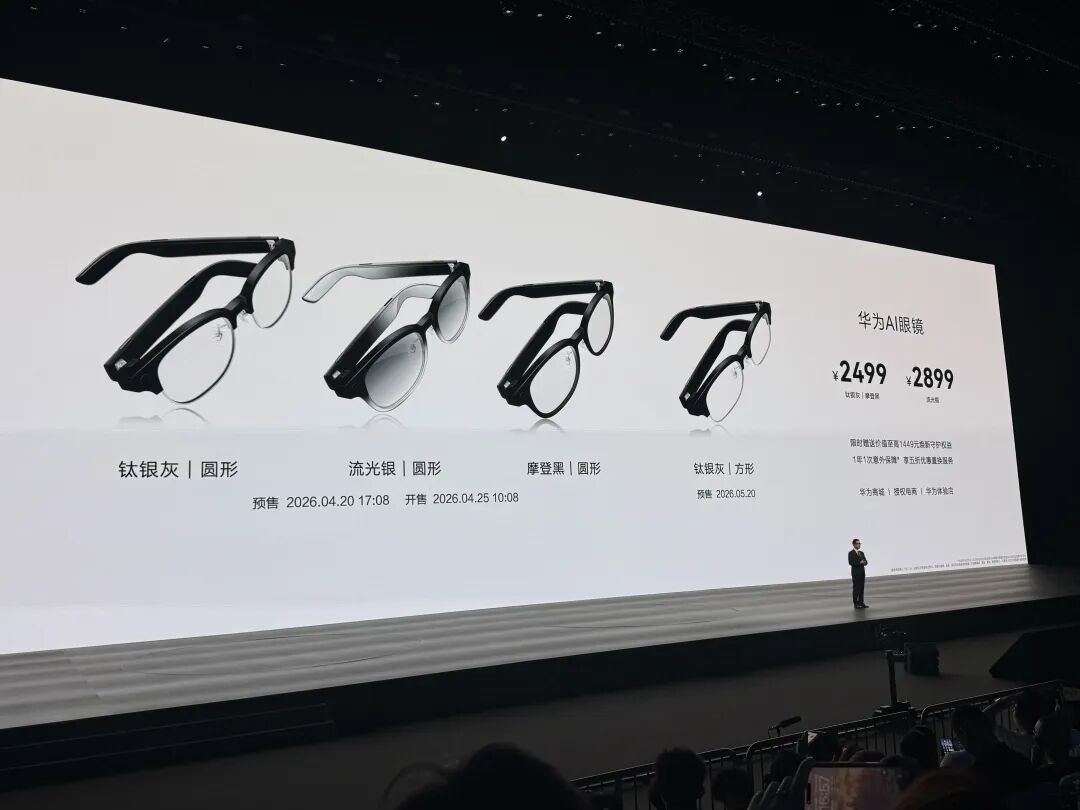
The product is available in four stylish options: Titanium Silver Gray (Round), Streaming Silver (Round), Modern Black (Round), and Titanium Silver Gray (Square), with prices starting at 2499 yuan. The Streaming Silver variant, priced at 2899 yuan, boasts a unique gradient finish on both temples and lenses.
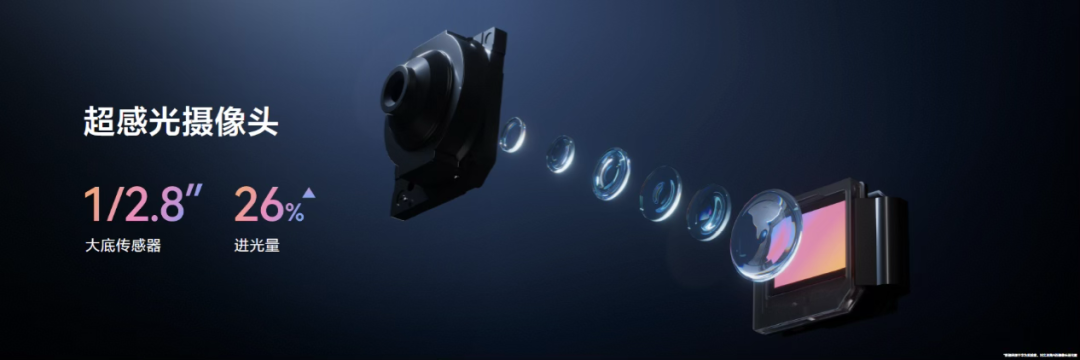
At its heart, the imaging module is equipped with a 1/2.8-inch large-bottom CMOS sensor and a 12MP camera, supporting photo resolutions up to 4096 × 3072 and video recording at 1920 × 1440 resolution and 30fps.
Event staff shared with VR Gyroscope that the product’s key selling point lies in its customized field of view (FOV) and aspect ratio adaptability. It is the first in the industry to achieve a 4:3 horizontal FOV while supporting both 16:9 (landscape) and 9:16 (portrait) outputs.
“Given the product’s emphasis on first-person POV shooting, we needed the lens to capture the user’s hand movements, so we expanded the vertical FOV. Additionally, the 4:3 aspect ratio is more suitable for sharing on mainstream platforms like Douyin and Xiaohongshu, avoiding distortion issues caused by excessive stretching of 16:9 vertical footage,” explained event staff to VR Gyroscope.
For recording duration, users can choose from 15s, 30s, 1m, 3m, and 5m options, with a default single recording length of 3 minutes. All models come with 64GB of built-in storage.
02
Dual-Chip Architecture, Delivering Up to 9 Hours of Battery Life
In terms of core specifications, Huawei’s AI glasses are powered by the company’s proprietary chips, featuring a dual-engine architecture that enables rapid, seamless processing of high-frequency AI tasks at the edge, with response speeds claimed to be 20% faster than competitors.
According to event staff, the improved response speed is evident in three key areas: significantly reduced shutter lag when capturing photos, faster data transmission, and quicker switching between high and low power modes.
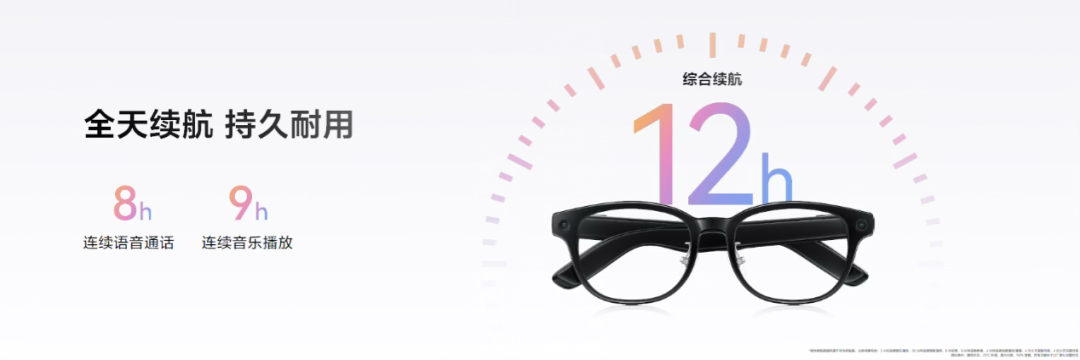
To balance high-performance computing with power efficiency, the glasses separate the Bluetooth MCU and ISP (Image Signal Processor) in their architecture, greatly extending battery life. The dual-temple batteries, totaling 252mAh, support up to 9 hours of continuous audio playback, 8 hours of voice calls, or 78 minutes of uninterrupted live streaming on a single charge.
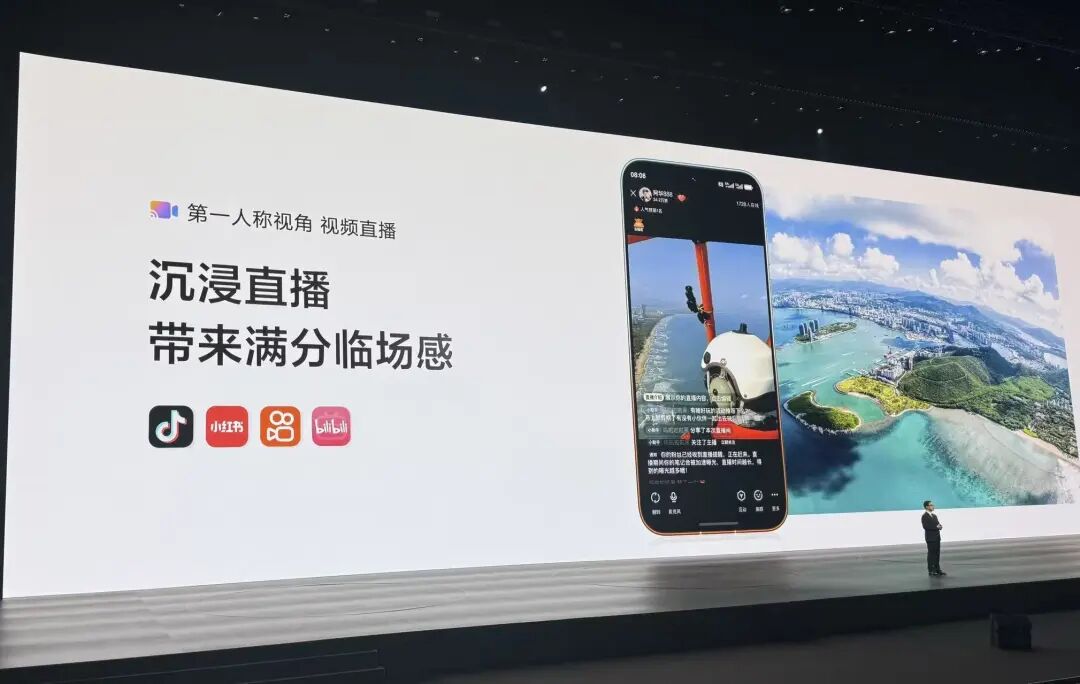
In terms of user experience, the product supports smart notifications, AI multimodal object recognition (such as animal and plant encyclopedias, food calorie estimation), and visual perception payments (Alipay), while also enabling multi-platform live streaming (Douyin, Kuaishou) and first-person video calls.
VR Gyroscope learned that features like multi-platform live streaming are exclusive benefits of the “Harmony Ecosystem.” Since mainstream short-video platforms do not open streaming interfaces to third-party peripherals, Huawei achieves this by leveraging system-level permissions on mobile devices—an ecological barrier that independent glasses hardware makers are unlikely to overcome in the near future.
03
Huawei’s Entry Shakes Up China’s AI Glasses Market
As Huawei steps into the AI glasses arena, other domestic players are also stepping up their game. AI glasses from Alibaba, Xiaomi, and Baidu have already been launched, with supply chain sources indicating strong sales for Qianwen AI Glasses and Xiaomi’s AI photography glasses.
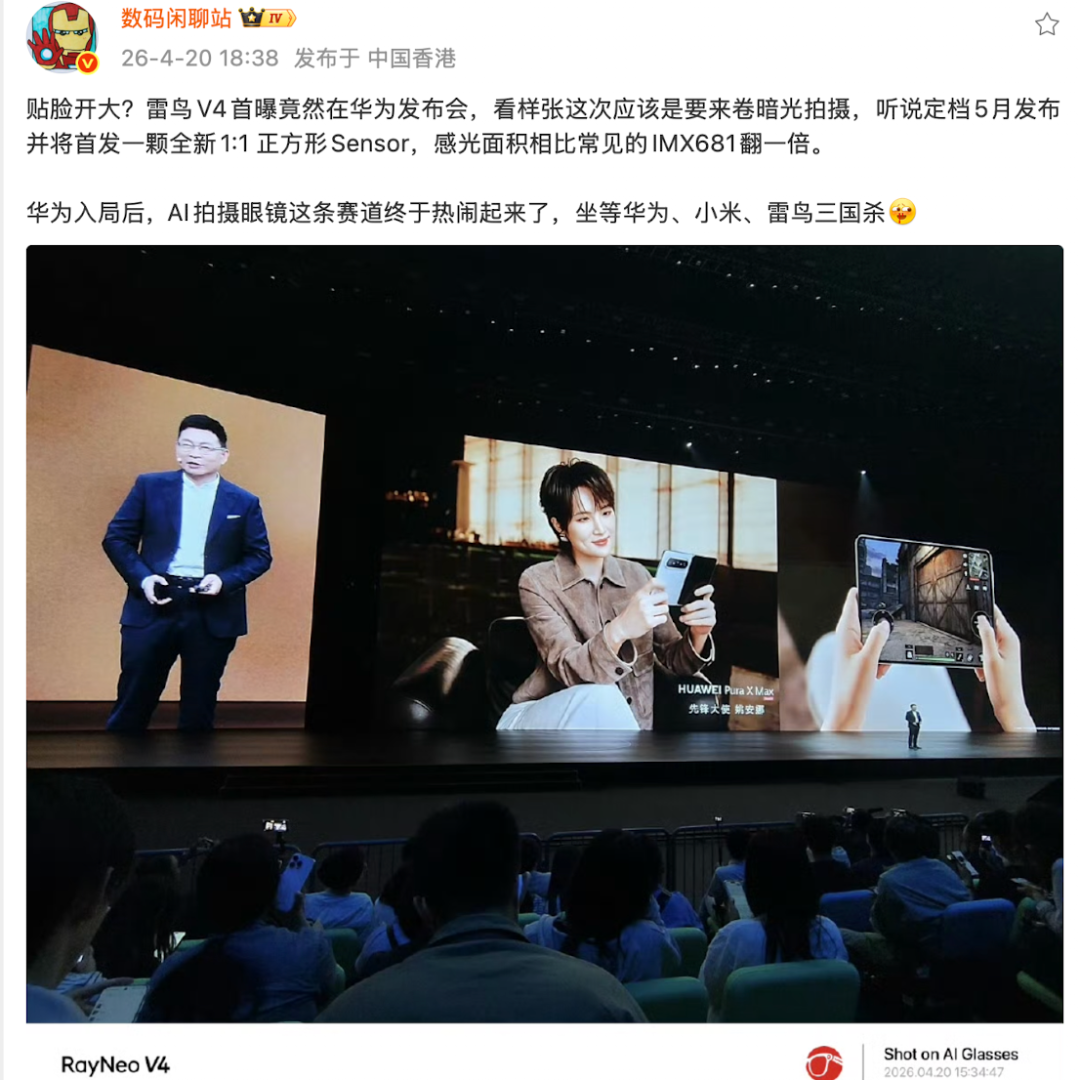
Meanwhile, Thunderbird Innovation is set to hold a launch event in May to unveil its next-gen AI photography glasses, the Thunderbird V4, featuring notable improvements in design, battery life, and imaging capabilities.
Sources reveal that the V4 will introduce a new 1:1 sensor for enhanced low-light performance. Sample images show natural colors, clear details, and strong HDR performance in low light, with no noticeable distortion in first-person captures.
Rokid is also working on its next product iteration. Earlier, Rokid CEO Misa stated at an ecosystem conference that an upgraded version of Rokid Glasses would launch this year, potentially including a full-color variant with improvements in weight, speakers, and light leakage.
XREAL, the first domestic smart glasses brand to file an IPO prospectus, is also gearing up for new releases. Besides its AI glasses collaboration with Google and split-style XR glasses, rumors suggest it is developing an all-in-one full-color AI glasses to cater to a wider range of scenarios. For smart glasses makers, all-in-one full-color AI+AR glasses represent the ultimate product form, making XREAL’s R&D efforts unsurprising.
Other players like DPVR, ZhiJing WeiZhi, INMO, Weiguang Technology, and Even are also continuously innovating, enriching the AI glasses market with diverse scene-based and market strategies. For instance, in February, DPVR officially released its pilot-style AI sunglasses, the DPVR G5 Air, for overseas markets, explicitly positioned as AI sunglasses supporting OpenAI’s ChatGPT large model.
Gyroscope Research predicts that as AI photography glasses mature and AI+AR glasses complete initial market validation, industry demand will continue to expand. The market is expected to maintain rapid growth, with shipments reaching 19 million units by 2026.
04
Why Huawei Pushes Forward While Doubao and Vivo Hold Back
In early 2026, smartphone maker Vivo chose to “pause” its smart glasses project. According to Smart Evolution, despite six months of secret preparation and Demo development, executives ultimately halted the project due to difficulties in “achieving differentiation” in the current market. Similarly, ByteDance’s Doubao AI glasses reportedly delayed production plans last month, with internal assessments citing a lack of compelling advantages in a crowded market.
In contrast to some majors’ caution amid “differentiation dilemmas,” Huawei’s entry reflects strong strategic resolve. This confidence stems partly from its self-owned “Harmony Ecosystem” foundation and partly from Huawei’s clear vision for XR industry development.
Leveraging HarmonyOS-level app permissions, Huawei’s AI glasses offer differentiated killer features like first-person video calls and short-video live streaming. Additionally, Huawei’s deep experience in smart audio glasses provides a strong user base (Huawei claims its audio glasses priced over 1000 yuan ranked first in sales from 2021-2025).
More crucially, Huawei firmly believes that 3D is the definitive technological form. This AI photography glasses model largely serves as Huawei’s “vanguard” in head-worn devices, with its evolution into an integrated AI+AR glasses—given further advancements in edge computing and optics—being only a matter of time.
-
![]()
Registered Capital Slashed to 372 Million Yuan! Yutong Optical Finalizes Industrial and Commercial Change Registration
-
![]()
Zhuque-3 Successfully Lands, and 'Time Traveler' Secures Another ¥100 Million in Funding: China's Commercial Space Industry Experiences a 'Dynamic August'
-
![]()
Autohome Faces a Shrinking Window of Opportunity
-
![]()
Even a Titan Like Musk Has Faced Setbacks in Fulfilling Promises
-
![]()
AI Office: The End of the Racing Era, Context Becomes the Key to Success
-
![]()
Domestic Vehicle Chassis Revolution ②: The Steering Wheel Remains, But Mechanical Connections in the Steering System Are Decreasing
-
![]()
Exploring MiniMax Design: Can Video Editing Be as Simple as Speaking?
-
![]()
Why Can SenseTime Achieve Profitability While CloudWalk Still Faces Challenges, Despite Both Adopting Large Models?