Why Does OPPO Maintain 200,000 Offline Stores Amid the Rise of E-commerce?
 05/20 2026
 668
668
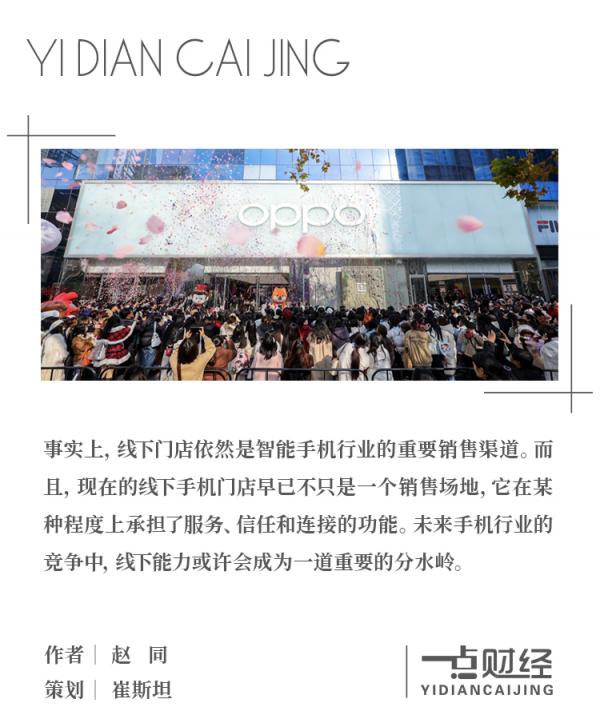
Recently, news surfaced that Apple plans to shutter three of its directly operated offline (direct-sales) stores in June this year. This move has left many surprised, underscoring the intense competition in the offline smartphone market.
However, on the flip side, some domestic smartphone brands, such as OPPO, are continuing to expand their store presence. In early 2026, OPPO announced plans to open 50 flagship stores within the next three years.
This dichotomy—where some are retrenching while others are expanding—has sparked curiosity: Why invest heavily in offline stores when online shopping offers such convenience?
After visiting several OPPO stores and analyzing their customer service offerings, Yidian Finance discovered that offline stores remain a crucial sales channel in the smartphone industry. Moreover, they now serve as more than just sales points; they are hubs for service, trust-building, and community connection. In the future landscape of smartphone industry competition, offline capabilities may emerge as a key differentiator.
Securing offline stores means safeguarding the future.
Why are offline stores still necessary in an era of advanced online shopping?
For many regular smartphone users, particularly the elderly, having a physical location to visit for assistance and issue resolution is a fundamental need. Today's smartphone stores leverage services to make technology products feel more approachable and reliable—something that pure e-commerce platforms find challenging to replicate.
Several real-life examples illustrate this point.
In September 2025, on the pedestrian street in Dong'an District, Mudanjiang, a group of elderly women in performance costumes spontaneously gathered outside an OPPO store, playing drums and gongs to attract onlookers. Initially, many assumed this was a performance team hired by the brand, but it turned out to be a volunteer act by several local women.
Here's what transpired: An elderly woman from a cultural troupe urgently came to the store to transfer music files from her phone to a USB drive. The store manager, Zhao Lili, not only resolved this issue smoothly but also patiently assisted her with subsequent phone problems. Deeply touched, the woman proposed performing with her friends outside the store as a "simple way to express her gratitude."

Many elderly individuals struggle with smartphones, and their children often live far away. The store manager mentioned that in such cases, she always takes the time to explain things slowly and clearly to ensure better understanding. She empathizes by thinking, "I'm also someone's child; I hope my parents are treated kindly when they're out."
In these everyday interactions, smartphone stores transcend mere transactional spaces. The services they provide also offer companionship to some extent. This "human touch" is precisely what gives offline stores a competitive edge over e-commerce—they address not just functional needs but also emotional ones.
A similar situation occurred in Tianjin. Yidian Finance observed that at OPPO's Tianjin Teem Plaza (Tianhe City) store, an elderly woman asked for help clearing her phone's memory and applying a screen protector. The experience consultant, Wang Qian, not only assisted her but also cleared her friend's phone memory while at it. Before leaving, Wang informed her about a remote control feature that would allow her children to help solve problems even when they weren't physically present.
Of course, not all issues can be resolved "remotely." Some elderly individuals require face-to-face, slow-paced explanations.
In Heilongjiang, a 78-year-old man accidentally deleted WeChat due to poor eyesight and became extremely anxious. He rushed to a nearby store for help, where employee Xue Jiawen calmly explained the process in simple terms while reassuring him. After completing the operation, she specially set up large-font mode and voice playback functions for the elderly man. Deeply grateful, he handwrote a thank-you letter.
These cases all lead to the same simple conclusion: Offline stores are not just places to sell goods; they are entry points for building trust between people and carriers that make tech products feel more humane.
Brands like OPPO, which operate over 200,000 stores nationwide, remain confident in offline channels precisely because they recognize this value.
In the future, competition among offline stores may shift from price to service. Stores will no longer be just places for one-time transactions but opportunities to initiate long-term relationships.
How can offline services become a brand's competitive advantage?
Though seemingly insignificant, store services can accumulate over time to form a brand's competitive moat.
What is a competitive moat? Simply put, it's something competitors cannot easily replicate. In the smartphone store system, this manifests in three levels: first, genuine reputation earned through unexpectedly excellent services; second, deep trust accumulated over time; and third, the network effect created when a vast number of stores work together.
An incident occurred at Guangzhou's Zhengjia Plaza. One summer, a college student suffered from heatstroke and entered an OPPO store to rest. The experience consultant, Yu Jiaxin, immediately brought him Huoxiang Zhengqi liquid (a traditional Chinese remedy for heatstroke) and hot water. After recovering, the student wrote a thank-you letter, saying the staff's sincerity deeply moved him. Yu later mentioned that sincerity is her "secret weapon," and providing unexpectedly excellent services was a key lesson repeatedly emphasized during her onboarding training.

The reputation built through such services often proves more persuasive than advertising. Many users trust personal experiences and word-of-mouth recommendations more than slogans on billboards.
There's also a video circulating online showing an elderly man bringing his mother into an offline OPPO store, stating upfront that he didn't plan to buy a new phone but just wanted to check the value of his old one. The reserve store manager, Li Xinyu, assured him that buying a phone wasn't necessary. She helped assess the old phone's value and applied a free screen protector. The elderly man was so satisfied that he wrote a thank-you letter afterward.
While many brands claim to prioritize "service" online, few truly set aside KPIs and focus purely on user needs offline. Yet, this is precisely the foundation for building long-term customer relationships.
Continuous accumulation of reputation transforms into deep trust.
When reputation and trust reach a certain level, combined with a sufficiently dense store network, the effect becomes entirely different. Numerous smartphone stores form a vast service network, ensuring consistent experiences whether you're in a city or a township—this may well be an impenetrable barrier for competitors to replicate.
In the future competition of the smartphone industry, products will merely serve as entry tickets; services will determine who comes out on top. Many say OPPO's competitive advantage lies in its extensive distribution channels and deep market penetration. But that's not quite accurate. Its true competitive advantage is the tens of thousands of service staff across its 200,000 stores. This network effect is nearly impossible for rivals to replicate.
Conclusion
In the smartphone industry, brands that persist in opening offline stores mostly recognize the same value: stores are not just for selling goods but for delivering services and building trust.
However, recognizing this value doesn't guarantee success. OPPO adheres to a cultural philosophy called "Ben Fen"—doing the right thing and doing things right. Doing the right thing means weaving this store service network; doing things right means ensuring every user feels the warmth from this network.
When warmth accumulates, it becomes trust. And trust, often, is a brand's deepest competitive advantage.
-
![]()
Kuaishou's 'Fundification' Strategy: Going All-in on Kling AI
-
![]()
"Tech Ferrari" Xiangjie RX: Yu Chengdong’s Glowing Review Sparks Wild Netizen Speculation: Is It the YU7?
-
![]()
Chery's 'Audi Suit Gangster' Makes Waves with Unbeatable Pricing. Netizens React: 'Is This the Aorui A6L?'
-
![]()
AITO Takes a Bold Leap, Forms Joint Venture with BMW and Mercedes-Benz
-
![]()
How Does the Cloud Data Engine Transform Physical Labor into Technical Work for Autonomous Driving Annotators?
-
![]()
Historic Strongest Mercedes-Benz GLE L Faces Intense Competition from Domestic 9 Series
-
![]()
Jeff Dean's First Entrepreneurial Venture After Leaving Google: Why Launch an AI Company 'Not Aiming to Make Money' at This Juncture?
-
![]()
Caught in the Traffic 'Web'