Farewell to Hyperlinks! Google Transforms Its Search Engine, Paving the Way for Websites' Obsolescence
 05/20 2026
 447
447
Google has made a bold move, effectively signaling the gradual decline of hyperlinks.
At the I/O conference, Google unveiled a suite of innovations including Gemini Omni, Gemini 3.5 Flash, Gemini Spark, AI-powered audio glasses, and Android Halo. These advancements seamlessly integrate robust AI and Agent functionalities across Google's extensive hardware and software ecosystem (encompassing Search, YouTube, Android, Books, glasses, and more). In contrast to the relatively isolated applications of OpenAI and other competitors, Google's approach clearly demonstrates its market dominance.
The updates to Google Search all converge on a single outcome: users will no longer need to navigate through web pages.
Agent Search Takes Center Stage, Traditional Search Takes a Backseat
For decades, the search paradigm remained consistent: users entered keywords, search engines returned links, and websites received traffic. In recent years, Google, Baidu, and Bing have progressively incorporated AI summaries into search results, acting as temporary fixes to the existing system.
This time, Google has taken a significant leap forward by introducing an alternative experience beyond the traditional 'search results page': Google Search AI Mode. Essentially a versatile ChatBox, it leverages Gemini 3.5 Flash to generate real-time responses, freeing users from the constraints of the traditional ten blue links.
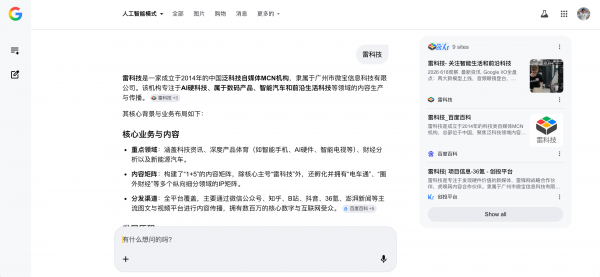
(Image source: Google)
This approach is not entirely novel; applications like Doubao, Qianwen, DeepSeek, and Kimi have already adopted similar strategies. Chinese users have embraced the 'universal input box' concept to an extraordinary extent, with Doubao boasting over 345 million monthly active users (MAU). Despite occasional inaccuracies or 'AI blunders,' younger users now instinctively turn to AI for answers rather than traditional web searches.
However, the responses from ChatBoxes, including Google's AI Mode, remain static—altering the method of information access but not its inherent form.
Google's second major initiative directly challenges the 'web page' format by introducing a new 'Generative UI' that utilizes Antigravity technology to produce dynamic results. Instead of static content, users are presented with interactive applications. For instance, searching 'how do mortise and tenon joints work?' generates an interactive demonstration; searching for a new car model instantly transports users to an AI-generated 3D space where they can explore interiors, inspect seats, and simulate driving views.
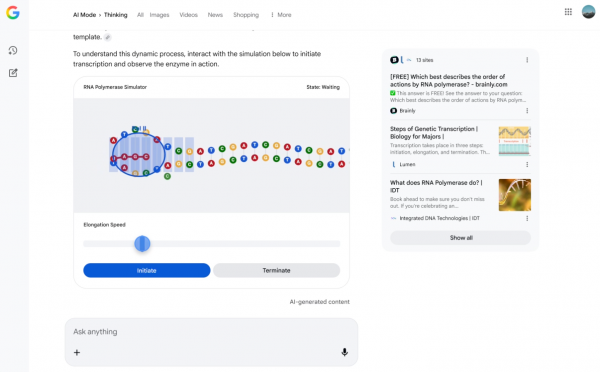
(Using Google AI Search: 'Explain how RNA polymerase works. What are the stages of transcription? How does transcription differ between prokaryotic and eukaryotic cells?')
Each search dynamically customizes an application, presenting results in a more vivid, intuitive, and interactive manner—though not all queries necessitate such elaborate outcomes. AI determines the most suitable format based on user intent.
This marks a true revolution. For decades, the internet's foundational logic has been centered around 'web pages carrying information,' with Google facilitating their discovery by accelerating information flow. Now, Google contends that web pages are redundant intermediaries, as AI can either aggregate information from third-party pages or provide more appropriate interactive interfaces, fundamentally altering the information flow.
Once upon a time, the internet was openly 'interconnected': HTTP connected, HTML expressed, and browsers accessed. But in the AI era, Gemini assumes control, reducing web pages to disposable outputs generated for users who rarely interact with them directly.
Websites Degrade into Databases, Primarily for AI Consumption
Google also introduced Agent Gemini Spark for individual users, integrating it seamlessly into search. This transformation turns search into a continuous, 'lobster-like' process, with Spark running in the background 24/7, monitoring specific information based on user requests. For example, a Leikeji editor could instruct the search Agent to track AI news from OpenAI, Anthropic, Grok, Perplexity, and X, receiving email alerts for major breaking stories.
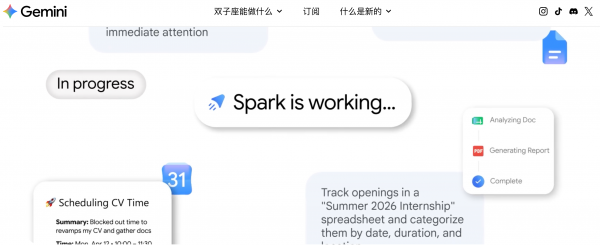
(Image source: Google)
Gemini Spark operates on Google Cloud, supporting multi-device collaboration. Users can assign tasks on their phones and receive results on their computers. It already integrates with Google’s ecosystem (Google Docs, Calendar, Gmail, etc.) and will soon connect with external apps via the MCP protocol, enabling comprehensive task delegation. Future integrations include Android Halo, Google Books, Chrome, and AI glasses.
Web pages are now primarily created for Agents like Spark, and even applications must develop 'Skills' to interface with them, actively feeding content to AI. Users are only presented with final answers, rarely concerning themselves with the information's origin.
This scenario echoes Chris Anderson's (the father of the Long Tail Theory) famous 2010 Wired article, 'The Web Is Dead, Long Live the Internet.' He argued that while the Web was dying, the internet would endure. At the time, the mobile internet was on the rise, and users were shifting from browsers to apps, fragmenting the open Web into isolated silos.
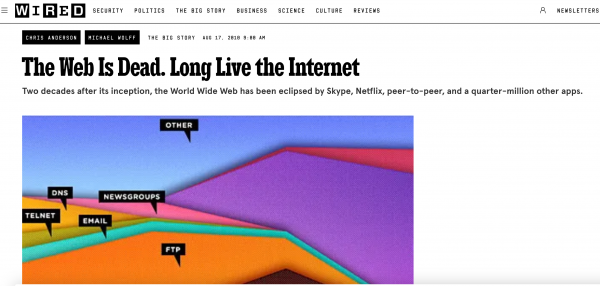
(Image source: Wired)
Following the mobile revolution, browsers were marginalized, and companies like Sogou, Cheetah Mobile, and Firefox faded into obscurity. Users' time was consumed by apps; many young people today are unaware of URLs, relying solely on Douyin, Xiaohongshu, WeChat, and Taobao.
However, the transition from PC to mobile was merely an 'entry point migration.' Web pages still existed, albeit hidden behind apps—this article, for instance, is hosted as a web page, but users don't need to know its URL.
Google's current move is different: it aims to eliminate the 'click' itself. As Anderson wrote, we love the open, free Web but are abandoning it for simpler, trendier, more comfortable services. Sixteen years later, that service has arrived: Agents, simple and effective enough to replace traditional web navigation.
The Web will truly meet its end. Websites once relied on Google for traffic, and Google needed their content, giving rise to SEO. But AI now provides answers instead of links, completing tasks without the need for users to click through web pages. Results from AI searches are accurate enough; if not, users can probe further without leaving the AI interface. For verification, they're more likely to cross-check with other Agents.
Thus, SEO fades into obscurity, and GEO (Generative Engine Optimization) takes center stage. Brands no longer strive for 'top web rankings' but aim to 'become the answer,' strategically feeding content into AI to secure prime positions as the sole solution to relevant queries. Using misinformation for this purpose is 'AI poisoning'; the legitimate approach is GEO. One GEO tactic involves flooding websites with content to feed AI. GEO may become websites' last remaining value, with most traffic originating from AI and Agents, which decide whether to cite or aggregate content.
Gemini Can't Take Over Everything; Apps Still Have a Bright Future
Google's Android Halo mode strengthens Agents and will integrate Spark for Agent-ization. Meanwhile, true AI phones like Doubao's will also adopt Agents. Will Agents consume all information and services on mobile, rendering apps obsolete?
No.
Websites are being eliminated because their core value lies in 'displaying information.' The Web era thrived on search, portals, forums, blogs, and browser games, but the WEB ecosystem has sharply declined into an 'internet information ecosystem,' further polluted by AIGC content in recent years.
However, the internet's truly complex, valuable components are service systems, all housed in apps—e-commerce, payments, social media, logistics, short videos, local services, and mobile games. These require sophisticated capability systems beyond simple information display, which Agents cannot replace anytime soon, at best only interfacing with them.
Moreover, apps are fighting back by embracing AI. Amazon explicitly blocks AI scraping, including from Gemini, realizing that if AI captures its product info, reviews, and pricing, users might not need to open Amazon. Even if they use Amazon’s fulfillment services, the platform would demand fees from AI.
China's internet mirrors this trend. Alibaba's 'All in AI' strategy encompasses not just AI infrastructure built on Alibaba Cloud's substantial investment—Zhenwu AI chips, Qwen foundation models, Bailian inference platforms, and AI apps like Qianwen and Kuake—but also a thriving consumer service network: Taobao, Taobao Deals, Fliggy, Taopiaopiao, Hema, Gaode, Cainiao, and external platforms like Alipay. These apps represent physical-world services and capabilities, including SKUs, logistics, payments, finance, membership, instant delivery, and merchant fulfillment, plus vast consumer behavior data. Qianwen rapidly integrates Alibaba’s ecosystem into a unified portal, forming an end-to-end service loop.
No matter how powerful Gemini becomes, it cannot automatically generate human relationships, payment systems, supply chains, content copyrights, financial capabilities, or offline fulfillment networks—Meta, Amazon, Alibaba, and Tencent’s core competitive advantages.
Yet Google's upgrades are still worth noting: as the greatest beneficiary of the open internet, Google has ruthlessly killed hyperlinks. The old internet king, who ruled by distributing blue links, overturned its own foundation. It knows this will disrupt website traffic systems and search ad models but must act: better to self-destruct before OpenAI, Perplexity, or Anthropic does it, and achieve rebirth through AI.
In 'The Web Is Dead, Long Live the Internet,' Chris Anderson said the internet would endure: the World Wide Web is just one form of the internet, whose essence—connection, openness, and intelligence—is seamlessly integrating into humanity’s underlying logic. Now, it seems he was at least one-third right: intelligence is ubiquitous.
-
![]()
Doubao Work Unveiled! Domestic AI Leaders Fully Commit to the 'Work' Sector
-
![]()
Who’s Sounding the Alarm on ‘Rushed Vehicles’?
-
![]()
Over 5.3 Billion Yuan in Losses Over Three and a Half Years! Can Yonyou Reverse Its Fortunes Through Streamlining and AI Transformation?
-
![]()
Baidu AI Adopts Free Model: A Strategic Maneuver in Traffic and Monetization
-
![]()
Silicon-Based OLED Pioneer Unveils Financial Results: H1 Shipments Outpace Entire 2025 Volume
-
![]()
AI's First "Lost Summer"
-
![]()
Zeiss Makes Another €2.2 Million Bet: Will Eye Tracking Be the Next Big Thing in the Smart Glasses Industry?
-
![]()
RUNTO Ranking | Global Top TV ODM Factories' Shipment Figures for July 2026