Internet Valuation Logic Shifts: From Scale Narrative to Profit Accountability
 06/30 2026
 720
720
By Bishan
Source: Bowang Finance
On June 26, 2026, Meituan held its Annual General Meeting of Shareholders. CEO Wang Xing stated at the meeting, 'The company's stock price has been unsatisfactory over the past few years, and I feel deeply responsible for this.' He added, 'Since the company's inception, I have not sold a single share.'
On the same day, Meituan's stock price closed at HK$64.25, with its market value falling below HK$400 billion, marking a one-year low. Year-to-date, the stock price has fallen by over 37%. Meituan's IPO price in 2018 was HK$69—meaning that nearly eight years after listing, the stock price has returned to its starting point and even broken below the IPO price. CFO Chen Shaohui stated at the meeting that the company's value is 'severely underestimated' and announced plans for stock repurchases.
This issue is not unique to Meituan. Looking at Hong Kong stocks on the same day: Alibaba stood at HK$89.5, down over 32% year-to-date; Tencent Holdings had a price-to-earnings (PE) ratio of 14-15 times, having just hit a year-to-date low of HK$420.4 in late May; the Hang Seng Tech Index fell over 22% year-to-date. From Alibaba and Tencent to Meituan and Kuaishou, and further to Bilibili, iQIYI, and Zhihu—Chinese internet assets are undergoing a collective valuation reassessment.
(Source: East Money)
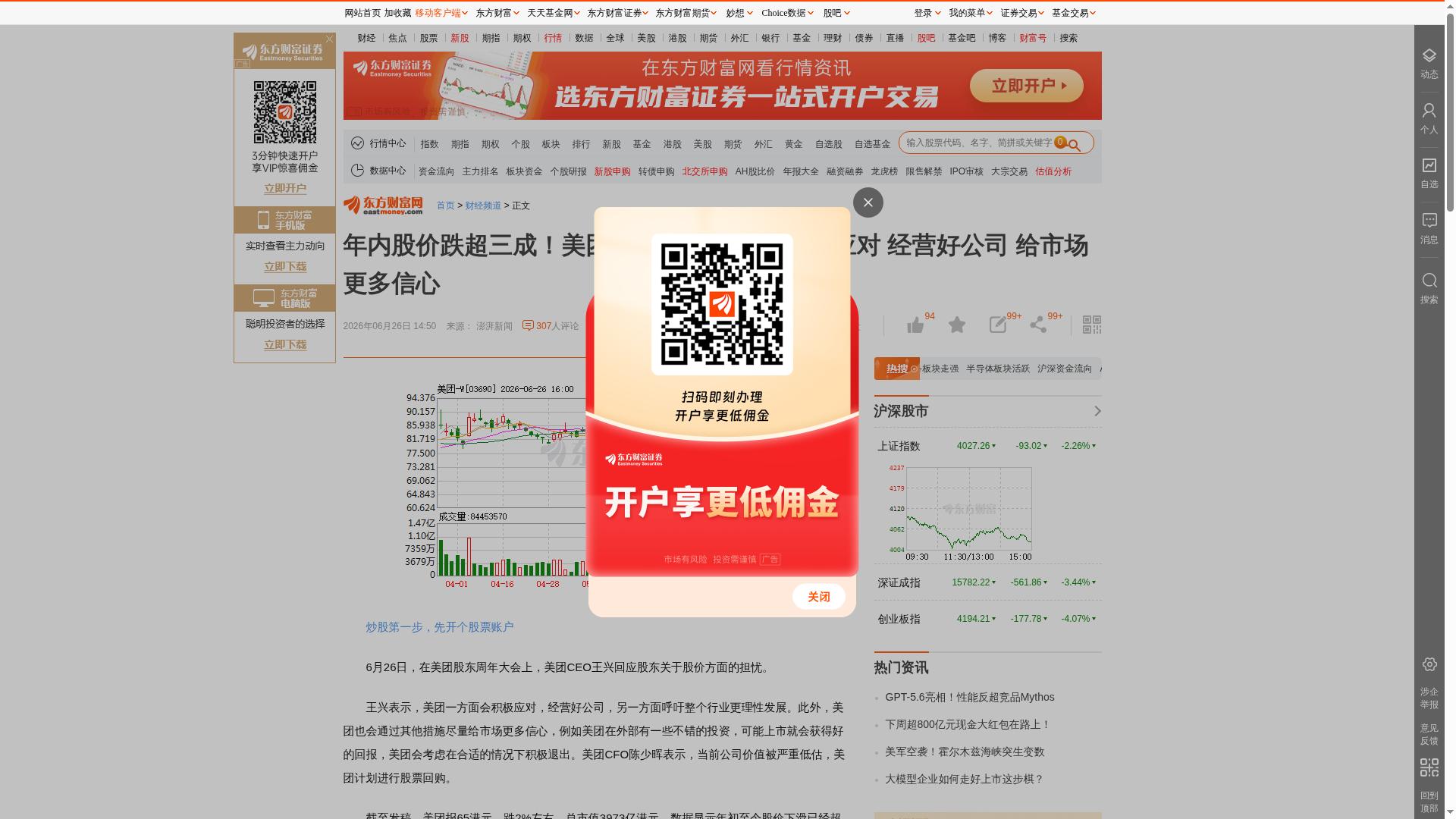
East Money: Meituan's stock price has fallen over 37% year-to-date, with market value dropping below HK$400 billion on June 26
01
Meituan: After Spending HK$200 Billion, What Has Been Achieved?
Wang Xing reflected on two major regrets from the past five years at the shareholders' meeting. The first was the delayed international expansion, stating, 'We should have gone global earlier,' and missed the window of rapid growth in foreign food delivery penetration. The second regret was Meituan Select—a major investment starting in 2020, which was gradually shut down by 2025. Wang admitted, 'Non-standardized products easily lead to price-based selection, slipping below the bottom line (bottom line), and despite significant resource investment, expectations were not met.'
Together, these regrets point to the same issue: Over the past few years, Meituan has poured massive funds into new businesses, but most have failed to deliver expected returns.
CFO Chen Shaohui revealed an even more sobering figure at the meeting: Rough estimates suggest that the industry invested approximately HK$200 billion in food delivery competition over the past year, but much of it was 'ineffective internal competition, failing to create incremental value.' What does HK$200 billion represent? Meituan's total revenue for 2025 was about HK$250 billion—meaning the company essentially burned nearly an entire year's revenue in price wars, only to conclude with the phrase: ineffective internal competition.
(Source: Tencent News/First Financial)
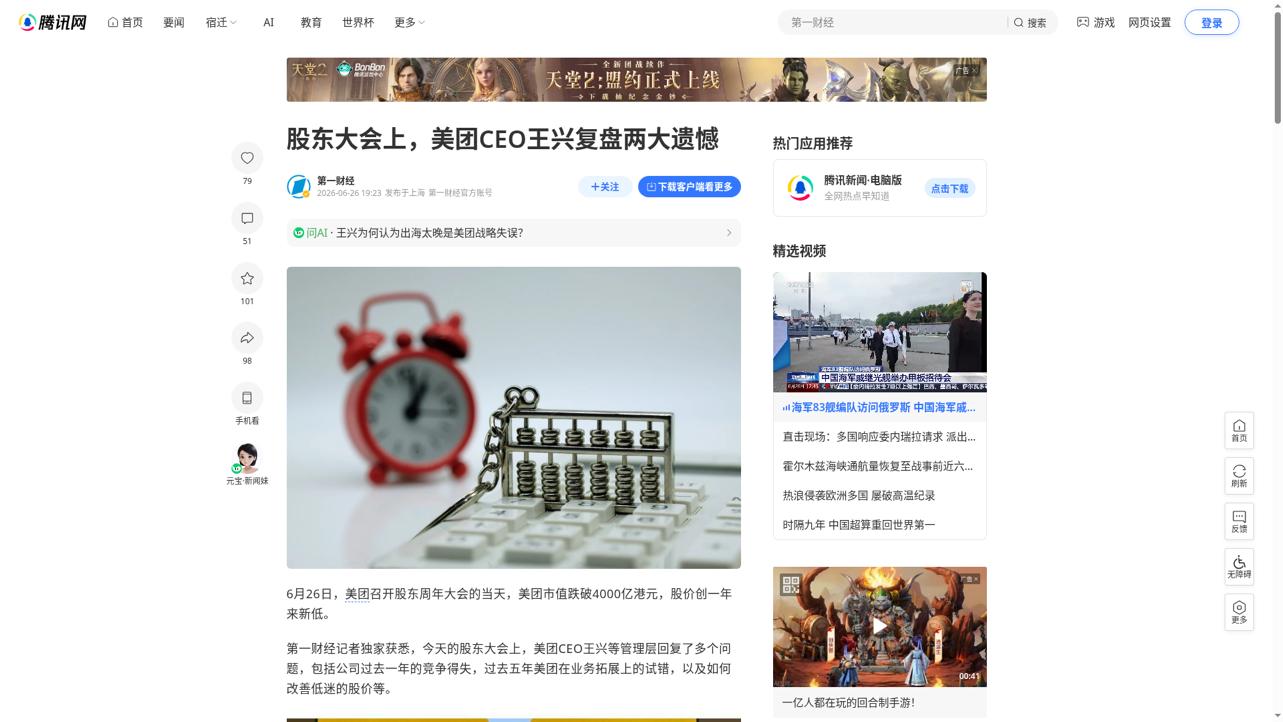
First Financial: On June 26, the day of Meituan's Annual General Meeting of Shareholders, its market value fell below HK$400 billion, and its stock price hit a one-year low
02
Tencent: Is a 14x PE a Bargain or a Trap?
Now, let's look at Tencent. In early June 2026, Tencent's stock price surged by 10% in a single day, marking its highest daily gain in five years. However, this followed eight months of sluggish performance—from a high of HK$677.7 in October 2025 to a low of HK$420.4 on May 28, 2026, representing a maximum drawdown of 38%.
Even after the rebound, Tencent's trailing PE ratio remains in the 14-15x range. How does this compare? Meta's PE ratio is 25x, and Google's is 20x. Tencent, as a benchmark for Chinese internet companies, is valued at just half to 70% of its U.S. peers.
Why is the market withholding valuation from Tencent? Three reasons:
First, massive AI investments with no short-term returns. In 2025, Tencent's capital expenditures reached HK$79.2 billion, with HK$18 billion allocated to new AI products. President Martin Lau publicly stated that AI and model investments would at least double in 2026, possibly leading to a reduction in share buybacks. Upon this announcement, the stock price fell over 6%. The market is asking: With so much invested in AI, when will it become profitable? Tencent has no clear answer.
Second, slowing growth in the gaming business. Gaming is Tencent's cash cow, contributing about one-third of its revenue. However, the domestic gaming market is nearing saturation, and while game approvals have loosened, regulatory scrutiny remains strict. International gaming revenue grew by 34%, which looks promising, but the base is small, making it difficult to drive overall growth in the short term.
Third, dwindling liquidity in Hong Kong stocks. The Hang Seng Tech Index has fallen over 22% year-to-date, with foreign capital continuously flowing out of the Hong Kong market. As one of the largest weighted stocks in the Hong Kong market, Tencent is inevitably affected by this liquidity crunch. A 14x PE is not just a Tencent issue—it reflects a broader problem across Hong Kong's tech sector.
On May 13, Tencent passed a new buyback resolution, authorizing the repurchase of up to 10% of its outstanding shares. At the time, this represented approximately HK$50 billion based on market value. But can buybacks sustain the stock price? Referencing Meituan's precedent—announcing a US$1 billion buyback plan in November 2023 did not prevent the stock from falling from over HK$100 to HK$64. Buybacks can only slow the decline; they cannot change the fundamentals.
03
Alibaba: Back to 2014
Alibaba's stock price trend is even more symbolic. Closing at HK$89.5 on June 26, 2026, the stock has fallen over 32% year-to-date. Historically, Alibaba's stock price has returned to its March 2020 level—the low point at the onset of the pandemic.
Alibaba's challenges are more complex. Its e-commerce core faces erosion from Pinduoduo and Douyin E-Commerce, with market share continuously declining. Cloud computing growth has slowed, facing fierce competition from Huawei Cloud and Tencent Cloud. While international business is growing nicely, its scale remains too small to support overall valuation. A series of adjustments following Jack Ma's return—splitting into '1+6+N' and appointing Joe Tsai and Eddie Wu as management—have yet to show results in financial performance.
From a valuation perspective, Alibaba's forward PE ratio is about 10-12x, falling into the value stock range. However, the market is hesitant to assign valuation because Alibaba's profit floor remains uncertain. With each quarterly earnings report, the market asks the same question: Has the profit decline bottomed out? The answer remains: Not yet.
Kuaishou faces a similar situation. Despite revenue growth in Q1 2026, adjusted net profit fell 46% year-over-year. The core issue lies in the commercialization efficiency of content and e-commerce businesses—traffic growth has slowed, ad load rates are nearing ceilings, and e-commerce GMV growth is decelerating. Kuaishou's valuation logic is shifting from 'high-growth platform' to 'mature platform,' and during this transition, valuation multiples are inevitably declining.
Bilibili's situation is even bleaker. Its U.S.-listed stock has fallen over 60% year-to-date, while its Hong Kong-listed stock has dropped nearly 50%, with a market value below HK$30 billion. Commercialization efforts have yet to find a breakthrough, gaming performance is lackluster, ad revenue growth has slowed, and membership subscription growth is weak. Capital market patience with Bilibili is wearing thin—if profitability is not achieved in 2026, the company may face even harsher survival pressures.
04
Valuation Logic Shift: From 'Scale Narrative' to 'Profit Realization'
The reassessment of Chinese internet asset valuations fundamentally represents a shift in logic: The market is moving from rewarding 'scale' to penalizing 'unprofitability.'
From 2019 to 2021, Chinese internet was in the golden age of 'scale narrative.' Capital believed that with enough users and GMV, profitability was just a matter of time. During that period, Meituan incurred hundreds of billions in losses, yet its stock price hit record highs; Alibaba and Tencent traded at 40-50x PE, which the market considered normal. Everyone was betting on a future where Chinese internet users grew from 800 million to 1 billion, ARPU doubled, and platform economies dominated everything.
But that future never arrived. User growth peaked, ARPU did not double, and price wars intensified. More critically, the regulatory environment changed—antitrust, data security, and education reforms shattered the narrative of 'unlimited expansion' for platform economies.
From 2023 to 2024, the market attempted to pivot to a new narrative: 'AI empowerment.' Tencent invested in the Hunyuan large model, Alibaba launched Tongyi Qianwen, Baidu developed ERNIE Bot, and Meituan explored AI applications in local services. However, the payoff period for AI narratives is too long, with no short-term profit contributions. After a year and a half, the market's patience ran out.
By 2025-2026, the market had fully shifted to 'profit realization' mode. It no longer cares about user counts, GMV, or AI investments—only one metric matters: profit. Meituan is still losing money, so its stock broke below IPO price; Alibaba's profits are declining, so its PE is just 10x; Tencent's profit growth is slowing, so its PE is only 14x. This is not bias—it's an inevitable result of valuation model shifts.
Global capital allocation to Chinese internet is also declining. Geopolitical risks, U.S.-China tensions, and dwindling Hong Kong stock liquidity have created a negative feedback loop: Foreign capital outflows → stock price declines → valuation compression → more foreign capital outflows. Breaking this cycle requires not buybacks or CEO statements, but tangible profit growth.
From an industry perspective, Chinese internet has entered a ' Stock game (stock competition)' phase. User growth has peaked (1.2 billion netizens, over 85% penetration), average usage time is no longer increasing, and penetration rates across sectors are already high. This means the dual-engine growth model of 'user growth + usage time expansion' that platforms relied on in the past has failed. New growth must come from ARPU increases (difficult in a consumption downgrade environment), international expansion (more resistance for Chinese companies post-TikTok incident), or AI empowerment (too long a payoff period). All three directions are challenging, so the market chooses not to assign valuation—because no clear second growth curve is visible.
(Source: Sina)
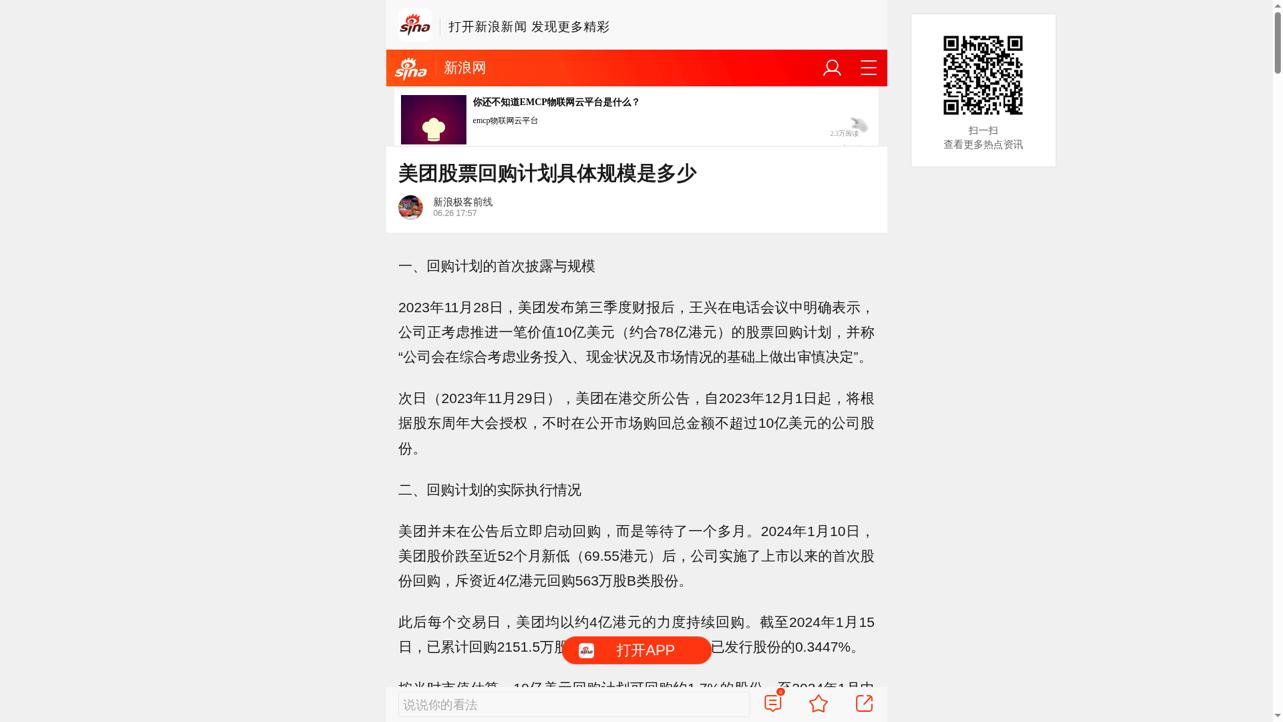
Sina: Meituan's US$1 billion stock buyback plan fails to impress the market
05
Conclusion: Have We Hit Bottom?
Where is the valuation floor for Chinese internet assets? Historical data suggests Tencent's extreme low PE was 12-13x (during the October 2022 Hong Kong liquidity crisis), while Meituan's price-to-sales (P/S) ratio was around 1x. Based on current stock prices, Tencent's PE is 14-15x, and Meituan's P/S is 1.6x—still some distance from extreme lows, but not far either.
The issue is that even reaching valuation bottoms does not guarantee an immediate rebound. Valuation bottoms and stock price bottoms are two different concepts. A valuation bottom only means 'no longer expensive,' while a stock price bottom requires a fundamental turning point for confirmation—and that turning point is not yet visible.
Wang Xing said, 'Irrational competition in the industry is improving.' If this proves true—if Meituan achieves core business profitability in the second half of 2026, if Tencent's AI investments start generating returns, if Alibaba's profit decline bottoms out—then current prices may represent a long-term bottom. But if these 'ifs' fail to materialize, then HK$64.25 for Meituan, HK$420 for Tencent, and HK$89 for Alibaba are not yet the bottom.
The rewrite of internet valuation logic is fundamentally a revolutionary shift from 'believing in stories' to 'only caring about profits.' In this revolution, some will be eliminated, and others will be reborn. For investors, the key is not guessing where the bottom is, but understanding whether the companies they invest in can survive under the new valuation regime.
-
Alibaba’s Earnings Soar with Triple Catalysts: Full-Stack AI Hits Maturity, Capital Efficiency Drives Sustainable Growth
-
![]()
Raking in Big Profits Overseas! Chery’s Overseas Revenue Makes Up 70% in H1, with Gross Margin Climbing to 16.1%
-
![]()
Alibaba’s New Fiscal Quarter: 45% Revenue Surge in Alibaba Cloud, Enhanced Profitability in AI Cloud, but Widening Losses in the Application Layer
-
![]()
The AI Version of 'PayPal Mafia' Has Arrived: 20 AI Startups Raise Over $4.6 Billion in Funding
-
![]()
Wang Jian's Vision: Paving a Pathway for Alibaba Through AI
-
![]()
Hyundai Motor Workers Strike Today, Fearing Job Losses to Robots
-
![]()
Embracing 'Light': O-film Unveils Its 'Illuminating the Future' Strategy
-
![]()
SenseTime’s SenseNova U1.5 Lite Goes Open Source: Ushering in a New Era of Predictable AI Image Generation