The Successful Debut Flight of Long March 10B: China’s Unique Approach to Reusable Rockets Diverges from SpaceX
 07/13 2026
 432
432
NEW PERSPECTIVES
This is the 86th original article from the Thinking AI Society.
Approximately 1,860 characters in total, with an estimated reading time of 6 minutes.
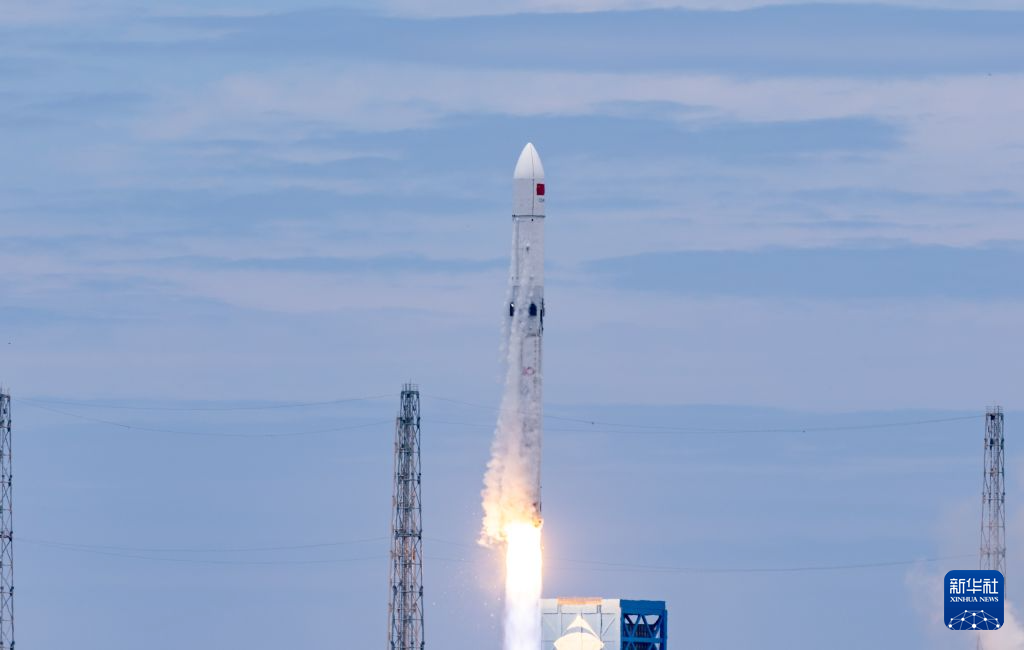
The news of the successful maiden flight of the Long March 10B rocket at the Hainan Commercial Space Launch Site took center stage in my newsfeed at noon today. The satellite smoothly entered orbit, and the first stage was precisely caught by a massive flexible net aboard the "Navigator" recovery vessel.
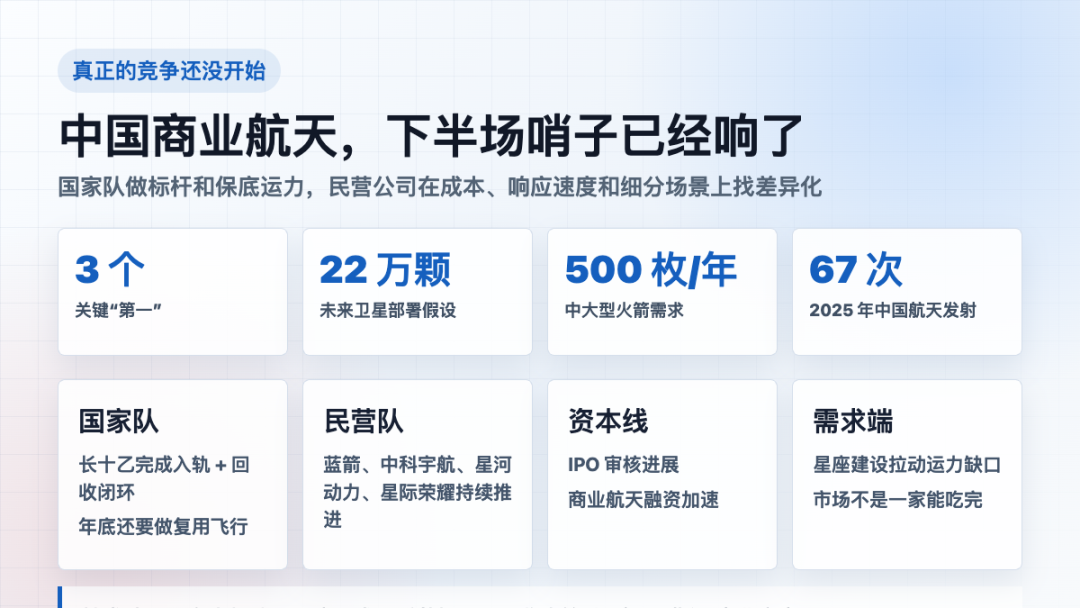
Three Milestones Achieved: China's first controlled recovery of a rocket's first stage, the world's inaugural sea-based net recovery, and China becoming only the second nation, after the United States, to master large-scale reusable rocket technology.
Witnessing this historic moment of successful recovery truly evokes a sense of national pride!
It's widely acknowledged that SpaceX pioneered rocket recovery technology. So, how does China's technological approach differ from SpaceX's, and what implications does this hold for the global commercial space industry?
Net-Based Recovery vs. Landing Legs: Divergent Technical Philosophies
Let's delve into the core technical disparities.
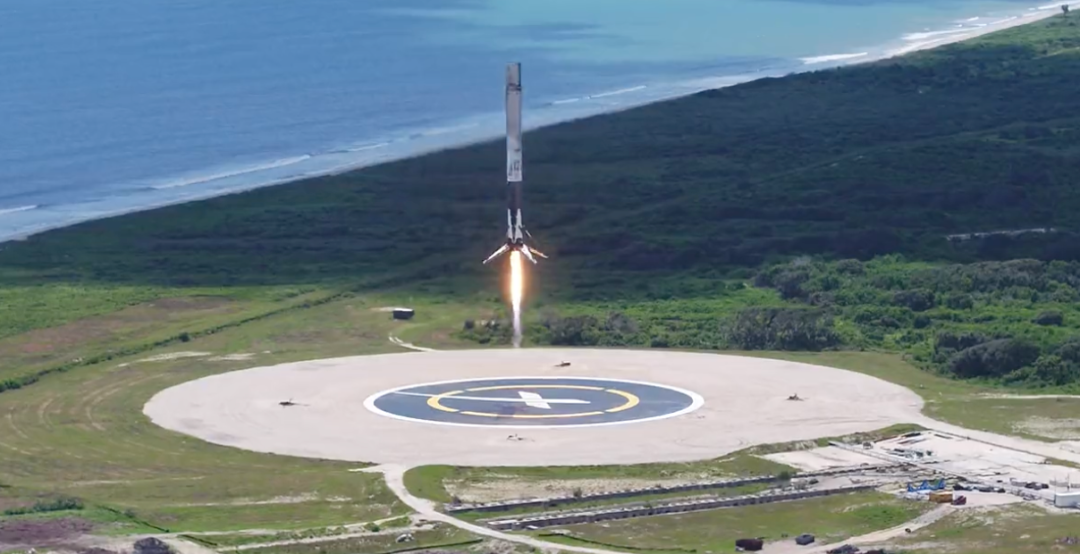
SpaceX's Falcon 9 employs a landing leg system—the rocket descends vertically, deploying four legs to stabilize itself on the recovery vessel's deck. This method has been a hallmark of "reusable rockets" for over a decade.
In contrast, the Long March 10B opts for net-based recovery. The rocket's base is devoid of landing legs, featuring only four hooks.
The "Navigator" recovery vessel deploys a colossal "well"-shaped flexible net. As the rocket descends, it is captured by the net, with four ropes providing cushioning and securing it in place.
Why choose this path?
The official rationale highlights higher fault tolerance, better adaptability to landing point deviations, and a lighter rocket body.
Let's examine the specifics of the Long March 10B launched this time.
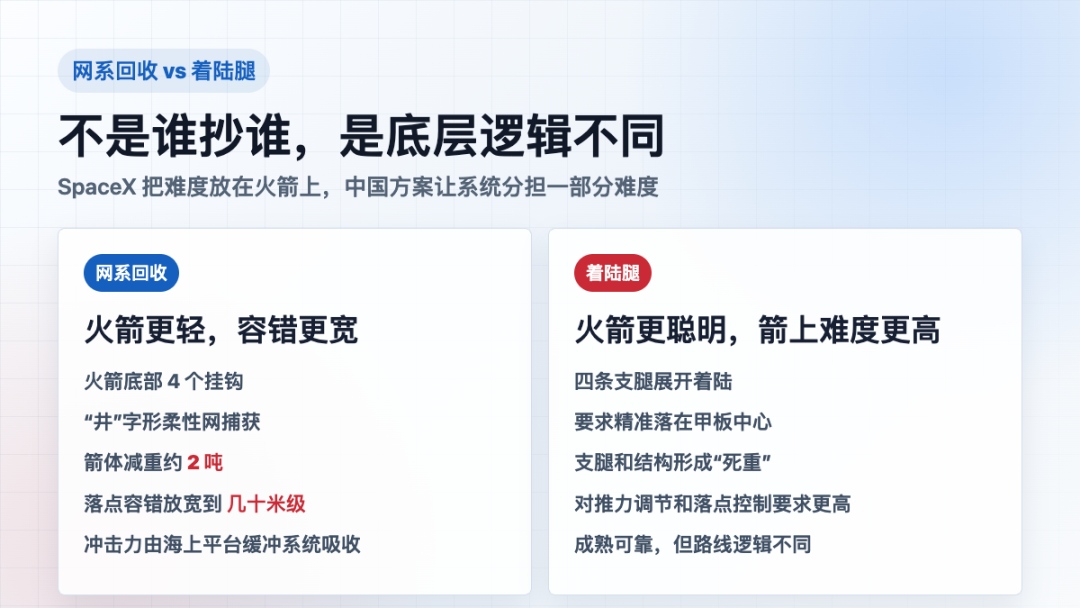
The rocket body is approximately 2 tons lighter.
Landing legs and support structures constitute dead weight that must be carried on every launch, directly consuming payload capacity. Net-based recovery eliminates this, making the rocket itself lighter and naturally increasing its payload capacity. In its recoverable state, the Long March 10B boasts a Low Earth Orbit (LEO) payload capacity of 16 tons, roughly on par with the Falcon 9.
Landing point fault tolerance is relaxed from meter-level to tens-of-meters-level accuracy.
The landing leg approach necessitates the rocket to land precisely at the center of the deck; even a slight deviation can cause it to tip over. Net-based recovery only requires the rocket to "land roughly within the net," imposing much lower requirements on engine thrust regulation and landing point control—higher fault tolerance means easier reliability improvements.
Kinetic energy is absorbed by the ground system, reducing stress on the rocket body.
When the rocket enters the net, most of the impact force is absorbed by the buffer system of the offshore platform, reducing the load on the rocket body itself.
Conversely, the recovered rocket body experiences less damage, lowering the costs of reuse inspection and refurbishment.
Of course, this approach comes with its own costs. A dedicated recovery vessel is required—the "Navigator" is 144 meters long, 50 meters wide, with a full-load displacement of 25,000 tons, the only one of its kind globally.
This vessel is itself a massive engineering system, featuring DP2 dynamic positioning and stable operation in Sea State 5 conditions, with technological complexity no less than that of the rocket.
In essence, SpaceX's approach is to "make the rocket smarter," concentrating difficulty on the rocket itself; China's approach is to "have the system share the burden," transferring some of the difficulty to ground/sea-based facilities.
Neither approach is inherently superior; each has its own applicable scenarios.
However, once net-based recovery is proven viable, it will have a demonstration effect for later adopters—as mentioned in reports by Financial Associated Press, private companies like Arrow Yuan Technology and Huosheng Aerospace are also pursuing similar approaches.
The Long March 10B: More Than Just a Commercial Rocket—A Strategic Piece in a Larger Puzzle
Many may not realize that the Long March 10B is not an isolated model; it is an "intermediate link" in the Long March 10 series.
The overall framework of the Long March 10 series is very clear:
Long March 10A: Crewed version, with a liquid oxygen-kerosene core stage and upper stage, primarily for crewed spaceflight and space station cargo transport, adhering to the highest safety standards.
Long March 10B: The model that made its maiden flight today, retaining the 10A's first stage while switching the upper stage to liquid oxygen-methane, targeting commercial launches and validating net-based recovery technology. The first stage is designed for reuse ≥10 times.
Long March 10C: Fully transitions to liquid oxygen-methane, switching recovery methods from net-based back to landing legs, aiming for high-frequency reuse—with a goal of reusing a single first stage more than 10 times per month. Expected to make its maiden flight before the end of this year.

Do you see the pattern? This is a typical progressive path of "using crewed technology as a foundation → validating with commercial models → ultimately achieving high-frequency commercial launches."
The first stage of the Long March 10B shares modules with the Long March 10A (crewed rocket), meaning that data accumulated from every commercial launch feeds back into improving the reliability of the crewed rocket.
Conversely, the safety redundancy design of the crewed rocket provides a foundation for the commercial model.
This forms an interesting contrast with SpaceX's path from Falcon 1 to Falcon 9 to Starship, which entirely built upward from the commercial end.
Another detail worth considering: The Long March 10B's upper stage uses liquid oxygen-methane, while the first stage remains liquid oxygen-kerosene.
Why not go fully methane at once? Because liquid oxygen-kerosene is mature and reliable, allowing the team to first validate first-stage recovery before moving on.
Once the technology is proven, the Long March 10C will fully switch to liquid oxygen-methane—methane burns cleanly without coking, allowing for simple inspections and reuse after recovery, making it more suitable for high-frequency reuse scenarios.
First, achieve availability; then, strive for quality; finally, strive for speed. This pace is very much in line with the ethos of the China Aerospace Science and Technology Corporation—and very Chinese.
The Second Half of China's Commercial Space Industry Takes Off
The successful maiden flight of the Long March 10B's greatest significance may not be "adding another rocket model" but rather the national team's official entry into the reusable rocket arena.
Prior to this, the story of reusable rockets in China was primarily told by private companies: LandSpace's Zhuque-3, CAS Space's Lijian-2, Galactic Energy's Pallas-2, i-Space's Hyperbola-3... Each had its own timeline, but none had yet completed the full closed loop of "orbital insertion + recovery."
Now, the Long March 10B has achieved both in one step, with successful orbital insertion, successful recovery, and plans for a reused flight by the end of the year. The weight of this signal is significant.
Some may worry: With the national team entering the field, do private companies still have a chance?
My view is quite the opposite—this is actually a positive development.
Why? Because the market for reusable rockets is vast enough that no single company or even a few companies can satisfy it alone.
LandSpace's chief designer, Zhang Xiaodong, has calculated: If China plans to deploy 220,000 satellites in the future, it will require 500 medium-to-large rockets annually over the next 7 to 10 years to meet demand.
What does 500 rockets mean? In 2025, China conducted only 67 aerospace launches.
With such a massive gap, neither the national team nor private companies can meet demand alone.
The true landscape should be: The national team sets technological benchmarks and provides guaranteed launch capacity, while private companies differentiate themselves in cost, responsiveness, and niche scenarios, collectively growing the industry's pie.
Moreover, if the net-based recovery approach validated by the Long March 10B proves mature and reliable, it will pave a new path for the entire industry. Later adopters won't need to reinvent the wheel; they can stand on the shoulders of giants.
Several key milestones to watch in the second half of the year:
Zhuque-3 Yao-2's recovery test (Yao-1 failed recovery last year); CAS Space's 100-kilometer-class recovery test; progress on LandSpace's and CAS Space's Sci-Tech Innovation Board IPO reviews; and the Long March 10B's reused flight by year-end.
With the national team and private companies advancing on parallel tracks, coupled with technological validation, capital acceleration, and constellation demand creating triple resonance,
The second half of China's commercial space industry has begun.

All content is sourced from publicly available information and represents only the author's personal views.
-
![]()
Even Li Auto Is Facing Challenges. Can Xiaomi Make a Mark in the Extended-Range Hybrid Vehicle Market?
-
![]()
Surplus Capacity Leasing vs. Aggressive Expansion: Is Meta's 'Dual Strategy' a Deliberate Move?
-
![]()
German Business Leaders Contemplate 'Embracing the 996 Culture,' While Chinese Auto Workers Simply Aspire to Clock Out On Time
-
Graduating with a Violin Serenade in a Luobo Kuaipao, Enjoying Yunba Rides, and Watching Football with Milu: Shenzhen's Seamless Integration of Driverless Cars into Daily Life
-
![]()
Shenzhen Unveils 331 Nighttime Autonomous Vehicle Routes in Three Months: Even Logistics Embrace Off-Peak Operations in the Vibrant City
-
![]()
Why Did the Lingguang App Lose Its Competitive Edge? A Strong Hand Played Poorly
-
![]()
Monthly Double Building Purchases for 3.8 Billion: Is Duan Yongping Still in Sync with Pinduoduo?
-
![]()
Tesla FSD’s China Debut: How Orbbec’s ‘AI Eyes’ Are Revolutionizing Intelligent Driving and Robotics