Shenzhen Unveils 331 Nighttime Autonomous Vehicle Routes in Three Months: Even Logistics Embrace Off-Peak Operations in the Vibrant City
 07/13 2026
 748
748
Introduction
The nocturnal landscape of Shenzhen is undergoing a transformation, thanks to a fleet of “night riders”.
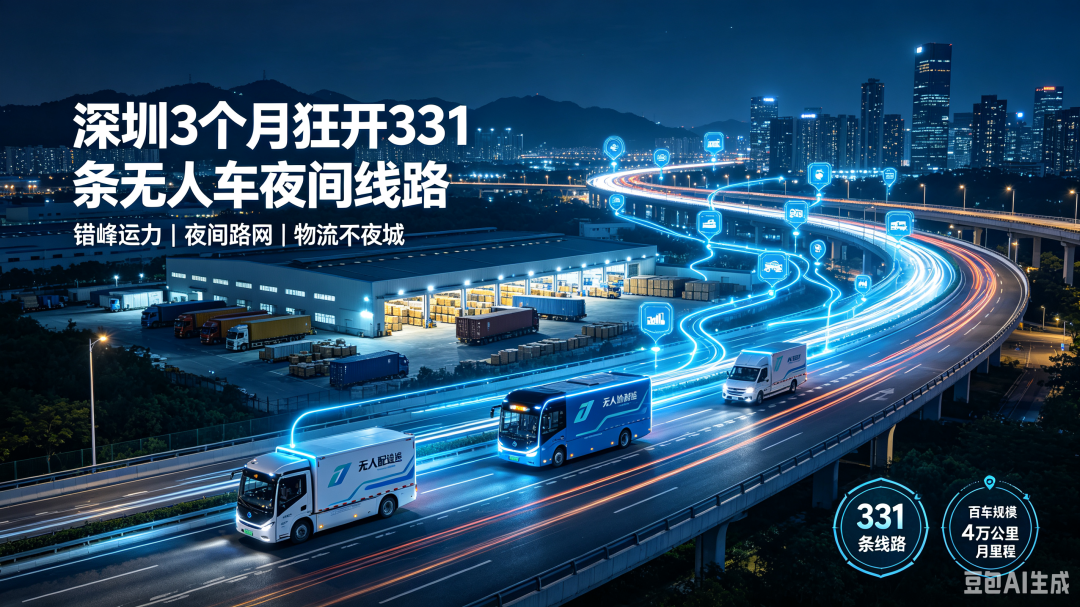
In March of this year, Shenzhen officially opened its roads to functional autonomous vehicles during nighttime hours. In a mere three months, the number of nighttime delivery routes for these vehicles soared from an initial 2 to an impressive 331, with over a hundred vehicles now in operation. By June alone, the monthly nighttime driving distance surpassed 40,000 kilometers.
On one hand, this initiative leverages off-peak transportation capacity to alleviate urban traffic congestion; on the other, it ensures safety through standard regulations. Shenzhen has successfully transformed nighttime autonomous delivery into a new facet of urban logistics infrastructure.
The WeChat Official Account: Unmanned Vehicle is Coming, posits that while the city sleeps, hundreds of autonomous vehicles are weaving a 24/7 logistics network across its streets.
(For further insights, please refer to: “Shenzhen Longgang District Issues New Regulations for Autonomous Vehicles, Initial Application for 30 Vehicles, Inspection Ratio of 5%, and Nationwide Recognition of Off-Site Inspections”)
I. Rapid Expansion: From Zero to Over 300 Routes, Off-Peak Scheduling Frees Up Daytime Roads for Citizens
Shenzhen's pioneering approach is vividly illustrated in the nighttime delivery of autonomous vehicles.
From granting nighttime road access in March to establishing 331 routes by the end of June, this growth rate is remarkable within the autonomous delivery industry.
More significantly, this expansion is not merely for show; it represents tangible operational data:
In June alone, the monthly nighttime driving distance of autonomous vehicles across Shenzhen exceeded 40,000 kilometers. In the two core pilot areas of Longgang and Pingshan, the distances reached 18,070 kilometers and 17,370 kilometers, respectively. This indicates that each vehicle is actively utilized daily, rather than being mere showpieces.
To optimize transportation capacity, Shenzhen has adopted a dynamic and flexible launch mechanism for autonomous logistics vehicles: not all vehicles are deployed simultaneously. During peak periods, approximately 30% of the total fleet is operational, with a daily average of around 15%.
Through refined scheduling, delivery demands at various times are precisely matched. This ensures sufficient capacity during peak hours while significantly reducing vehicle empty runs and idle losses, directly lowering the average operational cost per delivery.
The greatest urban value of this initiative lies not only in enhancing logistics efficiency but also in returning valuable daytime road resources to citizens.
Previously, many urban delivery trucks were restricted from entering the city during the day and caused disturbances at night. Autonomous vehicles have shifted most logistics operations to late-night hours, transforming otherwise underutilized nighttime road resources into quantifiable and schedulable transportation supply, achieving multiple benefits.
Currently, Shenzhen's nighttime logistics network is centered around the two major pilot areas of Longgang and Pingshan. It connects Bao'an, Longgang, and Pingshan through cross-district routes, forming a backbone corridor and gradually extending to areas such as Futian, Nanshan, and Longhua.
The service scope is expanding to encompass the entire city, with a round-the-clock nighttime autonomous delivery network rapidly taking shape.
II. Leading Companies Dive Deep: Real Data Showcases Cost Reduction and Efficiency Gains
Shenzhen's nighttime autonomous delivery sector has attracted a host of leading companies, including Neolix, Jiushi, JD Logistics, Xingshen Intelligence, and Minieye. These firms cover almost all mainstream logistics scenarios, such as express delivery, grid warehouse replenishment, and fresh produce delivery, establishing a multi-tiered nighttime transportation network.
JD Logistics directly utilizes nighttime autonomous vehicles for cross-district warehouse network allocation and replenishment. The routes connect logistics nodes in the Pingshan and Longgang areas, relying on over a hundred nighttime routes in these two districts to handle cargo transfers between sites.
Neolix has deployed 51 vehicles, focusing on scenarios such as express delivery and cross-district logistics. The post-deployment data has been impressive:
End-mile delivery costs have directly decreased by 30%-50%, delivery efficiency has increased by approximately 30%, and overall costs, including transportation and loading/unloading, have decreased by 40%-50%. Currently, more than ten nighttime cross-district routes are awaiting gradual activation, with a steady pace of expansion.
Jiushi Intelligence has directly collaborated with Shenzhen Post to implement nighttime express transit scenarios. The cooperative route in Pingshan has been operating smoothly for an extended period without any issues.
Minieye Innovation and Xingshen Intelligence are focusing on niche scenarios for pilot projects, accumulating nighttime operational data step by step to lay the groundwork for subsequent large-scale route expansions.
From the strategic deployments of these companies, it is evident that none are here merely to ride the policy wave. They genuinely recognize the value of nighttime autonomous delivery and are willing to invest substantial resources to pursue it. This genuine industry enthusiasm is far more convincing than any abstract concept.
III. Standards Pave the Way: Strict and Detailed Rules Ensure Safety and Livelihoods
Many people wonder: With so many autonomous vehicles operating at night, how can safety be ensured? How can disturbances to residents be prevented?
Shenzhen has already addressed these concerns. While rapidly expanding in scale, the city, under the regulatory framework led by three joint bus companies, has formulated the “Shenzhen Municipal Management Measures for Nighttime Operation of Functional Autonomous Vehicles (Trial)”. These measures establish comprehensive rules covering the entire chain from vehicles to operations, ensuring safety while addressing public concerns. This approach is truly exemplary for many regions.
The management measures prioritize safety and enforce stringent standards, setting three core requirements for vehicles:
First, strict nighttime low-noise operation standards must be implemented to minimize operational noise interference with surrounding residential areas, ensuring that excessive noise does not disrupt residents' sleep.
Second, vehicles must display compliant reflective markings that clearly outline their contours, enhancing visibility during nighttime operations so that oncoming vehicles and pedestrians can easily spot them.
Third, lighting systems must simultaneously meet road recognition needs and anti-glare requirements, complying with urban light pollution control standards to avoid blinding others with high beams.
At the operational level, a closed-loop management mechanism covering the entire process has been established:
During the access phase, the principle of “assessment before operation” is strictly followed. Routes must undergo comprehensive evaluation and approval before they can be put into operation, preventing just any vehicle or route from accessing the roads.
During the operation phase, a municipal-level platform is used to monitor vehicle status in real-time, enabling immediate detection of any abnormalities.
During the emergency response phase, a mechanism of “5-minute online response and 15-minute on-site arrival” has been established to ensure rapid handling of issues without delays.
At the same time, the responsibilities of operation entities, vehicle manufacturers, and user units have been clearly delineated to ensure full traceability of safety responsibilities. In Shenzhen, incidents without accountability simply do not occur.
What is even more commendable is the humanistic consideration behind these standards:
For logistics practitioners, autonomous vehicles take over repetitive driving tasks such as late-night replenishment and cross-district transfers, directly eliminating the risks of nighttime fatigue driving. Frontline personnel can shift from high-intensity operations with irregular schedules to more growth-oriented roles such as collection services and site maintenance.
For urban residents, refined standards such as low noise and anti-glare lighting minimize disruptions to daily life from logistics operations, preserving the tranquility of the city at night while enhancing efficiency.
Conclusion
The WeChat Official Account: Unmanned Vehicle is Coming, believes:
What Shenzhen is doing is not just about getting autonomous vehicles up and running but ensuring they reach every corner of the city at night and penetrate into the capillaries of urban logistics. As hundreds of autonomous vehicles quietly traverse the streets late at night, the city is redefining what it means to be “open 24/7” at the lowest cost and highest efficiency.
What do you think?
References: Media reports from the Shenzhen Intelligent Connected Transportation Association's WeChat Official Account, Shenzhen Special Zone Daily, Shenzhen Economic Daily, PMC Pingshan Release, etc.
#UnmannedVehicleisComing #AutonomousDriving #SelfDriving #AutonomousVehicles
-
![]()
Mother and Son with a 7-Year Age Gap, Labor Remuneration Soars Over 2 Trillion: Xingyu Shares Faces Information Disclosure 'Mishaps' Amid Layoff Controversy
-
If You're a Disruptor, Let's Ride the Wave of CALB's Business Success Together
-
![]()
Foldable Smartphone Showdown: A Prelude to the 'Tech Spring Festival Gala'
-
![]()
China’s Wealthiest Individual Could Change! DeepSeek Aims for STAR Market IPO—Could Liang Wenfeng’s Net Worth Hit Trillions?
-
![]()
Porsche Sells Bugatti for €7.8 Billion to Cover Pension Obligations
-
Does Changsha Still Inspire Optimism?
-
![]()
Riding Tesla’s Wheel-less Cybercab: An Hour of Comfort, Marred by Perplexing Drop-offs
-
![]()
The iPhone Duo, Arriving 7 Years Late, Aims to 'Dominate' the Market from the Start