2025 New Energy Vehicle Industry Year-End Review
 01/08 2026
 741
741
A Stronger, More Confident Chinese Auto Industry
Author | Zhou Ruijun, Producer of Shengma Finance and Economics
Editor | Ouyang Wen
In 2025, China's new energy vehicle (NEV) industry experienced a profound structural reshaping as it transitioned from rapid expansion to high-quality development. For the first time, market-driven forces surpassed policy subsidies, with 'intelligence' and 'quality' replacing 'price' as the main competitive themes. A series of landmark events not only outlined a clear trajectory for industry development but also set the tone for future market evolution.
01
Market-Driven Milestone
NEV Passenger Vehicle Penetration Exceeds 50% for the First Time
In 2025, China's NEV market reached a historic turning point. According to data from the China Association of Automobile Manufacturers, in October 2025, the monthly sales of new energy passenger vehicles accounted for over 50% of total passenger vehicle sales for the first time, reaching 51.6%. For the entire year, this proportion is expected to remain stable at over 53%, indicating a full transition from 'policy-driven' to 'market-driven' growth.
Shengma Commentary: Surpassing 50% penetration marks the 'coming of age' for the industry. It signifies that NEVs have shifted from alternative options to mainstream choices, with consumer purchasing decisions evolving from 'whether to buy NEVs' to 'which NEV model to choose.' Behind this shift lies the absolute advantage brought by technological progress, including improved range, charging convenience, and intelligent experiences. From now on, the industry's endogenous growth drivers will be fully activated, leading to more stable growth and intensified competition centered on product strength, technology, and service quality.
02
Regulatory Breakthrough
L3 Autonomous Driving Approval Implemented
In late December 2025, the Ministry of Industry and Information Technology (MIIT) issued the first batch of L3 (conditional autonomous driving) vehicle approvals to models such as the Changan Deepal SL03 and Arcfox Alpha S6. This marks China's autonomous driving sector's official entry into a critical stage of commercialization, moving from closed testing and small-scale trials to broader applications. L3 means that, in specific scenarios, driving responsibility shifts from the driver to the system, representing not only a technological breakthrough but also a major innovation in legal and insurance frameworks.
Shengma Commentary: The L3 approval breakthrough extends far beyond technology itself. It sends a clear signal for scaled demand across the entire supply chain—from LiDAR, high-computing-power controllers to high-definition maps. More importantly, it provides automakers with a clear path for transitioning from a 'hardware sales' model to a 'software + services' business model. However, the clear delineation of responsibility (automakers bear liability during system takeover) also imposes unprecedentedly high requirements on technological redundancy and safety design, marking the industry's formal entry into the 'intelligent safety' deep waters of competition.
03
Policy's 'Visible Hand'
The Strictest-Ever National Standard for Power Batteries Released
In March 2025, the MIIT issued the mandatory national standard 'Safety Requirements for Power Batteries Used in Electric Vehicles,' set to take effect on July 1, 2026. The new standard, dubbed 'the strictest ever' by the industry, mandates 'no fire, no explosion, and no harm to occupants from smoke,'
Shengma Commentary: This standard serves as the 'safety cornerstone' for China's NEV industry to mature. By imposing the most rigid constraints, it eliminates potential risks where some companies previously sacrificed safety for energy density and cost. The new standard not only builds a stronger trust barrier for consumers but also shifts the industry's competitive focus from 'price wars' to 'value competition.' In the globalization process, this stringent standard will also serve as a key technical endorsement for Chinese brands to gain international trust and achieve sustainable growth.
04
Technology Democratization Race
Explosive Iteration in Fast Charging and Battery Technologies
In 2025, competition in power battery technology shifted from pure range to comprehensive performance encompassing 'all-weather capability, long lifespan, and high power.' CATL unveiled sodium-ion batteries supporting 5C fast charging and low-temperature resistance, along with its 'Xiaoyao Dual-Core' architecture batteries. BYD introduced its 'Second-Generation Blade Battery with Flash Charging,' claiming '400 km of range in 5 minutes of charging.'
Shengma Commentary: 2025 marks a decisive year for 'charging efficiency.' Breakthroughs in ultra-fast charging technology directly address the last pain point for EV adoption—range anxiety. The essence of this technological competition is 'charging democratization,' aiming to make EV usage experiences comparable to, or even superior to, internal combustion engine vehicles. Meanwhile, the progress in sodium-ion battery mass production hints at a future where multiple technology routes—lithium, sodium, and solid-state batteries—coexist, meeting diverse market demands while enhancing the supply chain's resilience.
05
Infrastructure Upgrade
Charging Facility Service Capacity Launches 'Three-Year Doubling' Plan
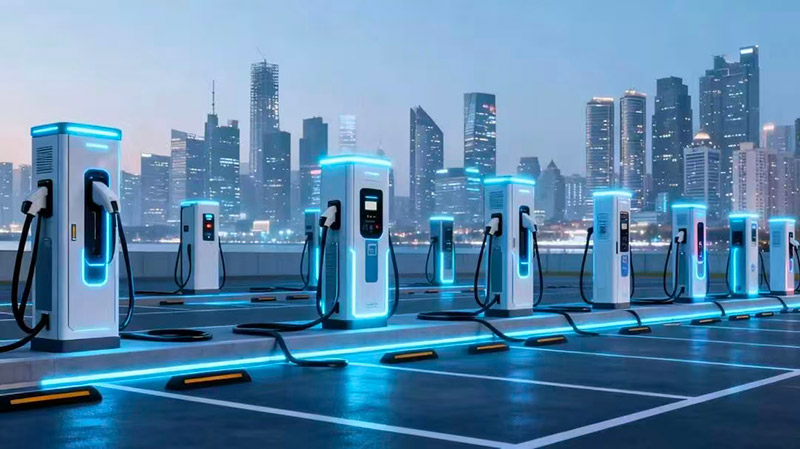
By the end of November 2025, China had built a cumulative total of 19.322 million charging facilities nationwide, including 70,500 at highway service areas. Nineteen provinces achieved full coverage of charging facilities in rural townships. That same year, the National Development and Reform Commission (NDRC), National Energy Administration, and other departments issued the 'Three-Year Doubling Action Plan for Electric Vehicle Charging Facility Service Capacity (2025–2027),' aiming to systematically address uneven charging infrastructure distribution and shift the industry focus from 'scale expansion' to 'service enhancement.'
Shengma Commentary: The charging network serves as the 'highway' for the NEV industry. The 2025 achievements demonstrate that China has built the world's largest and most extensive charging infrastructure system. The current primary challenge has shifted from 'availability' to 'usability.' Future priorities will include increasing the proportion of high-power fast charging, optimizing coverage in residential areas and rural regions, and promoting vehicle-to-grid (V2G) pilots. A high-quality charging network is fundamental to supporting the seamless operation of tens of millions of EVs and facilitating the construction of a new-type power system.
06
Drastic Market Reshuffle
Traditional Giants Strike Back and New Forces Diverge
The 2025 market competition landscape witnessed dramatic changes. While BYD maintained its top position, its growth rate slowed, prompting it to adjust its development pace proactively. Geely surged with its Galaxy series, achieving over 60% NEV penetration. Chery staged a strong comeback through its Fengyun brand, with rapid sales growth. In stark contrast, Li Auto, once a leader among new forces, fell out of the top 10 in November sales, surpassed by HiPhi, Leapmotor, and others.
Shengma Commentary: This reshuffle reveals the harsh reality of industry competition: there are no eternal kings, only automakers of their time. Traditional automakers leveraged their deep systemic capabilities, supply chain control, and financial strength to stage a late comeback in electrification, showcasing remarkable explosive power. Meanwhile, some new forces, after surviving the initial phase, face new challenges such as a narrow product lineup, catching up on technological routes, and unproven profit models. The 2025 landscape indicates that competition has entered a stage of comprehensive 'systemic capability' benchmarking, where a single strength can no longer sustain long-term leadership.
07
Export Surge in Volume and Quality
NEV Exports Double with Structural Optimization
From January to November 2025, China exported 6.343 million vehicles, including approximately 2.315 million NEVs, representing a 100% year-on-year surge. Full-year exports are expected to challenge a new record of 7 million vehicles. Export markets also diversified, successfully penetrating high-end markets like Europe after early expansion in Asia, Africa, and Latin America.
Shengma Commentary: Chinese automakers are reshaping the global automotive landscape through a 'technology-for-market' approach. The export boom stems not only from cost-effectiveness but also from leading technologies in electrification and intelligence. To counter trade barriers, mainstream automakers accelerated overseas localization production and after-sales network deployment, upgrading their export model from 'product trade' to 'brand operation.' Meanwhile, new government policies, such as stricter regulations on 'zero-kilometer used car exports,' aim to standardize the market and shift exports from 'low-price competition' to 'quality competition.'
08
Regulating Industry Ecosystem
Comprehensive Crackdown on 'Cutthroat Competition'
In 2025, a sweeping 'anti-cutthroat competition' campaign was launched from the central government to industry organizations. The state revised the 'Anti-Unfair Competition Law,' while multiple departments jointly addressed online disorder and price wars in the automotive sector. The China Association of Automobile Manufacturers (CAAM) also issued consecutive initiatives to standardize data disclosure and driver assistance system promotions.
Shengma Commentary: This crackdown marks a regulatory shift from encouraging innovation and expansion to balancing innovation with regulation. Its core goal is to curb malignant (vicious) price wars, false advertising, and online black PR, creating a fair and transparent development environment. In the short term, companies relying on marketing gimmicks and low-price strategies will face pressure. Long term, this will guide the industry to focus resources on core technology R&D, product quality improvement, and user services, driving true high-quality development for China's auto industry.
09
Restructuring Industrial Relations
Implementation of the 'Regulations on Ensuring Payment to SMEs'
On June 1, 2025, the revised 'Regulations on Ensuring Payment to Small and Medium-Sized Enterprises' took effect, setting a 60-day maximum payment term. Leading automakers such as FAW Group and BYD actively responded by shortening payment cycles to suppliers.
Shengma Commentary: This policy directly addresses the long-standing issue of automakers delaying payments to suppliers. Shorter payment terms significantly improve cash flow for SME suppliers, enabling them to increase R&D investment and ensure production stability. This not only fulfills social responsibility but also represents a strategic move by automakers to optimize supply chain management and build long-term win-win ecosystems with suppliers. A healthy industrial chain is the foundation of industrial competitiveness, providing solid support for China's auto industry to compete globally.
10
Balancing Consumption and Safety
Expansion of Trade-In Policies and Detailed Safety Regulations
In early 2025, the vehicle trade-in policy scope expanded to include gasoline vehicles meeting National IV emission standards, further unlocking consumption potential. That same year, regulators extended their safety focus to design details, proposing new regulations for 'fully concealed door handles' that require them to remain operable under extreme conditions such as low temperatures and post-collision power failures.
Shengma Commentary: These two initiatives reflect the 'precision and empathy' of industrial policies and regulations. The trade-in policy expansion stimulates consumption while promoting the retirement of old vehicles and resource recycling across the supply chain, aiding the 'dual carbon' goals. Meanwhile, regulations on door handles and other details highlight increasingly refined oversight, warning companies that safety remains the cornerstone of the automotive industry. No innovation should compromise basic safety or user experience, guiding R&D back to the core needs of vehicle safety and user satisfaction.
Conclusion
From Scale Race to Value Creation
Looking back at 2025, China's NEV industry has navigated through cyclical uncertainties and stands at a new starting point. Surpassing 50% penetration heralds the true arrival of the market-driven era; L3 autonomous driving breakthroughs open a new commercial epoch for intelligence; while the 'anti-cutthroat competition' crackdown and supply chain reforms reshape a healthier, more sustainable industrial ecosystem.
Future competition will hinge on technological depth, product quality, systemic efficiency, and global operational capabilities. China's NEV industry is moving from its 'adolescent' phase of rapid expansion into a 'young adult' phase centered on value creation and global leadership. Challenges remain, but the direction is clear, and the foundation is solidifying. A stronger, more confident Chinese auto industry is sailing toward even grander horizons.
END
-
![]()
Model Giant Jieyue Xingchen Steps into Smartphone Arena: A Strategic Alliance with Huaqin Technology
-
![]()
Big Model Firm Dives into Phone Market: StepFun and Wingtech Forge a ‘Dynamic Duo’
-
![]()
Zhongrun Optics Makes a Bold Move with 1 Billion Yuan Investment: Is a Turning Point on the Horizon for the Precision Optics Industry?
-
![]()
Deploy CLBO Crystals and YIG Single Crystals! Erythritol Leader Invests 30 Million in Youwei Optoelectronics
-
CXMT’s July 16 Subscription: Leading Domestic Memory Manufacturer—What’s the Earning Potential per Lot?
-
![]()
Rhythm Discrepancy and Premium Value Erosion: Foreign Luxury Brands Must Re-evaluate Their China Strategy
-
![]()
Half-Year, 1 Billion Yuan Financing, 7 Billion Yuan Valuation: A New Dark Horse Emerges in the Embodied AI Sector
-
![]()
Strong Rebound for Tech Stocks in Hong Kong Stock Market: Is It Time to Bottom-Fish?