In-depth Analysis | Sales Interpretation of Emerging Automakers in March: Sales Recovery and New Model Launches Boost Momentum
 04/07 2026
 461
461
It's that time of the month again—time to hand in the performance report.
No need for lengthy introductions; let's dive straight into the main topic.
First up, the emerging automakers: NIO: 35,486 units
XPENG: 27,415 units
Li Auto: 41,053 units
Leapmotor: 50,029 units
Xiaomi: 20,000+ units
Now, let's enjoy the details.
01 NIO
In March 2026, NIO delivered 35,486 new vehicles (February: 20,797 units, January: 27,182 units).
The NIO brand delivered 22,490 new vehicles. The new ES8 was the top performer, with 16,255 units delivered in March (February: 11,260 units, January: 17,646 units), showcasing strong market momentum.
On April 3, the new ES8 completed its 90,000th vehicle delivery. Since its launch on September 21, 2025, the all-new ES8 achieved this milestone in just 195 days. As one user put it, "Sales speak for themselves when it comes to whether a product is good or not."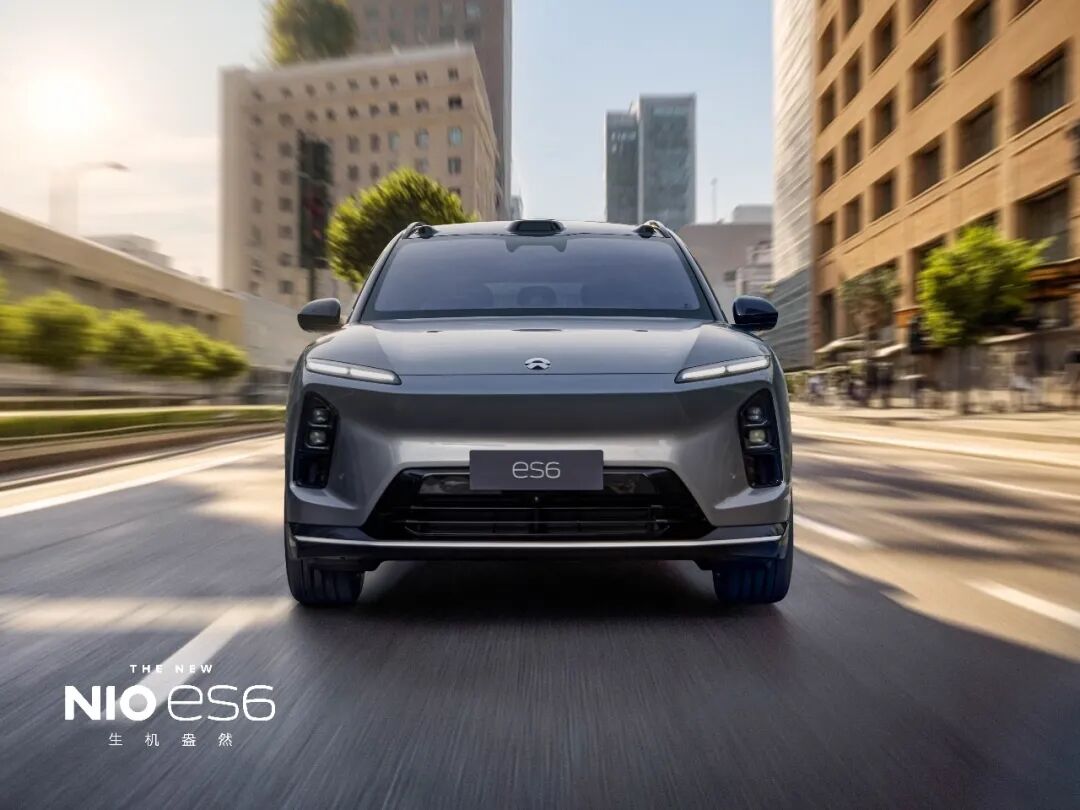
On April 2, the 2026 models of the ES6, EC6, ET5, and ET5T received minor updates, featuring upgrades in design, configuration, and intelligent driving experience. A quick look reveals generous configurations, but the platform remains the older 2.5 platform without 800V capability. This is a significant factor influencing user decisions.
However, I now understand why NIO cannot fully refresh all its 5566 models—resource constraints force them to prioritize. Unfortunately, consumer concerns revolve around price, configuration, and experience, so it remains uncertain whether users will embrace the refreshed 5566 models.
That said, the NIO ES9 will be a powerful trump card. With the ET9 previously setting a price ceiling at 800,000 yuan, the ES9, like the new ES8, can deliver value by lowering its price to the 500,000-600,000 yuan range, becoming a high-end "cost-effective" product and driving sales growth. Therefore, the configuration and pricing of the ES9 are crucial—hopefully, NIO stays grounded.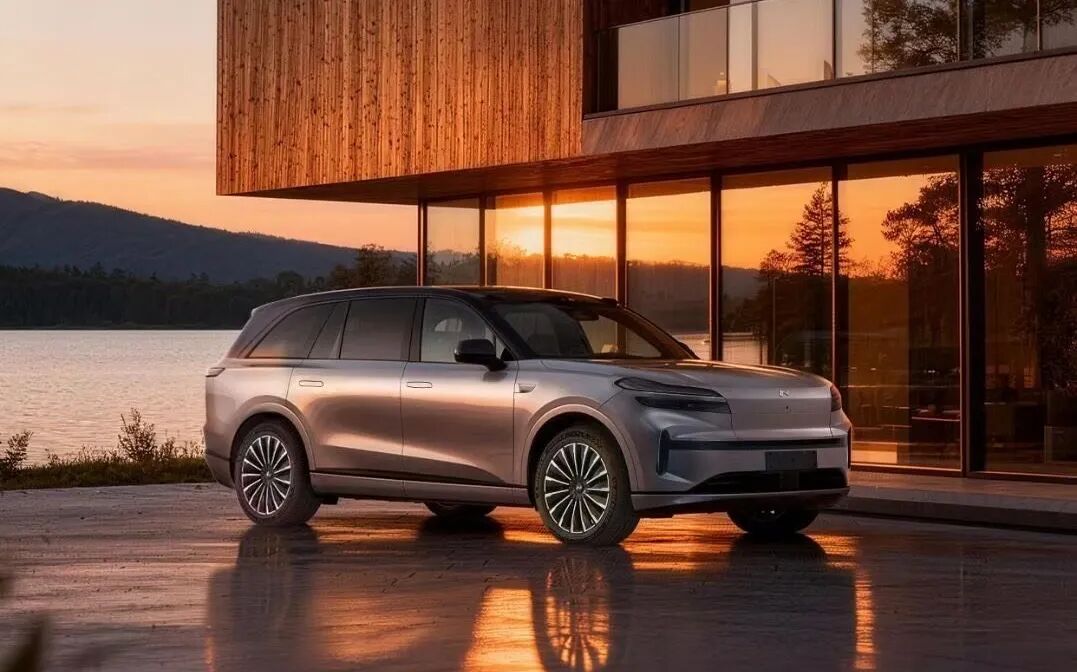
The LETO brand delivered 6,877 new vehicles in March, with the L90 contributing 3,360 units and the L60 contributing 3,517 units. From a market perspective, LETO's stability remains weak. With limited brand recognition and intense external competition, it faces significant challenges. This year, LETO plans to launch the L80 and L90 LiDAR versions.
While LETO aims to capture market share with large SUVs, the market is already saturated with various 8-series and 9-series models. Breaking through will not be easy. In April, LETO introduced a full purchase tax subsidy policy and a seven-year ultra-low-interest financing scheme, using time and money to fuel growth.
With the missed golden development period, LETO must now gradually claw its way back.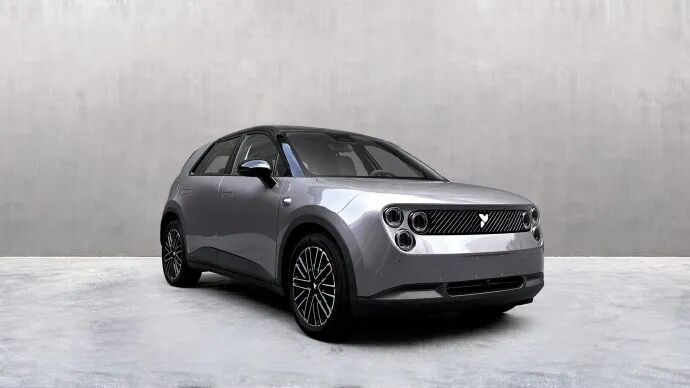
The Firefly brand delivered 6,119 new vehicles. This compact car brand has quietly risen through its unique automotive culture. Achieving over 6,000 sales with such a small model is impressive. If this momentum continues, Firefly could contribute significantly to NIO's annual sales and revenue.
In terms of product launches, NIO has entered a dense (intensive) promotion (promotional) phase: NIO: The ES9 product technology launch event will be held on April 9, with a Beijing Auto Show debut in late April and a market launch in late May. LETO: The 2026 L90 will be launched on April 21, and the L80 will hit the market in mid-May. Firefly: A refresh launch event is scheduled for April 7. Interested friends should stay tuned.
02 XPENG
In March 2026, XPENG delivered 27,415 new vehicles, marking a sales recovery.
In the first quarter, XPENG aggressively rolled out new models: On January 8, four mainstay models were launched simultaneously: the 2026 P7+, 2026 G7, 2026 G6 all-electric version, and 2026 G9 all-electric version.
The P7+ and G7 are available in both all-electric and extended-range versions; the G6 and G9 all-electric versions received updates.
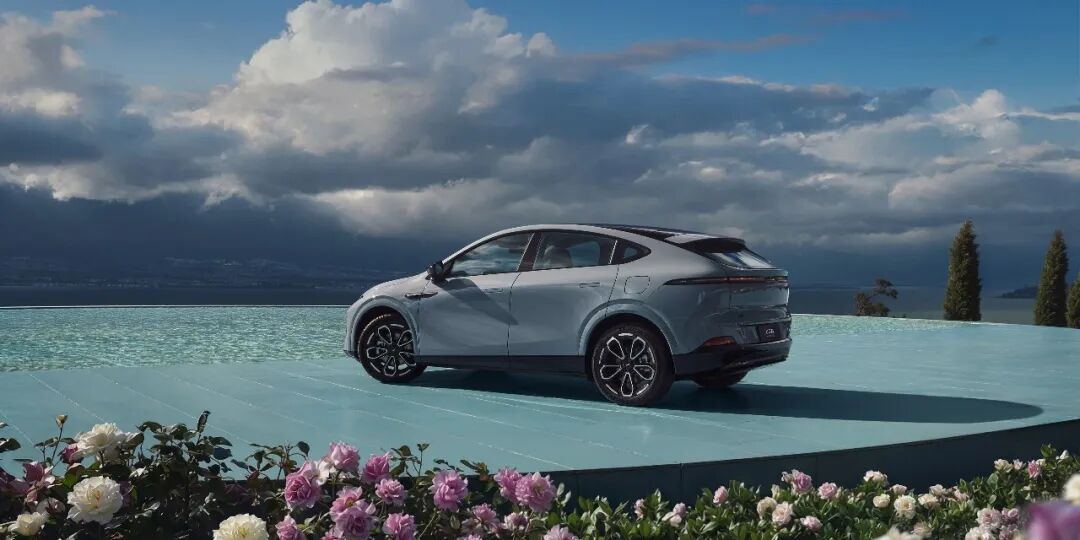
In March, XPENG continued to refine its product lineup.
On March 2, the XPENG X9 all-electric version was launched.
On March 6, the G6 extended-range version hit the market.
On March 18, the new XPENG P7 variant was launched, introducing Max and Ultra SE versions.
In essence, XPENG completed updates or launches for six models in the first quarter: the P7+, G7, G6, G9, X9, and P7. This rapid-fire approach led to a sales rebound from over 10,000 units to over 20,000 units in March. On April 2, the new MONA M03 arrived, offering six SKUs—quite a variety.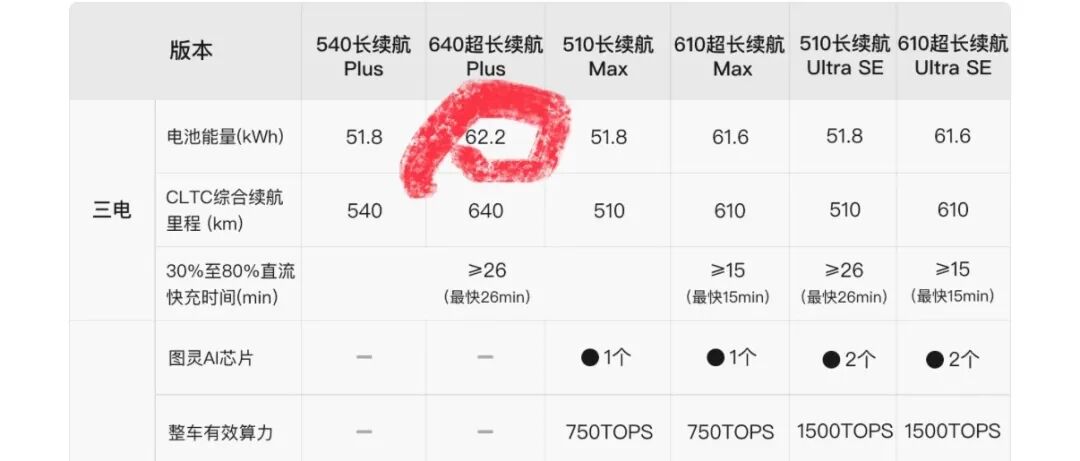
What puzzles me is the battery strategy—three versions: 51.8 kWh, 62.2 kWh, and 61.6 kWh. From a supply chain management perspective, two battery specifications would be more cost-effective and easier to manage. Unifying naming or range (540/640, 510/610) seems unnecessary, adding unnecessary costs.
From *Tech Jungle*'s perspective, the 129,800 yuan model offers the best value—not recommending the Ultra SE. First, it includes all essential configurations with numerous optimizations. Second, it comes with complimentary cloud massage seats and a 20-speaker sound system (including two headrest speakers). Finally, it features a 750 TOPS Turing chip, with the second-generation VLA distilled version arriving in Q3. While not as powerful as the full version, it suffices.
So, why not recommend the Ultra SE?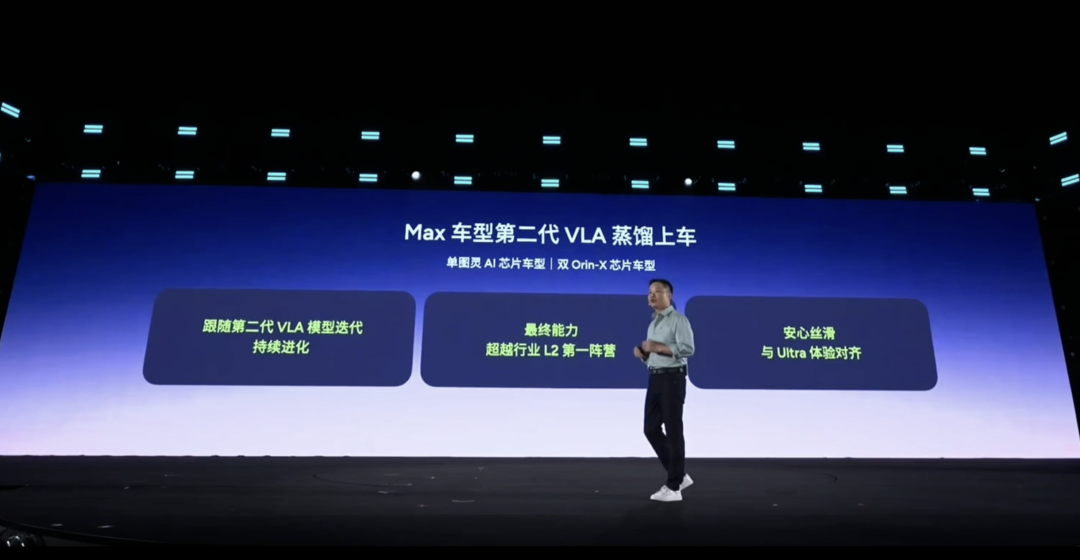
Currently, intelligent driving's computational demands are insatiable.
*Tech Jungle* observes that a usable high-level intelligent driving system requires a baseline of 1000+ TOPS this year—emphasis on "usable," not just "available." Next year, 2000 TOPS will likely be the standard.
Given that intelligent driving capabilities and computational power are still evolving, there is no one-size-fits-all solution for users. It's wiser to opt for a usable, decent version now and upgrade later. Moreover, the Ultra SE commands a 12,000 yuan premium, pushing the price to 140,000-150,000 yuan.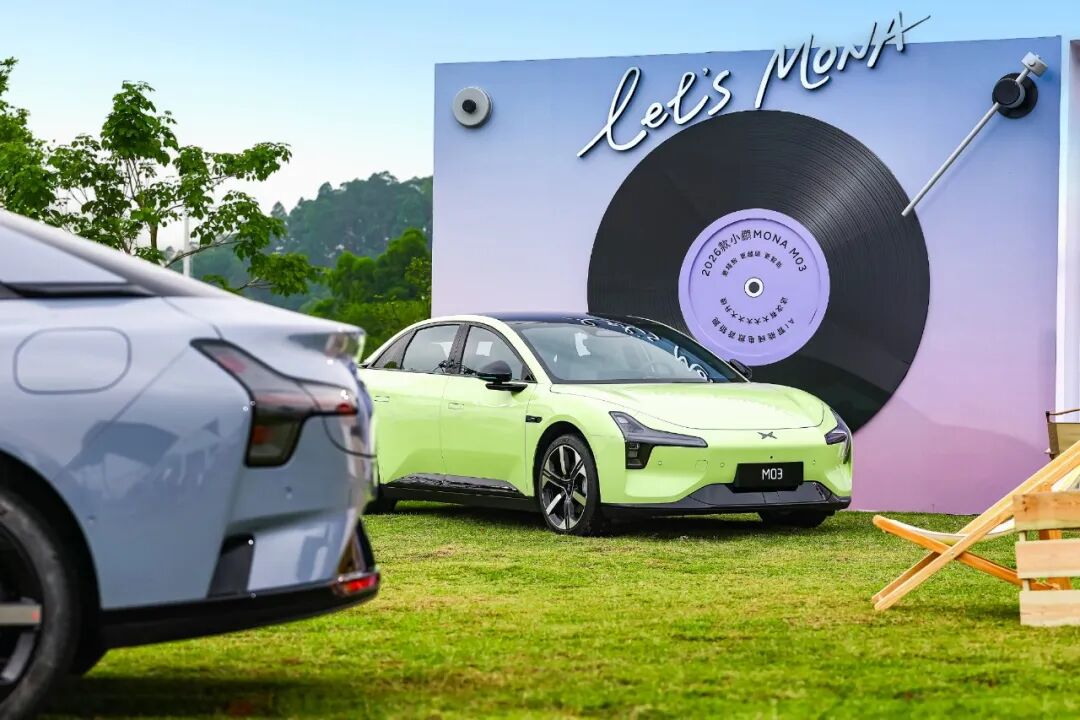
A key point to remember: In the 120,000-150,000 yuan price range, every 10,000 yuan difference directly influences user decisions, as there are more options, even across segments. Of course, take my words with a grain of salt.
Overall, this model is highly competitive, with strong market reception—37 minutes to reach 10,000 reservations is a great start. With this momentum, XPENG's April sales should rebound to over 30,000 units. However, XPENG's annual sales target is 550,000+ units. With 63,000 units delivered in Q1, monthly sales must reach 54,000-60,000 units going forward. Thus, current performance alone is insufficient.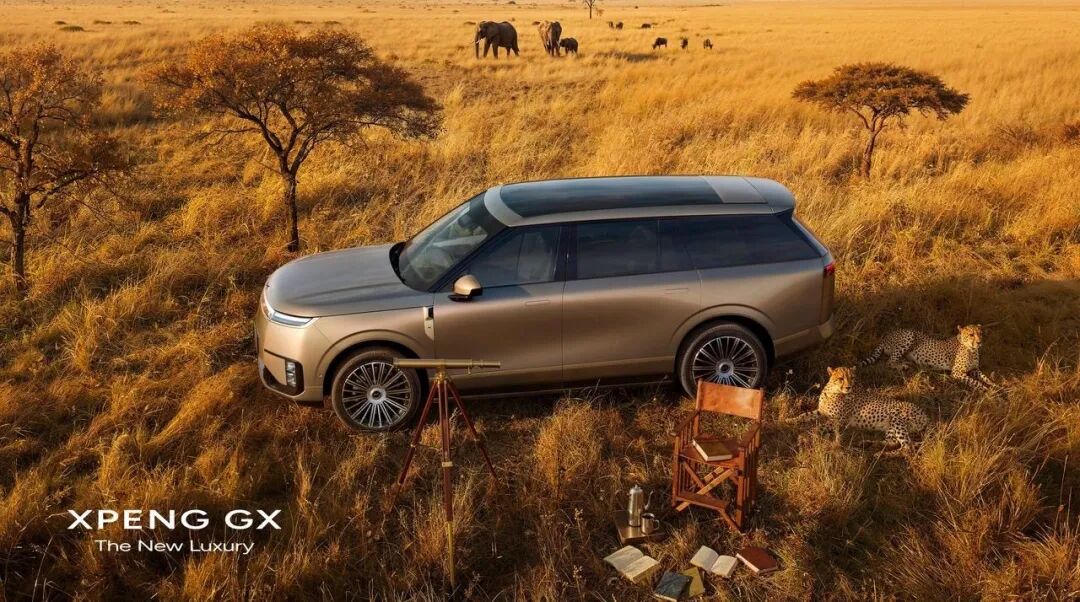
Next up are the XPENG GX, XPENG G02, MONA D02, and MONA D03, which will fill critical gaps. The two new MONA SUVs, in particular, target the broadest market segment with the highest sales potential. On April 1, XPENG officially rebranded from "XPENG Motors Co., Ltd." to "XPENG Group," embarking on a new journey from smart electric vehicles to physical AI.
03 Li Auto
In March 2026, Li Auto delivered 41,053 new vehicles, with Q1 deliveries totaling 95,142 units.
The significant March delivery surge resulted from resolving the i6 production bottleneck. The i6 alone accounted for 24,000 units—an impressive feat.
Orders for the i6 with Sunwoda batteries are expected to be fulfilled within 2-4 weeks, while CATL battery versions will take 4-6 weeks.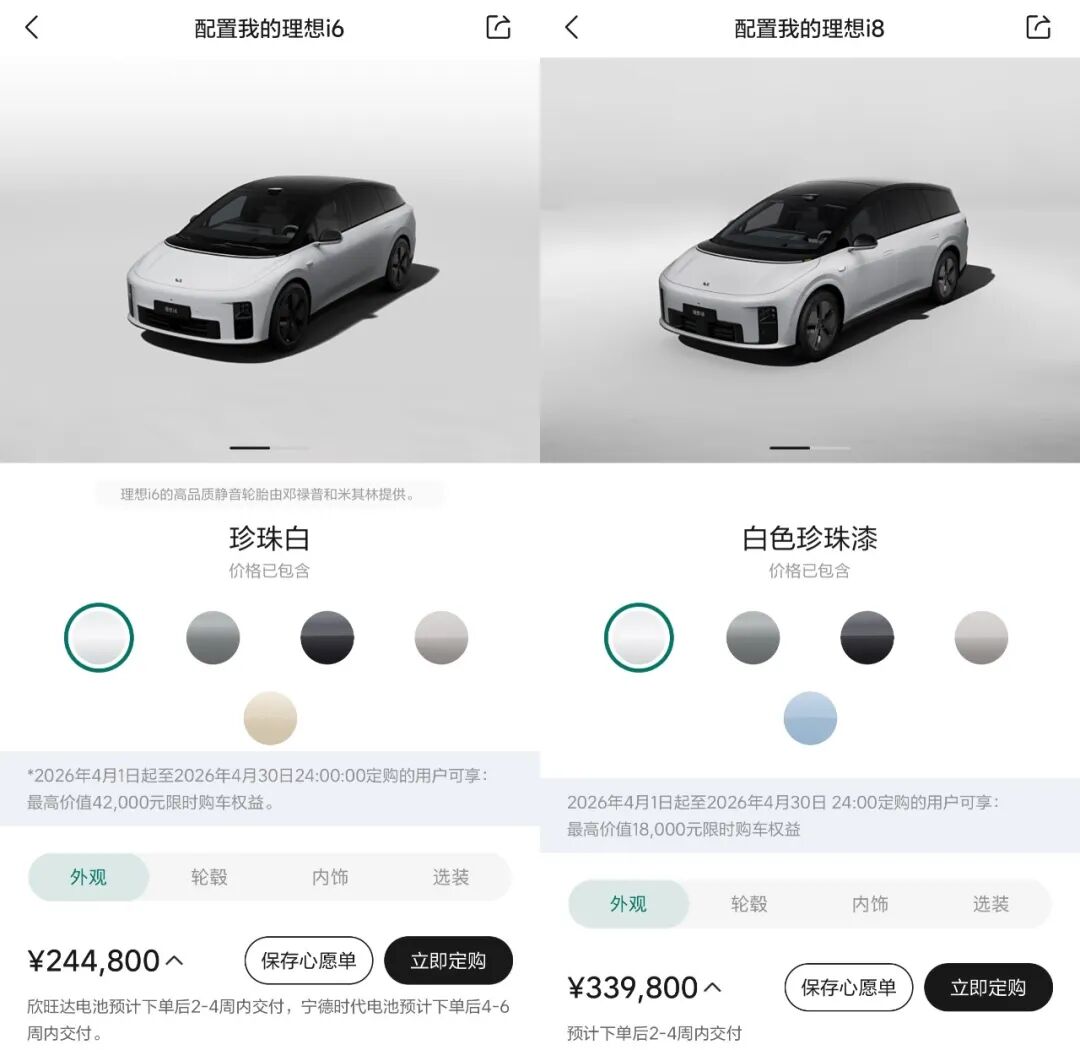
Starting in Q2, Li Auto will gradually hit its stride. First, the all-new Li Auto L9 will launch in Q2, spearheading the refresh of the extended-range L series. Once the L9 is unveiled, the updates for the remaining L6, L7/8 (possibly consolidated into one model, e.g., L8) will become clear.
Currently, the existing Li Auto L9 is no longer available for orders, likely discontinued. The L7 and L8 are mostly clearing inventory, with only select configurations remaining. The L6 remains fully available.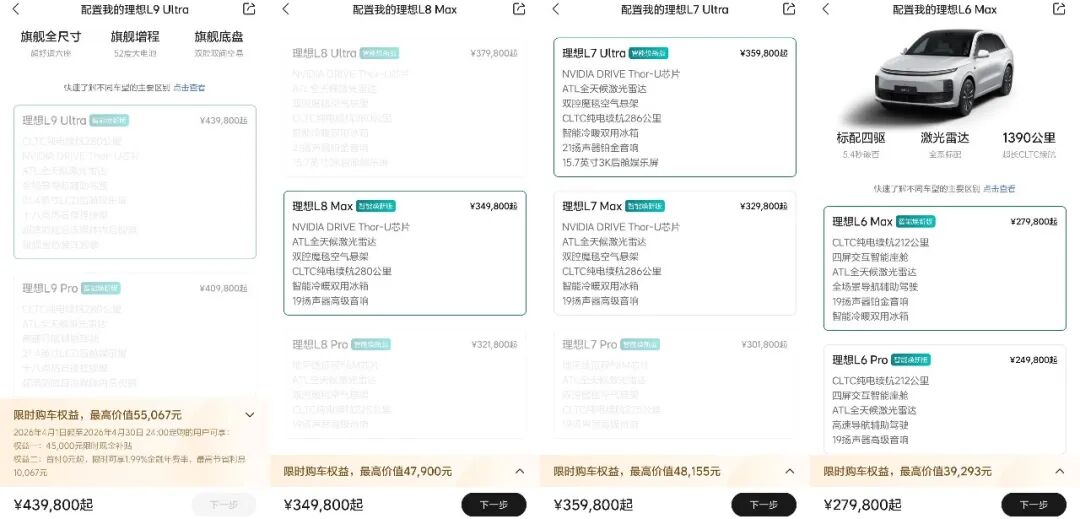
Following the L9 refresh, the L8 will be updated next. Later this year, Li Auto will unveil the all-new all-electric flagship i9. By year-end, Li Auto's "all-electric + extended-range" product matrix will be complete: MEGA and L9 Livis will dominate the 500,000 yuan market. L9 and i9 will target the 400,000+ yuan segment. L8 and i8 will cater to the 300,000+ yuan market. L6 and i6 will serve the 200,000+ yuan market. With high-end models like MEGA, 8-series, and 9-series leading and volume models like the 6-series driving sales, the foundation is set.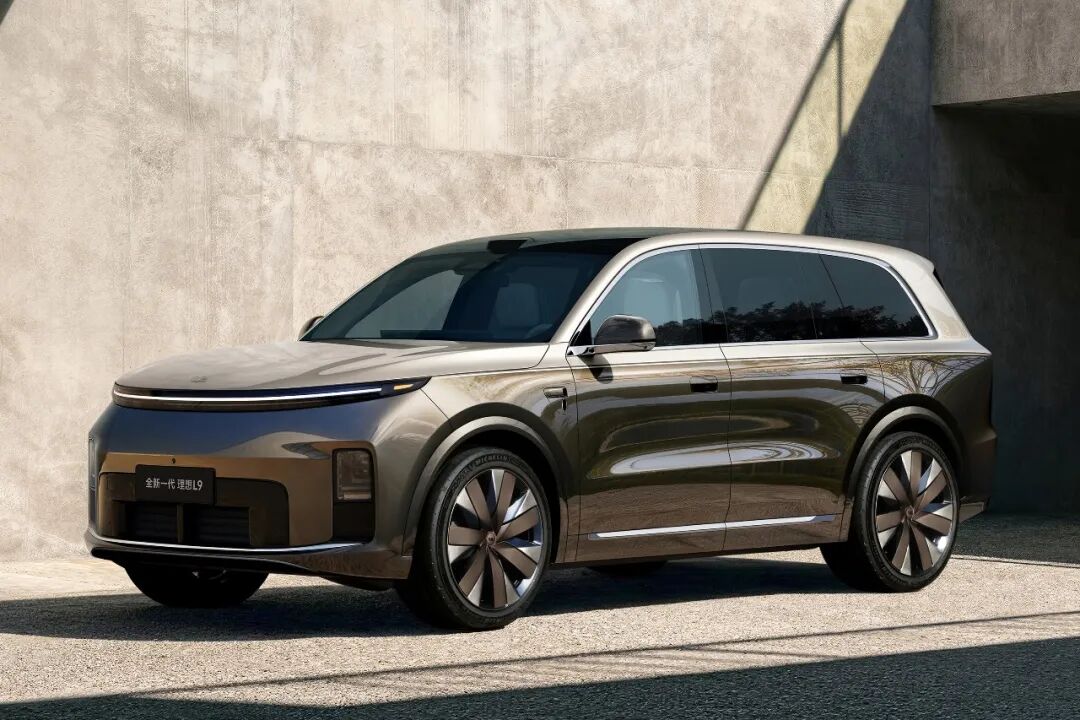
Li Auto's sales target for this year is conservative: 480,000 units (down from 500,000+ in 2024 and 406,000 in 2025). Q1 got off to a good start, but sustained growth each quarter is essential to meet targets.
04 Leapmotor
Leapmotor delivered 50,029 units in March, returning to rapid growth.
Product-wise, the volume-driving Leapmotor A10 officially launched on March 26. Priced competitively at 65,800-86,800 yuan, it initially promised standard LiDAR for under 100,000 yuan—now achievable at just over 80,000 yuan, making it highly appealing. Leapmotor truly earns its title as the king of cost-effectiveness. However, one major flaw: even the top trim lacks ventilated seats for the driver.
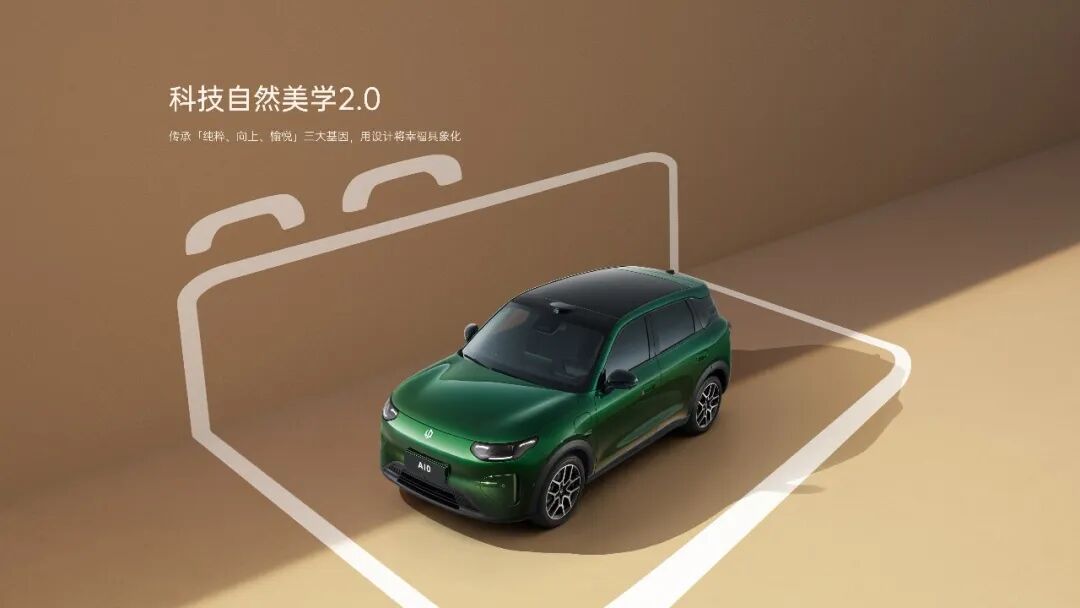
Despite this, the A10's overall value proposition remains strong, driving sustained order growth. Within an hour of the launch event, orders reached 3,041 units, with over 53% opting for the 505km LiDAR version.
On March 28-29, the A10 secured over 9,000 firm orders. In April, May, and June, Leapmotor will maintain a pace of one new model per month. Additionally, refreshed versions of the B and C series will arrive in H2 2026. This year, Leapmotor is refreshing its entire lineup to achieve its goal of one million annual sales.
On April 16, the D-series D19 will officially launch, priced under 300,000 yuan—expect another pleasant surprise. At the Beijing Auto Show (opening April 24), Leapmotor will unveil the Lafa5 Ultra version.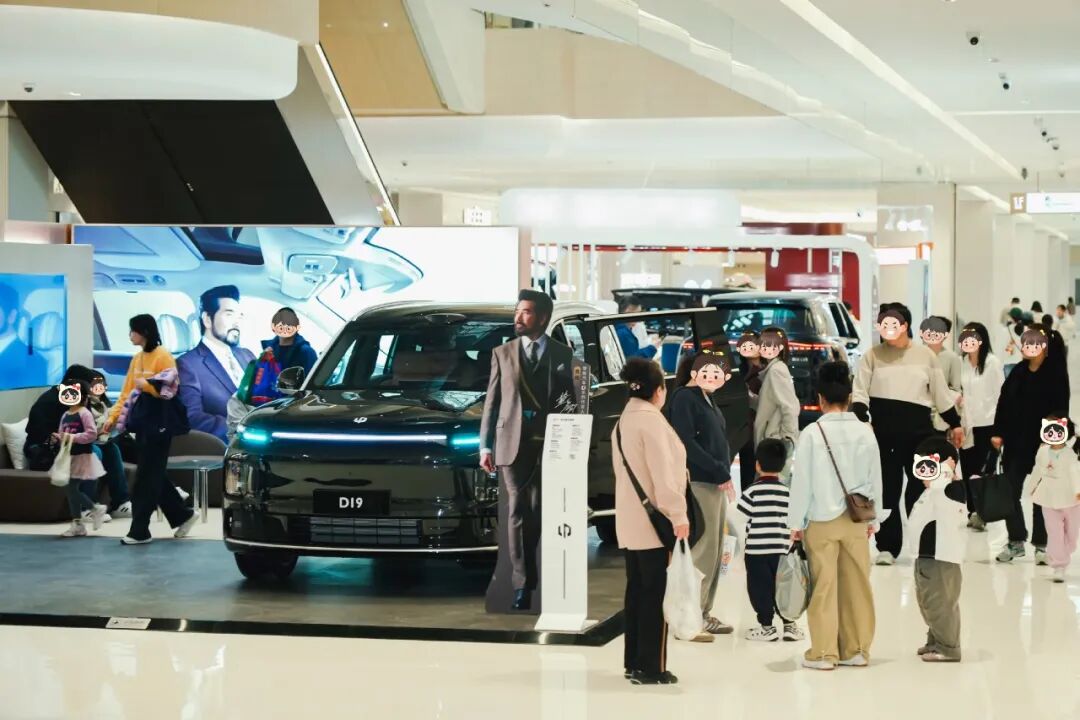
So Leapmotor is genuinely busy this year, operating at full throttle. Let's conclude with a quote from Leapmotor itself: 'With a relentless product offensive and technological implementation, Leapmotor is accelerating its journey to become a pioneer in making smart electric vehicles accessible to all.' Who agrees? Who disagrees?
05 Xiaomi
Xiaomi delivered over 20,000 vehicles in March. For comparison: over 39,000 units in January and over 20,000 units in February.
Another data point: since deliveries of the new-generation SU7 began on March 23, cumulative deliveries have surpassed 7,000 units. This means that, out of Xiaomi's March sales: over 7,000 units were the new SU7, and over 13,000 units were the YU7. Some might ask if Xiaomi's momentum is fading. Based on current indicators, it is not.
Firstly, the revamped new SU7 has been relatively successful. While it may not replicate the initial frenzy of the first-generation SU7, orders remain robust.
If you lock in an order now, the fastest delivery time for the new SU7 Pro and Max models is five weeks, while the most cost-effective standard version takes seven weeks. This indicates that the order backlog for the new SU7 remains substantial. Another detail: the new SU7 delivered 7,000 units in just nine days. In contrast, the first-generation SU7 took 28 days to deliver 7,058 units. This delivery efficiency is remarkably high. 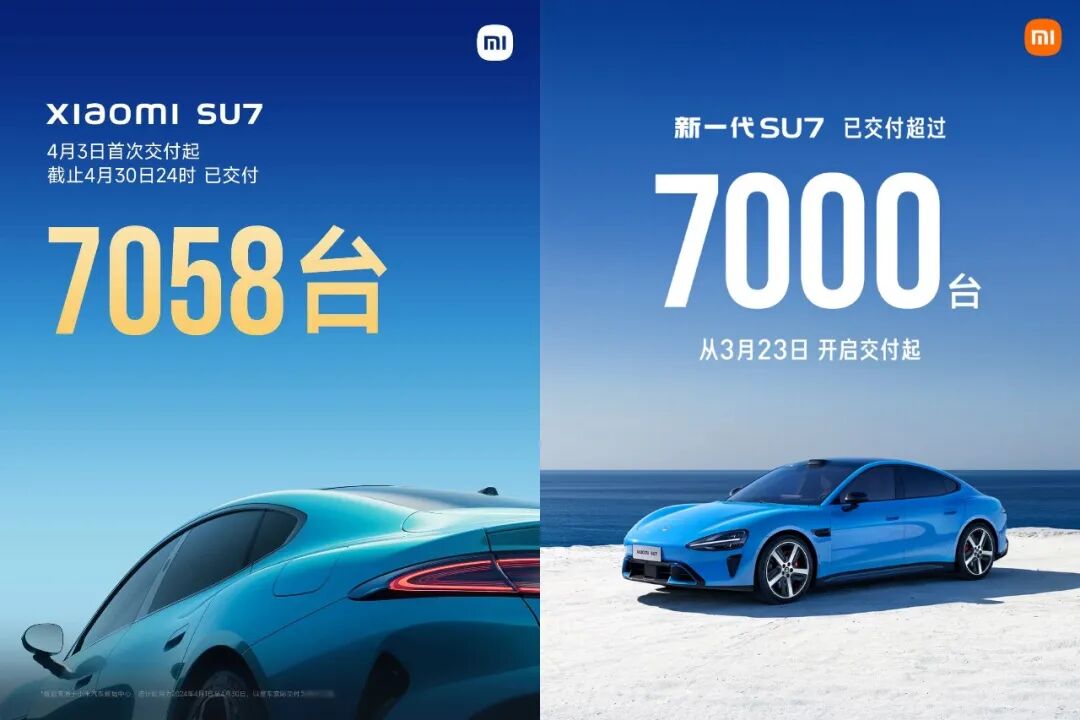
At this delivery rate, the new SU7 alone is expected to deliver over 20,000 units in April. Combined with YU7 deliveries exceeding 10,000 units, Xiaomi's total April deliveries will likely reach between 30,000 and 35,000 units. Thus, Xiaomi's current momentum remains strong. This also indirectly confirms that Xiaomi's overall operational capabilities—from production and supply chain to sales and terminal delivery—have significantly improved.
In today's fiercely competitive market, time translates to sales volume, and efficiency drives sales. Competitors should take note of Xiaomi's efficiency and organizational capabilities.
However, it must be noted that Xiaomi has set an annual sales target of 550,000 units this year. To achieve this, it must deliver an average of 52,000 units per month over the next nine months. 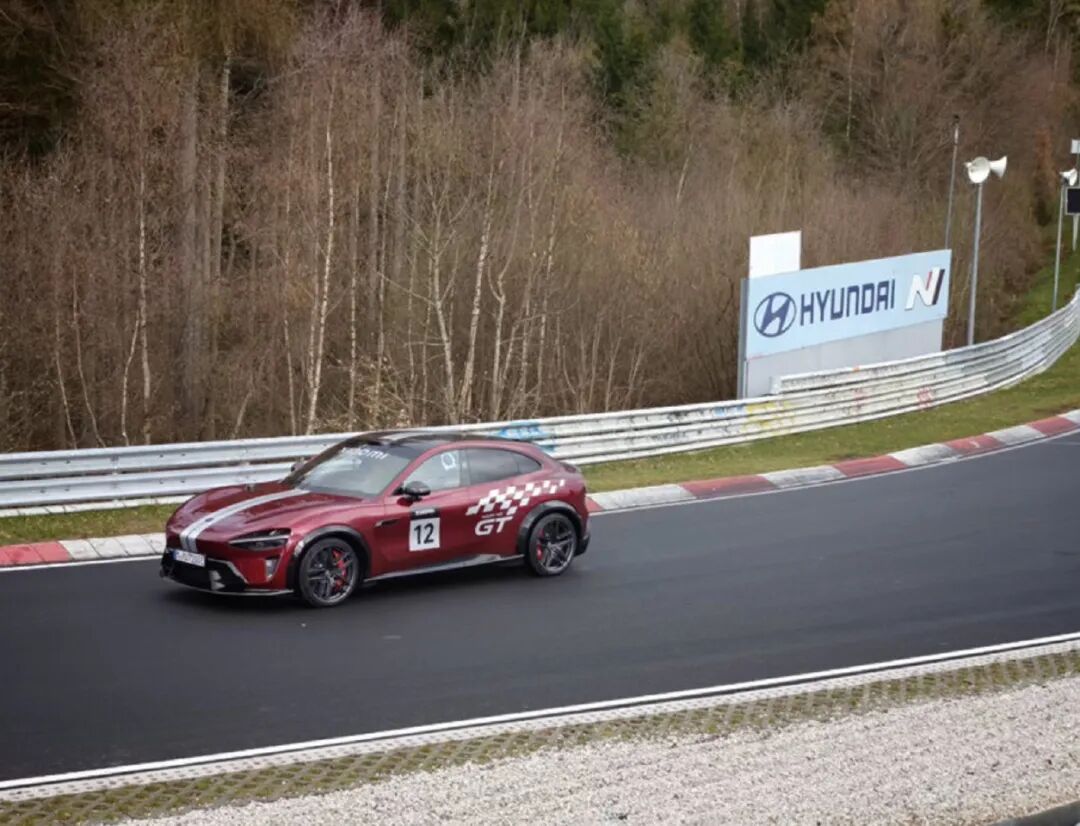
Next, Xiaomi will introduce the SU7L, YU7 GT, and its first extended-range model, the YU9. The first two are essentially minor revisions of the SU7 and YU7, requiring minimal additional development costs. What piques my curiosity is the narrative Xiaomi will craft around these two models to propel sales to new heights. Stay tuned.
The end.
-
![]()
The Allure of 'Acquisition Spree': Li Shufu's Left Turn, Xu Jiayin's Right
-
![]()
Strategic Transformation Yields Results: Phoenix Optics Reports 10.9% YoY Rise in Core Net Profit for H1 2026
-
![]()
Three Key Growth Trajectories Synergize! Crystal-Optech Reports 3.478 Billion Yuan in Revenue for H1 2026
-
![]()
Semi-Annual Report Sparks XPENG Motors Buzz
-
![]()
1.6 Billion Big Order Secured! SeeYA Technology's Revenue Soars by 287.87% in the First Half of the Year
-
![]()
Baidu's Profits Plunge by 68%: Unraveling the Mystery Behind the Numbers
-
![]()
Baidu’s Profits Tumble by 68%! Where Has All the Money Gone?
-
![]()
Hynix’s Taobao Store Shuts Down Abruptly: What Should Customers Do About Warranty Services for Memory Modules?