Midea Teams Up with BYD, Gree Joins Forces with Geely: Home Appliance and Auto Giants Forge Strategic Alliances
 07/07 2026
 497
497
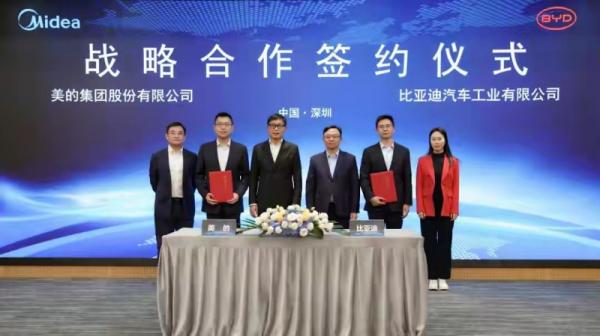
Following the strategic cooperation between Midea and BYD in November of the previous year, Geely and Gree have recently inked a strategic partnership agreement. These two collaborations epitomize profound industrial chain integration between leading home appliance enterprises and independent automotive companies. However, their strategic focuses, technological priorities, and target customer bases diverge significantly: Midea-BYD centers on the C-end consumer ecosystem, integrating people, vehicles, and homes, whereas Gree-Geely targets B-end industrial manufacturing and core in-vehicle components, representing the two predominant cross-industry approaches at present.
First, let's delve into the Midea + BYD partnership. The essence of this alliance lies in highly open ecological synergy and mutual benefit pursuit, emphasizing industrial-level deep integration and a closed-loop ecosystem encompassing 'people, vehicles, and homes.' It prioritizes three main areas of cooperation:
① Ecological and technological integration: Both parties are dedicated to transcending physical boundaries and constructing a smart ecosystem that seamlessly integrates 'people, vehicles, and homes.' This cooperation transcends mere functional叠加 (superposition in Chinese, but here 'integration' is more appropriate in English), delving into underlying AI agent collaboration, standardization of data protocols, and flawless connectivity between a comprehensive range of smart home products and BYD's entire vehicle lineup.
② Mutual pursuit of commercial benefits: This represents a multi-billion-dollar industrial collaboration and ecological partnership. BYD's vast factories and employee dormitories harbor a substantial demand for central air conditioning and HVAC equipment, with Midea poised to secure a core share through exclusive terms. In return, Midea deeply integrates BYD into its group vehicle procurement, executive transportation, and the smart vehicle-home ecosystem.
③ Channel and business model reconstruction: The two sides are also venturing into 'innovative channel convergence,' jointly establishing smart living experience spaces in offline stores and co-developing ecological products such as in-vehicle refrigerators and ice makers, achieving holistic integration from industrial collaboration to consumer scenarios.
Now, let's turn our attention to Gree + Geely. The crux of this partnership resides in precisely addressing technological gaps and sharing values at the manufacturing foundation, emphasizing complementary core technologies and resonance in manufacturing quality. It also prioritizes three main areas of cooperation:
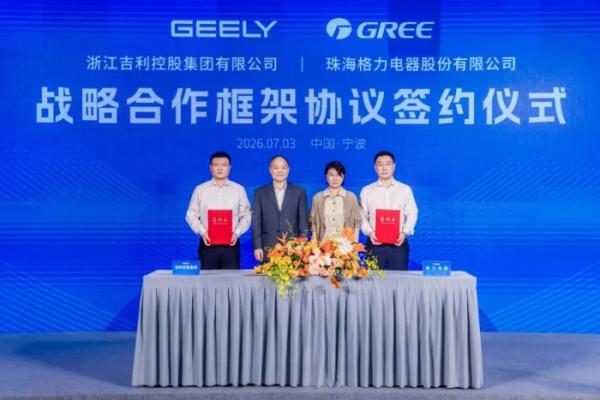
① Precise supply chain complementarity: Gree confronts pressure from a plateauing main business and urgently requires automotive scenarios to validate its silicon carbide power modules, lithium titanate batteries, and precision manufacturing capabilities. Meanwhile, although Geely is making rapid strides in new energy, it still relies on external suppliers for high-end power semiconductors and core thermal management components. Geely's massive sales volume furnishes Gree with a real-world testing ground for automotive-grade products, while Gree offers Geely a more autonomous and controllable supply chain alternative.
② Smart manufacturing and cost reduction and efficiency enhancement: Beyond in-vehicle hardware (such as heat pump systems and in-vehicle air conditioners), the two sides are also deeply collaborating on the smart manufacturing industrial chain. Gree equips Geely's factories with high-precision CNC machine tools and industrial robots, and its zero-carbon park solutions also aid Geely in reducing energy consumption costs in manufacturing.
③ Convergence of manufacturing 'fundamentalism': The cooperation between Dong Mingzhu and Li Shufu stems from an extreme pursuit of quality and safety. High-level exchanges between the two sides and Geely's invitation to Dong Mingzhu to serve as a 'Zeekr Quality Experience Officer' reflect the underlying resonance between the two companies in their user-centric and safety-first philosophies.
In my opinion, these two cross-industry partnerships essentially signify proactive transformations by traditional manufacturing behemoths in response to external competition (such as the encirclement by ecosystem giants like Tesla, Huawei, and Xiaomi). Among them, Midea + BYD's strength lies in long-term industrial collaboration and ecological closed loops, showcasing the ambition of trillion-dollar giants to reshape lifestyles in the AIoT era.
Gree + Geely, conversely, leans more toward complementary home scenarios and the localization of core supply chains, reflecting the deep cultivation of manufacturing in achieving autonomy and controllability over core technologies. Clearly, neither approach is superior; they are simply optimal choices made based on different corporate strengths, marking a complete departure from simple procurement cooperation between home appliance and auto companies and heralding the dawn of a new era of strategic partnerships.
In other words, Midea excels in whole-house smart solutions and market-oriented channels, aligning perfectly with BYD's massive civilian vehicle sales volume, making it natural for them to focus on the C-end ecosystem, connecting vehicles to homes and generating revenue from C-end scenarios and traffic. Gree, on the other hand, deeply cultivates core self-research and industrial equipment, aligning with Geely's comprehensive range of passenger and commercial vehicle layouts, making deep cultivation of industrial chain components its inevitable path, as they concentrate on factories producing high-quality vehicles and earning long-term dividends from core manufacturing and localization substitution.
In fact, the most stable cooperation in the business realm is the mutual pursuit of benefits. The robust alliances forged by these two partnerships not only broaden the long-term growth trajectories of their respective companies but also provide highly valuable demonstrations for China's manufacturing industry to transition toward high-end and intelligent manufacturing. What are your thoughts?
-
![]()
Registered Capital Slashed to 372 Million Yuan! Yutong Optical Finalizes Industrial and Commercial Change Registration
-
![]()
Zhuque-3 Successfully Lands, and 'Time Traveler' Secures Another ¥100 Million in Funding: China's Commercial Space Industry Experiences a 'Dynamic August'
-
![]()
Autohome Faces a Shrinking Window of Opportunity
-
![]()
Even a Titan Like Musk Has Faced Setbacks in Fulfilling Promises
-
![]()
AI Office: The End of the Racing Era, Context Becomes the Key to Success
-
![]()
Domestic Vehicle Chassis Revolution ②: The Steering Wheel Remains, But Mechanical Connections in the Steering System Are Decreasing
-
![]()
Exploring MiniMax Design: Can Video Editing Be as Simple as Speaking?
-
![]()
Why Can SenseTime Achieve Profitability While CloudWalk Still Faces Challenges, Despite Both Adopting Large Models?