Disappointing, Utterly Disappointing, Falling Short on All Fronts. Yet, Brighter Days Lie Ahead...
 08/24 2026
 447
447
This marks the 1377th original piece from 'New Energy Frontier'. Simply click on 'New Energy Frontier' at the top to follow and star this account for more insights. Please note, this article solely reflects the musings of 'New Energy Frontier' and should not be construed as investment advice. The author neither operates investment groups, charges for stock tips, nor manages client portfolios.
--------
Let's delve into the economic indicators for July...
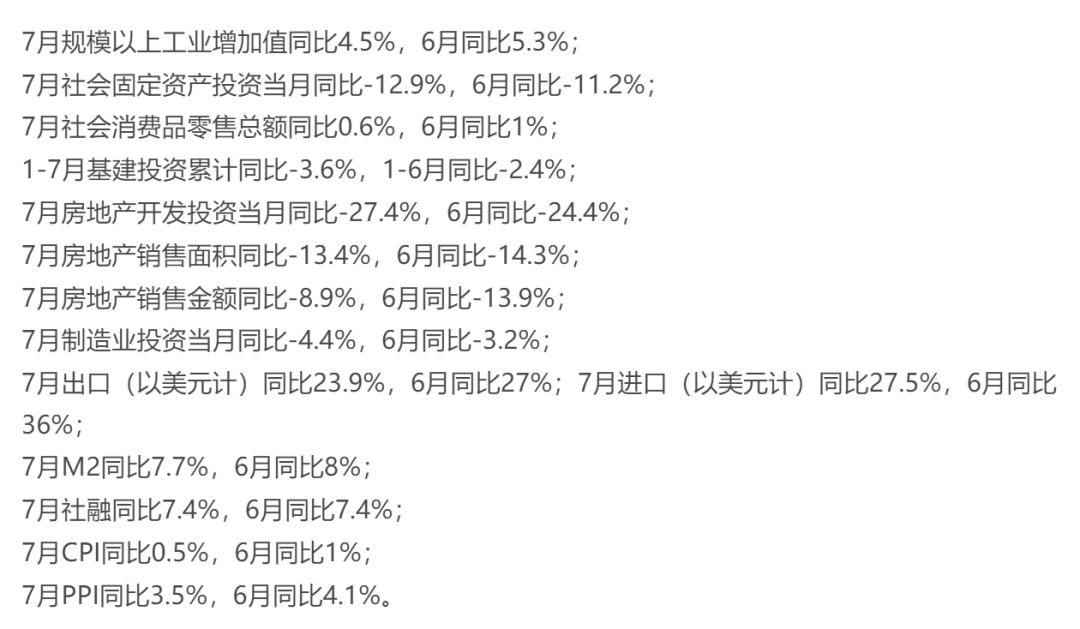
Now, let's zoom in on data from select industries:
In July, automobile retail sales plummeted by 17.0% year-on-year, marking a 0.9 percentage point drop from the previous month. This downturn was largely attributed to the exhaustion effect following the phase-out of new energy vehicle subsidies, escalating costs such as chip shortages constraining automakers' pricing flexibility, and subdued consumer purchasing sentiment.
In July, China's sales of power and energy storage batteries reached 185.2 GWh, experiencing a 5.5% month-on-month decrease but a robust 45.5% year-on-year surge. Within this, power battery sales hit 129.1 GWh, accounting for 69.7% of the total, with a 3.3% month-on-month decline but a 41.6% year-on-year spike. Energy storage battery sales, on the other hand, reached 56.1 GWh, constituting 30.3% of the total, showing a 10.3% month-on-month decrease but a remarkable 55.4% year-on-year increase.
In the real estate sector, the cumulative year-to-date decline in new construction starts stood at 24.0%, commercial housing sales fell by 13.1%, and the unsold commercial housing area decreased by 0.8%.
Regarding exports, valued in US dollars, the export volume witnessed a 23.9% year-on-year uptick, primarily fueled by exports in the AI supply chain, automobiles, ships, and other sectors.
Quite speechless, indeed...
China's economic engine is propelled by three main forces: investment, consumption, and exports. From the macroeconomic data above, it's clear that, barring exports, both investment and consumption are languishing.
01 Domestic Demand: Still Not Worth the Hype
The sluggishness in domestic demand can be attributed to various factors, including short-term extreme weather conditions like heatwaves, frequent typhoons, and heavy rainfall. However, it's crucial to acknowledge objectively that domestic demand has been lackluster for years due to slowing economic growth, particularly the strain on household income levels and a pervasive lack of confidence, resulting in greater deflationary than inflationary pressures in the country.
Investment issues are equally pronounced. With the real estate price bubble deflated, real estate investment has hit rock bottom. Infrastructure investment, too, faces significant challenges. After decades of frenetic infrastructure spending, the return on investment has dwindled, making it unrealistic to rely on large-scale infrastructure projects to stimulate the economy.
Among the three main drivers, exports remain the most reliable, especially in AI technology, automobiles (particularly new energy vehicles), ships, etc.
Indeed, after the release of July's macroeconomic data, many phenomena in the secondary market become readily explainable. This applies not only to July's data but also to previous macroeconomic indicators.
Why has AI hardware shone in the past two years? Because it has genuinely delivered, with outstanding export performance, and remains a key export product. Given that several major global economies are still betting on AI technology's future, it's expected to remain a primary driver of investment and exports.
Why is domestic demand not a priority? The macroeconomic data speaks volumes. Various industries are genuinely struggling. Big-ticket items like houses and cars are self-explanatory. Even the automobile industry, previously buoyed by new energy vehicles, is now seeing its growth rate inevitably slow down as penetration exceeds 65%. These two sectors will continue to face pressure. Many other domestic demand industries also grapple with peak consumption demand due to negative population growth. Essentially, only a few emerging consumer industries are experiencing significant growth.
02 AI and Innovative Pharmaceuticals: Still the Focal Points
If we consider pharmaceuticals and healthcare as part of the broader consumer sector, they may be among the rarest industries where supply creates demand. An aging population will boost healthcare consumption demand, and advancements in pharmaceutical and healthcare technology can generate new demand, making long-term growth prospects still promising. Of course, the low-end pharmaceutical and healthcare industry cannot escape the pressures of centralized procurement and fierce competition. The focus should remain on innovative pharmaceuticals and medical devices, especially those targeting the global market.
Why do Americans always stir up trouble in the market?
Well, the American market is genuinely high-quality. With a vast consumer base where per capita GDP exceeds $70,000, it offers a large market size and favorable prices, making it an attractive destination for companies worldwide. If they can penetrate this market, the rewards can be substantial.
Especially given China's massive manufacturing sector and relatively weak domestic demand, if the global market remains closed, intense competition becomes inevitable, and deflationary pressures will continue to mount. Meanwhile, Americans face inflationary pressures due to a lack of affordable goods. Therefore, it's certain that the two countries will not completely cut ties and will continue to engage in trade. However, in the long run, boosting domestic demand remains paramount for China. After all, the supply chain system can evolve over time. Besides boosting domestic demand, expanding influence abroad and opening up more markets are also crucial. The Belt and Road Initiative, launched a decade ago, has yielded positive results, but more is needed.
Nevertheless, there's no need to be overly pessimistic. Why aren't American goods worried about sales? Apart from strong domestic demand, it's also because American goods find it easier to penetrate the global market, largely due to the global presence of American warships. When China has more aircraft carriers, it will also become easier for Chinese goods to sell globally...
I must admit, following the example of the "Eagle Sauce" (a nickname for the United States) does make things easier...
Indeed, before these past few years, macroeconomic factors had minimal impact on investment outcomes, especially for medium- to long-term investments, which primarily required studying the companies themselves. However, these past few years have witnessed unprecedented changes. Macroeconomic factors now wield significant influence over investment results. Failing to recognize changes in the broader environment and adjust investment directions accordingly will almost certainly lead to disastrous outcomes.
For instance, those who invested in real estate and consumer companies like liquor at their peak a few years ago are still struggling to recover. They must endure a prolonged process of valuation corrections, and it's almost certain that many of these companies will never regain their previous highs.
Therefore, in the secondary market, until macroeconomic data shows significant improvement, domestic demand should still be approached with caution. The focus should remain on high-growth sectors with certainty, such as AI technology, innovative pharmaceuticals, and emerging global consumer trends. It's essential to meticulously select companies that genuinely benefit from industry trends and avoid those that merely ride on conceptual hype.
-
![]()
Registered Capital Slashed to 372 Million Yuan! Yutong Optical Finalizes Industrial and Commercial Change Registration
-
![]()
Zhuque-3 Successfully Lands, and 'Time Traveler' Secures Another ¥100 Million in Funding: China's Commercial Space Industry Experiences a 'Dynamic August'
-
![]()
Autohome Faces a Shrinking Window of Opportunity
-
![]()
Even a Titan Like Musk Has Faced Setbacks in Fulfilling Promises
-
![]()
AI Office: The End of the Racing Era, Context Becomes the Key to Success
-
![]()
Domestic Vehicle Chassis Revolution ②: The Steering Wheel Remains, But Mechanical Connections in the Steering System Are Decreasing
-
![]()
Exploring MiniMax Design: Can Video Editing Be as Simple as Speaking?
-
![]()
Why Can SenseTime Achieve Profitability While CloudWalk Still Faces Challenges, Despite Both Adopting Large Models?