Guangzhou Gains Renewed Dynamism, Eyes Next Five-Year Leap
 12/07 2025
 853
853
The year 2025 heralds a significant milestone for Guangzhou—
The 138th Canton Fair draws merchants from across the globe, while the 15th National Games ignite widespread enthusiasm citywide, with the National Games for Persons with Disabilities and Special Needs also on the horizon.
A series of high-profile, high-energy events are unfolding in succession, not only showcasing Guangzhou's urban influence but also highlighting its vibrant internal driving forces.
This ancient city, boasting a history spanning over 2,200 years, is experiencing a miraculous 'reverse growth' amidst the tides of the times, advancing resolutely forward.

Guangzhou's Newfound Vitality Springs from Its Economy
Since the Qin Dynasty, Guangzhou has flourished by the Pearl River, prospering through its proximity to water and its maritime orientation.
For over two millennia, Guangzhou has served as China's southern gateway to the world, playing a pivotal role in linking South China with global trade networks.
In 2025, Guangzhou Port will introduce eight new foreign trade routes, bringing the total to 286 and weaving a denser global maritime network.
From Guangzhou, cargo ships can directly reach over 400 ports in more than 100 countries and regions worldwide, with 60 'international friendly ports,' ranking first nationally.
The 138th Canton Fair, which concluded last month, attracted over 310,000 overseas buyers from 223 countries and regions, marking a 7.5% increase from the previous session and setting a new historical high.
On-site intended export transactions reached USD 25.65 billion, demonstrating sustained and stable growth. Among them, buyers from countries participating in the Belt and Road Initiative numbered 214,000, a 9.4% increase, accounting for nearly 70%.
In the first ten months of this year, Guangzhou's total foreign trade imports and exports historically surpassed the RMB 1 trillion mark.
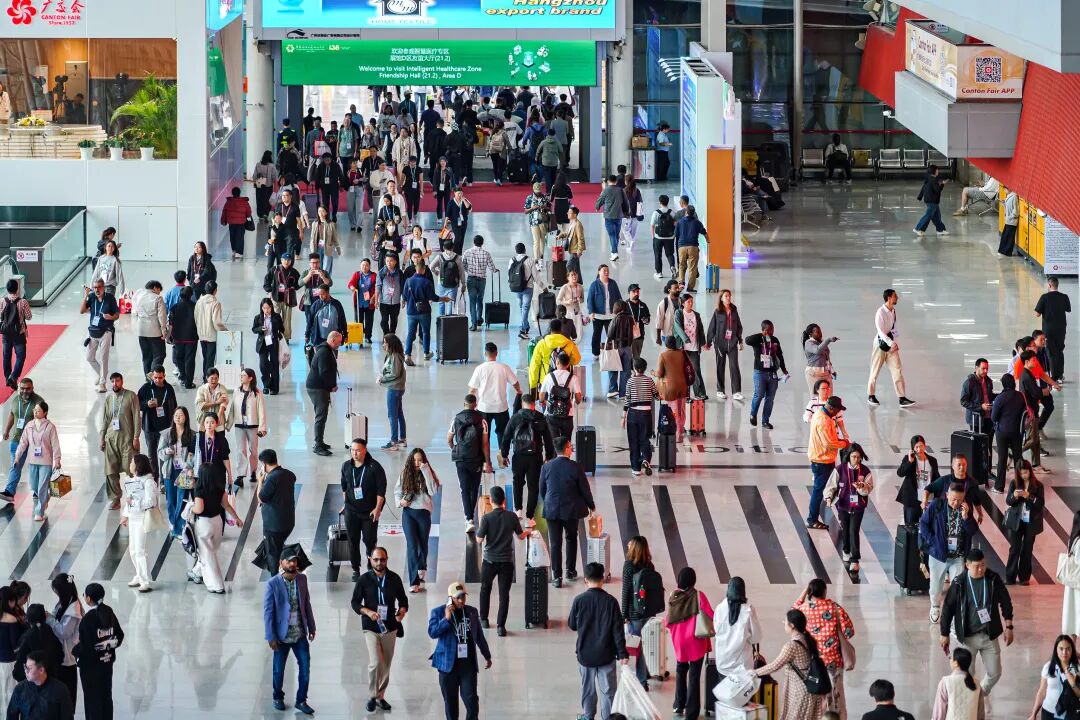
(Scene from the 138th Canton Fair)
Exhibitions Attract Businesses, Events Drive Foot Traffic
The recently concluded 15th National Games saw Guangzhou welcoming over 2.57 million tourists daily, significantly boosting growth in 'accommodation, transportation, tourism, and shopping.' Air ticket bookings increased by 28.8% year-on-year, with hotel bookings in popular areas surging by over 30%, and dining consumption jumping by 145% year-on-year.
In terms of airport economy, Guangzhou Baiyun International Airport has also capitalized on this surge.
According to the Guangzhou Airport Authority, in the run-up to the opening of the 15th National Games, inbound passenger flow at Guangzhou Baiyun Airport continued to rise, with an average of 26,000 inbound travelers daily, marking a year-on-year increase of approximately 24%.
The new T3 terminal officially opened, providing crucial service support for the event and marking a significant leap in Guangzhou's aviation hub capabilities. Baiyun International Airport has entered an era of 'three terminals, five runways,' with annual passenger throughput capacity soaring to 120 million, aiming to become the world's largest.
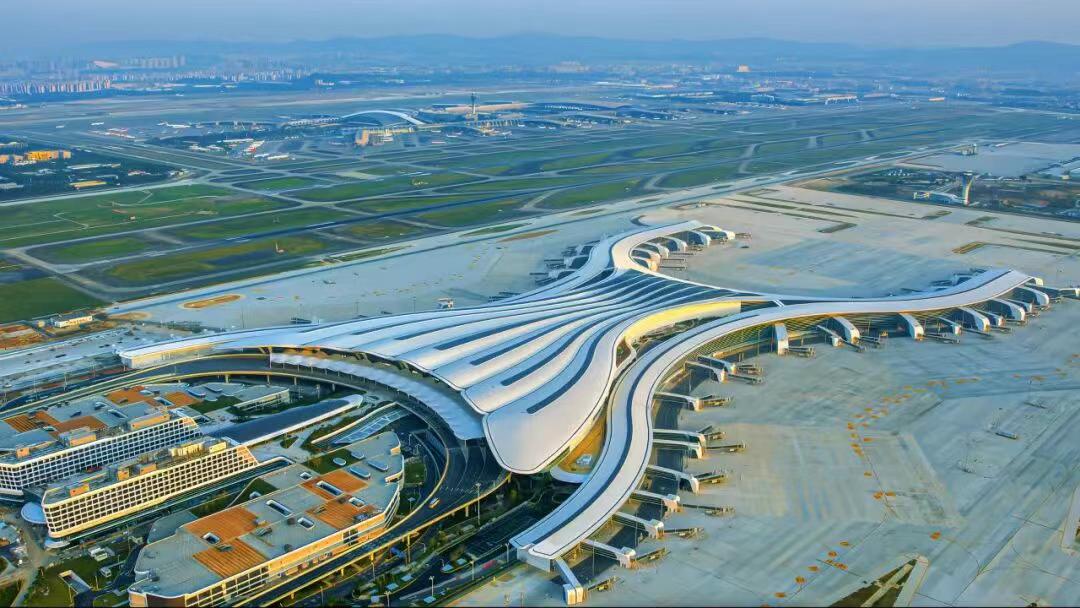
(Baiyun International Airport T3 Terminal)
From a GDP of RMB 4.3 billion in 1978 to surpassing RMB 1 trillion in 2010, RMB 2 trillion in 2017, RMB 3 trillion in 2023, and now approaching RMB 4 trillion in 2025, this upward trajectory reflects Guangzhou's remarkable rise over the past four decades. Undeterred, Guangzhou has set its sights on 'doubling its economic output by 2035.'

Economic Vitality Springs from Corporate Innovation
Economic development hinges on corporate innovation. Guangzhou is fully committed to building a '12218' modern industrial system driven by technological innovation.
This means that while Guangzhou continues to solidify its foundation in six advanced manufacturing clusters with output exceeding RMB 100 billion each, such as intelligent connected vehicles and new energy vehicles, biomedicine, and health, it is also accelerating the layout of future industries like the low-altitude economy and aerospace, as well as artificial intelligence.
For instance, in the robotics sector, XPENG's IRON humanoid robot made its debut with a 'catwalk' that stunned the market. In the low-altitude economy, EHang has become the world's first electric vertical take-off and landing (eVTOL) aircraft company with 'three certificates,' while XPENG AEROHT's flying car mass production factory officially commenced trial production, successfully rolling out its first 'Land Aircraft Carrier' flying vehicle, with a planned annual production capacity of 10,000 units.

(XPENG's new-generation IRON robot debut)
In the chip sector, GYEE Semiconductor has emerged as China's largest automotive-grade silicon carbide chip manufacturer, with products widely used in new energy vehicles and smart grids.
In the aerospace industry, CAS Space's 'Lijian-1' rocket has successfully launched 63 satellites into orbit, becoming China's only private commercial rocket to continuously launch ton-class payloads.
The intelligent connected vehicles and new energy vehicles industry is aiming for a trillion-yuan scale, with Pony.ai and WeRide's Robotaxi 'twin stars' not only listing on international capital markets but also sparking a wave of overseas expansion.
Moreover, Guangzhou boasts a strong innovation foundation, ranking eighth globally in the 'Nature Index - Research Cities.'
Many companies actively transform using cutting-edge technologies such as the Industrial Internet, 5G, and digital twins.
For example, Nansha is venturing into deep-sea exploration, with the construction of the Cold Spring Ecosystem Research Facility underway.
Haizhu Pazhou gathers 'new BAT' companies represented by ByteDance, Alibaba, and Tencent, creating a digital economy growth pole.
In 2025, 24 Guangzhou companies made the Global Unicorn List, ranking ninth globally; 12 companies were listed among the National Disruptive Technology Innovation Stars, accounting for nearly one-third of the national total.

Corporate Vitality Springs from a Vibrant Business Climate
Corporate innovation thrives in Guangzhou's vibrant business climate.
At the Guangdong Provincial High-Quality Development Conference earlier this year, Guangdong Party Secretary Huang Kunming stated, 'Industries thrive on talent, and talent gathers where industries flourish. We must attract global talent, work with Hong Kong and Macao to build a high-level talent hub, and solidify the talent foundation for a modern industrial system.' This year, Guangdong will implement the 'Gather Talents in Guangdong, See the Future in Guangdong' theme, launching the 'One Million Talents to Guangdong Action Plan,' offering competitive salaries and positions to attract one million college graduates to work and start businesses in Guangdong.
Meanwhile, Guangzhou is making precise efforts to expand effective investment through project initiatives. It is reported that Guangzhou is driving 998 municipal key construction projects with an investment of RMB 381.5 billion, boosting the city's fixed asset investment by around 5% year-on-year.
Huangpu District is piloting a 'zero-rent park,' providing 150,000 square meters of industrial space, offering up to three years of rent-free accommodation for biomedicine and low-altitude economy companies, and reducing startup costs through innovative models like 'rent-for-equity.'
An old factory in Guangzhou's Baiyun District has successfully transformed, with the Guangzhou Industrial Control Industrial Park · Tongli International Fashion Port evolving from the Guangzhou Semiconductor Device Factory into a 'high-end industrial carrier.' The project is equipped with facilities such as an international exhibition hall, immersive showroom, and e-commerce live-streaming base, expected to add 1,000 market entities, create approximately 20,000 jobs, generate an annual output value of RMB 2 billion, and RMB 120 million in annual taxes, achieving a 'triple win' of economic, social, and environmental benefits.

(Guangzhou Industrial Control Industrial Park · Tongli International Fashion Port)
From January to May 2025, the number of newly registered business entities in Guangzhou increased by 38.37% year-on-year, ranking first among national business environment pilot cities. These figures indicate a strong entrepreneurial and business climate in Guangzhou, providing a continuous driving force for its economic development.
Over the next five years, Guangzhou aims to build one trillion-yuan industrial cluster, four 500-billion-yuan industrial clusters, and four 100-billion-yuan industrial clusters, with a total scale exceeding RMB 6 trillion. Meanwhile, it will proactively layout six future industry sectors, striving for exponential growth within five to ten years and establishing a national future industry pilot zone.

Conclusion
From the Canton Fair attracting global merchants to the National Games boosting citywide consumption, from the densification of port routes to the enhancement of airport capabilities, Guangzhou has solidified its foundation for sustained growth through openness and innovation.
In 2025, Guangzhou is invigorating this ancient merchant city with a new era of vitality through a series of measures, including building a modern industrial system, stimulating technological innovation, optimizing urban spatial layout, and deepening reform and opening up.
Facing the '15th Five-Year Plan,' Guangzhou is taking pragmatic and resolute steps toward a future of higher-quality, sustainable development.
-
![]()
Raking in Big Profits Overseas! Chery’s Overseas Revenue Makes Up 70% in H1, with Gross Margin Climbing to 16.1%
-
![]()
Alibaba’s New Fiscal Quarter: 45% Revenue Surge in Alibaba Cloud, Enhanced Profitability in AI Cloud, but Widening Losses in the Application Layer
-
![]()
The AI Version of 'PayPal Mafia' Has Arrived: 20 AI Startups Raise Over $4.6 Billion in Funding
-
![]()
Wang Jian's Vision: Paving a Pathway for Alibaba Through AI
-
![]()
Hyundai Motor Workers Strike Today, Fearing Job Losses to Robots
-
![]()
Embracing 'Light': O-film Unveils Its 'Illuminating the Future' Strategy
-
![]()
SenseTime’s SenseNova U1.5 Lite Goes Open Source: Ushering in a New Era of Predictable AI Image Generation
-
![]()
Collaboration Initiated! Tesla Officially Welcomes Doubao Onboard