Zhejiang’s AI Industry Surges Forward: Who Will Be the Next Wave of ‘Tech Rising Stars’?
 08/24 2026
 572
572
@Zhejiang Sci-Tech Enterprises Zhejiang Initiates Selection for New Cohort of ‘Tech Rising Stars’
In recent years, China’s AI sector has experienced exponential growth, boasting over 680,000 enterprises across the supply chain. Marked by rapid advancements in large-scale models, accelerated deployment of intelligent agents, and upgraded computing infrastructure, the industry has emerged as a pivotal driver of high-quality economic development.
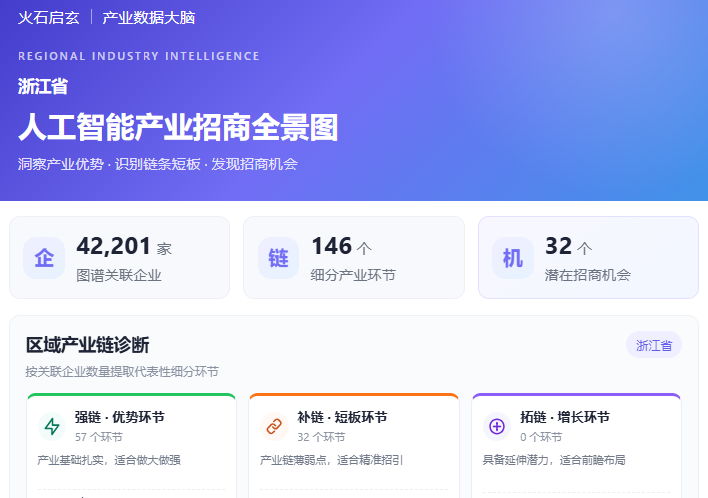
As a frontrunner in China’s AI landscape, Zhejiang Province is intensifying its efforts to establish a national AI innovation hub. It has established a comprehensive full-industry-chain ecosystem, encompassing chips, large-scale models, intelligent agents, and application services. This ecosystem serves as a fertile ground for nurturing ‘tech rising stars.’ Leveraging the ‘Huoshi Xinglan’ industrial recruitment intelligent agent and Zhejiang’s ‘Innovation Points System’ digital platform, this article delves into the fundamentals of Zhejiang’s AI industry and its innovative entities.
Industrial Scale Expands 2.6-Fold in Five Years, R&D Investment Surpasses 7%
In terms of industrial scale, Zhejiang’s AI sector soared from approximately 270 billion yuan in 2020 to 713.1 billion yuan in 2025, marking a 2.6-fold increase over five years. Regarding R&D expenditure, the ratio of R&D costs to operating revenue in the province’s core AI industries reached 7.6% in 2025, accompanied by an 11.3% rise in total profits. In terms of enterprise clustering, Zhejiang now accommodates over 40,000 AI enterprises, including more than 1,600 in the foundational layer and over 2,000 in the technical layer.
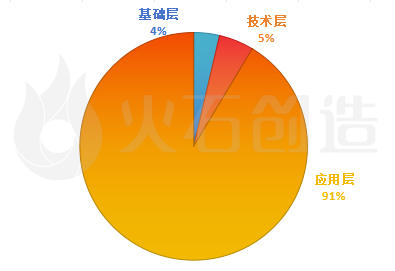
Figure: Distribution of Enterprises Across Zhejiang’s AI Industry Chain
Source: ‘Huoshi Xinglan’ Industrial Recruitment Intelligent Agent
Full-Chain Competition: Synergistic Efforts in Computing Power, Models, and Applications
From an industrial structure perspective, Zhejiang’s AI industry has transitioned from an ‘application-driven’ phase to a full-chain competitive era, encompassing ‘computing power—models—terminals—scenarios.’
1. Foundational Layer: Computing Power Leads, Chip Development Accelerates
On the computing power front, the province has deployed 193 EFLOPS of operational computing power, ranking among the top in China. A computing power network has been established, with Hangzhou and Jiaxing as central nodes and Ningbo, Wenzhou, and other cities providing multi-point support, while actively exploring cutting-edge domains such as space computing.
The chip sector remains a relatively weak link in the industrial chain. Current efforts are concentrated on design: the Chengxi Science and Technology Innovation Corridor has attracted chip design enterprises such as T-Head and Zhenlei Technology, specializing in computing power chips and RF chips. However, R&D intensity continues to escalate. The ‘15th Five-Year Plan for Digital Zhejiang Construction’ identifies ‘promoting GPU technology development, addressing technical bottlenecks in AI chip design, and establishing a complete domestic supply chain for high-performance GPUs’ as key priorities, elevating chips to a strategic R&D focus.
At the data level, the province has released over 44,000 public datasets and facilitates ‘available but invisible’ data sharing through trusted data space infrastructure, providing abundant ‘fuel’ for AI development.
2. Technical Layer: Large Models Propelled by ‘Open-Source + Vertical’ Dual Engines
Models represent Zhejiang’s most dynamic sector in recent years, forming a three-dimensional matrix of ‘foundational large models + industry-specific large models.’ Models like Tongyi Qianwen (Qwen) and DeepSeek consistently rank among the global elite and lead the open-source ecosystem. In vertical models, Huoshi Create has introduced an industrial economics large model, empowering industrial recruitment, financial risk control, and intelligent investment research; Supcon Technology and Zhejiang Lab deepen industrial scenarios, while Ant Group advances in medical AI... By mid-2026, 96 large models in Zhejiang had completed generative AI service filings.
3. Application Layer: Deep Scenario Penetration as the Strongest Moat
Zhejiang is accelerating the deep integration of ‘AI + industries.’ The ‘Implementation Plan for AI-Empowered Digital Transformation of Manufacturing (2026-2030)’ proposes cultivating 30 ‘AI Future Factories’ demonstration enterprises, 50 industrial intelligent agent platforms, 100 high-quality datasets for key industries, 150 typical application scenarios, and 300 industrial intelligent agents to comprehensively empower new industrialization.
One Core Leads, Gradient Collaboration: Computing Power Shifts West, Manufacturing Lands
In terms of industrial layout, Zhejiang’s AI industry has formed a ‘one-core-led, Greater Hangzhou Bay agglomerated, multi-node linkage’ pattern, with Hangzhou as the core and cities like Ningbo, Jiaxing, and Shaoxing in the Greater Hangzhou Bay region collaborating.
Table: Differentiated Roles Across Cities
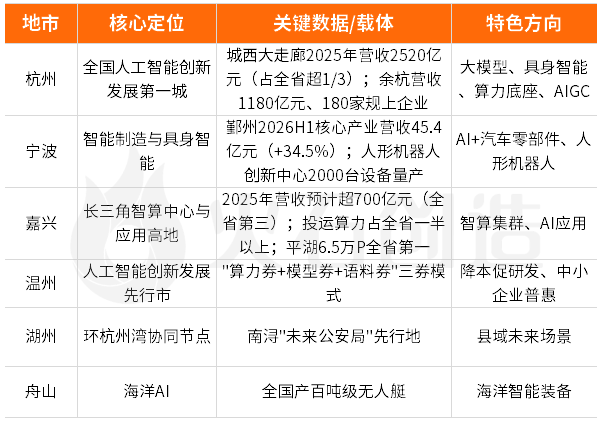
Source: ‘Huoshi Xinglan’ Industrial Recruitment Intelligent Agent
Spatially, a gradient feature of ‘computing power shifts west, models converge in Hangzhou, manufacturing lands, and scenarios decentralize’ has emerged. Computing power concentrates in Jiaxing to capitalize on land and energy advantages, building a Yangtze River Delta computing hub; models converge in Hangzhou, leveraging innovation hubs like the Chengxi Science and Technology Innovation Corridor and Future Sci-Tech City to foster a clustering effect for large model R&D and venture capital; ‘AI + manufacturing’ lands in manufacturing hubs like Ningbo to drive intelligent terminal industrialization; public scenarios such as government services, policing, and education decentralize to county-level regions, extending AI benefits to broader areas.
Industry Leaders Guide, ‘Six Dragons’ Break Through, ‘New Rising Stars’ Emerge
Among innovation entities, Zhejiang has established a three-tiered echelon structure of ‘industry leaders guiding—Six Dragons breaking through—New Rising Stars emerging,’ creating a unique ‘rainforest-style’ innovation ecosystem.
Industry leaders like Alibaba (Tongyi large models, Alibaba Cloud computing infrastructure) and Hikvision (machine vision and intelligent IoT) dominate foundational infrastructure areas such as large models, cloud computing, and intelligent IoT through strong capital strength, massive data resources, and complete ecosystems, providing platform support for the province’s AI industry.
The ‘Hangzhou Six Dragons,’ represented by DeepSeek, embody Zhejiang’s most explosive innovative force in AI, leading paradigm shifts in intelligent technologies.
Beyond ‘industry leaders’ and the ‘Six Dragons,’ the emergence of innovation entities like ‘tech rising stars’ warrants attention. The AI industry serves as a cradle for ‘tech rising stars,’ with nearly half of the first batch of 96 ‘tech rising stars’ being AI enterprises.
According to data from Zhejiang’s ‘Innovation Points System’ digital platform, as of August 21, 2026, Zhejiang hosts over 4,200 AI sci-tech enterprises, forming a vast reserve force for ‘tech rising stars.’
Who Will Be the Next Cohort of Sci-Tech Pioneers? The 2026 Selection for Zhejiang’s ‘Tech Rising Stars’ Is Underway! @Zhejiang Sci-Tech Enterprises Zhejiang Initiates Selection for New Cohort of ‘Tech Rising Stars’
-
![]()
Registered Capital Slashed to 372 Million Yuan! Yutong Optical Finalizes Industrial and Commercial Change Registration
-
![]()
Zhuque-3 Successfully Lands, and 'Time Traveler' Secures Another ¥100 Million in Funding: China's Commercial Space Industry Experiences a 'Dynamic August'
-
![]()
Autohome Faces a Shrinking Window of Opportunity
-
![]()
Even a Titan Like Musk Has Faced Setbacks in Fulfilling Promises
-
![]()
AI Office: The End of the Racing Era, Context Becomes the Key to Success
-
![]()
Domestic Vehicle Chassis Revolution ②: The Steering Wheel Remains, But Mechanical Connections in the Steering System Are Decreasing
-
![]()
Exploring MiniMax Design: Can Video Editing Be as Simple as Speaking?
-
![]()
Why Can SenseTime Achieve Profitability While CloudWalk Still Faces Challenges, Despite Both Adopting Large Models?