Huawei's Xu Zhijun: The Real Challenge of Super Nodes Transcends Technology
 10/08 2026
 365
365
At the recent Huawei Full Connect Conference held in Shanghai, Xu Zhijun, in conversation with HiSilicon Chief Scientist Liao Heng, unveiled the newly launched Peerium computing architecture alongside an interconnection solution dubbed the Lingqu Bus (UnifiedBus).
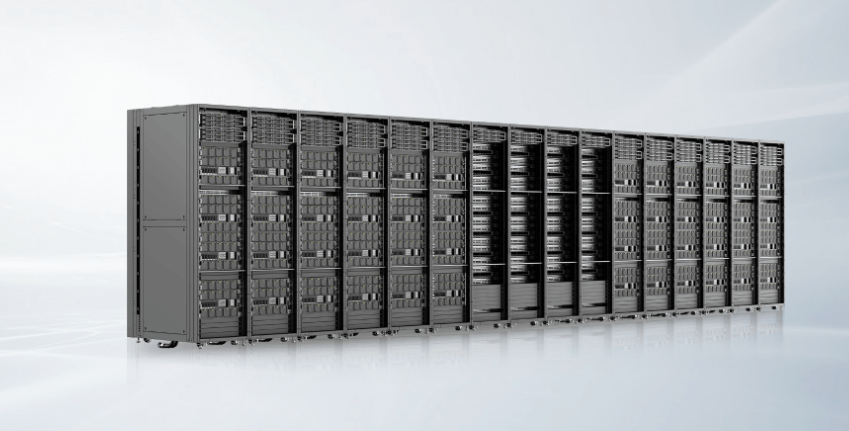
Image Source: Huawei Official Website
The concept of 'super nodes' has become a buzzword among computing power providers this year. Xu Zhijun emphasized that, despite widespread discussions on super nodes, implementation strategies diverge significantly. The true conundrum lies in how to seamlessly integrate thousands, or even tens of thousands, of processors into a unified computer system for collaborative operation. Huawei has christened this innovative architecture Peerium, with the ambitious vision of enabling millions of processors to function as a single, cohesive entity.
Huawei is currently in the process of constructing and rigorously testing the Atlas 950 SuperPoD supernode, boasting a staggering scale of 256,000 cards. While 256,000 cards may initially seem like an overestimation, within the framework of Liao Heng's subsequent insights, this figure appears rather conservative.
In response, HiSilicon Chief Scientist Liao Heng outlined a timeline, projecting that over the next two years, China is likely to witness the emergence of six to seven leading AI laboratories, each striving to train models with parameter counts ranging from 10 trillion to 40 trillion.
The resource demands of such colossal models are perfectly aligned with the memory capacity and scale of super nodes, underscoring the necessity for such a vast infrastructure to support their operations. From this vantage point, the cards Huawei is deploying are tailored for laboratories genuinely committed to training heavyweight models.
Regarding computing power chips, the Ascend 950 is now available in two variants: PR and DT. The PR version, launched in the first quarter of this year, is primarily geared towards inference tasks. The DT version, designed for training purposes, is currently undergoing testing for its corresponding super node, with large-scale availability anticipated by the end of this year or early next year. Liao Heng disclosed that Huawei has maintained close collaboration with various model manufacturers, and based on preliminary test results, the training performance of the 950DT is highly promising. He foresees that, commencing next year, a substantial volume of model training tasks will be executed on the 950DT super node.
Xu Zhijun highlighted that the paramount challenge moving forward may not be technological, but rather hinges on Huawei's ability to ensure adequate supply. He expressed his hope that the industry chain would swiftly ramp up production capacity to meet escalating demands.
From another vantage point, this statement implicitly acknowledges that Huawei has successfully surmounted technological barriers and is now primarily concerned with its capacity to fulfill supply requirements post-production. Given that Ascend chips are still far from satisfying domestic demand, Huawei has no immediate plans for a full-scale expansion into overseas markets, with only a select few countries undergoing testing and receiving limited supplies.
When queried about NVIDIA's standing in the Chinese market, Xu remarked that a singular metric would fail to provide a comprehensive picture. Nevertheless, based on the data at Huawei's disposal, Ascend has likely already overtaken NVIDIA, reflecting Huawei's current confidence in its domestic computing power supply capabilities.
The significance of the plea to 'produce more quickly' becomes apparent only when viewed within the broader semiconductor landscape. The manufacturing of Ascend chips is not entirely within Huawei's purview; advanced packaging and production scaling hinge on external supply chain collaborations.
Throughout the event, technical details took a backseat. While the capability of Peerium to amalgamate millions of chips into a single machine and the ongoing testing of the Atlas 950 with 256,000 cards are undoubtedly remarkable, Xu Zhijun consistently redirected the discourse towards production capacity and supply chain dynamics.
-
![]()
After a model evaluation, I began to re-understand WorkBuddy
-
[Shanhu Talks] The Diverse Lives Unfolding in the AI Era: A Ten-Month Journey
-
【Tibetan Fox Talks】These Ten Months in 2026: People and Me Amidst AI Anxiety
-
Second-Gen Doubao Phone Falls Short in Resolving Previous Flaws
-
Second-Generation Doubao Phone Falls Short in Resolving Previous Limitations
-
![]()
"Dark Side of the Moon" Completes Final Pre-IPO Funding Round with Valuation of Approximately $50 Billion, Kimi Set to List in Hong Kong!
-
![]()
Apple Imposes Mandatory Adaptation Directive for iPhone Duo, Marking Unprecedented Assertiveness
-
![]()
Huawei's Xu Zhijun: The Real Challenge of Super Nodes Transcends Technology