Find Ways to Make Agents Spend Money
 09/15 2026
 428
428

From September 9 to 12, the 2026 Inclusion·Bund Summit was held in Shanghai. At this summit, "agent commerce" replaced large models as the most frequently discussed topic.
Han Xinyi, CEO of Ant Group, judged at the main forum that the "ChatGPT moment" for agent commerce has arrived. AI practices from subsidiaries such as Ant Digital Tech, MYbank, Ant Consumer Finance, and Ant Insurance were all showcased; the theme of a roundtable forum was simply called "When Agents Become Transaction Entities."
A series of announcements collectively pointed to one judgment: agents are moving from capability demonstrations to real transactions. Supporting this judgment is not another leap in model capabilities but changes in user behavior.
As agents transition from "answering questions" to "spending money," what the industry truly lacks is no longer smarter models but a trust mechanism that encourages users to delegate tasks and merchants to participate.
01 Demand-Driven: From "Consultation" to "Transaction Intent"
The starting point of agent commerce is a change in user behavior.
In June this year, AI Alipay "Abao" launched its public beta, allowing users to accomplish tasks and place orders with a single sentence.
The needs Han Xinyi listed in his speech are all everyday: finding an economical and tasty place for five people to eat on a 200 RMB budget; getting a short hairstyle designed based on face shape; planning a trip to Shaoxing and buying high-speed rail tickets.
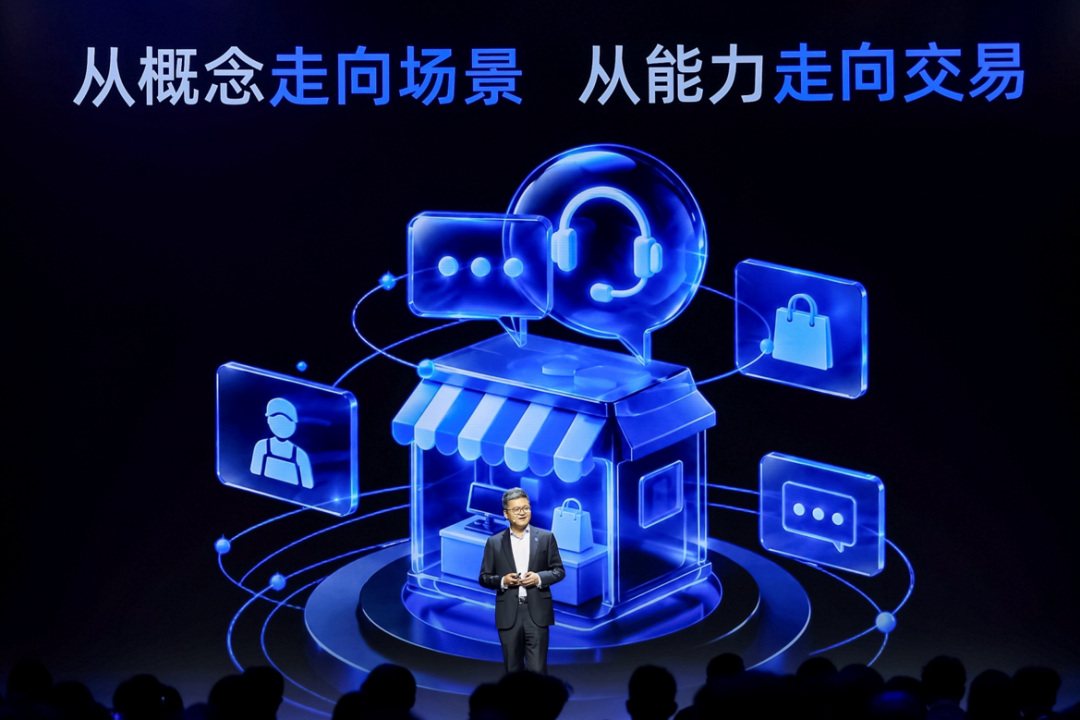
In his view, behind these one-sentence requests lies a combination of budget, location, preferences, timing, trust, and fulfillment expectations. "It's no longer just information queries but a pre-expression of transaction intent."
Zhu Lin, General Manager of AI Payments at Ant Group, predicts that within the next five years, more natural new interaction payments may account for over 50%, while payment volumes across diverse smart devices will grow tenfold. Han Xinyi was even more direct, stating in August that agent commerce would explode within 6 to 12 months.
However, this explosion depends not only on users. Han Xinyi also outlined three fundamental questions the industry must answer: How can services be understood and invoked by agents? Can agents complete transactions for users? After a transaction occurs, who authorizes, manages risk, and takes responsibility?
The first two questions concern capability; the third concerns trust. And it is precisely this third question that marks the dividing line between agent commerce and all previous online commercial stories.
Over the past two decades, the internet solved "whether people can pay"; in the agent era, the system must answer "who the AI is, who it pays for, why it pays, and whether the transaction is authorized."
02 Payment Redefined: From Checkout to "Trusted Commitment Engine"
To answer these questions, payments must first be transformed.
In traditional commerce, payments occur at the final stage of a transaction, like an action at the checkout counter; in agent commerce, payments will participate throughout the transaction process, with authorized amounts, executable scopes, risk judgments, and fulfillment responsibilities clearly managed from the moment a user expresses a need.
Han Xinyi summarized it as: "AI payments are not the last step; they become the trusted commitment engine for agent commerce."
Concrete implementations are emerging. Alipay announced the launch of the "AI Wallet Agent," positioned as a trusted ally for users in the agent world.
For example, when a user asks QianWen to order a coffee, QianWen handles "what to find and what to order," while the Wallet Agent ensures it aligns with the user's preferences, complies with authorization, and determines the final payment amount. It executes the payment only after risk identification and confirming the transaction aligns with user authorization.
On the supply side, changes are happening simultaneously. Alipay's "AI Collect" introduced three capabilities: Vibe Pay, Skill Pay, and Machine Pay. AI applications can receive payments after a single use, Skills generate ongoing revenue when invoked by agents, and machines settle automatically based on usage. This equips new digital entities with payment collection (payment collection) infrastructure.
Scenarios like AI recurring purchases, AI snatching deals, and AI reservations further integrate authorized transactions into daily consumption.
These capabilities are also extending beyond mobile screens. At the venue, Gaode's momentum robot dog "Tutu," QianWen AI glasses with iris payments, and AI earphones for voice payments all point in the same direction: agents are moving from the digital world into physical commerce. All bottlenecks converge on the same issue—not whether it can buy but whether it dares to buy.
This intent-driven transaction chain has already produced a model within Ant Group—MYbank's first micro and small business financial agent, "Bailing 2.0."
For example: Restaurant owner Mr. Wang wants to increase his credit limit. Instead of immediately submitting an application, Bailing 2.0 identifies through several rounds of questions that his real need is a 400,000 RMB funding gap for a new store. It then analyzes his old store's revenue, brand, and expansion plans, assists in completing materials, and ultimately raises his limit from 150,000 RMB to 400,000 RMB, usable in installments based on his progress.
From request to solution, the process took about 10 minutes, whereas similar complex requests previously took three days.
More notable is the process constraint. Operator information is only used within authorized scopes, while critical decisions like credit limits and repayment schedules remain made by authorized personnel. The gap between "can do" and "can do well" lies precisely in authorized boundaries and professional judgment.
03 KYA Step In: Giving Every Agent an Identity
To make users "dare," a system of identity and accountability is needed.
At the roundtable forum, Han Xinyi broke down the trust mechanism in the agent era into several layers: first, authorization, clarifying what users allow agents to do; second, identity, requiring "Know Your Agent" (KYA) in addition to KYC (Know Your Customer) and KYB (Know Your Business).
This also includes evaluating agent capabilities, a funds security system covering anti-fraud and risk control, and a traceable, auditable accountability mechanism.
In his words, "We need to trace and judge who made the mistake—was it a user authorization error, a misunderstanding by the agent, a miscommunication, or an execution issue by the merchant?" The chain of responsibility must be traceable and judgable.
The product-level counterpart is Ant's APASS commercial trust infrastructure. Based on the KYA concept, APASS establishes a dual trust chain of "identity + behavior."
When an agent initiates a payment, the system continuously evaluates its identity, transaction intent, and authorization boundaries. Trusted and compliant transactions proceed; suspicious ones request user confirmation; explicit oversteps are rejected, with traceable credible evidence retained. AI Pay also introduces blockchain notarization and compensation mechanisms.
Ant Digital Tech also collaborated with over ten units to drive the national standard project initiation (project approval) for "Blockchain and Distributed Ledger Technology—Agent Identity Management Requirements," systematically proposing a blockchain-based agent identity management model for the first time. Visa and Mastercard, two major international card organizations, are also exploring KYA framework interoperability with the Alipay+ payment network.
This means agent identities are evolving from proprietary mechanisms on single platforms to cross-platform, cross-network public rules.
04 Catalyst: Solve the "Chicken-and-Egg" Problem Before Waiting for the Flywheel
Beyond trust infrastructure, agent commerce faces a more fundamental cold-start challenge.
Han Xinyi admitted that in past half-year discussions with merchants, he clearly sensed their eagerness for new growth opportunities in the AI era, but a virtuous cycle has yet to form between supply and demand.
"Users want to use it, but merchants lack good agent services; merchants see no users and hesitate to invest in developing agents." This is a classic "chicken-and-egg" dilemma.
Ant Group positions itself as a "catalyst": first, to address safety and trust issues; second, to drive the formation of an agent supply-demand ecosystem flywheel.
Specific actions include Alipay establishing a 10 million RMB development fund for lifestyle agent developers, with annual individual awards up to 1 million RMB; "Abao" will launch agent incentive policies to support developers in creating usable, high-quality agents while providing users with incentivized channels to express new needs, connecting real demand with service supply.
Subsidy-based strategies are not new; what's novel is the shift in subsidy targets: not traffic but service supply understandable and invokable by agents.
Correspondingly, the logic of commercial traffic is shifting. Han Xinyi predicts that future merchant competition will no longer focus on exposure and dwell time but on whether they can be accurately understood by user agents and become the most trustworthy, fulfillable service providers. Commercial traffic is transitioning from "duration" to "intent."
05 Conclusion
Comprehensively, the short-term competition in agent commerce may not hinge on whose model has more parameters but on who first builds robust infrastructure for identity, authorization, risk control, notarization, and accountability.
This explains why payment platforms, terminal manufacturers, model companies, and merchants repeatedly emphasize the same point: on the eve of capability convergence, trust and security are prerequisites for ecosystem prosperity.
"When agents start helping you spend money, the entire agent commercial ecosystem transforms from a mere payment system into a thriving, diverse commercial ecosystem—its emergence moment truly arrives."
In other words, the "ChatGPT moment" for agents has arrived, while the "emergence moment" for agent commerce awaits the completion of trust infrastructure.",
-
The 'Three-tier Deconstruction' of the Restructuring Intentions Between FAW and GAC
-
![]()
"Living Room on Wheels": Pie or Trap?
-
![]()
Zhipu Secures Nearly US$5 Billion in Funding
-
![]()
FAW and GAC Integration: Will China's North and South Toyota Further Merge, and Will Dongfeng Continue Its Consolidation Efforts? | MINGJINGpro
-
![]()
Goldman Sachs Sets Its Sights on a City: Ulanqab!
-
![]()
The City in Goldman Sachs’s Spotlight: Ulanqab!
-
How Should Gas Stations Adapt Amid Declining Fuel-Powered Vehicle Sales?
-
![]()
Should GAC Shareholders Be Concerned: FAW Opts Not to Invest Cash but Lightens Its Joint Venture Load to Become Second-Largest Shareholder!