Perfect Model, Zero Business Impact - The Last Mile of AI Commercialization | FDE Industry Research Report
 09/18 2026
 474
474

While large models continuously break parameter records, an MIT survey shows that 95% of corporate AI projects fail to generate quantifiable profits. Impressive demo effects lose efficacy when integrated into real business processes. This delivery gap between model capabilities and commercial value is giving rise to a new core role—the FDE (Frontline Deployment Engineer).
Xiaoguang Think Tank releases the

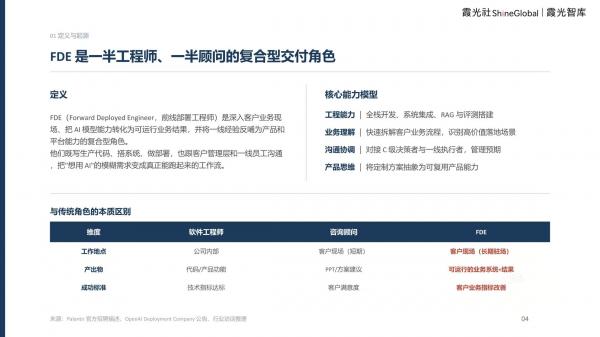
FDE (Forward Deployed Engineer) is broadly defined as professionals who deeply engage with client business operations over extended periods, transforming AI model capabilities into operational business outcomes while feeding frontline combat experience back to product platforms.
Core competencies include: engineering capabilities (full-stack development, RAG implementation, system integration), business decomposition skills, cross-level communication and coordination, and product abstraction thinking. FDEs can write production code for deployment, understand management-level strategies, grasp frontline employees' real pain points, and translate clients' vague AI aspirations into stable workflows.
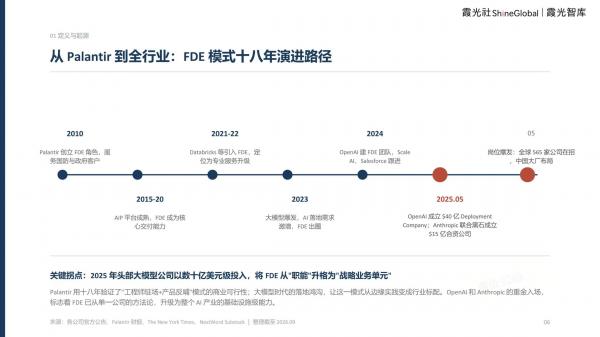
Tracing FDE's development: Palantir first created this role in 2010 to serve government and defense clients; the 2023 large model explosion drove AI implementation demand, propelling FDE into the spotlight; 2025 marked a critical inflection point as OpenAI invested $4 billion to establish a Deployment Company, while Anthropic formed a $1.5 billion joint venture with Blackstone, elevating FDE from a functional role to a strategic business unit.
From Palantir's internal weapon to strategic units heavily invested in by OpenAI and Anthropic, and now being actively pursued by domestic giants like ByteDance, Alibaba, and Tencent, FDE has evolved from a niche role into an infrastructure-level capability for the AI industry.

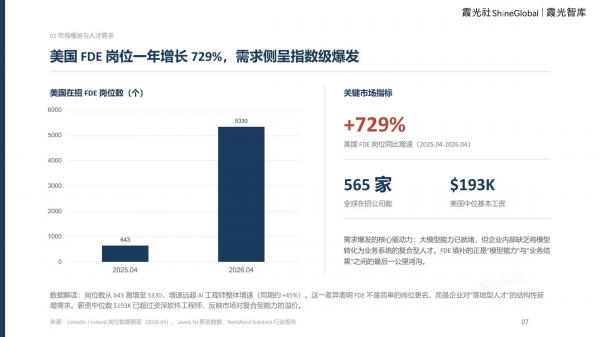
The critical demand for AI implementation has directly exploded the FDE talent market. Data shows U.S. FDE positions surged from 643 in April 2025 to 5,330 in April 2026, a 729% YoY increase—far exceeding the 45% growth rate for AI engineers overall.
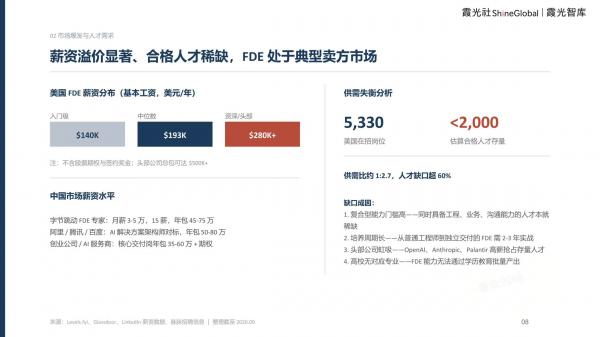
Globally, 565 companies now recruit FDE-related positions, but talent supply remains severely inadequate: The U.S. market has 5,330 open roles with fewer than 2,000 qualified professionals, creating a 1:2.7 supply-demand ratio and over 60% talent gap.
Salary levels directly reflect market premiums:
U.S. Market: Entry-level base salary $140,000, median $193,000, senior roles exceed $280,000 annually, with top companies offering total compensation packages up to $500,000+ (excluding equity bonuses).
Domestic Market: ByteDance FDE experts earn ¥350,000 monthly with 15 salaries annually (¥4.575 million total); Alibaba and Tencent offer comparable packages (¥5-8 million); AI startups provide ¥3.5-6 million packages plus equity for core delivery roles.

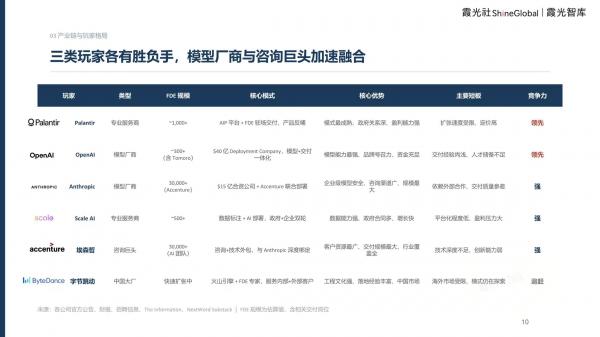
The global FDE landscape currently comprises three major player types: specialized service providers, large model vendors, and traditional consulting giants, each with distinct operational strengths and weaknesses.
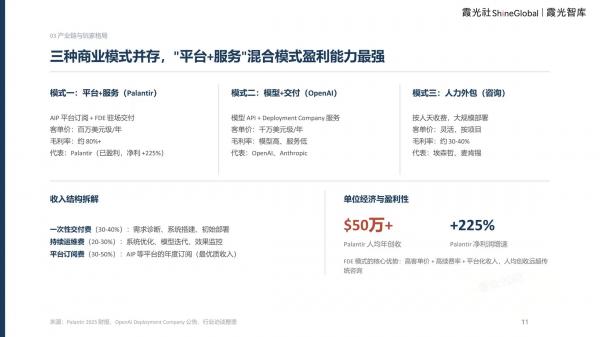
Profitability varies dramatically across business models:
Platform+Service Model (Palantir): Combines platform subscriptions with FDE on-site delivery, achieving million-dollar annual client contracts with >80% gross margins and 225% net profit growth, validating a profitable closed loop. Revenue comprises three parts: one-time delivery fees, maintenance fees, and platform subscriptions—with subscriptions being the highest-quality recurring income.
Model+Delivery Model (OpenAI/Anthropic): Combines model APIs with on-site deployment services, reaching ten-million-dollar contract values. While model margins are high, human delivery reduces overall profitability.
Human Outsourcing Model (Traditional Consulting): Charges per person-day with only 30-40% gross margins, prone to linear headcount expansion without product scalability barriers (P11).
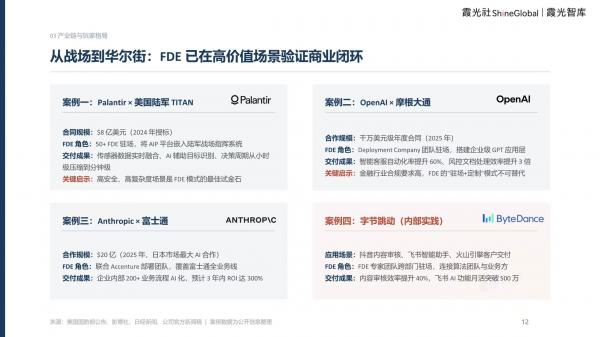
Real-world implementations prove FDE's irreplaceable value in high-stakes scenarios: Palantir secured an $800 million U.S. Army contract with 50+ FDEs on-site, reducing battlefield decision cycles from hours to minutes; OpenAI's FDE team improved JPMorgan Chase's intelligent customer service automation by 60% and tripled risk control document processing efficiency; ByteDance leveraged cross-departmental FDE on-site (on-site deployment) to boost content moderation efficiency by 40%.

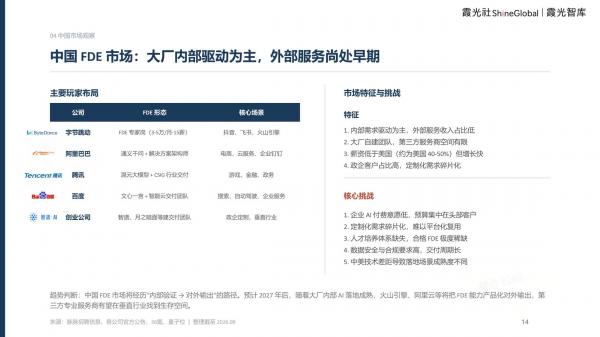
Domestic FDE development remains exploratory, primarily driven by internal demands from tech giants with immature external commercialization services.
Leading companies like ByteDance, Alibaba, Tencent, and Baidu have established FDE-like delivery teams: ByteDance supports Douyin and Feishu internally while serving enterprise clients externally through Volcano Engine; Alibaba leverages Tongyi Qianwen and DingTalk; Tencent utilizes its Hunyuan large model for financial and government sectors; AI startups like Zhipu and Moonshot AI also form delivery teams for government and enterprise customization projects.
However, the domestic market faces multiple challenges: AI adoption is concentrated among a few Top customers (key clients) with limited willingness to pay among most enterprises; highly fragmented government/enterprise customization demands hinder platform scalability; complete talent cultivation systems are lacking; and stringent data compliance requirements prolong delivery cycles.
After 2027, as internal AI implementation experience matures in tech giants, cloud vendors are expected to productize FDE capabilities for external output, while vertical industry third-party service providers will also emerge.
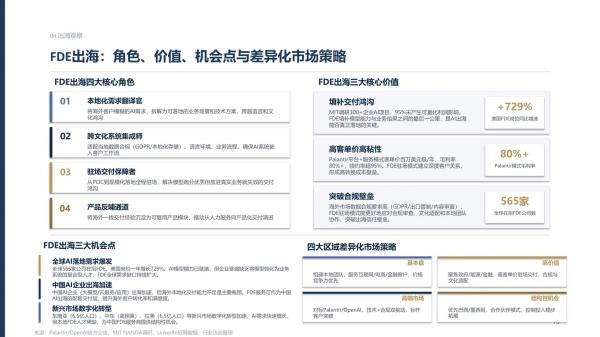
Notably, FDE holds strategic value for China's AI globalization. As Chinese large models and AI applications expand overseas, the primary bottleneck isn't model performance but localized delivery. FDE plays four critical roles in overseas expansion: local Requirement translator (demand translator), cross-cultural system integrator, on-site delivery guarantor, and product feedback channel—addressing pain points like language/cultural barriers, GDPR compliance, and business process adaptation.
Region-specific strategies include: price competitiveness in Southeast Asia; high-value government/energy projects in the Middle East; breakthroughs with benchmark client (flagship clients) in Europe and America driven by technical and compliance excellence; and steady expansion through partner models in Latin America.

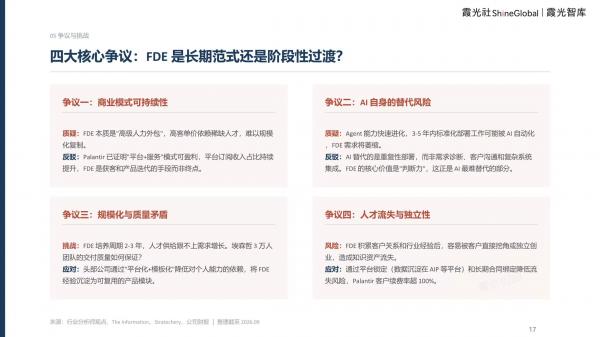
Four core controversies persist in the industry: Is FDE merely advanced human outsourcing? Will Agent AI replace it? How can delivery quality be maintained during large-scale expansion? How to mitigate client resource risks from talent turnover?
The report provides key judgments:
1. FDE ≠ human outsourcing. Palantir proves the viability of the "platform+service" model, where on-site delivery ultimately aims to solidify platform capabilities rather than endlessly expand headcount.
2. Agents can only replace standardized repetitive deployment tasks, but client Demand Diagnosis (demand diagnosis), complex system integration, and business judgment represent irreplaceable core values.
3. Template-based and platform-based precipitate (accumulation) to reduce reliance on individual talent is key to scalability.
4. Platform assets and long-term contracts mitigate client loss risks from talent turnover.
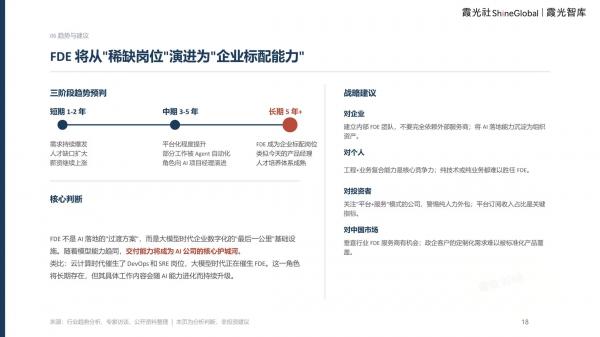
Similar to how the cloud computing era created SRE and DevOps roles, the large model era is now fostering FDEs. This isn't a temporary transitional solution for AI implementation but represents the last-mile infrastructure for digital transformation. As model performance converges across companies, delivery implementation capabilities will become AI firms' most critical competitive moat.
-
![]()
Final Decision Unveiled: The Importance of FAW and GAC Signing the Letter of Intent
-
![]()
The Latest Statement from the Godfather of AI: Don't Trust Industry Self-Regulation, It Will Be Too Late When You React
-
![]()
Perfect Model, Zero Business Impact - The Last Mile of AI Commercialization | FDE Industry Research Report
-
![]()
Is Liang Wenfeng Set to Become China’s Wealthiest Individual by Appointing a Post-90s CFO?
-
![]()
Stay Alert! Major AI Corporations Are Monopolizing Career Pathways—Universities Must Resist the Trend
-
Surge of Up to 109%! Weichai, the Engine Manufacturer, Reaps AI Dividends
-
Revealed: The Current State of Evergrande Auto—Accumulated Losses Hit 105.3 Billion, Yet There’s a Glimmer of Hope for a Comeback
-
![]()
Total Investment of 2.05 Billion Yuan! Shihua Technology's Optical Film Material Project Aims for Production Commencement