Yu Chengdong's 'You Can Sleep While Driving' Remark Sparks Debate, Quickly Corrected After Saying It
 11/22 2026
 502
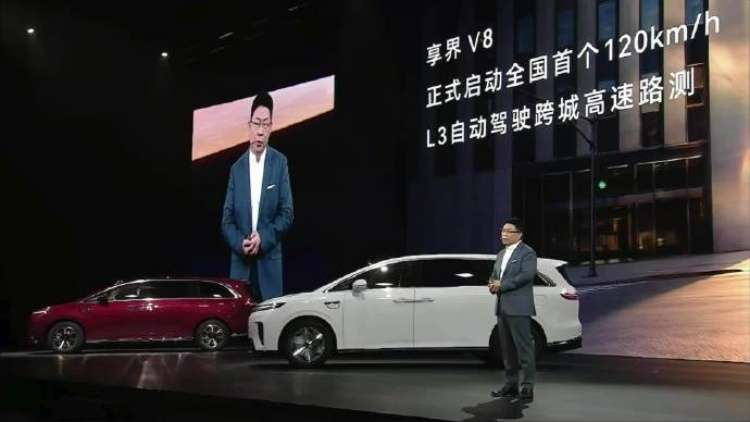
This afternoon, at the HarmonyOS Smart Mobility Xiangjie V8 launch event, Yu Chengdong, Chairman of Huawei Terminal, while introducing the country's first 120 km/h L3 cross-city highway road test, said half-jokingly that once L3 is implemented, driving will no longer require touching the steering wheel: "You can sleep—just don't sleep yourself to death. It only takes 20 seconds to wake you up."
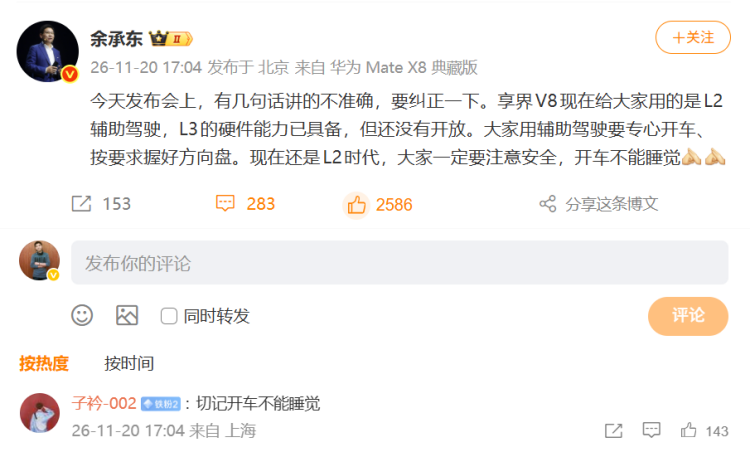
No sooner had he said this than the livestream feed was immediately cut away, instantly sparking widespread discussion. After the event, he posted on Weibo to correct himself, saying that what Xiangjie V8 currently offers users is L2 assisted driving; the L3 hardware is present but the function has not been enabled. He further emphasized, "We are still in the L2 era now; everyone must pay attention to safety and must not sleep while driving."
Strictly according to SAE and national standards, the core feature of L3 (conditional autonomous driving) is that within specific operational design conditions, the system is responsible for the dynamic driving task, and the driver may take their eyes off the road but must take over promptly when the system issues a takeover request. Therefore, Yu Chengdong's statement that "you can look away, but can be awakened to take over" inadvertently hit upon the responsibility-transfer logic of L3—and the essential difference between L3 and L2 is precisely who is liable when something goes wrong.
But the problem is that he put the emphasis in the wrong place. A truly rigorous statement should be: on specific highway sections where L3 is activated, and under the premise of regulatory approval—rather than a universal promise that sounds like "buy this car and you can lie back and catch up on sleep." What Yu Chengdong described is a future state, while what users have in their hands is the present state.
Whether people were in the audience at the launch event or watching in front of screens, they are referring to the cars delivered now, which use L2. The definition of L2 is crystal clear: the driver is always the first responsible person and must monitor at all times and take over at any time. At this point, Yu Chengdong promoted sleeping while driving; even if he added qualifiers such as "future" and "L3," the signal ordinary people receive is only the two words "sleep."
This also explains why the director urgently cut the footage—because the frontline team knows better than anyone the destructive power of this statement when applied to real road conditions. In smart driving accidents, a considerable proportion of root causes are owners treating L2 as L3 or even L4; if the promotional side adds fuel to the fire, lives will be lost.
I wonder if you have noticed that in recent years, auto industry launch events have increasingly resembled talk shows, pursuing punchlines, trending topics, and "parameter nuclear bombs." The phrase "just don't sleep yourself to death" from Yu Chengdong has extremely strong spread power; the next day the whole internet was full of headlines, and the marketing department was probably quite satisfied.
But autonomous driving is a field with extremely heavy responsibility and extremely low tolerance for error; the thrill of communication and the seriousness of safety naturally conflict. The model of firing first and reeling it back later essentially uses safety boundaries as the fulcrum of a traffic leverage, winning heat but losing trust.
Therefore, after realizing that his remarks were not rigorous, Yu Chengdong proactively clarified the boundary between L2 and L3 at the first opportunity and emphasized that "we are still in the L2 era, hold the steering wheel well, and must not sleep." This remedy was responsible and necessary, and the direction was completely correct. This is also the only commendable action of his in this controversy.
Looking at it from another angle, Yu Chengdong's first version of the remarks was out of control in terms of risk review. If there had not been the corrective Weibo post after the event, this video would have been endlessly edited and spread as "Huawei officially announces you can sleep while driving." A top-brand executive should not have left this kind of safety clarification to be patched up afterward. This controversy taught him a vivid lesson—namely, that smart driving marketing should be extremely cautious and must not speak carelessly or let oneself go, otherwise he really becomes "Yu Dazui" (Big Mouth Yu).
In my view, it is understandable that Yu Chengdong is extremely confident in the technical strength of HarmonyOS Smart Mobility and that it already has L3 hardware capability. But at a moment when mass-produced cars are still L2 and regulators are tightening the language used in autonomous driving promotion, his blurting out the word "sleep" was itself a rhetorical overreach that should not have happened. In fact, what is truly alarming about this controversy is not whether one can sleep while driving, but that the entire industry, in order to sell smart driving, is easily packaging safety responsibility into jokes and throwing them out, leading to rising potential risks. What do you think?
-
Alibaba.com's Next Stop: More Than Just Selling Goods
-
China's Smart Driving Crosses Germany's Threshold
-
Inside the 24-model Li Auto MEGA recall: CATL advised against a large-scale recall
-
Alibaba Cloud Begins to Profit from AI
-
![]()
Yu Chengdong's 'You Can Sleep While Driving' Remark Sparks Debate, Quickly Corrected After Saying It
-
Mercedes-Benz Carefully Selects 26 Models for the Guangzhou Auto Show—Which Ones Are Still Worth the Money?
-
![]()
AI in This Year: The Apps That Fell
-
What Pinduoduo Left Unsaid on Its Earnings Call