A Detailed Explanation of Li Feifei's World Model Atlas: How It Impacts Physical AI Industries Such as Autonomous Driving and Humanoid Robots
 09/20 2026
 559
559
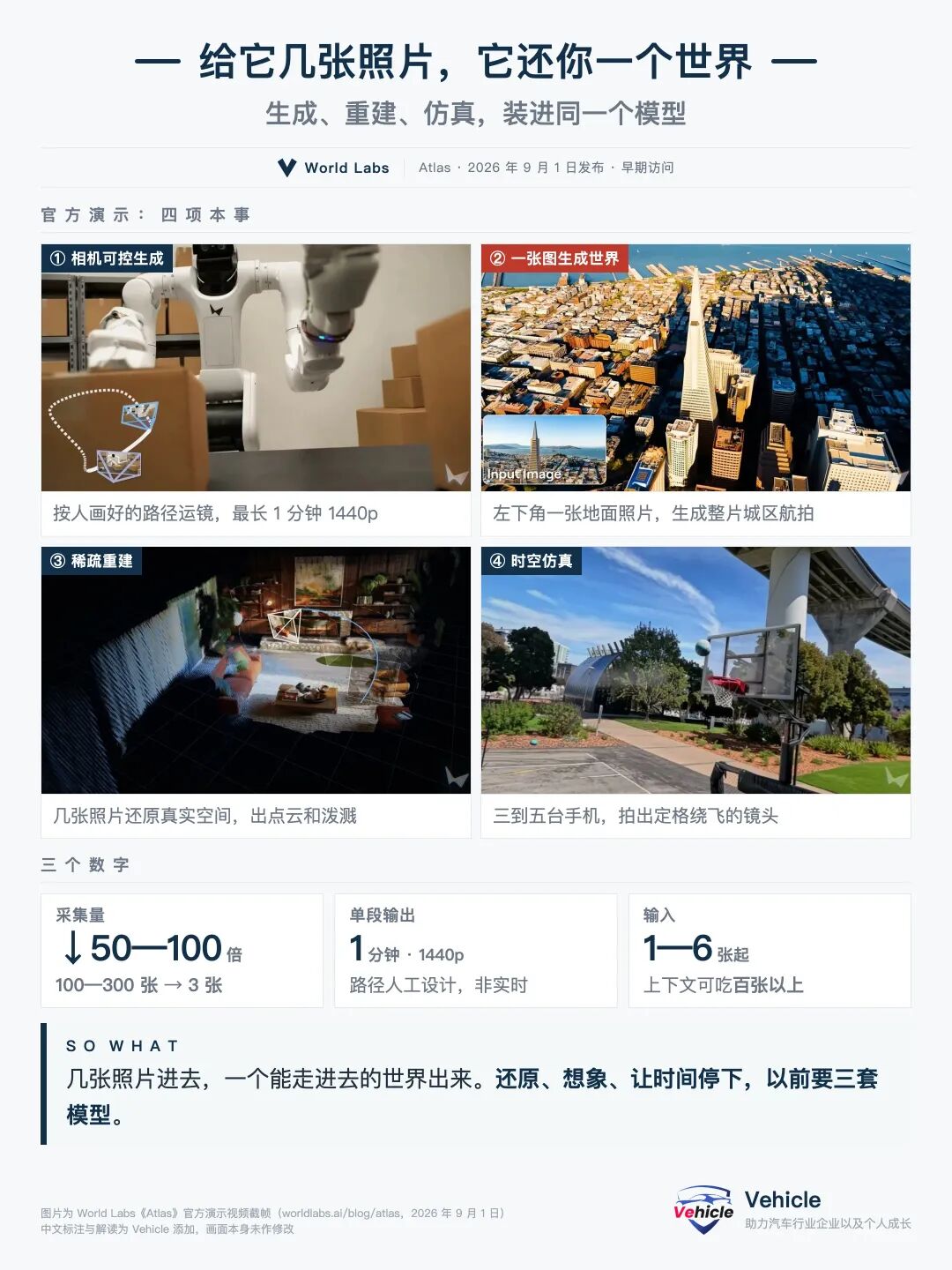
Recently, World Labs, founded by Li Feifei, released a new generation of world model called Atlas. Given a photo of a living room, Atlas can generate images of the room from any angle and reconstruct it into a walkable 3D space. If provided with three smartphones capturing the same basketball shot from different positions, Atlas can freeze the ball mid-air and allow the camera to circle around the player.
Li Feifei categorizes its capabilities into four types:
Camera-Controllable Generation: Input 1-6 reference images plus a camera path to output a 1440p video up to 1 minute long.
Spatial Reconstruction: Reconstruct real-world scenes using 1 to dozens of photos, while providing new perspectives and 3D results such as point clouds.
Spatiotemporal Simulation: Modify footage captured by multiple smartphones to arbitrary camera positions, and generate training scenarios for robots.
Image Generation: Text-to-image and 360-degree panoramas, though the team explicitly states this is not their primary focus.
The most intuitive breakthrough of this model lies in data collection: scanning a room previously required 100-300 photos, but now only 3 are needed.
However, the Atlas model is currently only available to a select few partners, with no published research paper, parameter count, or pricing information. Therefore, this article dissects the world model Atlas: What does its algorithmic architecture look like? What makes it unique? How will it impact our lives? Will it disrupt current algorithmic approaches in automotive autonomous driving and humanoid robots? What will be the next major milestone for world models?
 Generation, Reconstruction, and Simulation: All in One Model for the First Time
Individually, these capabilities are not new. Video models have long been able to generate scenes from different angles, and reconstruction algorithms can derive 3D information from photos. However, previously, these tasks were handled by separate teams and models—one for imagination and one for reconstruction. Now, Atlas accomplishes both tasks with a single model, outperforming specialized models in both areas. What architectural changes enable one model to both imagine and reconstruct?
What Makes It Unique, and What Makes It Difficult
In computer vision, reconstruction involves Restore (restoring) real-world objects with strict rules against fabrication, while generation involves creating something from nothing, with strict rules requiring fabrication. These two paths have evolved separately for many years.
The journey of 3D video scene reconstruction has spanned six years:
In 2020, NeRF represented a scene using neural networks, delivering stunning image quality but requiring hundreds of photos per scene and separate training for each. Its first author, Ben Mildenhall, is now a co-founder of World Labs.
In 2023, 3D Gaussian Splatting represented scenes as millions of tiny, colored, translucent ellipsoids, enabling fast rendering even on smartphones—but still requiring sufficient photos.
In 2025, VGGT, which won the CVPR Best Paper Award, could simultaneously calculate camera positions, depth, and point clouds for hundreds of photos—but could not fill in areas not captured by photos.
Algorithms like these are used by companies ranging from Tesla to domestic newcomers like Li Auto.
On the path of generating 3D scenes from 2D images, Google's 2024 CAT3D first used a diffusion model to "fabricate" missing perspectives and then combined them into 3D using reconstruction algorithms, effectively chaining two models together. According to World Labs, Atlas is the first to integrate both tasks into a single model.
 Top row: Original images from four key papers on reconstruction and generation pathways. Bottom row: Atlas generating an entire living room from a single photo.
Why Must 3D Reconstruction and Generation Be Combined?
Traditional reconstruction has an unavoidable flaw: a point must be captured from at least three or four angles to calculate its spatial position via triangulation. Missed shots result in holes in the final result. Areas under tables, between chair legs, or among leaves are commonly missed, even by professionals. Scanning a multi-room home might take two hours for an average person. Filling holes requires imagination—and imagination means generation.
This is where the difficulty lies: the goals of reconstruction and generation conflict. Reconstruction demands that the model avoid fabrication, while generation requires it. The Atlas world model balances this by relying on input: the more real photos fed into it, the less it imagines. In official demonstrations, with only a garden photo, the garden is accurate, and the rest is fabricated. Adding a cottage photo and then a main building photo progressively replaces fabricated areas with real ones.
Video dynamics introduce another layer of complexity. Reconstruction prefers frozen time, where every angle captures the same moment, but purely static training data is hard to scale. The previous product, Marble, could only handle static scenes. Atlas incorporates dynamic data during pre-training, letting the model learn to isolate moving parts, and then fine-tunes it toward static scenes during post-training. Thus, in demonstrations, only water ripples and passing cars are visible—a feature the team calls "infant-level dynamics."
The number of input photos acts as a dial between "fidelity" and "imagination" for Atlas. Previously, this required two models working in sequence; now, one model handles it.
How Its Architecture Differs from Video Models and Large Models
The official architectural description is brief: multimodal autoregressive diffusion Transformer. Each word matters:
Multimodal: Natively processes text, images, camera poses, and depth maps. Videos are treated as sequences of images. Camera pose refers to "where the photo was taken, which direction it faced, and how wide the lens was." Depth maps record how far each pixel is from the camera. Every image is tied to a specific pose, which World Labs claims has not been done during pre-training before.
Autoregressive: Generates sequentially, like large models, treating any task as a sequence of "input followed by output."
Diffusion: Starts from noise and gradually refines it—faster if fewer refinement steps are taken. This is a well-established technique in algorithm research.
Transformer: The backbone remains unchanged. It seems Transformers are fundamental in AI, used for large language models, vision, and now spatial tasks. What changes is the combination of the first three elements.
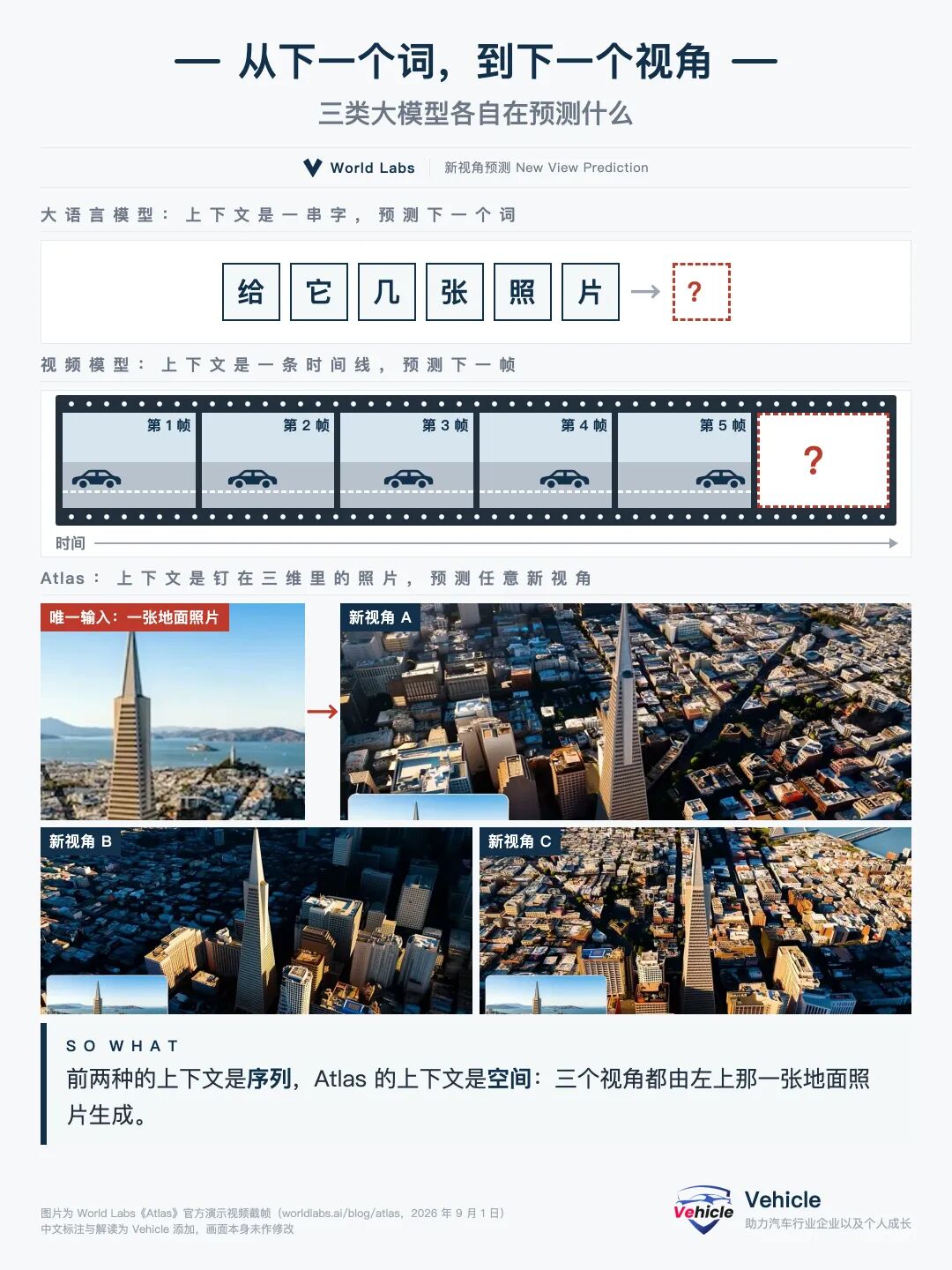 The same Transformer backbone with three different types of "next" predictions.
When compared side by side, the differences become clear. Large language models predict the next word, with context being a string of text. Video models predict the next frame, with context being prompts plus start and end frames—essentially a timeline. Atlas predicts a new perspective, with context being a group of photos pinned to 3D space, which the team calls "spatial context."
For users, the differences first manifest in control methods. Video models can only accept text prompts like "pan the camera left," with results depending entirely on the model. Unsatisfactory outcomes require regenerating, like pulling a slot machine lever. Atlas directly accepts geometric parameters for camera paths, allowing users to specify exactly where the camera moves. The same scene can be rendered along countless paths without distortion. In official evaluations, Atlas achieves a 75%-94% win rate against five mainstream video models in "following specified camera paths"—though competitors are limited to text-based camera descriptions, which favors Atlas.
 Top: Architectural diagram showing four inputs pinned into spatial context before model generation. Bottom: Official demonstration of camera pose-based input paths.
Secondly, Atlas can handle far more images. Large models have expanded context windows from 128,000 tokens to 1 million, but image and video models have not pushed in this direction due to the enormous context size of images. Ben Mildenhall argues that reconstruction is essentially "generation with extremely long context." Marble could only handle a few images, while Atlas can process over 100.
Atlas also builds on predecessors. Marble could generate 3D worlds but was locked into Gaussian Splatting as its output format. RTFM (Real-Time Frame Model) from October 2025 already used an autoregressive diffusion Transformer, with each frame carrying spatial position, enabling real-time rendering on an H100 GPU. Atlas treats "predicting new perspectives" as its fundamental unit, with splatting as an optional output, and borrows inference acceleration techniques from large models and video models.
While the context for the first two model types is a sequence, Atlas's context is a space. It knows where each photo was taken—the most valuable geometric information.
What Can It Do, and How Will It Change Our Lives?
The most relatable change for ordinary people is "getting a space from a few photos." Film, archival footage, design, and robotics are directions mentioned in official demonstrations and by the team. Property viewings and sports are natural extensions of this capability:
Film: The "bullet time" effect, which freezes time while the camera circles, previously required hundreds of cameras in a green screen studio. Now, 3-5 smartphones on tripods suffice—all fitting in a single backpack.
Archival Footage: Old home videos, online photos, or failed scans can be revived into 3D scenes. Discarding 95% of scan photos still yields similar reconstruction quality.
Design & Architecture: The most tedious part of 3D design is revising models based on feedback, often requiring a week of rework after a meeting. If spaces can be modified as easily as clay, this step would shorten dramatically.
Property Viewings & Home Decor: A few photos of a listing can generate a walkable showroom. Before buying a sofa, you could "place" it in your living room virtually—a task previously requiring specialized scanning equipment.
Sports & Live Events: Amateur leagues and school sports events can create multi-angle replays using a few smartphones, a capability previously limited to TV broadcast trucks.
Robotics: A few smartphone videos can build a training ground for robots, eliminating the most time-consuming part of scene setup.
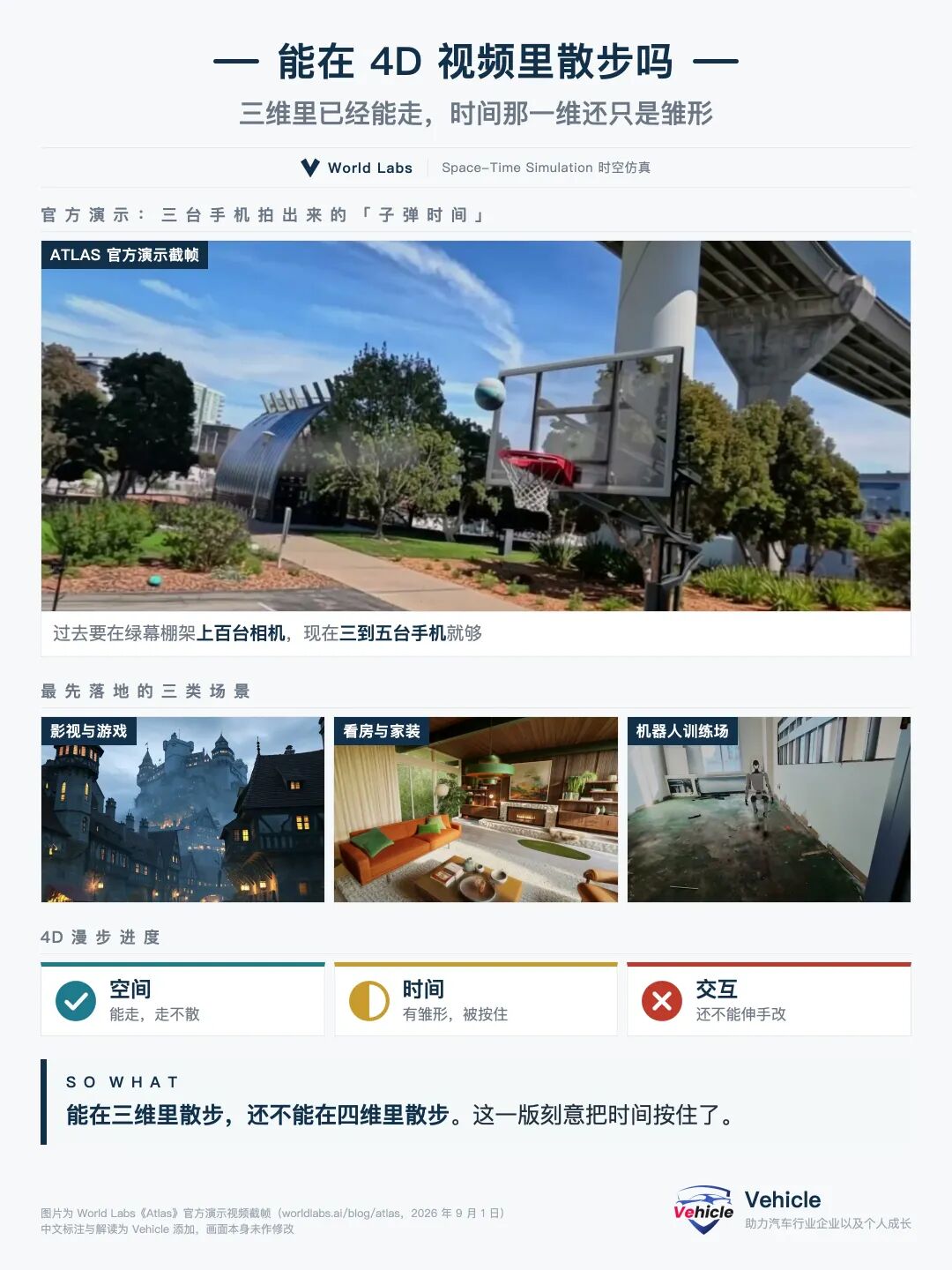 Top: Camera setup for freeze-frame circling shots reduced from hundreds to 3-5 devices. Bottom: Three types of scenarios where this technology lands first.
Can You Walk Through 4D Videos? Currently, space works, but time and interactivity do not. You can wander freely in generated scenes without distortion, but dynamics are rudimentary, and you cannot yet move objects like a cup on a table. Editability is World Labs' next focus, with the challenge being maintaining image quality while adding control—otherwise, it's just a gimmick.
You can walk in 3D but not yet in 4D. This version deliberately holds time still.
Will It Disrupt Algorithmic Paths in Autonomous Driving and Humanoid Robots?
Let's clarify the functional categories of world models. In a June 2025 article, Li Feifei divided "world models" into three functions:
Renderer: Outputs visuals for humans, e.g., Google's Genie 3.
Simulator: Outputs geometric and physical states for programs to compute.
Planner: Outputs actions, answering "what to do next."
Using this framework, Atlas is currently a renderer plus simulator—it does not output actions. The debate in autonomous driving and robotics centers on the planner.
In the simulator category, automakers are not lacking. Waymo's February 2025 Waymo World Model, built on Genie 3, underwent specialized post-training to directly generate camera and lidar data. Tesla uses generative Gaussian Splatting for counterfactual replay ("what if I had driven differently?"). NVIDIA uses Cosmos to generate data and Alpamayo for actions. Huawei's ADS 5 uses a world engine in the cloud for scene generation and a world behavior model in the vehicle for control. These systems are deeply integrated with each company's mileage, chips, and closed loops. Waymo's approach shows that general-purpose world models enter autonomous driving by first undergoing domain-specific post-training and then integrating as simulation tools into development workflows.
What Atlas can sell to autonomous driving and humanoid robots—categories of Physical AI—is reduced scene collection costs. However, breaking down the official benchmarks dataset by dataset yields unimpressive results. Among seven datasets, only KITTI was captured from vehicles. Atlas reduced errors by 38.1% compared to the strongest baseline in indoor RGB-D scenes, but by only 0.3% on KITTI (60.0 vs. 60.2) and lagged by 5.5% on large-scale outdoor Tanks & Temples. The same model had nine times higher error on in-vehicle (vehicle-mounted) roads than in indoor RGB-D scenes.
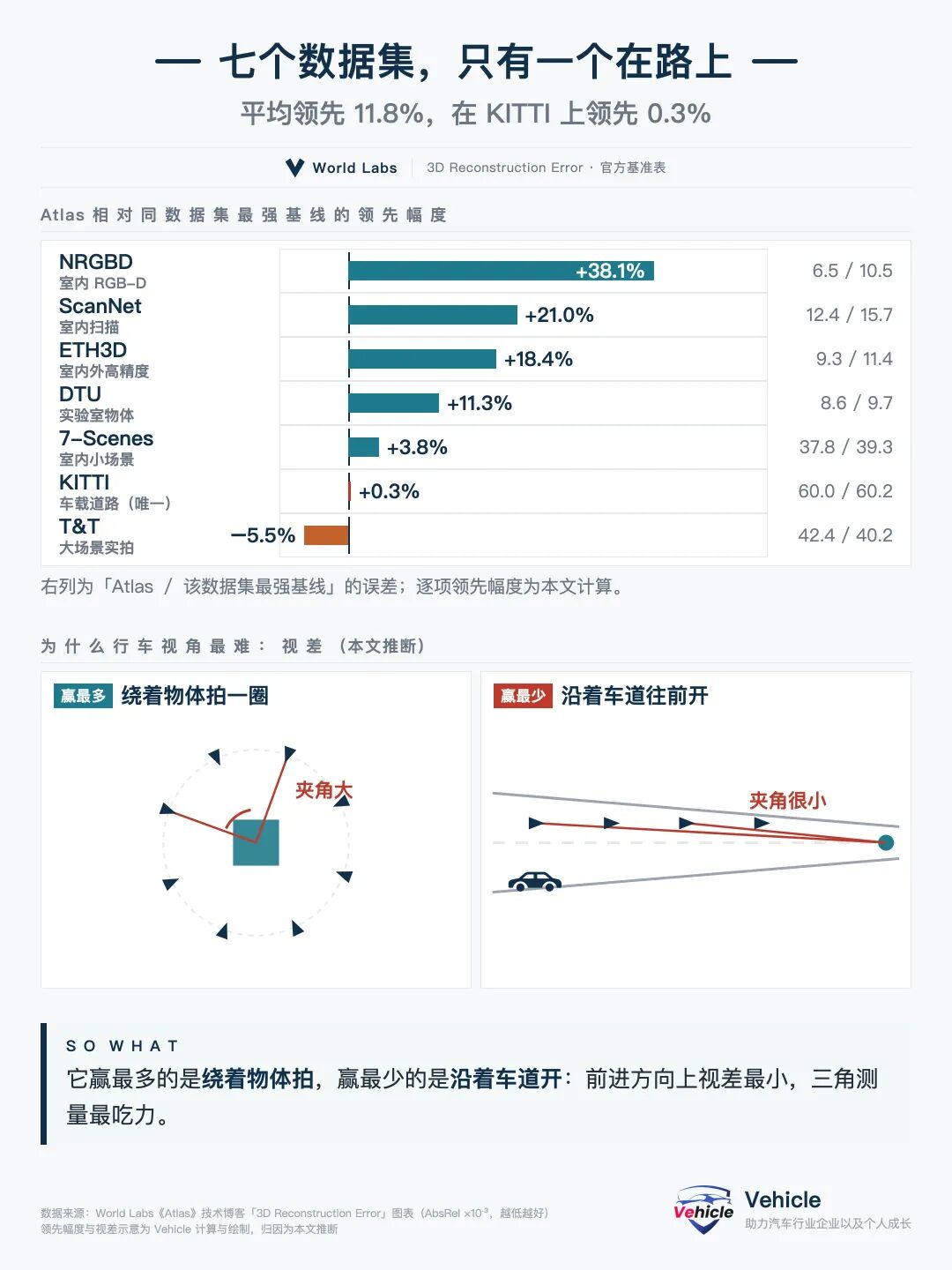 Top: Leading margins per dataset (calculated from official charts in this article). Bottom: Why parallax is smallest when moving along the lane.
Of course, the official team did not explain this. My inference is geometry. Multi-view reconstruction relies on the displacement difference (parallax) of the same point across camera positions. Walking around an object creates maximum parallax; driving straight ahead along the camera's line of sight creates minimum parallax—the most challenging scenario for triangulation, yet a daily occurrence for vehicle-mounted cameras. Outdoor depths often reach hundreds of meters, and streets are filled with moving vehicles, yet this version was tuned toward static scenes.
The accounting on the robotics side is much easier. In July this year, World Labs acquired SceniX, which specializes in 'reality-to-simulation.' In the publicly released R2S2R experiment, the policy was trained entirely in simulation without using any real-world data. Each version ran 2,000 simulations plus 100 real-world tests, with the rankings from simulation matching those from real-world tests. Multiple tasks could run continuously and autonomously for an hour. These experiments used desktop-grade robotic arms in indoor, bounded environments with static backgrounds—the type of scenarios where Atlas has achieved the most benchmark wins. However, their simulation environments were still built using dense reconstruction, which is precisely what Atlas aims to replace. Li Feifei's assessment is that the biggest bottleneck in robotics currently is data, with chips being a concern for the future.
The same applies to humanoid robots. The current mainstream approach relies on teleoperation to collect demonstration data for training visual-language-action models, which is both expensive and slow. Tesla has also demonstrated the use of the same neural world simulator for Optimus. If models like Atlas can streamline the process of 'capturing a few videos and obtaining a trainable scene,' the first change will be in where humanoid robots source their data, while the design of algorithmic strategy architectures will not be immediately affected.
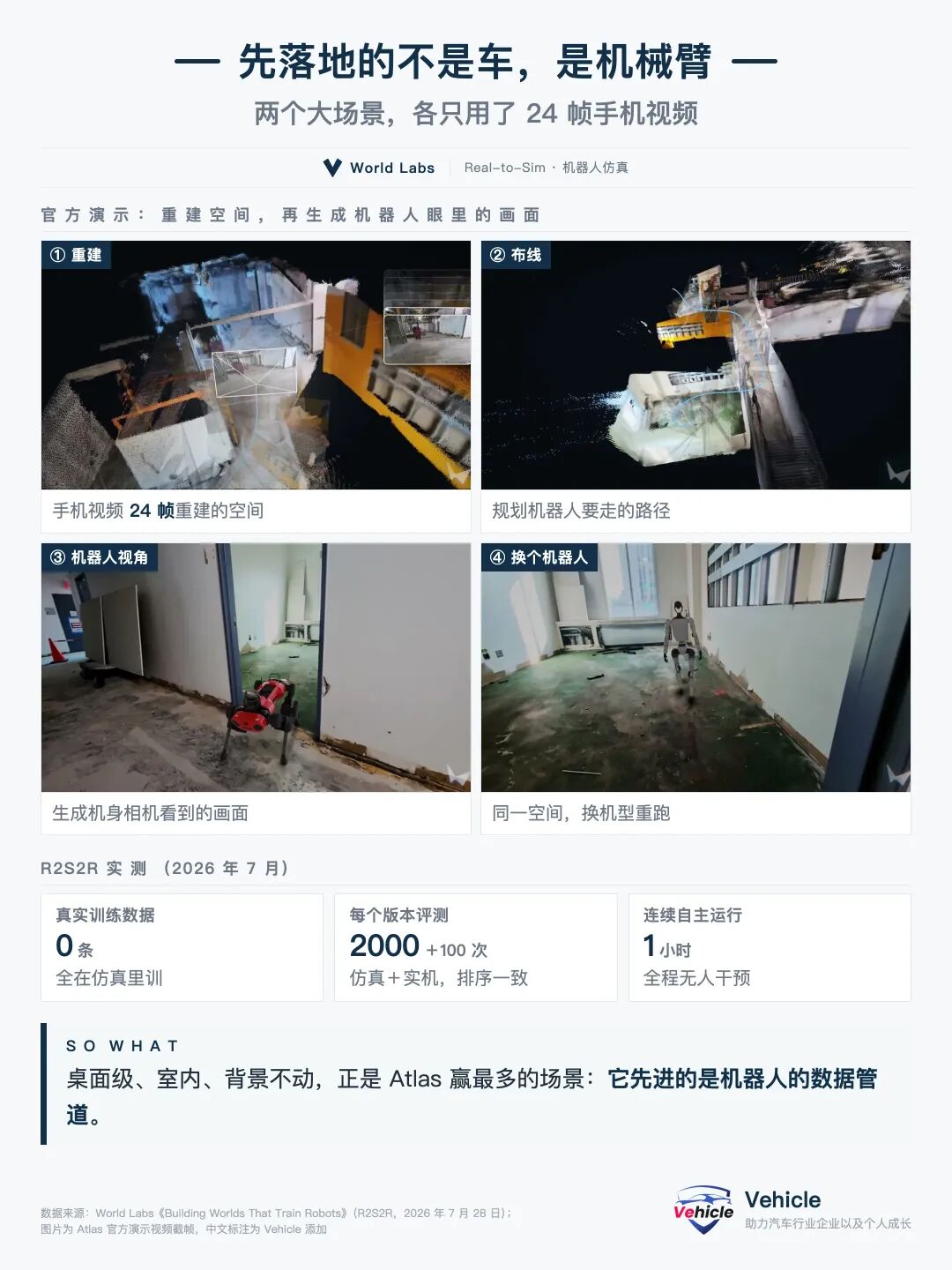 Each of the two large-scale scenarios used only 24 frames of smartphone video; the numbers on the robotics side are already from real-world testing.
What could potentially impact algorithmic approaches is a question recently raised by co-founder Justin Johnson: Since a simulator already understands how the world responds to actions, why can't it act as a planner itself? The direction makes sense, but for now, it is just a roadmap. To judge when it will start influencing intelligent driving, three points need to be monitored: a significant reduction in reconstruction errors from the driving perspective, the model beginning to output actions, and the disclosure of real-time performance and computational costs. However, none of these three conditions are currently met.
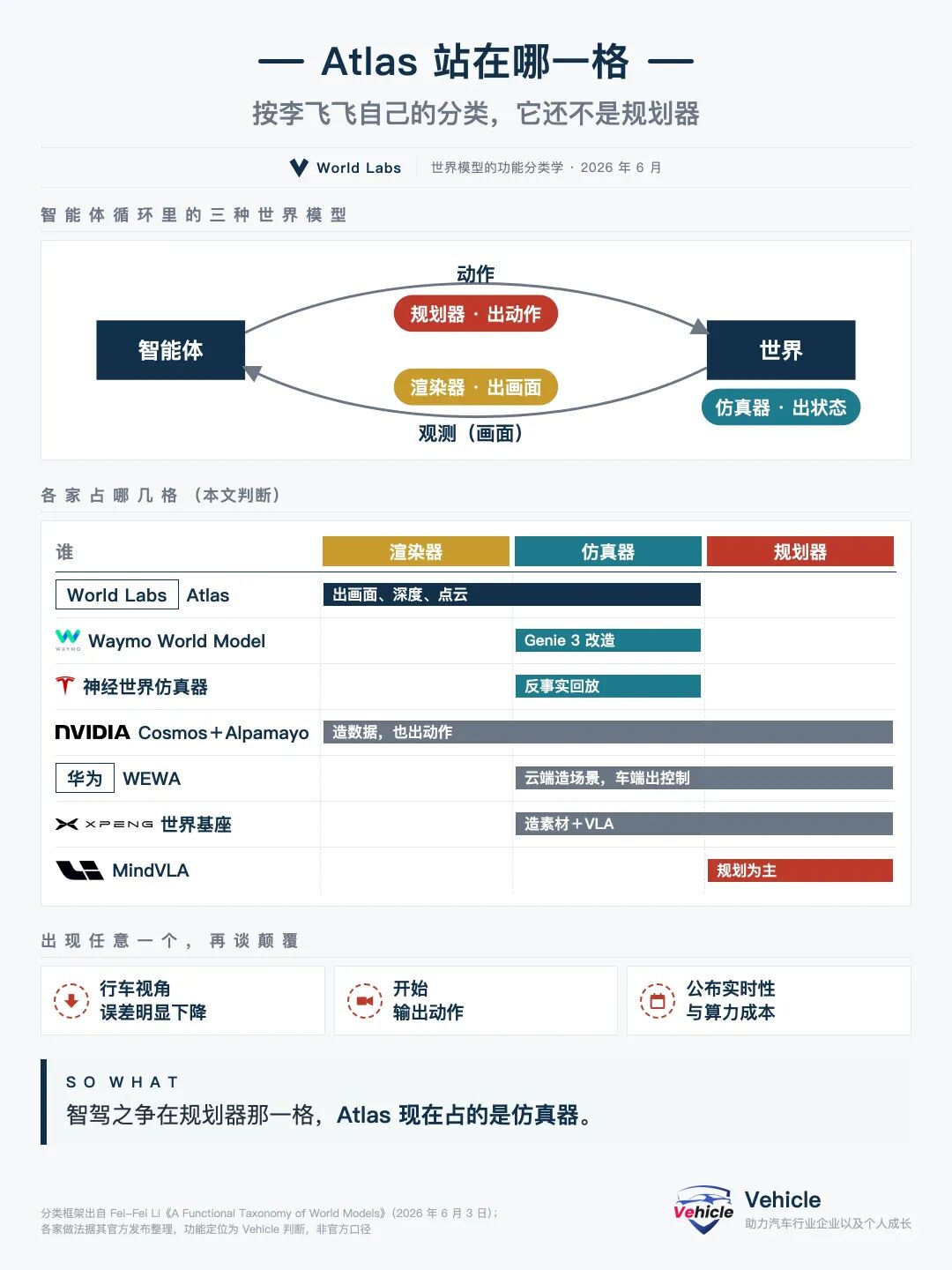 The classification framework is from Li Feifei's 'Functional Taxonomy of World Models' published in June 2026, with classifications judged by this article.
In the short term, what Atlas can rewrite are the costs of data and simulation, while the structure of decision-making networks is not yet its concern. For robotics, it is a new generation of data pipeline; for intelligent driving, it is still just one of many simulators.
What will be the next big moment?
The first point to watch is scale. According to Justin Johnson, the model shows significant improvement with each increase in size, longer training duration, and additional GPUs. The current bottleneck is training computational power. The size of this release was determined by the release date, with the model being as large as could be trained by the deadline. If this curve is still in its early stages, the next leap may simply require more GPUs.
The second point is real-time performance. RTFM can already generate images in real-time on a single H100, while Atlas has not yet released any real-time metrics. When Atlas's image quality combines with RTFM's speed, along with dynamic elements, people will be able to move in real-time within generated worlds, marking the arrival of the day when 'walking in 4D video' becomes possible.
The third point is more theoretical. OpenAI co-founder Ilya Sutskever famously compared it to letting a model read a mystery novel where the last line is 'the murderer is.' If it can correctly fill in the next word, it means it has understood the entire book. Thus, 'predicting the next word' is seen as a path to general intelligence. World Labs argues that 'predicting new perspectives' works similarly. Li Feifei's reasoning comes from evolution: nature gave eyes to moving animals but not to trees because movement leads to new perspectives. Her involvement in the VSI-Bench study also found that multimodal large models' spatial reasoning is significantly inferior to humans. Simply making them write more reasoning steps doesn't help; having them first draw a spatial map is more effective. In other words, spatial abilities do not automatically emerge from linguistic reasoning.
If this argument holds, the next big moment will not be a flashier demonstration but an 'emergence': a model trained only on predicting new perspectives suddenly demonstrates capabilities in untrained spatial and physical tasks, transitioning from a scene simulator to a control planner.
Until then, Atlas is more accurately positioned as an infrastructure that reduces the cost of 3D data collection by one to two orders of magnitude and a public bet on how far 'the next perspective' can go.
Epilogue
Although Atlas was released without a research paper or evaluation code, with baselines and evaluation questions self-replicated, the demonstrations were impressive enough to provide ample room for imagination. Spatial intelligence has become the most anticipated aspect of the current AI industry, and it may conquer humanity's potential (potential) spatial physical world just as LLMs have conquered the representational world.
*Unauthorized reproduction or excerpting is strictly prohibited-
-
![]()
Silicon Valley Sparks the AI Office War
-
![]()
Weekly Stock Review | Trump’s Concern Over AI Rivalry: The Auto Industry’s ‘Biggest Competitor’
-
![]()
FAW and GAC's Strategic Move: More Than Corporate Collaboration, a Pioneering Case of National Industrial Anti-Involution
-
![]()
Can the Long-Wheelbase Mercedes-Benz GLE SUV Tread in the Footsteps of the BMW X5?
-
![]()
From Netizens' Perspective, the XPENG G9L Still Seems Pricey
-
![]()
10 Questions I Care Most About Regarding Doubao Mobile Phone II
-
![]()
Quality Performance of China’s New Energy Vehicle Tri-Electric Systems in 2026: Experience-Centric Issues Take Center Stage, Range Remains Top Challenge
-
![]()
AIDrive’s Cooperation Model Undergoes Change: Is Xiaomi Pengcheng the Unexpected Winner?