AI Office Track: A Telecom Operator Makes Its Debut
 09/23 2026
 448
448
Telecom Operator Steps into AI Office Market: Can TeleAgent Make a Mark?
The vibrant AI office landscape is witnessing fresh waves of innovation.
Recently, the International Data Corporation (IDC) unveiled its "Technical Evaluation of Enterprise-Level General Agent Products in China," conducting a standardized practical test on 11 leading and open-source general AI agent products in the domestic market.
Among these, Tencent's WorkBuddy took the top spot with a score of 7.30, followed closely by Baidu's Dazi with 7.10, while TeleAgent, from China Telecom, secured third place with 6.85. ByteDance's TraeWork trailed with 6.74.
TeleAgent, the third-place finisher, hails not from a major internet company but from China Telecom, a telecom operator. As early as July at the WAIC, China Telecom announced the launch of its Starry Super Intelligent Agent (Xingchen Super Agent) TeleAgent, though it didn't garner much attention at the time.
In just two months, a telecom operator has managed to break into the top tier of intelligent agents, nestled between three internet giants. This achievement stands out as the most remarkable aspect of this report.
The day after the report's release, China Telecom announced that TeleAgent had surpassed one million registered users, with the number of skills growing from thousands at launch to 50,000, 99% of which were autonomously created by users.
Currently, AI office is widely acknowledged as the fastest-growing application scenario for large models, yet it has also become a fiercely contested battleground among industry giants.
ByteDance's Doubao Work seamlessly integrates with Feishu, Tencent's WorkBuddy enables remote computer control via WeChat scan, Kingsoft Office's WPS AI safeguards documents for millions, while Alibaba, Baidu, and Huawei each have their unique offerings.
TeleAgent, positioned as an AI office companion, has also entered this crowded arena. So, what entitles a telecom operator, lacking an office ecosystem, to participate? What sets this product apart from mainstream AI office products in the market?
A Product That Boosts Confidence in AI Security
Nowadays, when you engage AI to work for you, it often begins by sifting through your various files.
However, the security and privacy issues that emerge in this process are becoming a hot topic within the industry. Recently, an AI programming product was exposed for secretly uploading users' entire code workspaces to the cloud by default, with no option to disable it, leading to an official apology on the same day.
This incident not only highlighted a product flaw of a particular company but also shook the trust foundation of the entire Agent category. However, after testing TeleAgent, the product instilled a strong sense of security.
The desktop version of TeleAgent supports Windows, macOS, as well as two trusted systems, Kylin and UOS. Installation is straightforward, without complex environmental dependencies, and login follows the traditional method of China Telecom's products, supporting mobile phone scanning and operator number authentication.
Here's a detail: when scanning to log in, it requires confirmation that the phone has switched to the cellular network rather than WiFi. This is because its number verification goes through the operator's gateway to retrieve the number, which can only identify the SIM card through the mobile data channel.
Even when scanning with WeChat, it doesn't link to my WeChat account but to my own Tianyi Cloud account.
In contrast, Tencent's WorkBuddy uses WeChat scanning as a core login method. China Telecom, lacking this advantage, relies on its own gateway, which, while more cumbersome, offers higher security in terms of "machine-card-person" consistency verification.

After logging in, its UI design is notably simple. Unlike products like WorkBuddy, which feature a large input box to start working directly, TeleAgent first informs users of its capabilities.
Specifically, its scenario cards are highly detailed, such as searching for bids across the web in the last 7 days and automatically generating and displaying web pages. Clicking on the card can even automatically generate relevant command words in the dialog box, eliminating the need for separate user input.
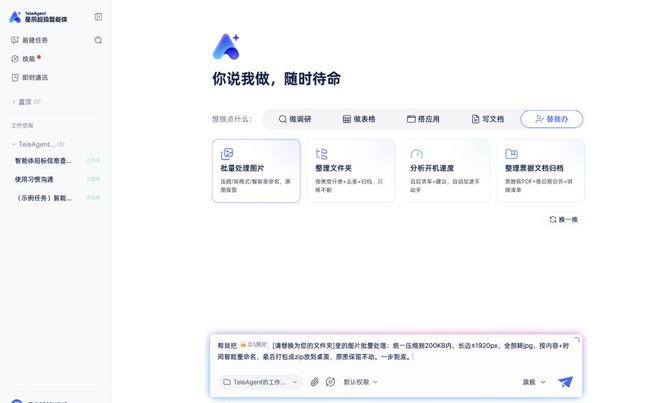
This makes WorkBuddy seem like a product for skilled workers, while TeleAgent appears more tailored for novices.
Its core output consists of an input box plus a workspace, meaning users must first designate a local folder as its "workstation," with read and write permissions confined within this range.
This design aligns with WorkBuddy's folder-level authorization approach, both clearly defining the boundary of "what AI can access." The difference is that TeleAgent makes it the main interface logic of the product rather than hiding it as a security option in the settings.
Another design feature is the prominent placement of the permission mode on the main interface.
There are mainly two modes: in the default state, the agent requires user authorization to view files and execute operations. For users with high trust in the agent, they can switch to a fully automatic execution mode, allowing it to run independently. Before enabling this mode, a prompt appears: "If you enable fully automatic execution mode, AI will no longer seek your confirmation and will directly modify files, execute code, or change system configurations. Do you wish to continue?"
This design assures new users that "the product's boundaries are well-defined," contrasting sharply with the approach of secretly uploading data and code.
In the left sidebar functions, compared to the comprehensive nature of mainstream AI products like WorkBuddy, TeleAgent's design is more concise, featuring only three main function bars: New Task, Skills, and Instant Messaging.
This minimalist design resembles a "work order list," restrained, focused, and with clear delivery status. In contrast, WorkBuddy's sidebar is more akin to an operating system Dock, with complete modules and an exposed ecological ambition.
This also reflects the strategic positioning of each company. China Telecom, lacking an ecosystem, focuses on deep delivery, while Tencent, with an ecosystem, prioritizes a broad platform.
In terms of skills, TeleAgent follows a preset + co-creation route, with built-in skills such as news weekly reports, contract reviews, in-depth research, and chart drawing. If these are insufficient, users can describe their needs in natural language, and it will create a new skill on the spot.
At the model level, only the flagship and express categories are visible on the product homepage, with no other third-party integrated models in sight. However, according to public information, in addition to its self-developed Xingchen large model, it also supports third-party models such as Zhipu, DeepSeek, and Kimi through APIs.
After examining the interface design, I input a command word in the dialog box—"Search for bidding information about agents from the China Bidding Network in the last 7 days and organize the results into a web page format." As a control, I also input the same command word in WorkBuddy.
Both provided bidding information about agents in the last 7 days, but comparatively, TeleAgent not only listed the relevant information but also classified and summarized it, offering its own observations and judgments, while listing the data source links at the end.
Overall, using TeleAgent, one can sense that the product's design philosophy is to leave control in the hands of users. File permissions are set by users, operation authorizations are given by users, and even whether it remembers you and how much it remembers are all under the user's watch.
This design aligns with its main features of local data storage and security controllability.
Self-Organizing Context: Visible and Tangible
While using this product, I discovered an intriguing feature: it supports the ability to organize task context.
After completing a task, a task context option appears beneath it, along with the ability to organize the task context. Clicking on it automatically organizes the context of the previously performed task.
Once organized, users can more intuitively see the entire thinking and execution process of the AI.
Simply put, this feature translates underlying technical issues into visible product actions for users.
As the industry knows, entering 2026, a clearer consensus is emerging: the capabilities of foundational models are becoming homogeneous, and the real battleground for differentiation has shifted from inside the model to outside. This external battleground is context engineering.
The way agents work means they will "accumulate more as they work more." The longer they work, the more file contents they open, the results returned by each tool call, and previous requests discussed will continuously fill the context window.
Although TeleAgent's window can handle 400K Tokens, for long tasks running for hours with dozens of files being read and written back and forth, even the largest window will eventually fill up.
Once full, there are only two paths, neither of which is ideal: one is hard truncation, which means discarding early content directly. However, users' initial requests are often found there, and discarding them leads to "amnesia," where the sixth revision forgets the goal of the first.
The other is hard stuffing, which causes Tokens to continuously swell, requiring each round of inference to recalculate with the entire history, slowing down speed and causing costs to skyrocket.
Therefore, context must be balanced between "remembering" and "not being able to hold anymore." This is the core contradiction that context engineering aims to solve and the fundamental reason for the existence of the context organization feature.
To address this issue, TeleAgent adopts a hierarchical organization approach, not simply deleting history but implementing a three-tier mechanism:
First is lightweight pruning, which discards the least valuable old content, such as large segments of raw output returned by early tool calls—once the task has used them, keeping them is meaningless.
Second is model compression. If pruning still leaves it too long, a dedicated compression model condenses the entire history into a summary, preserving task goals, key decisions, and intermediate conclusions.
Finally, there is water level monitoring. The system continuously monitors context usage and proactively triggers compression when nearing capacity, allowing execution to continue—ensuring long tasks stay on track.
For tasks spanning multiple days, autoDream long-term memory takes over, periodically organizing recent dialogues and merging them with existing memories, preserving project backgrounds and user habits across sessions, eliminating the need to re-explain everything the next day.
The benefits of this mechanism are tangible.
First, it ensures long tasks stay on course, remembering the requirements of the first revision even when modified to the sixth, and executing continuously for ten hours without becoming confused. Second, it reduces Token consumption, meaning after compression, each round of inference processes less content, saving users points and reducing costs for manufacturers, while also speeding up overall response times.
This is also one of the key reasons for its perfect task performance score and highest cost efficiency in the IDC evaluation.
Most importantly, it is visible to users.
When the agent works continuously for hours and pauses to organize context, users clearly know it has not crashed or lost connection but is simply tidying up its workspace. For a product that needs to work unattended for long periods, this sense of certainty is itself trust.
In fact, organizing context is an industry standard, as the physical limitations of context windows apply equally to all agents running long tasks. Claude Code automatically compacts context when nearing capacity, and Cursor does the same. Manus even gained attention for writing a technical blog specifically about context engineering.
In other words, engineers at every company are working on context organization; the difference is that TeleAgent has moved it from the backend to the foreground, turning it into a visible feature for users.
After all, its target users are government and enterprise clients and cautious office workers, whose psychology is the opposite—what they cannot see is what frightens them.
The IDC report includes a key conclusion: Agent Harness capability (with context engineering as its core) determines task performance. TeleAgent's task performance is in the highest 5-point tier, while most participating products scored 3 points.
In this light, within the domestic enterprise-level office agent track, TeleAgent's context engineering is in the first tier, with IDC-backed single-point leadership in the specific capability of stable task delivery.
However, looking closely at the score structure, TeleAgent scored 3.49 for regular tasks and only 3.36 for complex tasks, while WorkBuddy achieved the highest score for complex tasks, meaning TeleAgent has not yet reached the top in complex, long-chain tasks.
More fundamentally, there is no universally recognized evaluation system for context engineering in the industry. TeleAgent's current industry position is largely defined by IDC's single evaluation.
Ultimately, whether it can solidify its label as a first-tier player in context engineering depends on subsequent independent practical tests and its willingness to openly share technical details for scrutiny, as Manus did.
A Strong Contender for Government and Enterprise, a Follower in the Consumer Market
A prominent aspect of TeleAgent's product design is its emphasis on privacy and security, which naturally fits the government and enterprise market.
China Telecom's customer base is predominantly categorized into three main groups: individual consumers, families, and government and enterprise clients. This segmentation marks a key distinction between China Telecom and internet-based companies. Among the three major telecommunications operators, China Telecom boasts a relatively well-balanced revenue distribution across these three sectors, with the government and enterprise segment holding the largest share. This composition underscores its inherent orientation towards the business-to-business (B-end) market in terms of AI product development.
According to its official description, TeleAgent is designed to offer comprehensive intelligent life and office services tailored for both individual and government/enterprise users. It provides three deployment options: public cloud, private deployment, and local operation and maintenance. In the commercial landscape, the individual version of TeleAgent is offered free of charge, whereas the enterprise version (Digital Employees) and private deployment services are targeted at small and medium-sized enterprises, as well as central and state-owned enterprises, on a paid basis.
Judging from this strategic layout, TeleAgent's approach appears to be centered around using the consumer (C)-end as a training ground and the B-end as the primary battlefield. It capitalizes on its vast user base of over 400 million mobile subscribers and an extensive business hall network to drive volume on the C-end. Simultaneously, it leverages its relationships with 30 million government and enterprise customers, along with its existing Tianyi Cloud clientele, to facilitate conversions on the B-end.
After all, Tianyi Cloud already commands a roughly 28% share of the government cloud market, making these clients prime candidates for private deployment solutions. More significantly, China Telecom already boasts a user base of over 110 million for its AI applications.
However, when considering the broader AI office solutions landscape, TeleAgent's core strength lies in its positioning as a leading contender for intelligent agents in the government and enterprise office sectors. In the consumer market, though, it may initially be seen as a follower rather than a leader.
After all, Doubao boasts a staggering 140 million daily active users, while Feishu has 30 million monthly active users. By integrating both, Doubao Work enjoys a natural traffic advantage. Additionally, WorkBuddy also has 20 million monthly active users.
In terms of customer acquisition, TeleAgent has to rely on its business halls, the Tianyi App, and word-of-mouth referrals. While achieving one million registered users in a short span is commendable, it still falls short of the scale achieved by industry giants. Moreover, the retention and paid conversion rates under its free strategy remain untested.
More critically, the consumer market is fiercely competitive, with ecological stickiness and user habits playing pivotal roles—areas where telecom operators traditionally lack strength. The industry still vividly remembers the stories of Fetion and Yixin, which serve as cautionary tales.
Nevertheless, for the telecommunications industry, TeleAgent represents a strategic asset in implementing its future AI vision.
Its true value may not lie in outcompeting any particular rival, but rather in validating a viable path forward. In the AI era, operators have the opportunity to transition from selling bandwidth to selling intelligence, and TeleAgent stands as the most concrete and tangible manifestation of this transformative journey.
-
![]()
Apple Relies More on Scalpers Than Ever Before
-
![]()
Starting at 235,800 Yuan! Honda Unveils Another New Model: Official Release Set for September 28
-
![]()
Starting from 122,600 Yuan? Subaru Unveils New Model: On Sale from September 22
-
![]()
In-Depth Performance Analysis of iPhone 18 Pro: Unmatched Superiority, Enhanced Cooling, and the Advantages of 2nm Chip Technology
-
![]()
OPPO Find X10 Pro Max Imaging Review: Perfect for Beginners in Street Photography, The Only 'All 200MP' Claim That Stands Up
-
![]()
QianWen Computers Have Arrived! When Thought Becomes a Tradable Good, Alibaba’s Ambitions Reach Farther Than You Think
-
![]()
AI Office Track: A Telecom Operator Makes Its Debut
-
![]()
The AI Landscape Evolves: How Can Kimi Bridge the 'Dark Side of the Moon' Gap?