World Model: The First Year of AGI for Robots
 09/23 2026
 501
501
【Introduction】 Alibaba CEO Wu Yongming declared at the Cloud Summit that the total thinking volume of machines will exceed that of humans by over 1,000 times, with machines handling 99.9% of thinking work. However, 'the representative product of the machine intelligence era has yet to emerge'—he compared AI Coding to 'the electric light of 1882.' Focusing on the three cornerstones of AI models, AI chips, and AI clouds, Alibaba announced that the parameter count of the next-generation Qwen model will reach 5-10T, T-Head unveiled the Zhenwu V900 (with 3x the computing power of the M890 and scalable to 500,000 cards in a single cluster), and Alibaba Cloud's data centers will exceed 20GW by 2032. Interestingly, while industry leaders envisioned ASI, academia was breaking down 'superintelligence' into three actionable engineering blueprints through a series of papers—cybersecurity superintelligence, the debate over world model definitions, and the grading of embodied AGI. As ASI grows a 'body,' what will the singularity of physical AI look like?
The final piece of the AGI puzzle lies not in larger dialogue models but in world models and physical AI that 'give AI hands, feet, and a body.'
01 World Model: Why AGI Needs a 'Body'
The Physical Intelligence Team at the Shanghai AI Laboratory provided a restrained yet sharp definition: A world model is a compressed representation of the state transition processes in the physical world, constrained by limited computational resources.
The key term is 'compressed,' not 'generated.' The core task of a world model is information-theoretic compression, distilling high-dimensional, redundant, and noisy physical observations into a compact, usable physical representation. Generating videos is merely an emergent capability that arises after effective compression, not the goal itself.
This definition gives rise to three key attributes: multimodality (simultaneously modeling all perceptions such as vision, hearing, and touch), multidimensional asynchronicity (natural differences in data sampling frequencies across dimensions), and locality (agents can only perceive locally, with external influences limited to interventions, inherently forming a Partially Observable Markov Decision Process—POMDP).
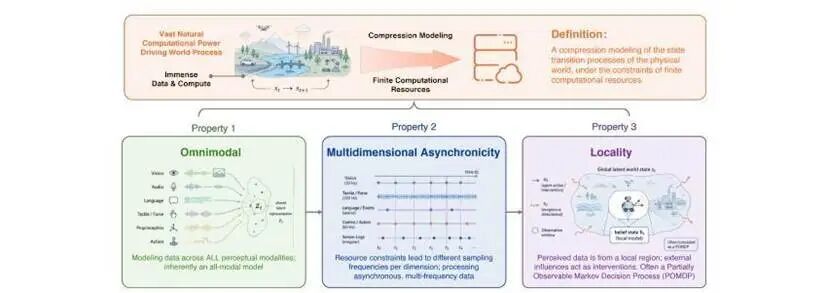
Definition and Three Attributes of World Models by the Shanghai AI Laboratory
The most thought-provoking aspect is the assertion that 'data determines the upper limit': The upper bound of any intelligent system's generalization ability in the physical world is determined by the physical diversity of the training data, not the model architecture. Currently, the only source capable of providing such diversity at scale is the open internet—every ordinary video contains hidden physical priors such as object permanence, rigidity and flexibility, occlusion, and causality.
02 From 'Act on Sight' to 'Imagine Before Acting'
If the world model is the 'brain of the physical world,' robots also need an interface to translate imagination into action. Over the past three months, this interface has been named: the World-Action Model (WAM).
Traditional VLA models 'act based on what they see'; WAM takes an additional step—it first predicts 'how the world will evolve under this action' before deciding on the action. This small step propels robots from 'reflexive' to 'deliberative.'
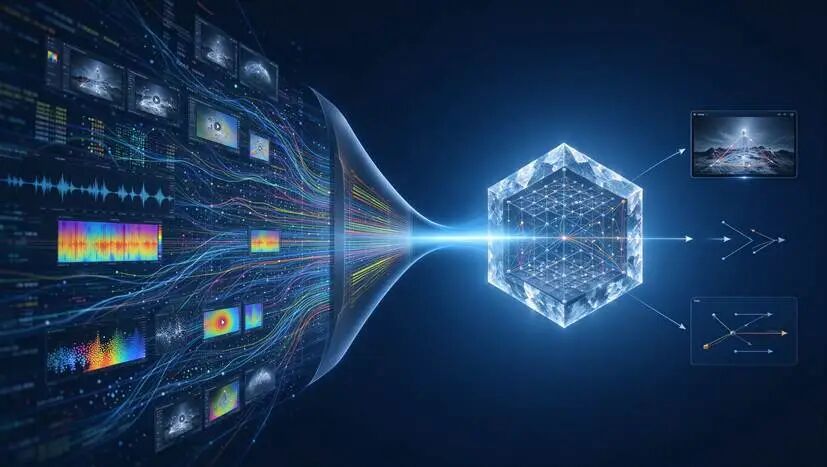
World models compress high-dimensional physical data into a unified representation, which is then decoded for rendering, simulation, and planning.
In recent months, this field has seen collective breakthroughs.
NVIDIA's Cosmos 3 uses a unified Mixture-of-Experts Transformer architecture to integrate five modalities—language, images, videos, audio, and actions—into a single model, claiming to simultaneously 'consume' visual language models, video generators, world simulators, and world-action models within one framework.
Zhiyuan Robot's GE-Act 2.0 is the first 'native' world-action model—trained from scratch on embodied data without any fine-tuning for specific evaluation tasks. It uses a proprietary CoAE encoder to compress a 256×384 frame into just 24 tokens, one-sixteenth of DINOv3's size, and generates an action block in 104 milliseconds on an RTX 5090.
The most striking result is its validation of the 'robot scaling law': Increasing training data from 300 hours to 30,000 hours (a 100x increase) enabled robots to complete 76 fine-grained tasks in zero-shot testing on unfamiliar scenes, up from 39—tasks like folding towels, nesting paper cups, and arranging flowers, which were previously incomprehensible, suddenly became feasible when data volume was sufficient.
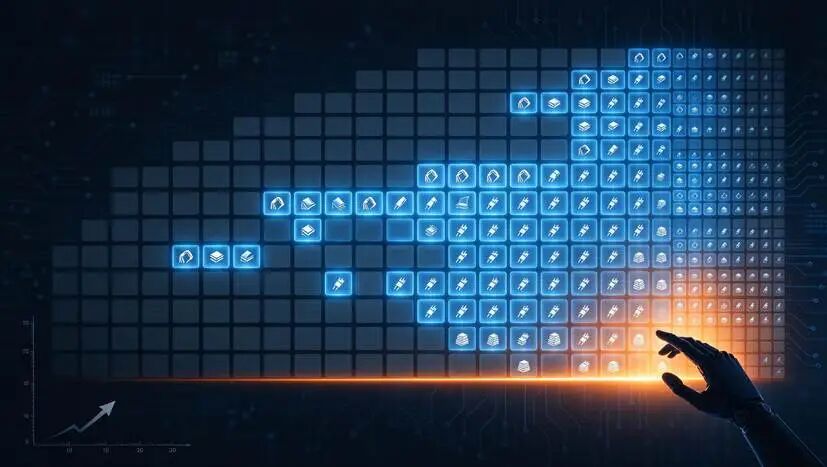
Robot capabilities unlock progressively as data scale expands.
03 World Models Are Being 'Fed' with More Data
Scaling requires data. Here, the 'inverted pyramid workflow' provides a methodology: First, unlock implicit physical priors from billions of internet videos, then filter, synthesize, and refine them layer by layer into task-aligned, compact real-world data. The logic is straightforward—proprietary robot data cannot compete with the internet in diversity, so it's better to 'borrow' existing physical common sense from the internet.
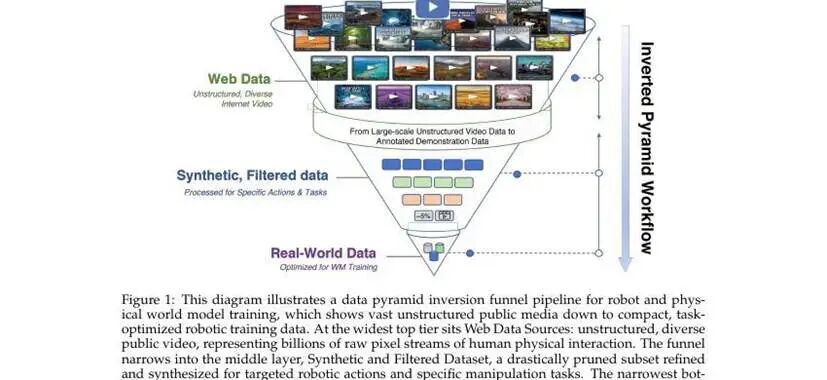
The 'inverted pyramid' data workflow for world models, from internet videos to task-specific data.
τ0-WM, jointly released by Zhiyuan and Shanghai Chuangzhi College, is a large-scale implementation of this approach: pre-trained on ~27,300 hours of heterogeneous data (including 17,800 hours of real robot teleoperation, 6,500 hours of UMI, and 3,000 hours of first-person human videos), the model has only 5B parameters but unifies 'action generation,' 'video prediction,' and 'task evaluation' into a shared predictive representation. During inference, it samples multiple candidate actions, 'rehearses' the future using an action-conditioned video simulator, and selects the most promising one—forming a 'propose-evaluate-revise' loop.
Overseas, Riemann-1.0 integrates 'executable robot policies' and a 'multi-embodiment visual world simulator' into a single autoregressive model using 200K+ hours of interactive data, achieving 94.3% success on RoboTwin2.0 and 99.0% on LIBERO.
My judgment: Robots are following the path of LLMs—scaling and data diversity determine the upper limit of capabilities. However, physical data poses a challenge absent in LLMs: action labels are scarce and expensive to collect. Whoever can acquire sufficiently diverse physical data at low cost will hold the ticket to physical AI.
04 Embodied AGI: From L1 to L5, Where Do We Stand?
With world models and action interfaces, how far are we from AGI? A review by Nanyang Technological University provides a sober grading—L1 to L5, modeled after autonomous driving maturity levels.
L1 is single-task completion, L2 is combined-task completion, L3 is conditional general tasks, L4 is highly general, and L5 is an all-weather autonomous general-purpose robot. The paper's conclusion is calm: All current embodied intelligence systems fall between L1 and L2.
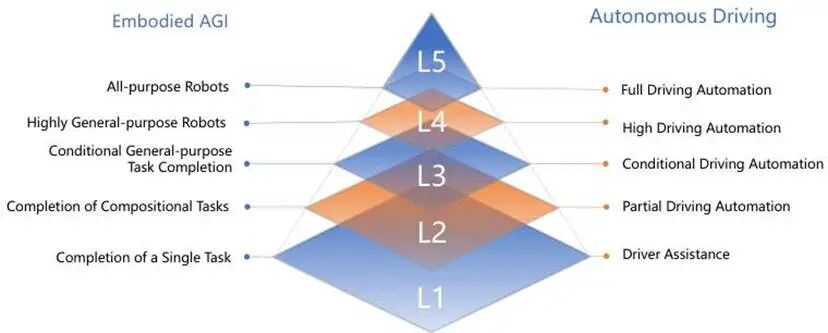
Five-Level Roadmap for Embodied AGI
Four dimensions are measured: multimodal capabilities, human-like cognition, real-time responsiveness, and open-task generalization. The hardest dimension is 'human-like cognition'—self-awareness, understanding social connections, procedural memory, and memory reconstruction. These cannot be learned through off-the-shelf supervised or reinforcement learning; they require lifelong learning: models must continuously update their internal states after deployment rather than being 'frozen' after training.
This is the fundamental difference between 'embodied AGI' and 'chat AGI': Language models can operate stably with frozen parameters, while a truly general-purpose robot must evolve continuously through daily interactions, like a living being with memory. This is both a technical and, to some extent, a philosophical challenge.
05 Another Path to ASI: Vertical Superintelligence First
If AGI represents 'breadth,' superintelligence (ASI) can also represent 'depth.' A paper by Alias Robotics presents a real-world example of vertical-domain superintelligence: cybersecurity.
It outlines three evolutionary stages: First, PentestGPT enables AI to 'assist' humans in penetration testing (AI guides humans); second, Cybersecurity AI (CAI) elevates AI agents to expert-level performance, completing security tasks 3,600x faster and at 1/156th the cost of humans; third, G-CTR integrates game theory (Nash equilibrium) into LLM agents, enabling strategic reasoning beyond human capabilities in 'attack-defense confrontations'—doubling success rates and reducing behavioral variance by 5.2x.
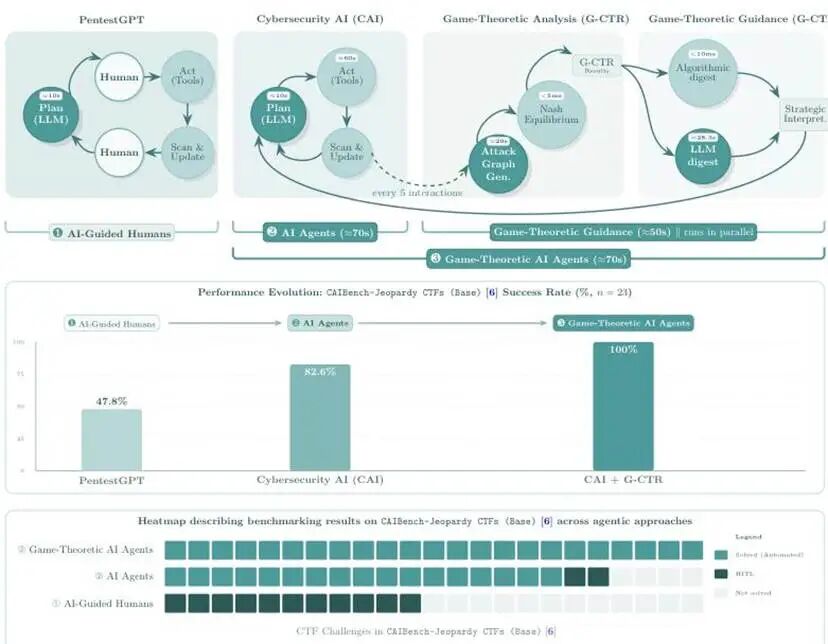
Three-Stage Evolution Toward Cybersecurity Superintelligence
Humans transition from 'executors' to 'operators' and finally to 'supervisors'; AI evolves from 'advisor' to 'executor' and finally to 'strategic actor.' When both attackers and defenders employ game-theoretic AI, cybersecurity transforms from 'human-machine collaboration' to an 'algorithmic arms race.'
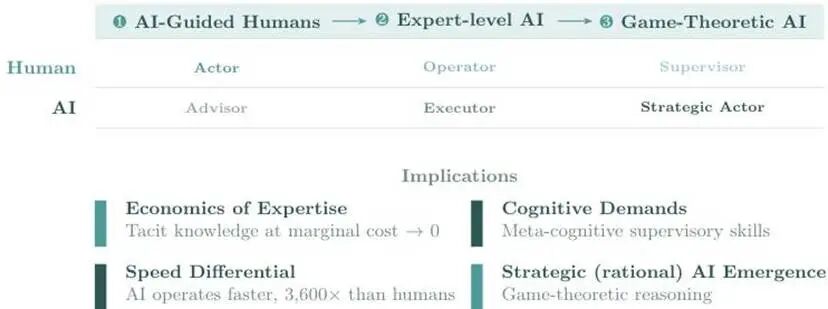
Reversal of Human-AI Roles—From AI Guiding Humans to Humans Guiding AI
This offers an alternative vision for 'superintelligence': ASI need not be an omniscient general-purpose brain; it could be 'an intelligent system that achieves superhuman performance in a narrow domain'—especially when embedded in an acting entity. The convergence of AI agents, artificial life, and robots may lead to a silicon-based form of superintelligence.
06 Roadmap to Physical AGI
First, build a unified multimodal world model; then create a 'unified physical representation' (a single state with multiple decoders for rendering, simulation, and planning); finally, develop a 'foundational-scale interactive simulator'—a closed-loop, reusable, and safe virtual physical world for trial and error.
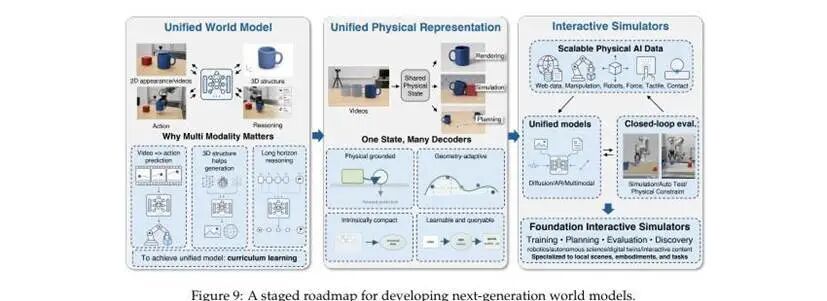
Phased Roadmap for Next-Generation World Models
This essentially answers the question of 'what a robot's brain should look like': It should not be three separate modules (one for seeing, one for thinking, one for acting) but a unified compressed representation paired with a simulator capable of 'rehearsing' the world. The real challenge is not making robots 'able to act' but 'able to think'—to mentally rehearse plans countless times before acting in the real world, and to do so accurately enough.
Of course, this path is far from romantic. Energy consumption, trade-offs between realism and precision, error accumulation in long-term predictions, and the gap between simulation and reality are all formidable challenges. A more fundamental concern is: When world models become sufficiently powerful and robots sufficiently versatile, will human-machine relations repeat the 'role reversal' seen in cybersecurity—where humans retreat to supervision while agents race ahead in the physical world?
World models serve as the bridge, and robots are AGI's foothold in the physical world. When enough diverse physical data is fed into a sufficiently large world model, robots might one day 'think things through' before acting.
Our task is to see the direction clearly and consider: When we entrust the world to a robot's brain, what should we keep in our own hands?
Sources (Verified Date: 2026-09-23):
Shanghai AI Laboratory, 'World Model Definitions and Roadmap';
Nanyang Technological University, 'Toward Embodied AGI: A Review of Embodied AI and the Path Forward';
Alias Robotics, 'Toward Cybersecurity Superintelligence: From AI Guiding Humans to Humans Guiding AI';
NVIDIA, 'Cosmos 3: A Multimodal World Model for Physical AI';
Zhiyuan Robot, 'GE-Act 2.0 Release Notes';
Shanghai Chuangzhi College, 'τ0-WM: The Largest-Scale Pre-Trained Embodied World Model';
Riemann-1.0, 'Embodied World-Action Models for Physical AI';
Kairos, 'Native World Model Stack for Physical AI';
Embodied-R1.5, 'Evolving Physical Intelligence Through Embodied Foundation Models'; Beijing Zhiyuan, 'Top 10 AI Technology Trends for 2026.'
-
![]()
More Than 50 Crashes: A Chinese Farmer Takes Flying Cars to the Emirates Palace in Abu Dhabi
-
Enterprises Embracing AI Truly Miss the 'Contextual' Mark
-
![]()
Chinese Brands Ascend to Dominance in Global Handheld Smart Camera Rankings: DJI and Insta360 Command 93% Market Share
-
![]()
Meta’s Market Value Rockets by Nearly $200 Billion Overnight, Cloud Town Conference Takes the Lead: AI Applications Begin to Boom, Six Key Beneficiaries Unveiled
-
![]()
World Model: The First Year of AGI for Robots
-
![]()
Is the Second-Generation Doubao Smartphone a Wise Purchase?
-
![]()
Is the Second-Generation Doubao Smartphone a Worthy Purchase?
-
Zhou Jingren Steps Down from Center Stage