The Android Moment of Embodied AI Lies in the Cost of Switching Bodies
 10/08 2026
 477
477

Author|Maoxinru
For years, the robotics industry has operated under the default rule of 'one machine, one brain.'
Service robots, industrial collaborative robotic arms, sanitation inspection robots, and humanoid robots each have their own algorithm systems, control frameworks, and development logics.
Data is isolated, algorithms are difficult to reuse, and scene experiences cannot be transferred, leading to isolated systems over time.
During the vertically specialized stage, this approach was effective. However, in the era of embodied AI, the desire for large-scale replication brings development costs, data silos, and adaptation cycles to the forefront as limiting factors.
Consider this: if a company purchases robots from ten different brands, it would need to prepare ten different models—an already exaggerated scenario.
More troubling is the vast diversity in robot types, configurations, sensors, and mechanical structures, all of which ultimately affect strategy execution.
Asking a robotic arm, a wheeled robot, and a bipedal robot to perform the same task would require different action strategies.
Just because one robot has learned a task does not mean another robot will as well.
Therefore, when the industry discusses generalization today, it is not just about scene generalization or task generalization but also about cross-model generalization.
The former asks whether a single robot can do more tasks; the latter asks whether a single 'brain' can switch to a different body and continue working, eventually achieving out-of-the-box usability.
From a business perspective, this is a natural choice.
If the brain algorithm must be rewritten for every hardware form, embodied AI will remain trapped in high customization, high costs, and poor reusability.
The concepts of one brain for multiple machines, one brain for multiple forms, and one brain for multiple states are responses to this challenge.
Although they go by different names, their core is the same: using a unified intelligent base to allow a single brain to adapt to and drive robot bodies with different configurations, such as robotic arms, wheeled, quadrupedal, bipedal, and even humanoid robots.
The brain handles perception, understanding, planning, and decision-making, while the body executes actions in the physical world.
If this approach succeeds, the embodied AI industry may witness its own 'Android moment.'
Why Does the Embodied AI Era Need One Brain for Multiple Machines?
When discussing embodied AI, the term 'general-purpose' is frequently heard.
From VLA and world models to reinforcement learning and data flywheels, nearly all technological advancements focus on enhancing generalization capabilities.
However, as more robot manufacturers enter the market, a highly practical question arises: if robot bodies themselves are heterogeneous, how can general-purpose intelligence be achieved?
This is the core challenge that one brain for multiple machines aims to address—enabling intelligent capabilities to transcend physical differences and achieve asset reuse.
In the future, a factory might simultaneously house mobile robots, robotic arms, humanoid robots, and robotic dogs, while a household might have robots for companionship, exercise, and housework.
If each robot still requires its own model, scalability bottlenecks will quickly emerge.
In the past, when companies invested in training a model, it was often tied to a specific robot and task.
Now, if the same brain can be transferred to more robots, the value generated from a single training session can be shared across more robot bodies.
This differs from the value logic of the traditional robotics industry.
Traditional robotics companies prefer customers to buy their robots; brain-focused companies hope that regardless of which robot a customer ultimately purchases, their intelligence can be used.
Only when brains can be transferred across different bodies can the significant upfront investments in data and models be truly diluted through large-scale deployment.
However, there is a common misconception that is easily overlooked: having a large number of adaptable models does not necessarily mean true one brain for multiple machines.
If switching to a new robot body requires collecting large amounts of new data, retraining, or even redesigning control strategies, it is essentially still a multi-machine, multi-model approach, albeit with the same underlying model framework.
Truly implementable one brain for multiple machines likely requires a clear decoupled architecture:
The general-purpose brain understands the world, tasks, and calls upon skills.
The body adaptation layer translates abstract actions into those executable by the specific body.
The low-level control system handles motion control and safety.
The more general-purpose the brain aims to be, the more body differences must be abstracted away from it—this is where the true challenge lies.
Four Types of Players Pursuing the Same Goal
If you only look at company publicity (promotional materials), it’s easy to think everyone is doing the same thing.
However, when categorizing current players based on their native business models, software and hardware layouts, and technical paths, four distinct groups emerge: native embodied platform players, pure software brain players, traditional hardware transformation players, and tool component adaptation players.
These groups differ in barriers, weaknesses, and commercialization paces, but together they form the current industrial ecosystem.
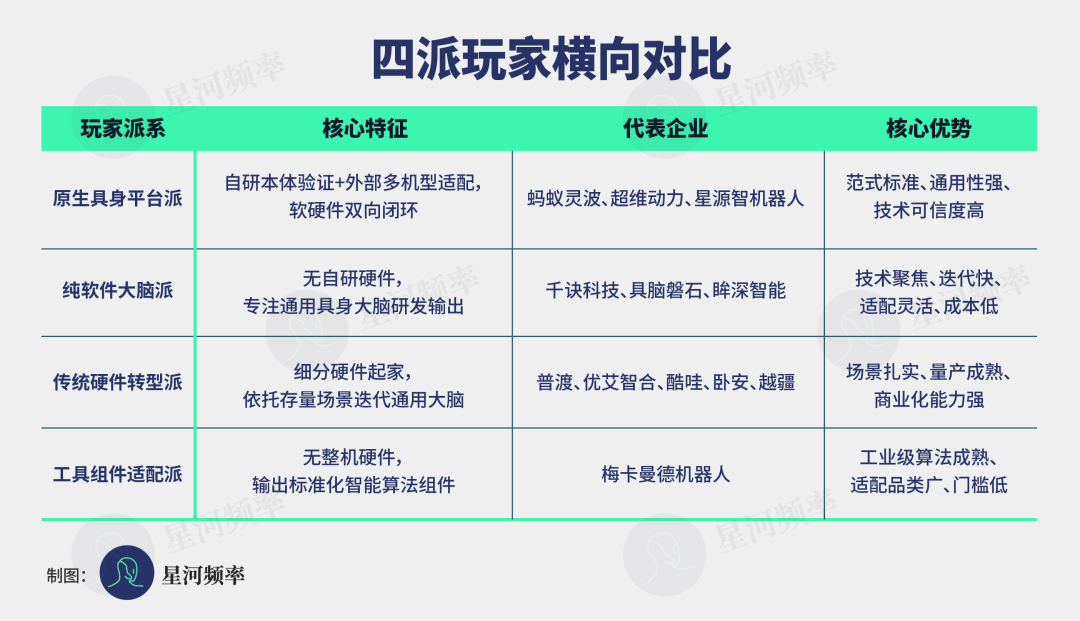
Native embodied platform players are the closest to the original definition of one brain for multiple machines, with representatives like Ant Intelligence, Chaowei Dynamics, and Xingyuan Intelligence Robots.
These players are deeply rooted in embodied AI, not transitioning from traditional robotics. Their most notable feature is the bidirectional loop formed by in-house hardware validation and multi-model external adaptation.
They use their own hardware to run models and validate physical interactions while also offering cross-brand, cross-form adaptation capabilities externally.
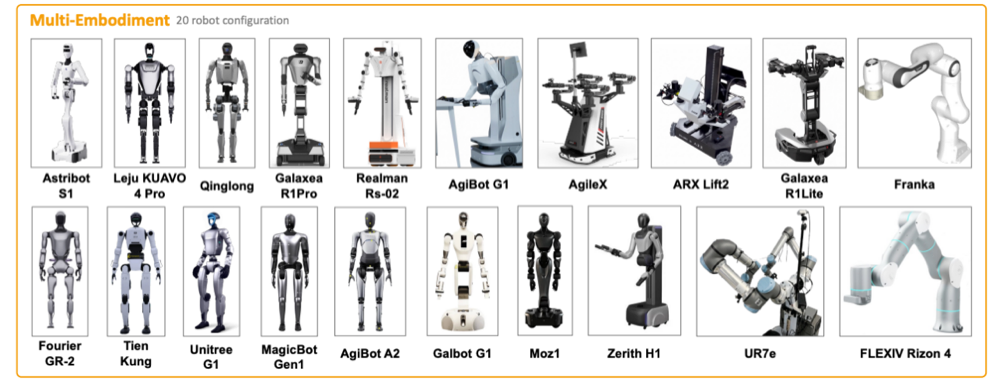
Ant Intelligence’s LingBot-VLA 2.0 refines its foundational capabilities and interaction logic using its own robots while adapting to over 20 robot configurations during pre-training, covering brands like Unitree, Zhiyuan, Galaxy General, Leju, and Stardust Intelligence.
Chaowei Dynamics focuses on underlying motion capabilities, addressing the common shortcoming of brains prioritizing cognition over motion. Using its self-developed humanoid robot, it completes algorithmic loops and builds the SMASH unified algorithm system, which is better suited for fine manipulation, physical interaction, and adaptive motion control in dynamic environments, meeting real-world operational demands.
Xingyuan Intelligence Robots takes a lightweight, highly adaptable route, using in-house hardware validation techniques to quickly adapt to multi-form hardware, avoiding the intense competition in heavy models and focusing on scalable deployment in small and medium-sized scenarios.
The barrier for these players lies in bidirectional closed-loop iteration of software and hardware, offering the highest technical credibility and paradigm standardization. Pure software brain players represent the most technologically focused force in this track (sector), with representatives like Qianjue Technology, Junao Panshi, and Moushen Intelligence.
These players do not engage in robot hardware or end products; instead, they concentrate research resources on general-purpose embodied large models, multi-machine collaborative scheduling, and perception-decision-making underlying architectures. Their positioning is clear: to serve as intelligent brain suppliers for robot hardware manufacturers.
Qianjue Technology emphasizes hardware-agnostic generalized solutions, excelling in algorithmic universality and rapid adaptation capabilities. It can quickly connect with various industrial, commercial, and household robot bodies without requiring long-term customization for single hardware, focusing on lightweight, highly flexible, and low-cost deployment.
Junao Panshi leans more toward industrial-grade highly reliable embodied brains, focusing on integrated perception, decision-making, and planning underlying architectures. It pursues high stability, real-time performance, and precision, specifically adapting to complex industrial operation scenarios and meeting requirements for collaborative operations, precise control, and safe operation.
Moushen Intelligence starts with vision, using visual perception as a generalized foundation. It unifies environmental recognition, target positioning, and scene adaptation for different robot forms through a single visual brain, addressing the lack of interoperability in visual algorithms for heterogeneous robots.
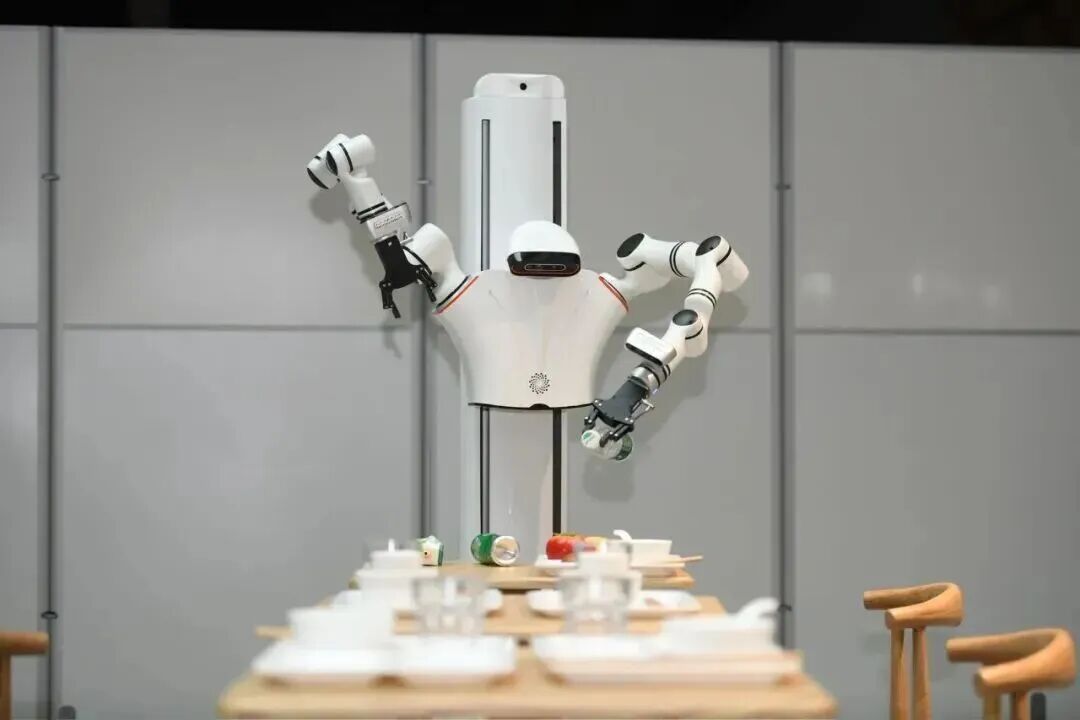
The advantage of pure software players lies in their technological focus, rapid iteration, and freedom from hardware cost burdens, enabling flexible adaptation.
Traditional hardware transformation players are the core pillars of current commercialization, including Pudu Robotics, Youibot, Cowarobot, Wuan Robot, and Dobot.
These companies originated in niche specialized robotics, with early vertical scenarios and products tailored to those scenarios. Leveraging years of mass production experience, supply chain systems, and vast amounts of real-world scene data, they have expanded upward to develop general-purpose intelligent bases, gradually forming multi-form product matrices and one brain for multiple machines capabilities.
Pudu Robotics started with commercial service robots, focusing on standardized scenarios like delivery and cleaning. With cumulative shipments exceeding 130,000 units and accounting for 44% of China’s service robot exports, it has built the PuduFM base model and PuduAgent OS universal platform. These integrate cleaning, delivery, humanoid, and anthropomorphic robots under a unified brain system, generalizing mobility, interaction, and scheduling capabilities accumulated in commercial scenarios across all service robot categories. It is a typical (typical) example of scalable commercial deployment.
Youibot specializes in semiconductors and high-end manufacturing, originally focusing on industrial mobile collaborative robots for high-precision, high-cleanliness, and high-reliability environments. Based on the FabriX industrial embodied model, it achieves multi-form adaptation for industrial AMRs, mobile manipulation robots, and industrial humanoid robots, excelling in multi-machine collaborative scheduling and precise operations.
Cowarobot started with wheeled robots for sanitation and cleaning, iterating the CooWAM world model with urban scene data. It extends mobility, obstacle avoidance, and scheduling capabilities to multi-form urban service robots, primarily targeting scalable RaaS deployment in urban scenarios.
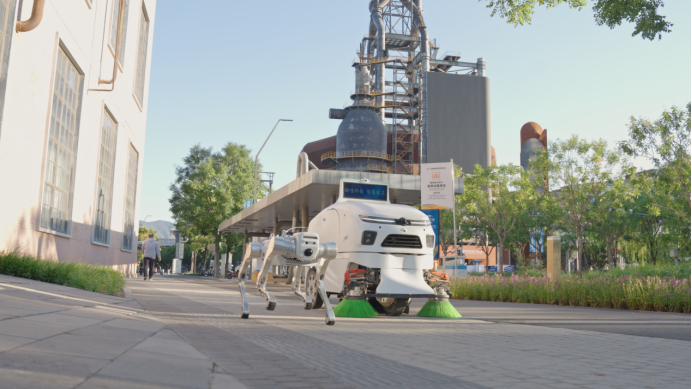
The advantage of these players lies in their mature commercialization systems, vast amounts of real-world scene data, and stable mass production capabilities, addressing the challenges of difficulty in landing and monetization faced by pure algorithm companies. Tool component adaptation players are currently best represented by Mech-Mind Robotics.
Positioned as an upstream infrastructure service provider, Mech-Mind does not develop complete robot systems or end products. Instead, it focuses on robot eye-brain-hand coordination algorithms, industrial-grade 3D perception, and intelligent planning systems, providing standardized intelligent capability components for various robots across the industry.
Leveraging the MechGPT intelligent engine, Mech-Mind builds a universal eye-brain-hand coordination system, freeing itself from single hardware form constraints. It outputs unified perception, understanding, planning, and operational decision-making capabilities for humanoid robots, industrial mobile robots, collaborative robotic arms, and more.
Its value lies in lowering the algorithmic adaptation threshold for one brain for multiple machines across the industry, enabling small and medium-sized hardware manufacturers to access lightweight, standardized general-purpose intelligent solutions.
Its barriers include deep industrial-grade algorithm accumulation, broad hardware adaptation categories, and strong industry universality.
When viewing these four groups together, the differences become clear: native platform players define paradigms, pure software players push technological limits, hardware transformation players drive commercialization, and tool component players lower adaptation thresholds.
They are not engaged in homogeneous internal competition but are instead advancing one brain for multiple machines into the industry from different positions.
One Brain for Multiple Machines: More Than Just a Number
When discussing one brain for multiple machines, the most commonly cited metric is the number of adaptable robot forms—how many types of robots a single brain can control.
Numbers like 10, 20, or 100 are meaningful but incomplete.
If adapting to each new robot requires collecting new data, retraining, or even rewriting control logic, no matter how impressive the number, it does not truly indicate a generalized model. It resembles integration rather than general-purpose intelligence.
The true test is how much capability remains after switching bodies.
Take organizing a desktop as an example. If a robot has learned this task and, when transferred to a different body, can still distinguish what to put away and what to leave, as well as the order of operations, it shows that the task itself has not been forgotten—only the physical execution needs adaptation.
Conversely, if switching bodies disrupts everything, it indicates that the robot only learned the actions for that specific body, not the task itself.
Only if the former is achieved can one brain for multiple machines be considered truly established.
To assess a company’s progress in one brain for multiple machines, consider these questions:
How much data is needed to adapt a new robot body?
Is adaptation time measured in months or weeks?
How much of the original skillset can be inherited?
Does the model require retraining, or only body-layer adaptation?
These questions all point to one factor: the cost of switching bodies. The lower this cost, the greater the commercial value of one brain for multiple machines.
Scalability in the robotics industry cannot be achieved by simply training more models.
Imagine a factory with dozens of robot types. If each requires separate training, costs escalate with scale, turning scalability into a burden.
However, if capabilities learned by one model can continuously transfer, the value of a single intelligent system grows with each additional robot. The former represents linear or even exponential costs, while the latter can form a flywheel effect.
Thus, one brain for multiple machines fundamentally changes how robot intelligence is utilized.
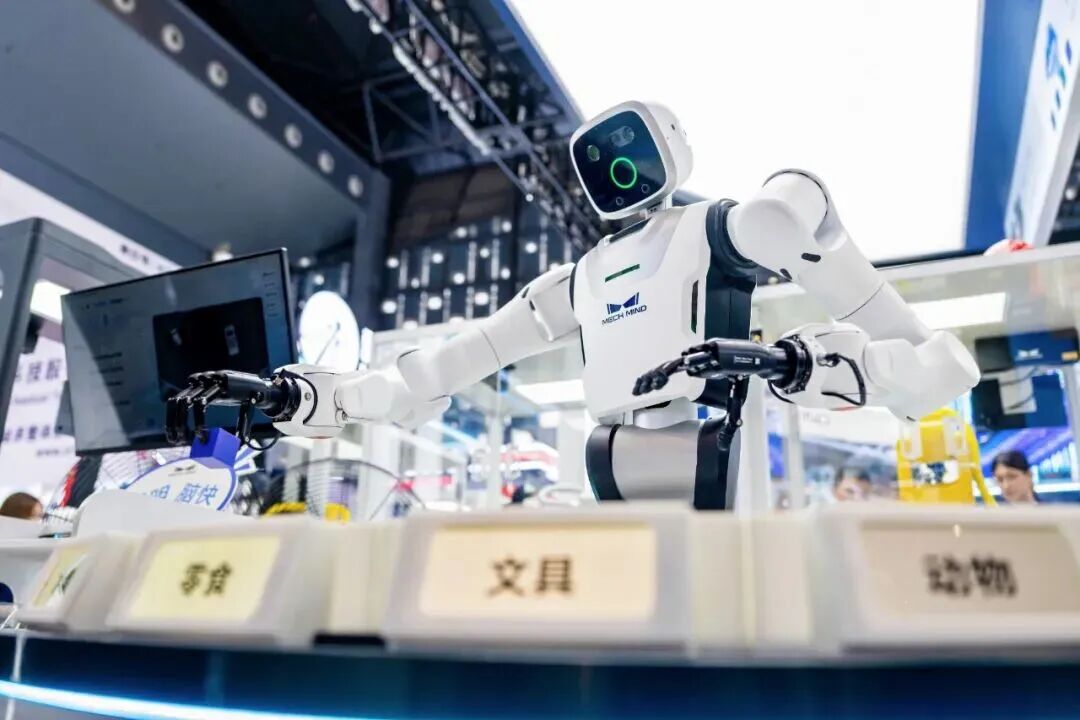
In the past, capabilities were tied to individual robots; in the future, a single set of capabilities can empower multiple robots.
That's why model companies and robot body companies will inevitably meet at this point: model companies want their brains to enter more bodies, while robot body companies want their bodies to share more intelligence.
Someone also needs to step in to address vision, control, computing power, and adaptability. Several originally independent industrial chains are thus gradually coming closer.
Of course, we must also face a question head-on: one brain for multiple machines does not mean the body is no longer important. On the contrary, the more bodies there are, the more problems arise from their differences.
How humanoid robots walk, how robotic arms grasp, how robot dogs maintain balance, and how wheeled robots move—these cannot all be left to a single general-purpose model.
The more general-purpose the brain, the more critical the adaptability layer below it becomes.
Therefore, after one brain for multiple machines matures, it is more likely that the division of labor between the brain, cerebellum, and body will become clearer, rather than the brain handling everything alone.
The brain understands tasks and environments, the cerebellum handles motion control, and the body executes the actions.
No one can fully replace the others; their roles will simply become more defined. Right now, everyone is showcasing how many robots one brain can control.
Moving forward, what the industry will truly compete on may be: How long does it take to integrate a new robot?
If one day, a company can buy a completely different new robot, perform a single body adaptation, and inherit most of its previously trained skills, then one brain for multiple machines will have crossed the threshold from demo to industry.
Therefore, the competition for one brain for multiple machines will not stop at showcasing how many types of bodies I can connect to.
It will inevitably come down to harder metrics:
How long does it take to integrate a new body, how much of the old skills can be inherited, and whether adaptation costs can continue to decline.
The numbers will be updated, but the cost curve does not lie.
Whoever can continuously reduce the cost of switching bodies will truly hold the key to industrialization.
By then, the competitive logic of the robotics industry will shift slightly. In the past, the competition was about who could build better bodies.
In the future, an additional criterion will be: who can enable their intelligence to enter more bodies.
And that is what truly makes one brain for multiple machines worth paying attention to.
-
![]()
Will Chinese Cars Secure 20% of the European Market This Year?
-
![]()
Qualcomm Pays Huawei, Yet Chip Sales Remain Restricted
-
![]()
The Android Moment of Embodied AI Lies in the Cost of Switching Bodies
-
![]()
After Testing ChatGPT dot, I Understand Why Big Companies Must Develop Personal Agents
-
![]()
SAIC Surpasses BYD! Automakers' 2026 Yearly Goals Prove to Be a Daunting Task
-
![]()
Leapmotor Surges Ahead! Li Auto and HiMo Harmony Intelligent Travel See Declines, September’s New Energy Vehicle Market a Blend of Triumph and Challenge
-
![]()
SERES and Huawei Make a Dramatic Shift! AITO Launches Ultimate Evolution Strategy
-
![]()
Changan Automobile Takes Action: What Lies Ahead for Deepal and Avatr?