Zhixiang Future Secures 2.1 Billion Yuan in Three Months of Financing, Yet Founder Maintains: 'We Haven't Achieved World-Model Status'
 10/10 2026
 338
338
Zhixiang Future, a multimodal generative AI company, has completed three rounds of intensive financing totaling 2.1 billion yuan over the past three months, showcasing remarkable momentum. However, the founder asserts, 'We haven't achieved world-model status yet.' With such a trendy concept, is Zhixiang Future being overly cautious by avoiding the label?
Author|Xiao Wei
Editor|Jiang Lan
A company has just secured 1.5 billion yuan in financing, explicitly earmarked for world-model development. Yet, the founder stated in an interview, 'The company hasn't achieved world-model status yet.' This Series C financing round for multimodal generative AI enterprise Zhixiang Future (HiDream.ai) began with an inherent tension-filled contradiction.
On July 23, Zhixiang Future announced the completion of a 1.5 billion yuan Series C financing round. This visual model company, established just three years ago, has raised over 2.1 billion yuan in cumulative financing over the past three months, with its valuation exceeding $1 billion, demonstrating remarkable momentum.
A key reason for capital pursuit lies in the company's professional pedigree. Founder Mei Tao is a foreign academician of the Canadian Academy of Engineering, with extensive experience at Microsoft Research Asia and JD.com. In 2023, he established the company with a two-decade visual research team, focusing on building a foundational architecture capable of unified understanding of images, videos, text, 3D models, and even object actions—conceptually, a native multimodal world model.
Yet, this company, which uses world models as its financing anchor, saw Mei Tao explicitly state in interviews: 'It's still too early to call any model on the market a true world model.'
Having secured world-model funding but rejecting the label, this statement reflects not humility but the logic behind the company's valuation. The key to decoding this logic lies in the investor list from this financing round.
One Financing Round, Four Strategic Cards
This round was jointly led by Sichuan Zhenxing Science and Technology Innovation Fund (Social Security Fund), ICBC Capital, Hongyi Asset Management, and Dunhong Capital, with follow-on investments from Xiamen International Trade Capital, Shanghai Film New Vision Fund, Huace Film and Television, and Communications Bank Capital. Existing shareholders Hefei Industrial Investment, Orient Fortune Capital, and Jinpu Investment also increased their stakes. According to CVSource, the company simultaneously completed its joint-stock transformation, renaming itself 'Zhixiang Future (Hefei) Technology Co., Ltd.,' with a clearer path to listing.
Breaking down the investor list into four categories: National-level funds (Social Security Fund Sichuan Zhenxing) validate technological autonomy; among bank-affiliated asset investment companies (AICs), the simultaneous presence of ICBC Capital (with registered capital exceeding 300 billion yuan) and Communications Bank Capital marks the first major model company investment by financial capital seeking certainty; among local state-owned assets, Hefei Industrial Investment's three consecutive rounds of follow-on investments reflect a familiar investment logic seen in Changxin Storage, BOE, and NIO; among industrial capital, the simultaneous participation of Huace, Shanghai Film, and Changjiang Film—three film and television companies across the supply chain—stands out.
Four types of capital, driven by different logics, all point to the same fact: Zhixiang Future's value is multidimensional.
Technologically, Zhixiang Future has taken a non-mainstream path. Mainstream multimodal models adopt DiT architecture—encoding images, videos, and text separately, training them independently, and finally combining them. Zhixiang's self-developed UiT architecture skips intermediate compression, enabling different modalities to enter the same network from the outset of training. This is akin to shifting from 'learning separately before translating' to 'growing up together from birth.' The trade-offs are slower training, higher computational demands, and greater difficulty—according to GeekPark, the Zhixiang Future team replaced its underlying architecture four times in four years, with internal debates before the latest switch: staying on the original path would yield 80 points, while starting over might reach 90 points or fail. They chose the latter.
The results are gradually materializing. At the image level, HiDream-O1 (open-source version) based on the UiT architecture topped the text-to-image rankings on independent evaluation platform Artificial Analysis, while its commercial version, HiDream-O1-1.5, ranked among the global top three. At the video and agent level, the company unveiled its new product, vivago R1, at the World Artificial Intelligence Conference in July, supporting continuous generation of coherent long videos and autonomous completion of the creative pipeline from storyboarding to final output.
Commercial data also explains why bank-affiliated capital got involved. Mei Tao revealed to Shanghai Securities News in May that first-quarter contracted revenue exceeded 400 million yuan, surpassing last year's total, with services now covering over 40,000 enterprise clients across more than 100 countries and regions.
At this point, Zhixiang Future's profile is clear—validated technology, commercial revenue, and capital endorsement. However, the true incremental information lies deeper.
Why Did Upstream and Downstream Players All Bet on It?
The simultaneous presence of Huace, Shanghai Film, and Changjiang Film in the investor list marks the most unusual aspect of this financing round. All three are leading players in the film and television industry, but their reasons for investing in the same AI company differ.
Huace's approach resembles 'binding production lines.' This leading company behind dramas such as I Am the Criminal Police, Blooming National Color, and Go to the Windy Place had previously established a 500 million yuan AIGC special fund and a 400 million yuan AI video investment fund, investing in Zhipu Huazhang and Kuaishou Kling before this move. Unlike previous fund investments, this involved direct equity stakes. Their collaboration extends directly into production workflows: co-building high-quality film and television corpora (Zhixiang Future's accumulated 200,000 hours of copyrighted video data form the foundation), establishing Material Factory and Short Drama Factory for joint production capacity, and deploying the AI film and television creation agent 'Frame Praise' to cover script evaluation, visual pre-visualization, and post-production. Huace Vice President Zhang Situo's earlier statement serves as a footnote: Film and television companies lack not standalone generation capabilities but collaborative systems that integrate into real production workflows.
Shanghai Film's approach resembles 'creating export channels.' The Shanghai Film New Vision Fund is an industrial investment platform jointly established by Shanghai Film Co., Ltd. and Beigaofeng Capital, among others. As a state-owned film enterprise listed on the A-share market, Shanghai Film Co., Ltd. operates 750 cinemas under its United Cinemas Line across 30 provinces, along with offline assets like Shanghai Film Paradise. In June, the fund announced a strategic investment in Zhixiang Future, with collaborations extending beyond cinema scene marketing and IP co-development to include formulating AI large-screen production standards and workflows.
Changjiang Film, an earlier entrant, resembles 'running validation tests.' This Hubei provincial state-owned film enterprise operates 202 cinemas under its Yinxing Cinemas Line as of late 2025. Having invested in the Series A round, it established a film and television AI joint laboratory with Zhixiang Future in December 2025, focusing on AI-assisted scriptwriting, intelligent visual effects generation, and virtual filmmaking. Under the agreement, Zhixiang Future will jointly build an AIGC film and television creation platform based on its HiDream large model and tools like Frame Praise.
Huace seeks deep workflow integration, Shanghai Film seeks offline monetization channels, and Changjiang Film seeks technical validation scenarios. While their demands differ, all three film and television capital players are betting on the same thing: Zhixiang Future's currently validated content generation capabilities.
After Choosing the Hard Mode, Who Can Play the Premium Game of World Models?
Placing Zhixiang Future within the sector's coordinates reveals its typical yet unique position.
According to Tencent News·DeepNet statistics, the total public financing in China's AI video generation sector has exceeded 10 billion yuan in 2025 alone. Kuaishou Kling secured nearly $3 billion in financing, with Tencent, Alibaba, and Baidu rarely appearing on the same stage; Aishi Technology raised 2.98 billion yuan in its Series C round, led by Alibaba. Overseas, the world model concept continues to heat up—Li Feifei's World Labs raised $1 billion, Yann LeCun's AMI Labs secured $1.03 billion in seed funding, and Runway completed a $315 million Series E round, directly repositioning itself as a 'world model company.' The sector's narrative is highly convergent: using today's content generation revenue to buy tickets for tomorrow's world models.
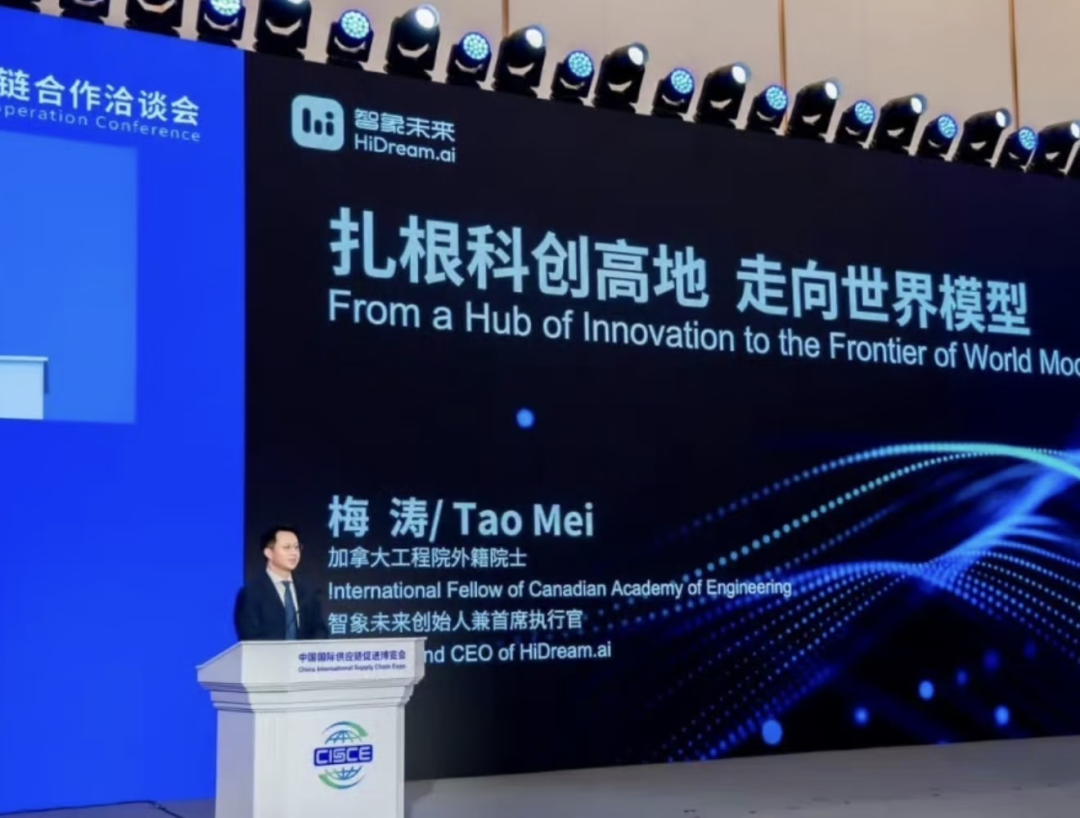
Zhixiang Future has not rushed to embrace the 'world model company' label because its criteria for world models differ from peers'. Its self-developed UiT architecture skips VAE compression, processing images, videos, text, 3D models, and actions uniformly from raw signals. A true world model must achieve unified perception and prediction of the physical world at this architectural level. This path is longer and less certain, which is why Mei Tao believes the entire industry remains in its 'middle game.'
Precisely because of these high standards, industrial capital is willing to stay involved. Once validated, the barriers become evident. Thus, industrial capital has shifted from LP mode to direct equity stakes and joint production lines, betting precisely on this point—while technological gaps may eventually close, the production collaboration system developed alongside leading players cannot be easily disrupted by latecomers in the short term.
For Zhixiang Future, the questions it must answer after Series C are already on the table: Where does the foundational path of world models lead? Can it accelerate industrial-scale production capacity? Can commercial scenarios achieve closed-loop operations? These are its major challenges. When Mei Tao says, 'We haven't achieved world-model status yet,' the market awaits the day he declares, 'We are now one.'
|END|
(Images and public data sources in this article come from the internet and public industry platforms. If there is any infringement, please contact us promptly for corrections.)
-
![]()
Keynote Speaker Announcement | Wang Peng, Alibaba's QianWen Office Business Development Expert, Confirmed for WAIE (10th) 2026 AI Industry Conference & AI Agent Industry Application Summit
-
![]()
A Chaotic Battle in the Smartphone Market: Who is Redefining the Imaging War?
-
![]()
Chaotic Competition in the Smartphone Market: Who is Redefining the Imaging War?
-
![]()
AI Is Not a Get-Out-of-Jail-Free Card: Why Only Microsoft Is Being Rewarded for Its AI Investments
-
![]()
Li Auto’s 2026 i6: The Brand’s Debut Global All-Electric Model Headed to Europe
-
![]()
Kimi K3 Goes Viral and Suspends Service in 48 Hours: Model Wins Benchmarks, Compute Falls Short Against Big Players
-
![]()
Zhixiang Future Secures 2.1 Billion Yuan in Three Months of Financing, Yet Founder Maintains: 'We Haven't Achieved World-Model Status'
-
11 Days, Five Launch Events: The Battle Behind the 2026 Domestic Flagship Smartphones