Green Bubble May Not Outshine Hongguo Yet, But This Step Is Vital
 10/14 2026
 561
561
Yiyan Business Observer
The truly daunting aspect of a monopoly isn't the monopoly itself, but the absence of a counterpart to negotiate rules with.
Recently, a free short drama mini-program named Green Bubble Short Drama has surfaced in WeChat. Despite its recent emergence, nearly everyone in the industry is pondering the same question: Can it surpass Hongguo?
From Yiyan Business Observer's standpoint: Not yet. However, the key point isn't whether it can outperform Hongguo. Green Bubble has done one thing correctly—it has provided the short drama industry with its first 'credible alternative.'
The truly daunting aspect of a monopoly isn't the monopoly itself, but the absence of a counterpart to negotiate rules with. Green Bubble's move is precisely a step towards negotiation.
01 WeChat Operates a 'Mall,' Not a 'Self-Operated Store'
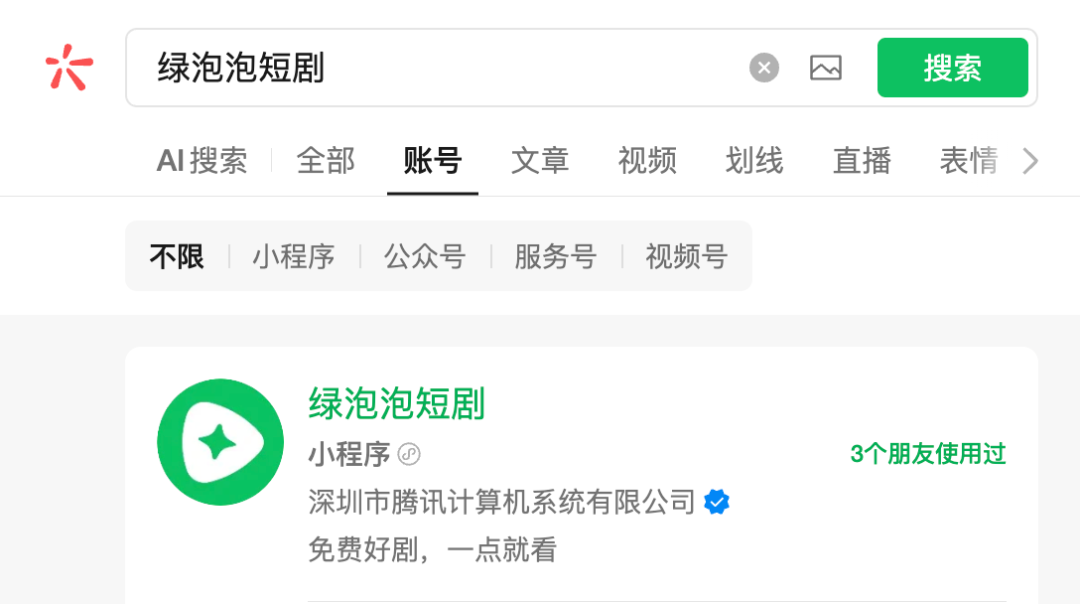
To evaluate Green Bubble, we must first accurately position it. It's not a new venture where Tencent's in-house team creates content; rather, it's WeChat's official short drama mini-program. Public reports indicate that it has taken over the entry point of previous short drama mini-programs, adopting a co-publishing model—integrating external drama series into WeChat's official content pool without creating content itself. Regarding the account entity, during the short drama phase, it can be confirmed as Tencent Computer System Co., Ltd. in Shenzhen. Whether Green Bubble will continue under the same entity has not been officially announced.
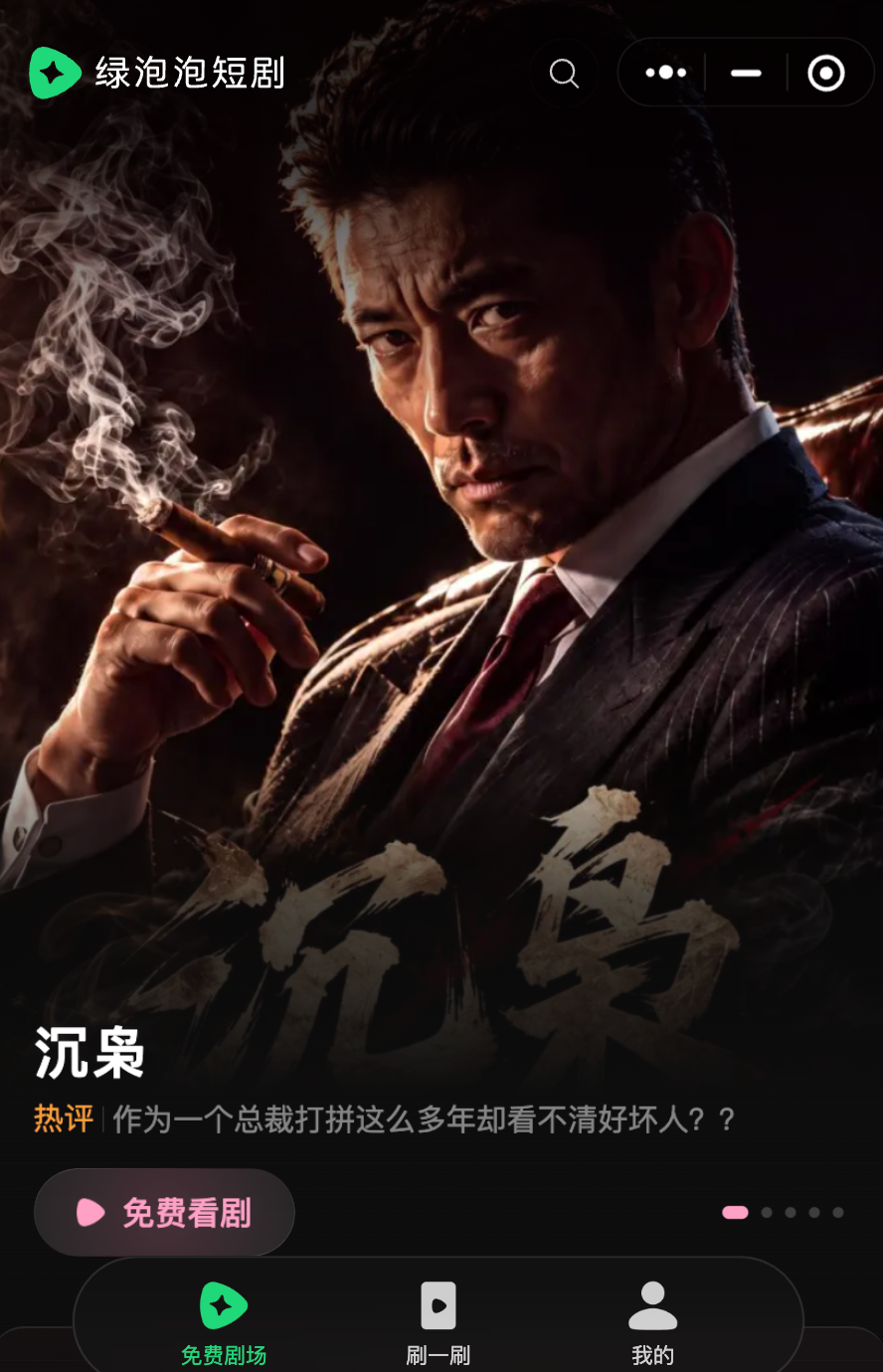
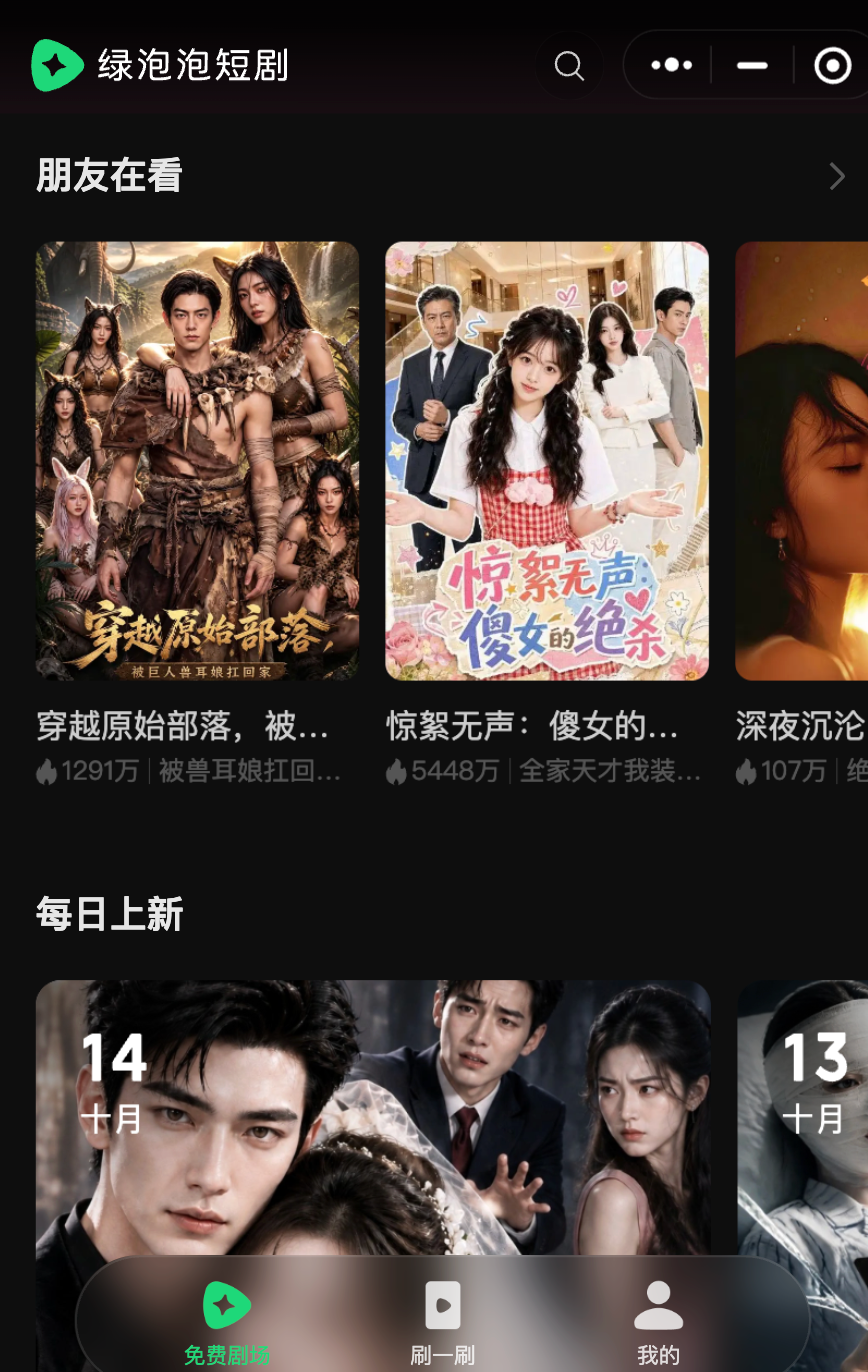
Industry insiders liken this model to operating a 'mall' rather than opening a 'self-operated store': WeChat doesn't produce dramas; it merely provides shelves, traffic, and rules. Interestingly, public reports show that content providers have promptly registered Green Bubble accounts but remain cautious—the shelves are set up, but merchants are still observing the foot traffic.
02 The Four Aces WeChat Has Dealt Green Bubble
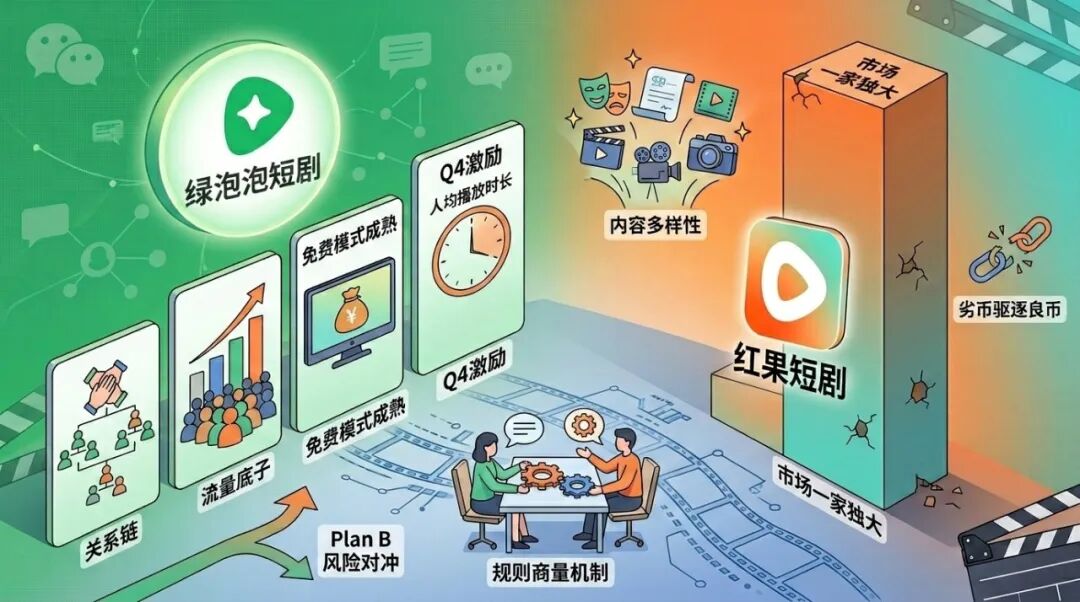
Green Bubble doesn't come to the table empty-handed; WeChat has given it four solid cards.
The first card is social connections. Friends are watching, one-click sharing to groups and friends—these are customer acquisition channels that independent apps like Hongguo find hard to replicate. Hongguo relies on sign-ins, tasks, and coin accumulation to extend user time; Green Bubble directly leverages WeChat's existing acquaintance network.
The second card is traffic foundation. QuestMobile data shows that in February 2026, WeChat mini-program channel short drama users reached 427 million, while the overall monthly active users of independent short drama apps stood at 335 million during the same period—WeChat's side has a larger user base. It should be noted that these 427 million represent WeChat's total short drama users, not necessarily Green Bubble's monthly active users. Green Bubble is just one of the official entry points in this channel, but all these users are potential Green Bubble users.
The third card is the maturity of the free model. DataEye Research estimates that the market size of free micro-short dramas will reach approximately 57.3 billion yuan in 2026, accounting for nearly half of the overall market for micro-short dramas, AI dramas, and comic dramas (estimated to exceed 121 billion yuan). This means the IAA model of 'watching dramas for free and monetizing through ads' has proven to be a viable business.
The fourth card, and the most potent one, is the change in evaluation metrics. The Q4 incentives have shifted from the industry's habitual focus on play counts to average play duration per user. This is a clear directional signal: the platform is now encouraging long-term content that retains users, rather than fast-food dramas that rely on hooks to generate clicks.
03 But Having More Cards Doesn't Guarantee a Win
However, having more cards doesn't guarantee a win. Green Bubble's shortcomings are also evident, and none of them are insignificant.
The entry point is too deep. Currently, it is hidden below the second level of the 'Discover' page and can only be accessed through search or the mini-program list. The entry level is the traffic ceiling—the reason why WeChat Channels grew to its current size was precisely because it was gradually promoted to the 'Discover' page. Whether Green Bubble will follow the same path depends on WeChat's determination.
The supply structure is misaligned. The homepage rankings still feature many old dramas from 2024, with AI dramas and comic dramas dominating, while industry feedback consistently indicates that live-action dramas perform better in retention and completion rates (according to the China Network Audio-Visual Association's first half of 2026 data, AI drama content accounts for over 74%). There is a clear mismatch between the shelf structure and the content the platform truly wants.
The ad delivery chain is not yet established. The advertiser self-service backend, material review, attribution metrics, and ad inventory are all immature. No matter how high the revenue share is, if it doesn't translate into stable ROI, it's just an empty promise to content providers. Referring to the DataEye White Paper, in the first half of 2024 alone, ByteDance's advertising platform accounted for 73% of industry ad spending, Tencent Ads 17%, and Kuaishou 8%—the main battleground for advertiser budgets remains within the ByteDance ecosystem.
The carrier inherently interrupts the experience. When watching a drama, a message from a friend pops up, directly interrupting the experience; liking a post in a familiar social context might reveal that 'I'm watching a short drama,' causing psychological burdens for many users.
The incentives are time-limited. The Q4 campaign runs only from October 16 to December 31, and the post-campaign revenue share rules have not been disclosed. While WeChat disclosed that 'Green Bubble users' average watch time is about five times that of WeChat's overall short drama users, and retention is more than 2.5 times higher,' since neither the denominator nor the sample period has been disclosed, this should only be used as a directional reference and not overinterpreted.
04 The Real Issue: The Fivefold Cost of a Monopoly
Why does Yiyan Business Observer insist that this move is important? We must first calculate what an industry pays when a single platform dominates. And currently, that 'single platform' is Hongguo. According to Nomura's August 2026 monthly tracking of China's internet industry (as cited by public media), among the top 50 mobile apps, ByteDance's apps accounted for approximately 41.8% of total usage time, while Tencent's apps accounted for about 28.6%. Under the same metric, Hongguo's average daily usage time per user was about 125 minutes, surpassing both Douyin and WeChat.
In terms of user scale, QuestMobile provides another set of figures: Hongguo's monthly active users reached 304 million in February 2026, accounting for about 90% of the overall monthly active users of independent short drama apps (335 million) during the same period; by May 2026, this figure further rose to 356 million, solidifying its position as the top independent short drama app.
When an industry is this concentrated, the following five costs are no longer abstract concepts.
First, pricing power becomes completely unbalanced. The platform holds three cards: entry points determine who gets exposure, coefficients determine how much you earn, and copyright rules determine what you own. With all three cards in one hand, the upstream of the supply chain is left with only one thing to do—accept orders at the prices set by the platform.
Second, content is produced for algorithms, not for people. When evaluation focuses solely on play counts, completion rates, and ad delivery ROI, creators will keep escalating the most extreme hooks, the densest conflicts, and the cheapest emotions. The more popular short dramas become, the scarcer good scripts become.
Third, the entire industry is held hostage by the same metrics. Everyone chases the same set of indicators: retention in the first ten seconds, single-episode completion rates, and ad delivery recovery cycles. Once this set of metrics proves effective, the entire industry will replicate the same template. Diversity isn't banned; it's eliminated.
Fourth, bad money drives out good. Those who dare to use exaggerated claims, dare to use vulgar tactics, and dare to compress 90 episodes into 40 watered-down ones will achieve higher short-term ROI. Compliant, meticulous creators will be pushed out first on a single-buyer platform.
Fifth, and the most easily overlooked—the industry loses risk hedging. With all eggs in one basket, if the platform adjusts rules, changes revenue shares, or tightens ad delivery, the entire industry suffers simultaneously. Without a second pole, there is no Plan B.
05 Green Bubble's Three Leveraging Moves
Only by understanding the costs can we appreciate Green Bubble's true value: it may not steal Hongguo's users, but it steals something more valuable—certainty. It achieves this through three moves.
First, it aggregates scattered traffic. Those 427 million users were originally spread across countless mini-programs, none of which could challenge Hongguo individually; Green Bubble aims to consolidate scattered watch time and ad value into a single official entry point.
Second, it uses revenue shares to sway content providers. The Q4 incentives target new dramas that rank in the top 5 for user watch time within seven days of launch, offering a 90% cash share plus a 10% ad credit bonus, with up to 100% for the next seven days; ordinary dramas receive tiered shares of 50%, 75%, and 85%. Note that these are time-limited incentives, not structural concessions. But for content providers, this represents a window of opportunity to reconsider platforms—public reports already show securities analysts viewing Green Bubble as a signal of healthy competition that may improve content providers' bargaining power.
Third, and most fundamentally—it provides the industry with a 'credible alternative option.' The value of a second pole lies not in its size but in its existence: content providers have one more option when negotiating terms, and platforms have one more layer of consideration when setting rules. A healthy industry requires negotiable rules.
But a dose of realism is necessary here. The second pole might simply transform the monopoly from 'single' to 'duopoly'—take turns extracting rent; time-limited high shares might just be phased user acquisition; and incentives based on ad revenue as the denominator mean that if the denominator doesn't rise, no matter how high the percentage, it's still zero.
Thus, a more accurate assessment is: Green Bubble may not take users away from Hongguo, but it will divert traffic from other short drama mini-programs within WeChat. For the entire industry, having an additional distribution outlet of this scale means having one more bargaining chip.
06 Green Bubble Must Prove Itself, and the Industry Must Remain Vigilant
For Green Bubble to prove itself, it must address at least six issues: elevate the entry point to the first or second level of the 'Discover' page; increase the proportion of live-action dramas and exclusive high-quality new dramas; disclose revenue share rules after Q4; open up the ad delivery self-service backend and attribution metrics; reduce exclusivity clauses and encourage cross-platform supply; and make likes and 'in-view' actions default to private.
The entire industry must also guard against, but not be limited to, the following: preventing duopolies from taking turns extracting rent and not pinning hopes on a single new platform; avoiding subsidy illusions and accurately calculating ad revenue as the denominator; resisting metric-driven creation and leaving space for content not produced for indicators; preventing the inertia of bad money by including compliance costs in contracts and settlements; preventing copyright collapses by verifying authorization for each episode in co-publishing chains; preventing AI dilution by requiring AI-generated content to be clearly labeled in each episode; and avoiding the lack of a Plan B by conducting A/B testing with Douyin, Kuaishou, and Hongguo under the same conditions and settling based on increments.
The most direct observation window is December 31, 2026: after the Q4 incentives expire, what revenue share rules WeChat introduces will determine whether Green Bubble becomes a long-term infrastructure or a time-limited promotion.
Green Bubble still struggles to compete head-on with Hongguo, and there's no need to avoid this fact. But this move remains crucial—because when an industry has only one rule-setter, what ultimately gets exhausted is the content itself.
An industry can only nurture good content if it can accommodate more than one rule-setter.
END
-
![]()
[Attendee Guide] The WAIE (10th) 2026 AI Industry Conference & AI Agent Industry Application Conference Kicks Off on October 23! (Including Conference Schedule + Transportation Guide)
-
![]()
Achieving 100% Year-on-Year Growth! Domestic Ultra-Precision Optical Equipment Emerges as a 'Dark Horse' with Thousand-Unit Shipments
-
Q3 Report | Inspur Information’s Net Profit Soars 176%, Fueled by Robust Server Demand
-
Chinese Automakers Shine Bright at the Paris Auto Show
-
![]()
Changan Technology Strikes Out on Its Own, Leaving Parent Company Behind
-
![]()
US/China: The All-Out War for AI Gateways
-
![]()
Leqi’s Second-Gen AI Glasses: The Path to Blending In—Four Optical Hurdles to Tackle!
-
![]()
GAC Toyota’s September Vehicle Registrations Reach 49,000 Units, with Camry Registering 6,898 Fewer Units Than Wholesale Volume