Changan Technology Strikes Out on Its Own, Leaving Parent Company Behind
 10/14 2026
 456
456

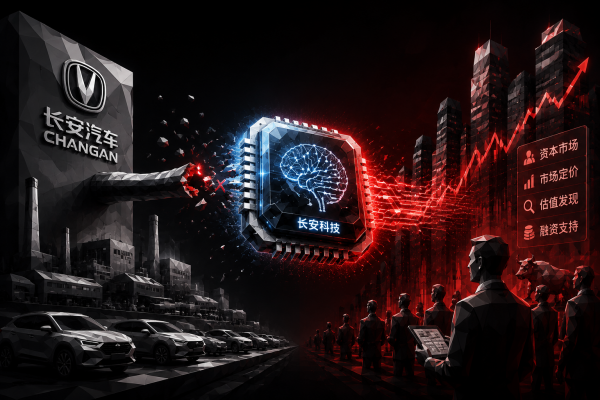
This marks a pioneering moment in China's automotive sector: a central state-owned enterprise has transitioned its core intelligent subsidiary from internal resource allocation to market-driven valuation.
On July 31, 2026, Changan Automobile issued a succinct announcement: it was scrapping a RMB 3 billion capital increase and share expansion plan for its wholly-owned subsidiary, Chongqing Changan Technology Co., Ltd. The reason cited was "intelligent innovation exceeding expectations and the need to expedite market-oriented financing."
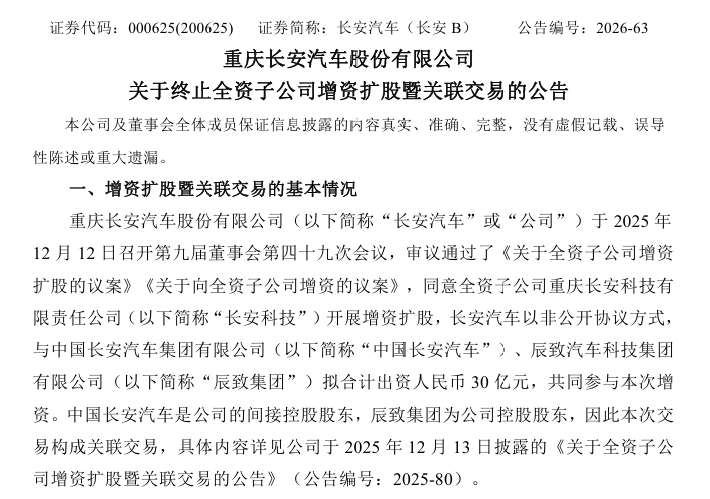
The capital increase was first announced in December 2025 but was shelved after seven months of inactivity. The announcement also mentioned that original investors would participate in a new round of market-oriented financing, though specifics like the amount, valuation, and investor list remained undisclosed.
The decision to abandon an approved capital increase plan in favor of an undervalued market-oriented approach reflects both the transformation of Changan Technology over the past year and broader strategic shifts within the company.
Assessment Reports Can't Keep Pace with Changan Technology's Evolution
To understand why the capital increase was halted, it's crucial to grasp Changan Technology's role within Changan Automobile and the issues the capital increase aimed to resolve.
Established in December 2022, Changan Technology is a wholly-owned subsidiary of Changan Automobile, with an initial registered capital of RMB 90 million. Its mission is clear and focused: to serve as the cornerstone of Changan Automobile's intelligent transformation, undertaking R&D for three key product lines—intelligent cockpit, intelligent driving, and intelligent vehicle control—compatible with both traditional fuel-powered and new energy powertrains.
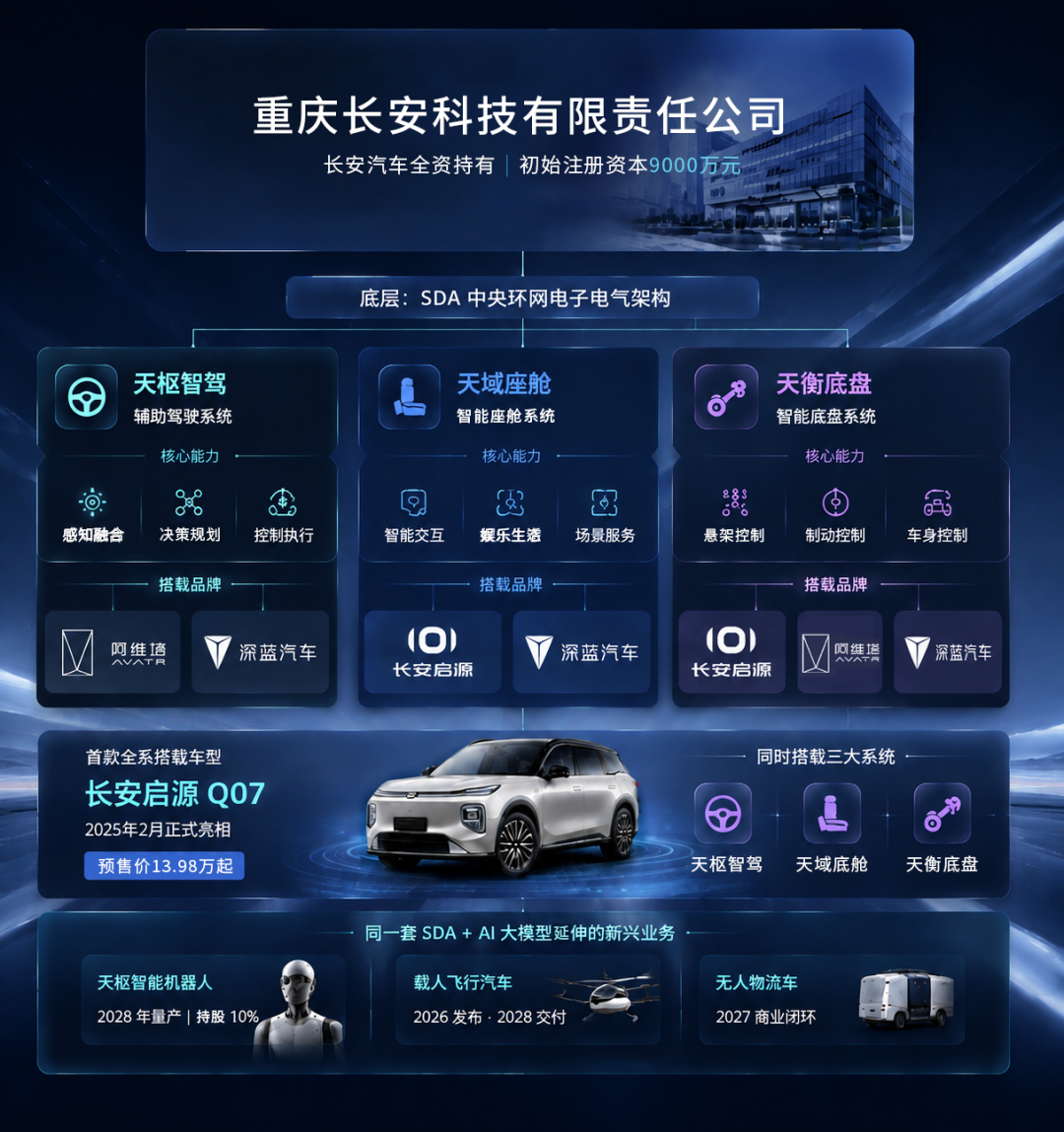
Within this framework, Changan Technology acts as an R&D hub, providing technical solutions for Changan's Avatr, Deepal, and Qiyuan brands. Its core technological architectures include Tianshu Intelligent Driving, Tianyu Cockpit, Tianheng Chassis, and the underlying SDA Central Ring Network Electronic and Electrical Architecture. Tianshu Intelligent Driving handles assisted driving functions, Tianyu Cockpit manages in-car interaction and entertainment systems, and Tianheng Chassis oversees suspension, braking, and vehicle dynamics control. In February 2025, the Qiyuan Q07 debuted as the first mass-produced model equipped with all three systems, with a pre-sale price starting at RMB 139,800. Changan Technology generates revenue through internal settlements for providing technical solutions to Changan's brands. In 2024, it reported RMB 938 million in revenue and RMB 6.38 million in net profit. In the first half of 2025, revenue reached RMB 623 million, with a net loss of RMB 4.12 million.
On June 30, 2025, an assessment agency issued a report on Changan Technology in this state: the book value of shareholder equity was approximately RMB 1.7 billion, with an income approach valuation of RMB 6.4 billion, representing a 276% appreciation rate.
Based on this assessment, Changan Automobile disclosed the capital increase plan in December 2025: in addition to fully owning Changan Technology, it would invest RMB 600 million, holding 75% post-increase; its indirect controlling shareholder, China Changan Automobile Group, would invest RMB 2.1 billion, holding 22%; and its controlling shareholder, Chenzhi Group, would invest RMB 300 million, holding 3%. The total investment was RMB 3 billion, with all three parties being related entities, classifying the transaction as a related-party deal. After the capital increase, the registered capital would increase from RMB 90 million to RMB 1.3 billion, with a post-investment valuation of approximately RMB 9.4 billion.
According to the plan's design, this funding was essentially an internal blood transfusion within the group. The core assumption at this stage was that Changan Technology remained a "research and development department," making the group the sole reasonable funding source.
However, around the same time as the plan's disclosure, Changan Technology was undergoing rapid transformation.
Firstly, organizational integration. In the second half of 2025, Changan Automobile merged four intelligent R&D entities within its system—the Intelligent Research Institute, Software Company, Wutong Technology, and Changxian Intelligence—into Changan Technology, all under the unified management of Vice President He Gang. Before integration, significant redundant R&D efforts existed among these entities and Changan Technology: the Intelligent Research Institute, Wutong Technology, and Changan Technology were all developing intelligent cockpits, while Changxian Intelligence and Changan Technology were simultaneously working on intelligent driving. The intended innovation-promoting horse-racing mechanism resulted in resource dispersion and efficiency constraints. After integration, Changan Technology's team expanded from approximately 1,400 to over 5,000 people, with the entire Changan Group's intelligent R&D personnel exceeding 7,500. The talent structure also shifted from traditional mechanical vehicle manufacturing to software, algorithms, and AI computing power. According to Changan Group's plan, the team will expand to over 10,000 people in the next decade, with cumulative investments exceeding RMB 150 billion.
From 1,400 to 5,000 people, Changan Technology was no longer just a research and development center—it became the sole gateway for Changan Automobile's intelligent R&D system, with almost all technical resources and talent reserves related to intelligent driving and cockpits concentrated under this company.
Organizational integration reduced internal consumption and significantly accelerated the pace of technological achievements, with key milestones arriving in succession:
In December 2025, Changan Technology obtained the country's first batch of L3-level conditional autonomous driving access permits. This permit, jointly approved by four departments including the Ministry of Industry and Information Technology, granted road operation pilot qualifications—L3 means the vehicle can take over driving tasks under specific conditions, with the responsibility shifting partially from the driver to the automaker.
In March 2026, Changan Technology secured an L4-level full-scenario driverless testing license. The interval between L3 access and L4 testing license was less than four months. In the industry, most companies typically take over a year to transition from L3 to L4 qualifications—because L4 requires full-scenario operation without safety officers or preset routes, with verification standards for perception, decision-making, and redundancy safety far exceeding those of L3. Changan's ability to complete this transition in four months largely benefited from the centralized deployment of R&D resources after organizational integration.
In June 2026, at the Chongqing Auto Show, the self-developed assisted driving system "Tianshu Pilot" was officially launched. Tianshu Pilot comes in three gradient versions: Pro, Max, and Ultra. The Pro version comes standard with LiDAR, recognizing dark scenes 2 seconds faster than the human eye, equipped with the self-developed SDA Central Ring Network Architecture, and responding 150 milliseconds faster. The Max version is trained on over 20 million real driving data points, targeting urban commuting scenarios. The Ultra version incorporates a VLM visual language large model, supporting interactive driving assistance. These three versions cover the complete range of needs from basic safety to advanced interaction.
With the release of technological achievements, the production timeline became clear. The Changan Qiyuan Q06 is scheduled for launch in the second half of 2026, fully equipped with Tianshu Pilot. This marks the first large-scale production application of this self-developed system. According to the plan, L3 production for limited scenarios will be achieved in 2027, with partial L4 scenarios landing in 2028.
The combination of these three stages of change—completing organizational integration, obtaining market access, and locking in production models—fundamentally altered Changan Technology's financing foundation. The Changan Technology in the assessment report was an R&D entity with technological reserves but still distant from mass production: annual revenue of RMB 900 million, slight profits, and a small team. The Changan Technology in July 2026 is a technology company that has completed integration, verified its technologies, and has a clear production timeline.
From Changan Automobile's perspective, a structural gap emerged between the assessment report based on the mid-2025 state and the actual situation in the second half of 2026. Continuing with the original plan meant matching a company at a different stage with the pricing and shareholder structure from a year ago. From Changan Technology's and Changan Automobile's perspectives, the pricing assumptions of the old plan were no longer valid.
The original plan's funding structure faced similar dilemmas. All RMB 3 billion in funding came from related parties, with the listed company holding 75% post-increase—a setup corresponding to the logic of "group funding for a research and development department." A ready comparison is Deepal Automobile. On November 26, 2025, Deepal initiated its C-round financing on the Chongqing Property Exchange, announcing its completion on December 25, taking just one month from listing to closing, with a total of RMB 6.122 billion raised, introducing two new shareholders: Yufu Group (investing RMB 2.5 billion) and CMB Investment (investing RMB 500 million). This represents a combination of industrial and financial capital, with Yufu Group being a municipal-level state-owned industrial capital operation platform in Chongqing—its involvement itself sending a signal. Changan Automobile President Zhao Fei once remarked when responding to progress on Deepal and Changan Technology's financing: "Financing isn't about lacking money; it's about making sub-brands more competitive. We must be adept at leveraging capital's power and not rely solely on our own hard work."
However, Changan Technology's previous capital increase plan did not introduce any external investors. China Changan Automobile Group and Chenzhi Group—the two parties investing RMB 2.1 billion and RMB 300 million, respectively—are Changan Automobile's indirect controlling shareholder and controlling shareholder. The fund flow remained entirely within the same consolidated financial statements, without bringing any new industrial resources or market credit endorsements to Changan Technology.
This was no longer an issue of whether the investors had the money but rather that the model itself no longer matched the company's development stage.
Converging Paths
While suspending the capital increase, Changan Technology shifted towards market-oriented financing, moving from internal blood transfusion to market-based pricing. This step's root cause lies in changes in Changan's intelligent technology route selection.
Over the past two years, Changan has made various attempts in intelligent technologies, each with its positioning and costs.
The first path was external procurement. The Avatr brand fully adopts Huawei's ADS intelligent driving solution. Huawei's solution is mature, with strong brand appeal and clear user recognition. Avatr's sales of 123,000 units in 2025 largely relied on the label of "buying Avatr means buying Huawei." To prioritize this path, Changan invested RMB 11.5 billion to acquire a 10% stake in Huawei's independent intelligent automotive business platform, Yinwang, becoming its largest external shareholder. The core of this deal was exchanging equity for priority supply rights, ensuring Avatr could always access Huawei's latest intelligent driving systems.
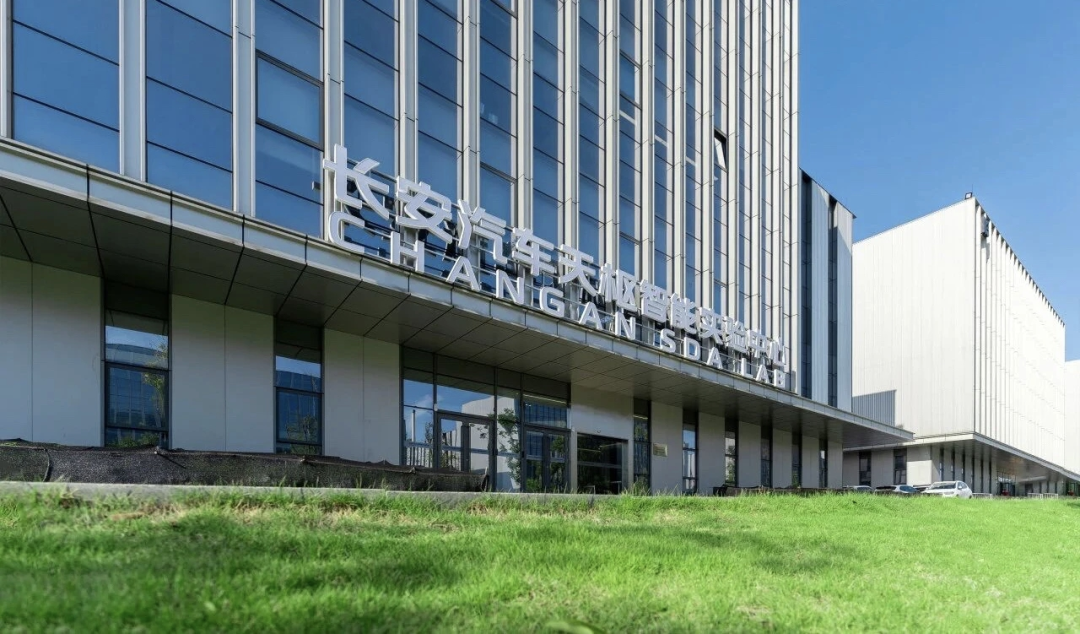
The second path was self-development, undertaken by Changan Technology, outputting Tianshu Pilot for the two main brands, Qiyuan and Deepal. This path requires the largest investment, the longest cycle, and the highest risk but offers unparalleled cost advantages and strategic autonomy once successful.
Besides these two paths, the market had previously speculated about Changan's contact with Qianli Technology, an independent intelligent driving supplier strategically invested in by Geely, holding about a 30% stake. Qianli Technology aims to replicate Huawei Yinwang's model—independent from the Geely system and supplying the entire industry. Changan was rumored to have intentions to invest but later denied it.
The logic behind pursuing multiple paths was to diversify risks. Huawei's solution secured current product competitiveness, while self-development ensured long-term technological autonomy—a rational layout in the early stages when technology routes were unclear.
However, once one path proved successful, the costs of maintaining multiple choices needed reevaluation.
In May 2026, when Changan Automobile officially denied investing in Qianli Technology, it cited "Tianshu's self-developed technologies reaching maturity, making a switch impossible" as the reason. This reasoning deserves closer examination—it's not just a technological judgment but also an economic one.
According to industry estimates, self-developed intelligent driving solutions can save over RMB 20,000 per vehicle compared to external procurement. What does RMB 20,000 per vehicle mean? Changan's self-owned brands sold 2.4682 million units in 2025. If the self-developed solution covers the main models, the annual cost savings would be in the tens of billions. Compared to Changan's 2025 net profit attributable to shareholders of RMB 4.075 billion, the significance of this figure is evident.
At another level, accelerating intelligent self-development plays a crucial role in supporting Changan Automobile's current operating conditions.
On August 5, Changan Automobile disclosed its production and sales figures for July. Sales for the month reached 161,600 units, marking a 23.29% decrease compared to the same period last year. Cumulative sales for the first seven months stood at 1.2805 million units, down 18.23% year-on-year. Within these figures, sales of the company's self-owned brands in July amounted to 132,700 units, a 25.29% decline year-on-year, with a cumulative drop of 20.63% over the first seven months. New energy vehicle sales for July were 74,800 units, experiencing a 6.53% decrease year-on-year, and a cumulative decline of 8.04% in the first seven months.
The only sector that managed to maintain growth was overseas sales. In July, overseas sales reached approximately 89,900 units, with cumulative sales for the first seven months exceeding 540,000 units. Nevertheless, the growth in overseas markets has not been sufficient to offset the declines in the domestic market. Domestic sales of self-owned brands decreased by around 270,000 units in the first seven months, while overseas sales increased by about 150,000 units, resulting in a widening net gap.
One often-overlooked fact is that Changan Automobile's shift towards new energy vehicles has placed significant pressure on its traditional fuel vehicle business. A prime example is Changan Ford. Changan Ford was once Changan Automobile's most vital profit contributor. In 2016, it reached its peak with annual sales of 957,000 units and a net profit of RMB 18.165 billion, contributing over RMB 9 billion to Changan Automobile's profits. That year, Changan Automobile's net profit attributable to shareholders was RMB 10.285 billion, with Changan Ford alone accounting for nearly 90% of this figure. For years, dividends from the joint venture remained the cornerstone of Changan's profit statements.
However, with the rapid rise in popularity of new energy vehicles, sales of Changan Ford's fuel vehicle models have plummeted. In 2024, Changan Ford barely managed to turn a profit through export-driven growth and cost reductions, with revenue at RMB 48.33 billion and a net profit of RMB 2.09 billion. By 2025, wholesale sales fell to 121,500 units, and retail sales dropped to only 99,400 units, falling below the industry's widely recognized "survival line" of 100,000 units for the first time. Meanwhile, the Mustang Mach-E, the sole pure electric model under Changan Ford New Energy Technology Company, sold just 35 units in 2025.
When we look at the longer-term picture, the downward trend in profits becomes even more apparent. In 2023, Changan Automobile reported a net profit attributable to shareholders of RMB 11.327 billion. This figure dropped to RMB 7.321 billion in 2024, a 35% decline. In 2025, it further decreased to RMB 4.075 billion, representing a 44.34% year-on-year decrease. Non-recurring net profits for these two years were RMB 2.857 billion and RMB 2.795 billion, respectively, showing virtually no growth. Revenue in 2025 reached RMB 164 billion, up just 2.67% year-on-year, while net profit reverted to levels seen before 2022—a year when Changan relied on non-recurring gains, such as the disposal of long-term equity investments, to boost profits to RMB 7.799 billion.
As profits declined, cash outflows accelerated. In 2024, net cash from operating activities was RMB 4.849 billion. This dropped to RMB 1.836 billion in 2025, a 62.15% year-on-year decrease. In the first quarter of 2026, it turned negative, with a net cash outflow of RMB 11.647 billion from operating activities, a 232.71% year-on-year decline.
Meanwhile, expenses continued to rise. In 2025, full-year R&D expenses reached RMB 7.158 billion. Including capitalized expenditures, Changan disclosed total R&D investment of RMB 12.6 billion, accounting for 7.67% of revenue. Selling expenses amounted to RMB 9.993 billion. Both expenses continued to grow in the first quarter of 2026—R&D expenses rose 24% year-on-year, and selling expenses increased by 33%—while revenue declined by 4.26% over the same period.
With revenue under pressure and expenses on the rise, financing naturally became a top priority for Changan Automobile. In late July, Changan issued 560 million shares to its controlling shareholder, China Changan Automobile Group, raising RMB 5.267 billion through a private placement. The Shenzhen Stock Exchange approved the offering on July 22.
Under these financial conditions, whether in-house intelligent driving solutions are "better" than outsourced alternatives has become a secondary concern. A more pressing issue is how Changan will justify the new accounting entries to the market if it converts annual procurement costs in the tens of billions into internal settlements.
Under the pressure of demand and financial constraints, Changan's roadmap for intelligent transformation continues to narrow, with planned milestones emerging. According to reports, internal meetings at Changan have designated "vigorously advancing Tianshu Pilot" and "resolutely securing the top spot in intelligent driving" as core priorities for the second half of the year.
Beyond Vehicles
In 2025, Changan Automobile underwent the largest institutional restructuring since its founding. It was transferred from China South Industries Group Corporation to the newly established China Changan Automobile Group, becoming a first-tier central state-owned enterprise on par with FAW Group and Dongfeng Motor Corporation. Chairman Zhu Huarong described the company’s new positioning as a "smart, low-carbon mobility technology company"—no longer a traditional automaker but a mobility technology platform built on intelligence and new energy.
Under this new positioning, Changan’s business boundaries are expanding rapidly.
In September 2025, at the Tech Ecosystem Conference, Zhu Huarong unveiled two new business lines beyond automobiles for the first time. Firstly, humanoid robots: Mass production of humanoid automotive robots is set to begin in 2028, with expansion into household service robots after 2030. Secondly, flying cars: The first manned flying car product will be launched in 2026, with mass production and delivery in 2028. Ten operational centers will be established nationwide, and by 2035, a low-altitude industrial ecosystem will be constructed, creating a trillion-yuan industrial cluster.
The timeline quickly took shape. In April 2026, Tianshu Intelligent Robotics completed its industrial and commercial registration in Chongqing, with a registered capital of RMB 450 million and Changan Technology holding a 10% stake. The concurrent plan also includes autonomous logistics vehicles, aiming to achieve full-stack self-research and commercial closure by 2027. From vehicles on the road to flying aircraft and then to autonomous robots and logistics vehicles, Changan has packaged this entire vision under the concept of the "SDA Super Digital Architecture," describing it externally as "integrated land, sea, and air mobility."
The technological connections between these businesses are evident. Battery technology, electric drivetrains, intelligent cockpits, and autonomous driving are core automotive technologies that also serve as foundational technologies for robots and flying cars. Flying cars require high-energy-density batteries and lightweight electric drivetrains, robots demand autonomous perception and motion control, and autonomous vehicles need path planning and environmental understanding. From a technology stack perspective, the reuse rate is indeed high. Changan Automobile Chairman Zhu Huarong stated, "The same set of self-developed large models and AI computing capabilities can be extended to more intelligent terminals."
However, governance and capital considerations extend beyond technological logic.
A traditional automaker selling 2.9 million vehicles annually is simultaneously advancing self-developed intelligent driving, humanoid robots, flying cars, and autonomous logistics—each an emerging industry with high investment, long cycles, and high uncertainty. Humanoid robots will not enter mass production until 2028, flying cars will not be delivered until the same year, and scale production of L3 autonomous driving will not occur until 2027. In the foreseeable short term, Changan Group faces massive capital expenditures.
Therefore, under multiple pressures, pushing core technology subsidiaries to the market represents the most practical financing solution at present.
Tan Benhong, Deputy Secretary of the Party Committee at Changan Automobile, acknowledged to the public that Changan’s current investments in intelligent driving "indeed face weak public perception and a low short-term return on investment." This statement reflects a deeper contradiction: A central state-owned enterprise must continually balance long-term technological investments with quarterly performance reports. However, he also said, "This is an inevitable process of technological transformation. Changan’s strategic layout extends beyond automotive intelligent driving itself. It relies on self-developed large models and AI computing power to explore future ecosystems and will later extend this AI capability to more intelligent terminals, such as intelligent robots."
The direction itself holds significance. A central state-owned enterprise pricing its intelligent core subsidiaries through market mechanisms has no precedent in China’s automotive industry. Whether this step succeeds depends on whether the market and industry are willing to assign it a value.
-
![]()
[Attendee Guide] The WAIE (10th) 2026 AI Industry Conference & AI Agent Industry Application Conference Kicks Off on October 23! (Including Conference Schedule + Transportation Guide)
-
![]()
Achieving 100% Year-on-Year Growth! Domestic Ultra-Precision Optical Equipment Emerges as a 'Dark Horse' with Thousand-Unit Shipments
-
Q3 Report | Inspur Information’s Net Profit Soars 176%, Fueled by Robust Server Demand
-
Chinese Automakers Shine Bright at the Paris Auto Show
-
![]()
Changan Technology Strikes Out on Its Own, Leaving Parent Company Behind
-
![]()
US/China: The All-Out War for AI Gateways
-
![]()
Leqi’s Second-Gen AI Glasses: The Path to Blending In—Four Optical Hurdles to Tackle!
-
![]()
GAC Toyota’s September Vehicle Registrations Reach 49,000 Units, with Camry Registering 6,898 Fewer Units Than Wholesale Volume