The Most Aggressive Investor, Mediocre Returns: Has Amazon Become a Worker for Nvidia?
 11/02 2026
 521
Amazon released its Q3 financial report in the early morning of the 30th, Beijing time. Dolphin's overall read is neutral to slightly negative: all three items the market cares most about fell short of expectations—AWS growth was below buy-side expectations; bullish funds wanted growth above 43% and margin above 40%, and neither was achieved.
In addition, after excluding the impact of Prime Day, advertising still slowed markedly; capital expenditure significantly exceeded expectations, pushing free cash flow deeply negative; and management said capital expenditure in 2027 will be significantly higher than this year. Only profit, as usual, greatly exceeded the upper end of guidance, and was the sole bright spot that saved the day.
1. Overall Performance: Revenue Met Expectations, Profit Greatly Exceeded the Upper End of Guidance
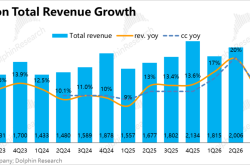
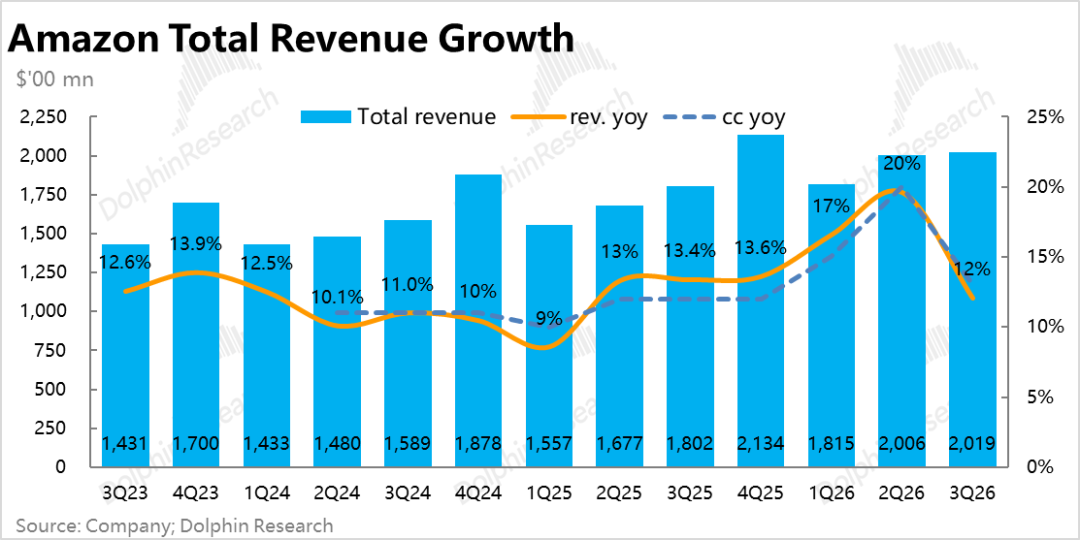
Total revenue this quarter was $201.9 billion, up 12.1% year over year (up 13% excluding FX), basically in line with the Bloomberg consensus. In terms of trend, growth slowed markedly from 19.6% last quarter, mainly because Prime Day was moved to Q2, dragging down this quarter's growth by about 4 percentage points, with FX dragging down another about 0.5 percentage points.
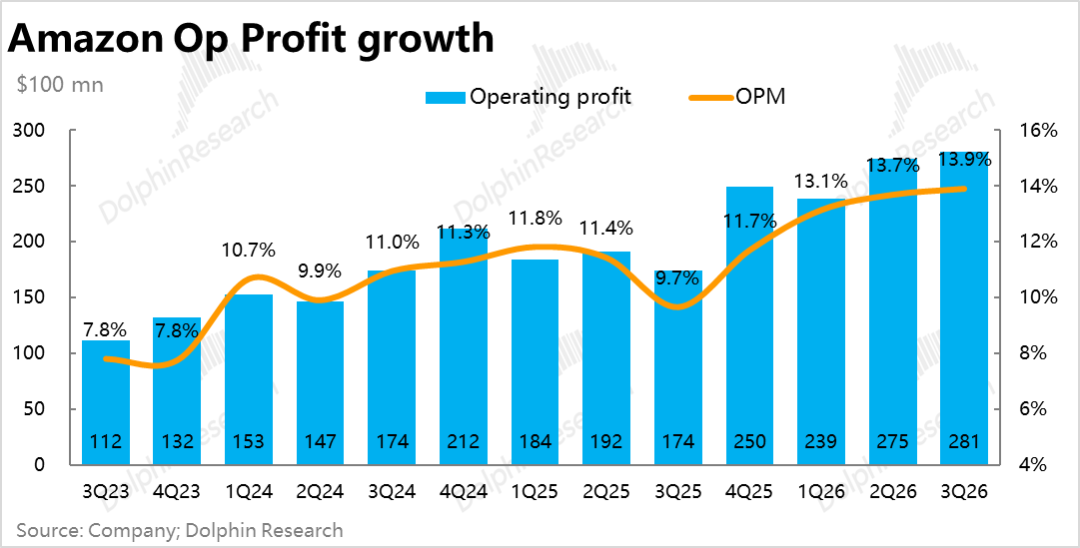
Operating profit was $28.1 billion, up 61% year over year (the year-ago period included one-off costs such as the FTC settlement, making the base low), about 8% above consensus, and as usual above the previous upper end of guidance; operating margin was 13.9%, a record high, up another 0.2 percentage points quarter over quarter.
2. AWS: Continued to Accelerate, but Did Not Reach the Buy-Side "Pass Mark" of About 43%
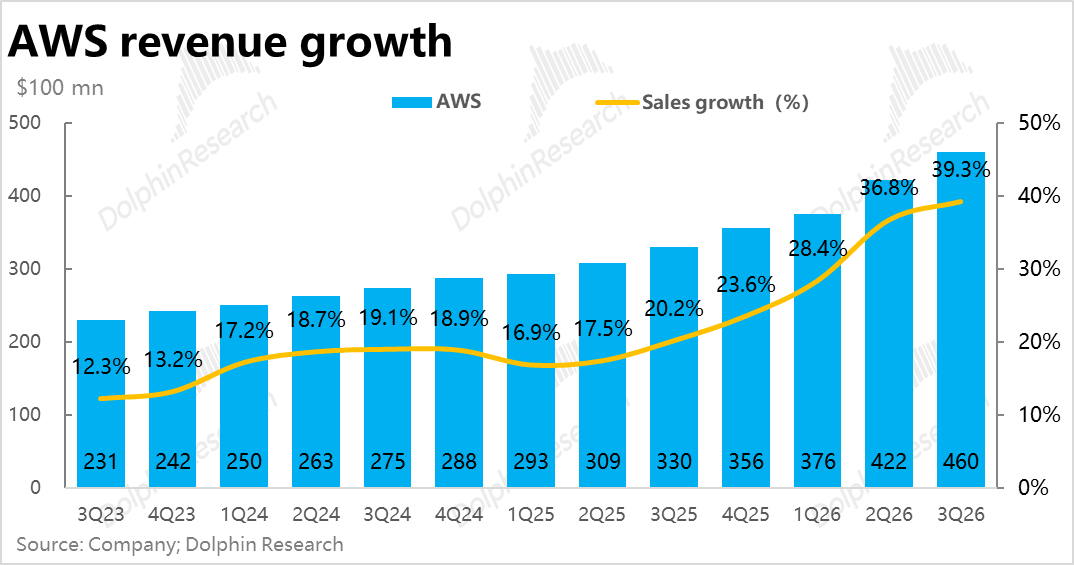
AWS revenue was $46 billion, up 39.3% year over year, accelerating about 2.5 percentage points from last quarter, but the general buy-side expectation was around 43% (range 42%-44%), so the actual result was about 3-4 percentage points short; moreover, sequential net new revenue was $3.75 billion, less than $4.65 billion in Q2, meaning the increment actually contracted. Management's explanation for this only said that capacity coming online was uneven across quarters.
Fortunately, management said AWS revenue growth in both 2027 and 2028 will be above 40%, in line with major banks' expectations for 2027, but far above the roughly 35% expected for 2028 before the results.
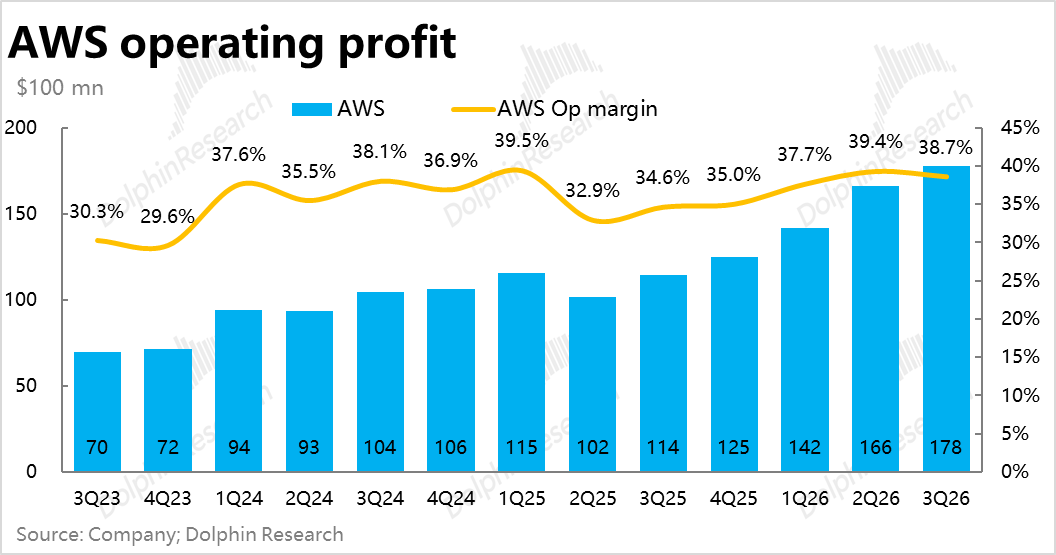
Segment operating profit was $17.8 billion, about 12% above consensus; margin was 38.7%, down 0.7 percentage points quarter over quarter, also short of the buy-side psychological level of about 40%. However, last quarter's margin was abnormally high, including about $600 million of one-time gains from energy contracts; excluding that, it was about 38.1%, so this quarter's margin actually improved quarter over quarter. That also counts as growth showing weakness but profit saving the day.
The earnings call disclosed backlog of $578 billion at the end of this quarter, up $82 billion quarter over quarter and up triple digits year over year, with management saying customers are diversified. For three consecutive quarters, AWS has added about $100 billion of net new orders, and backlog is now 3.1x AWS's annualized revenue, so the medium- to long-term growth outlook is still secured.
3. Advertising: Still Slowed Markedly After Adding Back Prime Day
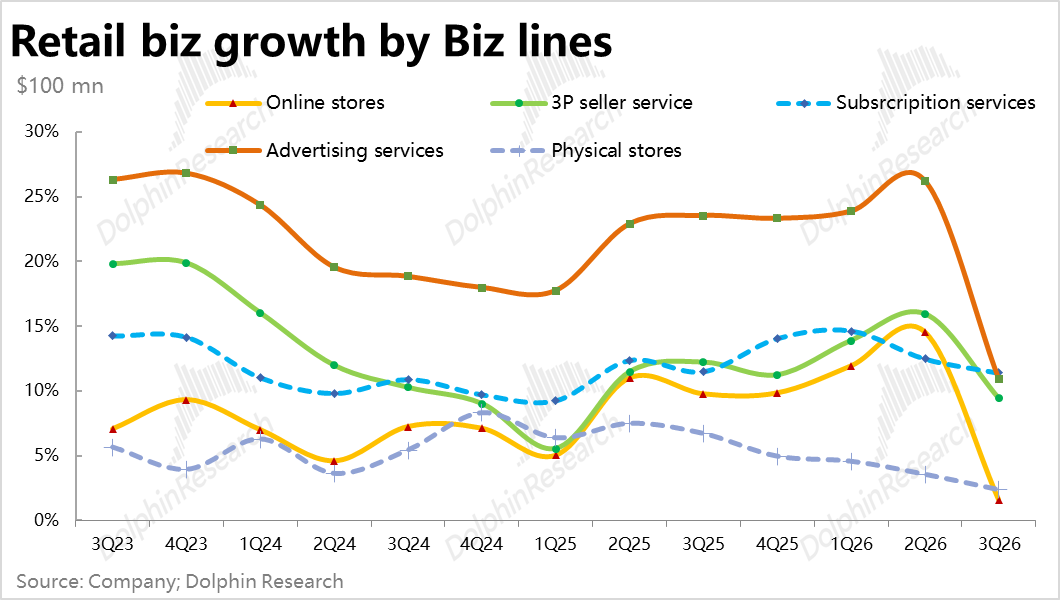
The biggest growth driver in the retail segment—advertising revenue—was $19.6 billion, up 10.9% year over year (up 12% excluding FX), about 6% below consensus, and growth fell sharply from last quarter. Management explained the reasons: Prime Day was moved to Q2, causing about an 8.5 percentage point quarter-over-quarter drag; Q2 had the NBA's first season games, while Q3 did not.
Although the company guided Q4 advertising growth to rebound to the "high teens," that is still below the 20%+ level of many previous quarters.
Based on channel checks, advertising growth has continued to slow for two reasons. First, the total costs borne by merchants are near their upper limit (commissions, fulfillment, advertising), and growth in on-site search advertising is already limited, so it needs to be driven by advertising on non-transactional channels such as video and Twitch. Second, although the impact of AI assistants should be limited, they are also pulling traffic from transactional platforms toward AI.
Among other retail businesses, online retail revenue was $68.5 billion, up 1.6% year over year, also slowing markedly and missing expectations; while growth in third-party seller services and subscription services was relatively stable and better than market expectations.
Why did subscriptions and 3P services not weaken? Dolphin believes subscriptions recognize revenue on a monthly basis and are less affected by factors such as the timing shift of Prime Day, while the 3P business recently added fuel and logistics surcharges as a cushion, offsetting the impact by raising monetization rates (showing that the burden on merchants is indeed increasing).
4. Retail by Region: North America Margin Beat Expectations, International Was a Drag
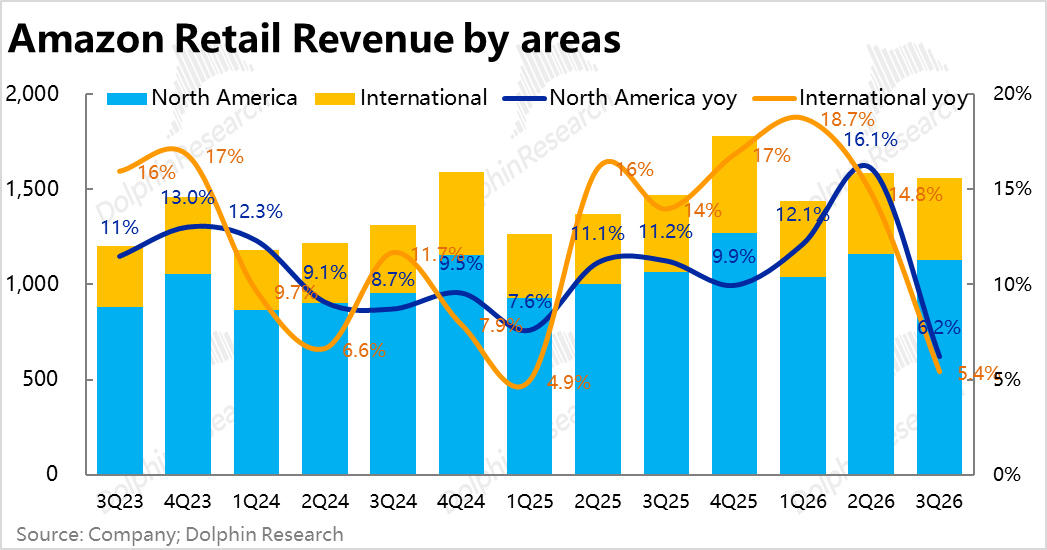
By region, North America retail revenue was $112.9 billion, up 6.2% year over year, in line with consensus; international retail revenue was $43.1 billion, up 5.4% year over year (up 8% excluding FX), slightly below expectations on a nominal basis.
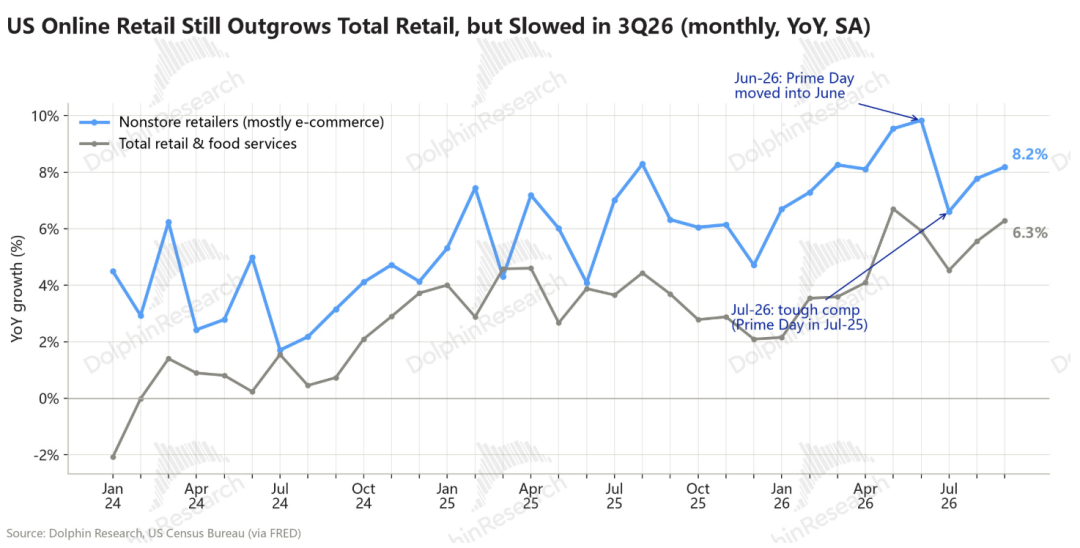
Compared with the overall industry performance, data published by the U.S. Census Bureau (seasonally adjusted) showed Q3 non-store retail sales up 7.5% year over year, down from 9.2% in Q2, with Q2 and Q3 combined up 8.3%. Amazon's North America segment combined revenue growth in Q2 and Q3 was about 11% year over year, about 3 percentage points higher than non-store retail, still gaining share.
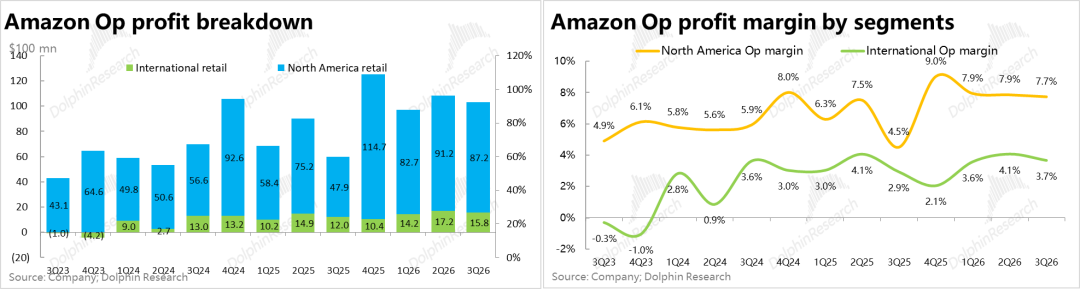
On profit, North America operating profit was $8.72 billion, with a margin of 7.7%, about 1.1 percentage points above consensus; although the margin also appears to have declined quarter over quarter, last quarter had a one-time tax refund benefit, and excluding that, this quarter's margin still improved quarter over quarter. International operating profit was $1.58 billion, with a margin of 3.7%, below the 4.5% consensus, though FX was a drag of about $130 million.
5. Capital Expenditure Greatly Exceeded Expectations, 2027 Will Require Even More, Cash Flow Deeply Underwater
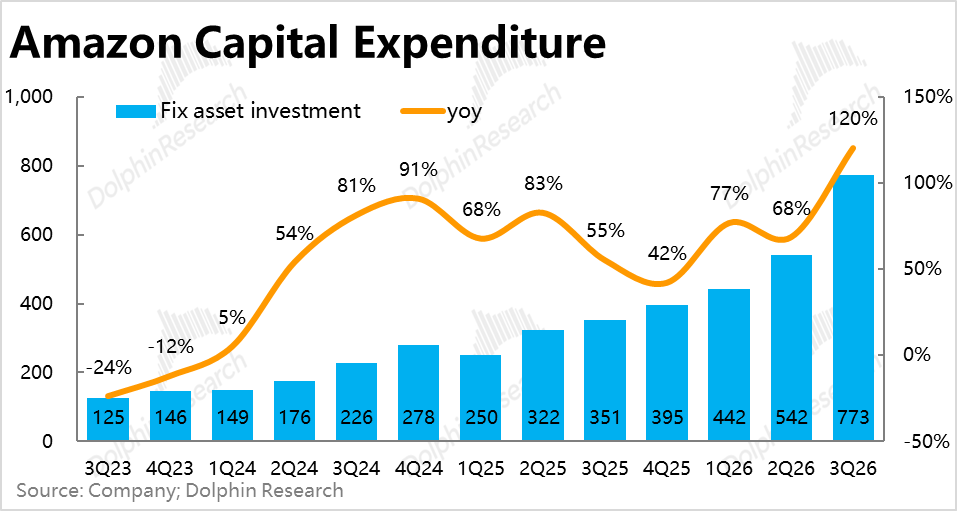
Cash capital expenditure this quarter was $77.3 billion, 31% above consensus and up another 43% quarter over quarter from Q2, greatly exceeding expectations. Management did not directly explain the reason for the increase, only saying that the pace of investment follows demand visibility. We believe rising prices for hardware such as storage and the payment pace may be the reasons.
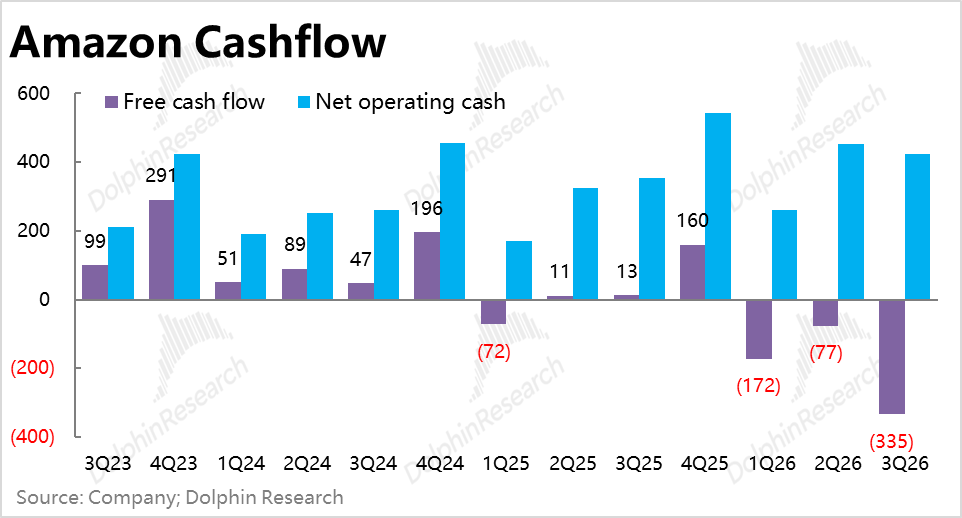
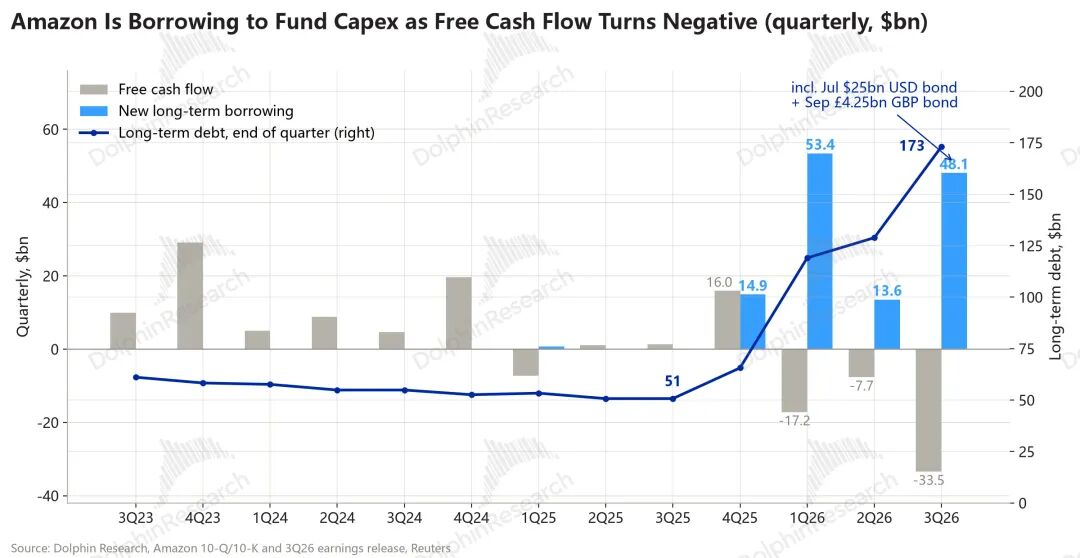
Operating cash flow was $42.4 billion, up 19% year over year, but free cash flow was -$33.5 billion, deeply underwater and far below expectations. With AWS growth this quarter not particularly surprising, clearly deteriorating cash flow will undoubtedly make the market question ROI and worry about the damage financing could do to the balance sheet or shareholders' equity. In fact, Amazon has already begun frequent financing, adding about $48.1 billion of long-term debt this quarter.
According to full-year guidance, Q4 capital expenditure will be about $49 billion, markedly below the roughly $65 billion consensus, and will fall back to a normal level, indicating that this quarter was indeed an anomaly. But at the same time, the company also said capital expenditure in 2027 will be "significantly higher" than in 2026 (buy-side expectations before the report were about $325 billion-$350 billion), implying greater cash flow and financing pressure ahead.
6. Gross Margin and Expenses: Gross Margin Better Than Expected, Technology and Infrastructure Expenses on the High Side
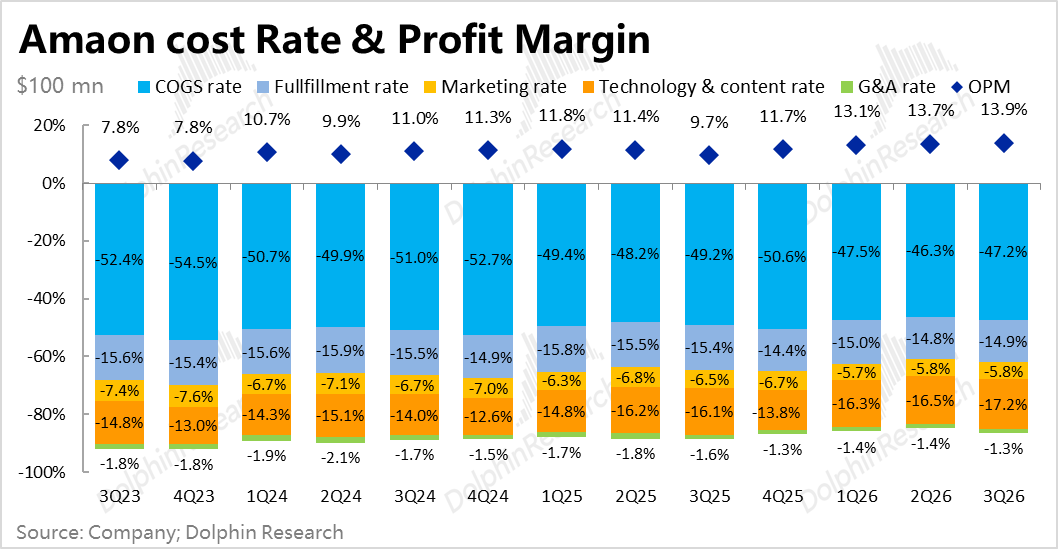
Gross margin was 53.2%, about 1.1 percentage points above consensus, as the revenue mix continued to tilt toward high-margin businesses such as AWS and third-party seller services, driving a structural upward trend in gross margin. On the expense side, technology and infrastructure expenses were $34.8 billion, about 3% above consensus, the only item that clearly overspent, also consistent with major companies' investment in AI R&D.
Other expenses were generally below expectations, with marketing expenses flat year over year and administrative expenses declining year over year, similar to Microsoft, as they are aggressively controlling or even cutting spending in non-AI technology areas.
7. Q4 Guidance: Revenue in Line with Expectations, Profit Upper End Slightly Above Consensus but Below Buy Side
Revenue guidance was $240-247 billion, up 12%-16% year over year, with the midpoint about 0.4% below consensus, basically in line, with FX expected to be a drag of about 0.6 percentage points; but the upper end only matched the lower bound of buy-side expectations (about $247-248 billion).
Operating profit guidance was $28.5-33.5 billion; as usual, looking only at the upper end, it was slightly above consensus but below the buy side's expectation of about $34-35 billion; implied operating margin is about 13.6%, up about 1.9 percentage points year over year.
Working backward, retail growth still looks slightly low: assuming AWS Q4 growth is 40%, retail revenue would grow about 7%-11% year over year, with a midpoint of about 9%, below the overall 11%-12% level in the first three quarters; only reaching the upper end of guidance would be flat.
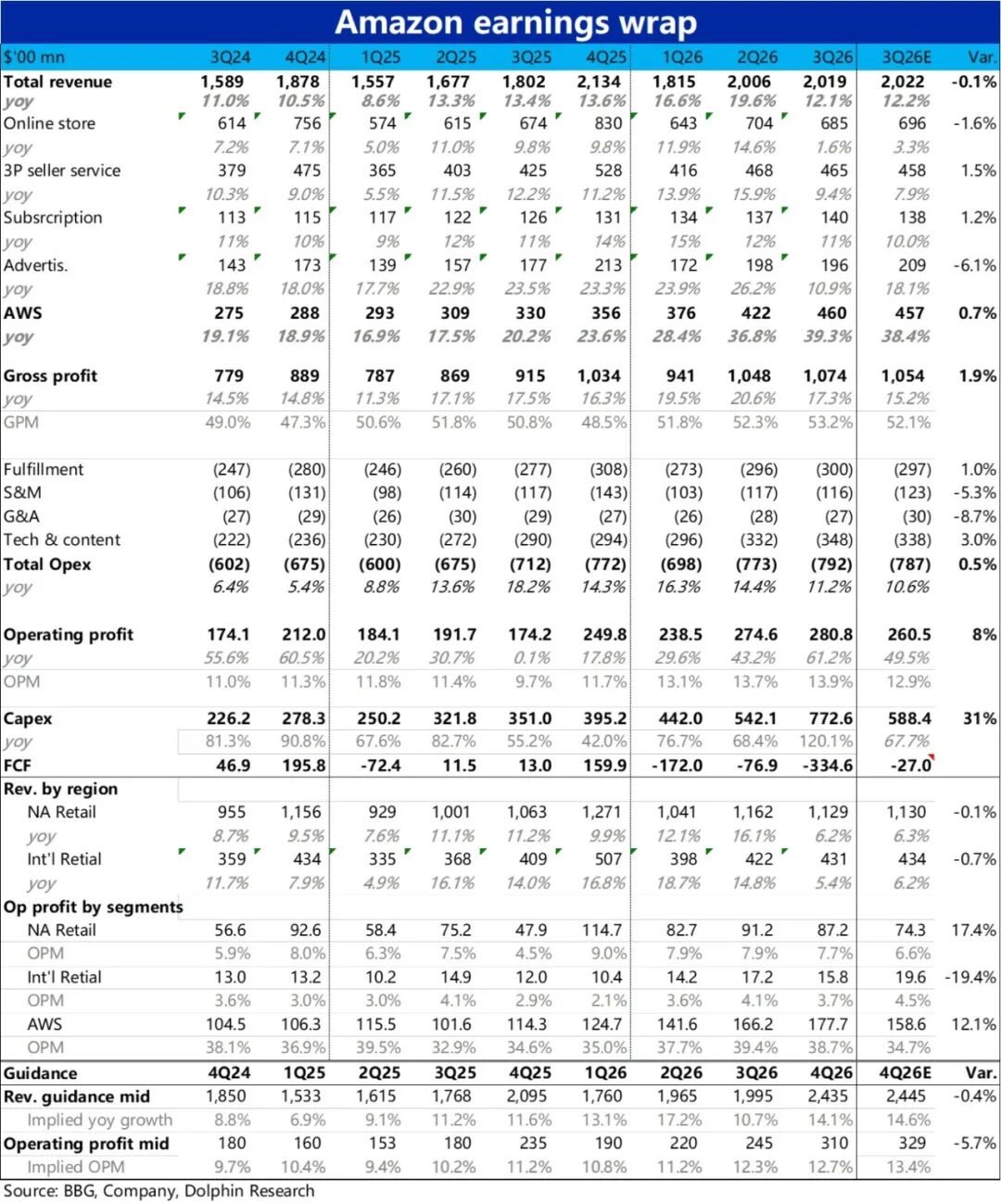
8. Below Is an Overview of Core Metrics
Dolphin Research View:
Overall, the signals from this earnings report are clearly more negative. The three things the market cares most about all fell short of expectations: AWS growth did not cross the line, and the sequential increment is still contracting; advertising, the biggest profit source in the retail business, slowed markedly; capital expenditure greatly exceeded expectations, free cash flow was deeply negative, and more will be spent next year. The earnings call also did not eliminate these concerns, as management did not directly answer questions about the slowdown in incremental growth or the returns on capital expenditure.
Although next quarter's guidance is in line with Bloomberg consensus and not bad, it also did not meet optimistic buy-side expectations.
Besides the performance itself, Dolphin also focuses on the following issues:
1) AWS: No Recent Beat, but Medium- to Long-Term Visibility Remains High
In the near term, AWS performance indeed did not beat expectations: growth did not cross the buy-side line, the sequential increment is still contracting, and management only brushed it off with "uneven capacity coming online." Management said a large amount of capacity will come online over the next 8-10 quarters, and growth will likely fluctuate with the production pace, making it hard to deliver sustained positive surprises in the short term.
Medium- to long-term visibility is quite high: backlog has reached more than 3x AWS's annualized revenue, large chunks of capacity have been booked beyond 2027, and management reiterated that growth in both 2027 and 2028 will be above 40%, markedly higher than major banks' previous expectations for 2028.
The bulk of orders comes from two large deals, OpenAI and Anthropic (about half), so concentration is high, but it also means demand is underpinned by contracts; the proprietary chip business grew triple digits year over year, and Trainium will also be sold externally by the end of 2027, an additional growth option.
Dolphin believes AWS's problem is not demand, but the supply pace and overly high market expectations: short-term growth is unlikely to surprise, but as long as capacity comes online as scheduled, medium- to long-term growth of around 40% is supported by orders.
2) Compute Pricing Power: Bedrock and Price Increases Are the Same Logic
First, on distribution, according to Anthropic's IPO materials, about half of its revenue in the first half was realized through cloud vendors' channels, showing that cloud vendors' channel distribution capabilities are also crucial for leading AI labs.
Second, on pricing, according to news reports, AWS's reserved GPU compute capacity raised prices for four consecutive quarters this year, by a cumulative 50%-70%, also indicating that cloud pricing power is rising.
Dolphin Research believes this shows that cloud providers simultaneously hold scarce compute power and distribution channels, and their bargaining power across the entire industry chain is rising. Bedrock pushes AWS from selling compute to selling inference services, with most inference running on self-developed chips at margins notably higher than AWS overall—this is also why AWS's margin wasn't dragged down by AI when revenue accelerated.
3) Advertising: Monetization Rate Peaks, Low-to-Mid Teens May Be the New Normal
As noted earlier, on-site search advertising is capped by merchant costs. More tellingly, in Q3 the digital advertising sector as a whole outperformed expectations while Amazon decelerated—a sign that the issue is retail advertising's monetization rate nearing its ceiling, not the industry cycle. Over the medium to long term, AI shopping assistants (including Amazon's own Alexa) bypass search and display pages altogether, which naturally leaves fewer ad slots; the more successful the assistant, the more it siphons away from search advertising.
Dolphin Research believes advertising growth is converging toward GMV growth, and a slowdown from over 20% to the low-to-mid teens may become the new normal.
4) Capex and financing: More needed next year, returns not quantified
Management has said 2027 capex will be "significantly higher" but has not quantified the scale or the returns. In the current environment, capital clearly has little appetite for high capex and heavy cash flow pressure.
Since the start of the year, Amazon has completed multiple rounds of financing, currently mainly through bond issuance. New long-term borrowings in the first three quarters were approximately $53.4 billion, $13.6 billion, and $48.1 billion, respectively. Long-term debt at quarter-end stands at approximately $173.1 billion; according to Bloomberg statistics, Amazon is already one of the largest corporate bond issuers in the U.S. this year.
Based on buy-side expectations of approximately $325–350 billion in 2027 capex before earnings, against consensus operating cash flow of approximately $247 billion, Dolphin Research roughly estimates a 2027 free cash flow gap of approximately $80–100 billion—equivalent to 70–90% of quarter-end cash and marketable securities (approximately $114.2 billion); including subsequent funding for external investments, the gap would be even larger, making continued large-scale bond issuance next year almost inevitable.
Overall, the problem with this earnings report is that it is "not good enough short-term, spending too aggressively": neither AWS nor advertising delivered the upside buy-side wanted, while capex and financing are accelerating, and crowded long positions before earnings need time to digest.
But AWS's medium-to-long-term fundamentals have not deteriorated: a backlog of over 3x annualized revenue and clear capacity planning provide support, with 40%+ growth in 2027 and 2028 above prior major bank expectations. Retail remains relatively stable with initial signs of weakening: the most profitable advertising business is decelerating, which may weigh on further retail margin expansion.
Earnings forecast adjustments: This update uses Q3 actuals and Q4 guidance, with Q4 operating profit conventionally set slightly above the upper end of guidance (approximately $34.5 billion). The main adjustment is raising 2028 AWS growth from the pre-earnings major bank average of approximately 35% to approximately 41%, consistent with management's statement of "above 40% in both 2027 and 2028."
After adjustment, 2027 operating profit is approximately $154.2 billion, and 2028 approximately $209.5 billion.
Valuation approach: Continue the method of valuing retail and AWS separately, but switch to 2027 and lower multiples (25x retail and 40x AWS last quarter).
Retail is assigned a 20x PE on approximately 22% profit growth in 2027, corresponding to approximately $940 billion; AWS is assigned a 30x PE on approximately 44% profit growth in 2027, corresponding to approximately $2.4 trillion (both are after-tax operating profit, with a 17% tax rate).
Neutral valuation result: total of approximately $3.4 trillion, corresponding to approximately $312 per share. At the after-hours price of approximately $224, current market cap is approximately $2.4 trillion, about 28% below the neutral valuation; proportionally, this implies only approximately 14x 2027 after-tax operating profit for retail and approximately 22x for AWS.
From a longer perspective, Dolphin Research believes the original businesses of major cloud giants—software/SaaS, search/advertising, retail—will all be impacted by AI, with core businesses under pressure and AI and cloud used to hedge.
Among the three, we believe retail may face relatively less ultimate impact: it involves substantial physical-world fulfillment, and Amazon's self-built logistics network further raises barriers. The most impacted is advertising, the "discovery" link, which is why this quarter's advertising deceleration needs continued tracking.
Therefore, Dolphin Research believes the short-term stock price will remain suppressed by the capex and financing narrative, but among the three major cloud giants, Amazon's original businesses have relatively stronger resilience against AI disruption, combined with AWS's medium-to-long-term order visibility; after sentiment is digested, the risk-reward will gradually become more attractive.
- END -
// Reprint authorization
This article is original content by Dolphin Research. Authorization is required for reprinting.
// Disclaimer and general disclosure notice
This report is for general comprehensive data purposes only, intended for general reading and data reference by users of Dolphin Research and its affiliates, and does not consider the specific investment objectives, investment product preferences, risk tolerance, financial situation, and special needs of any person receiving this report. Investors must consult independent professional advisors before making investment decisions based on this report. Anyone making investment decisions based on the use or reference of content or information mentioned in this report must bear the risk themselves. Dolphin Research shall not be liable for any direct or indirect liability or loss arising from the use of data contained in this report. The information and data contained in this report are based on publicly available information and are for reference only; Dolphin Research strives for but does not guarantee the reliability, accuracy, and completeness of the relevant information and data.
The information mentioned or views expressed in this report shall not be regarded or deemed as an offer to sell securities or an invitation to buy or sell securities in any jurisdiction, nor do they constitute advice, inquiry, or recommendation regarding relevant securities or related financial instruments. The information, tools, and materials contained in this report are not intended or proposed to be distributed to citizens or residents of any jurisdiction where distribution, publication, provision, or use of such information, tools, and materials would conflict with applicable laws or regulations, or would cause Dolphin Research and/or its subsidiaries or affiliates to be subject to any registration or licensing requirements in that jurisdiction.
This report reflects only the personal views, opinions, and analytical methods of the relevant creators and does not represent the position of Dolphin Research and/or its affiliates.
This report is produced by Dolphin Research, and copyright belongs solely to Dolphin Research. No institution or individual may, without prior written consent from Dolphin Research, (i) produce, copy, reproduce, reprint, forward, or otherwise create any form of copies or reproductions in any manner, and/or (ii) directly or indirectly redistribute or transfer to other unauthorized persons. Dolphin Research reserves all related rights.
-
![]()
This "Silver October" New Energy Report Card Is Most Striking for Its "Zero, Xiao, Xiao" Polarization
-
![]()
AITO's First Real Test: Can the New M8 Carry Seres on Its Own?
-
![]()
Huawei Wins Audi A8 Deal — Why That Matters More Than Launching Another "Jie" Brand
-
![]()
The Most Aggressive Investor, Mediocre Returns: Has Amazon Become a Worker for Nvidia?
-
![]()
Explained: Anthropic's Prospectus — and What It Means for the Auto Industry and Us Workers
-
![]()
[Xauto Smart Driving Rankings] Xiaomi SU7 N70 HyperOS 1.18.3 Urban Evaluation Report
-
Why AI Short Dramas Have Exploded in Popularity
-
Japanese Big Four See Sales Drop in China in First 10 Months; Are Toyota and Honda Hybrids Still Worth Buying in the Cold North?