Analysis of AI Industry Development in Key Cities of the Yangtze River Delta
 11/09 2026
 377
Two of the most talked-about developments in China's AI sector recently have both played out in the Yangtze River Delta. The 2026 World Internet Conference Wuzhen Summit, held from November 2 to 5, put artificial intelligence front and center. Meanwhile, according to media reports, DeepSeek has closed a new financing round of roughly 100 billion yuan (pending official confirmation from the company), the largest single round ever recorded in China's AI industry.
So where exactly does the Yangtze River Delta's AI industry stand when viewed across the entire value chain? What are its strengths, and where does it fall short? Drawing on the desktop version of the Huoshi Xinglan Industrial Intelligence Agent, we scanned the national landscape as well as key cities in the region.
01 Industrial Chain Map
The artificial intelligence map in the Industrial Chain Map Center of the Huoshi Xinglan Industrial Intelligence Agent covers fourteen segments, 1,176 nodes, and 749 relationships.
The upstream comprises three segments—training data and data services, development frameworks and basic software, and machine learning methods and model technologies—totaling 426 nodes. The midstream spans five segments—general large models and model services, computer vision and visual intelligence products, intelligent speech and natural language processing, intelligent agents and generative AI applications, and AI terminals and intelligent interaction hardware—totaling 115 nodes. The downstream covers four segments—empowering manufacturing, empowering energy, transportation, and urban governance, empowering healthcare and scientific research, and empowering consumer finance and public services—totaling 514 nodes. The supporting layer consists of two segments—security governance and compliance, and standards testing and industrial ecosystem—totaling 121 nodes.
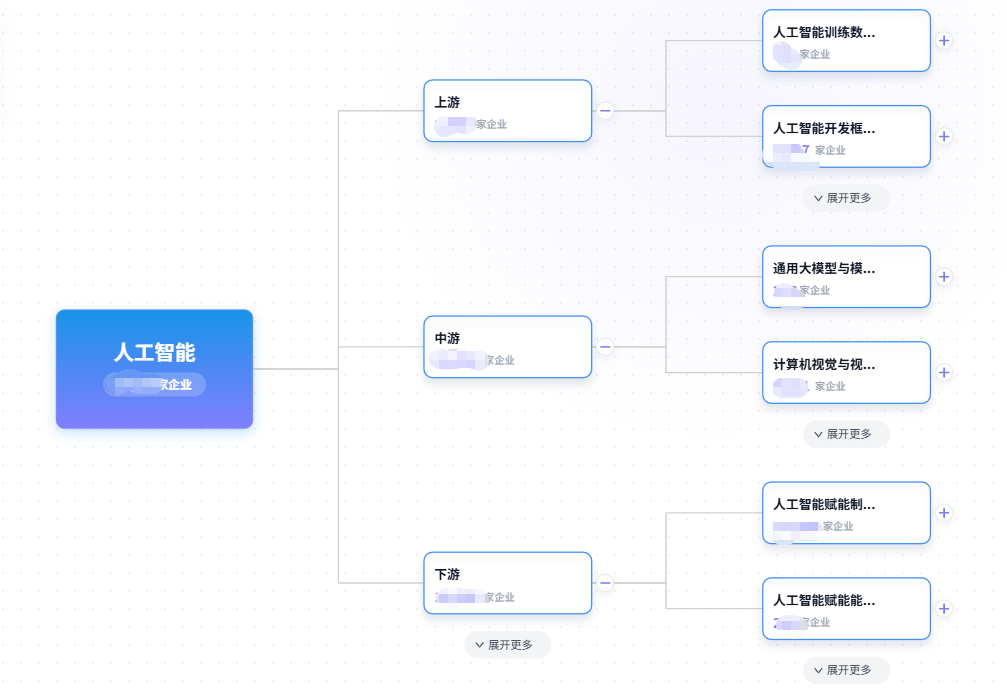 Figure: Artificial Intelligence Industry Chain Map Source: Huoshi Xinglan Industrial Intelligence Agent
Judging from the enterprise associations across the 14 segments, China's AI industry chain displays a pattern of "extremely broad applications, relatively narrow foundation." The "AI empowering manufacturing" segment alone has 17,600 associated enterprises, accounting for 49% of all associations across every segment. Midstream computer vision follows with nearly 10,000 enterprise-instances, whereas upstream "development frameworks and basic software" has fewer than 2,000, and "general large models and model services" only just over 300.
02 Overview of Artificial Intelligence Development in the Yangtze River Delta
The Yangtze River Delta's AI industry is currently one of the most complete and most densely populated in the country. By the enterprise-association caliber of the industrial chain map, Shanghai, Jiangsu, Zhejiang, and Anhui together account for 11,500 enterprises, roughly 33.2% of the national total.
Looking at enterprise associations across the 14 segments, the region's overall strengths cluster in the downstream application and scenario-service layer and in the intelligent-agent application layer. It is the country's largest supplier of AI scenario services and integration, with manufacturing-empowerment enterprises across the three provinces and one municipality making up 37.2% of the national total. That said, enterprise density in models and methodological foundations trails Beijing, terminal hardware trails Guangdong, and upstream development frameworks and basic software remain a shared gap.
At the city level, Shanghai, Hangzhou, Nanjing, Suzhou, and Hefei are the major hubs of the region's AI industry, with on-chain enterprises in these five cities together accounting for roughly 80% of the Yangtze River Delta total.
03 Industrial Development Situation of Key Cities
1. Top-level Planning
At the national level, the "Opinions on Deeply Implementing the Artificial Intelligence+ Action" serves as the master plan, setting phased goals for 2027, 2030, and 2035. All five cities have aligned their implementation documents with the "Artificial Intelligence+" framework and generally benchmark against national penetration-rate indicators, with Jiangsu and Nanjing respectively setting interim targets of 70% and 75% by 2027. What truly sets them apart, however, is the level of detail disclosed on funding and factor tools, and the substance of their implementation mechanisms.
Table: Key Points of Top-level Planning and Policy Tools for Artificial Intelligence in the Five Cities
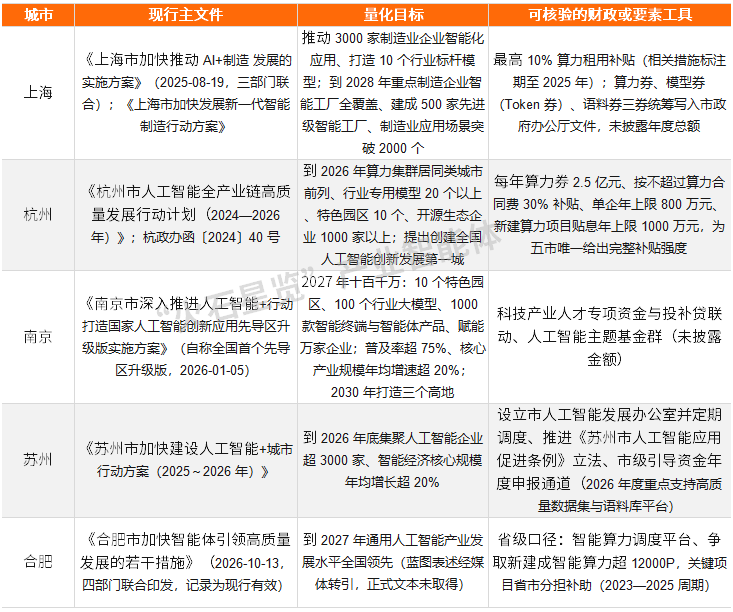
Source: Huoshi Xinglan Industrial Intelligence Agent
Shanghai's current policies take the form of a matrix of scenario-specific plans such as AI+Manufacturing and intelligent manufacturing. Suzhou stands out as a prefecture-level city with a relatively complete implementation mechanism—a development office, legislative progress, and normalized funding channels are all in place. Hefei has iterated its policies fastest, while Nanjing's policy timeline spans the longest period.
2. Enterprise Agglomeration
In terms of enterprise agglomeration, Shanghai leads by a wide margin, accounting for 45.8% of the Shanghai-Jiangsu-Zhejiang-Anhui total—nearly half. Hangzhou ranks second at approximately 13.8%. Measured by intra-provincial primacy, all cities show highly concentrated patterns: Hangzhou accounts for 62.5% of Zhejiang's enterprise count, Nanjing and Suzhou together for 64.1% of Jiangsu's, and Hefei for 64.4% of Anhui's. Taken together, Shanghai is the undisputed industrial highland of the Yangtze River Delta, while the other four cities are the core engines driving development in their respective provinces.
In terms of qualification density, Shanghai's high-tech enterprise density is roughly one-third that of Suzhou and Nanjing, and its absolute number of "little giants" is slightly below Hangzhou's. The immediate reason is dilution from including traditional manufacturing and service-sector entities in application nodes. Hefei's AI entities are mainly "small but hard" technology-based firms, ranking first among the five cities in both little-giant density and specialized and sophisticated enterprise density—though the absolute numbers remain too small. Hangzhou ranks at the forefront in both scale and qualification density; Suzhou has a relatively large number of small and medium-sized technology enterprises but a comparatively low density of little giants.
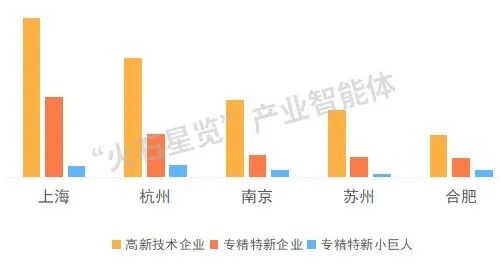 Figure: Distribution of Qualified Enterprises in Each City Source: Huoshi Xinglan Industrial Intelligence Agent
3. Industrial Structure
In terms of hierarchical structure, Shanghai's upstream and downstream enterprise counts both exceed those of other cities, but its absolute downstream number far outstrips the midstream and upstream, giving it the profile of an application highland. Hangzhou has the most balanced structure, with midstream and downstream roughly equal. Nanjing and Suzhou are midstream-dominated, with Nanjing posting the highest upstream share among the five cities. Hefei's downstream share is slightly higher than its midstream. Looking at enterprise associations across the 14 segments in each city, the top-ranked segments overlap: manufacturing empowerment ranks first in Shanghai and Hefei, while computer vision ranks first in Hangzhou, Nanjing, and Suzhou.
The five cities share a common weakness in the AI development frameworks and basic software segment. Drilling down to lower-level nodes—AI chips and intelligent computing power foundations—more than 60% of enterprises within Shanghai's segment fall under chips and computing power foundations, giving it one of the highest densities of chip and computing power enterprises in the country. Hangzhou's absolute number is smaller than Shanghai's, but more than 60% of its enterprises also sit at the chip and computing power foundation node. The region's true relative weakness, then, lies in framework software and algorithm toolchains rather than in AI chips.
04 Summary
Overall, 79.1% of Shanghai's on-chain enterprises are downstream and 2.8% upstream, with more than 60% of the upstream segment consisting of chips and computing power foundations. The city needs to translate its downstream scenario density into verifiable supply-side strength. Hangzhou has a balanced structure, with midstream and downstream essentially equal, and ranks at the forefront in both scale and qualification density. Its relatively weak point is upstream—chip computing power and framework software volumes are comparatively small. It could focus on framework software and algorithm toolchains, breaking down the goal of becoming the country's leading city for AI innovation and development into specific segments such as frameworks, compilers, evaluation, and operations and maintenance toolchains.
Nanjing has the highest upstream share among the five cities and a relatively thick midstream, but shows an obvious tilt toward the single segment of computer vision. It should work to expand single-point advantages into a multi-segment layout. Suzhou has the highest midstream share among the five cities, and its weakness lies in the model and foundation layers—the number of general large model and model service enterprises is relatively small, and it needs to accelerate the filling of model-layer entities. Hefei ranks first among the five cities in both specialized and sophisticated enterprise density and little-giant density, but its total number of on-chain enterprises is relatively small, and iFlytek appears simultaneously across multiple segments such as training data, development frameworks, algorithm models, manufacturing empowerment, and medical applications—a significant dependence on a single point. It needs to maintain policy stability while expanding the number of enterprises.
-
![]()
Valuation in the Hundreds of Billions, Revenue Just Over a Billion—Can Kling AI Carry Kuaishou's Second Growth Dream?
-
Alibaba Cloud Token Plan Boosts Quota by 70% Starting Today
-
![]()
Just the Facts, No Emotions—Has AI Actually Crashed or Not?
-
![]()
New Forces' Annual Targets in Jeopardy?
-
![]()
In 2026, Tencent Is Frantically Playing Catch-Up
-
![]()
Optical Brain-Computer Interface Paves the Way for Chip Integration! Huichuang Medical Makes Strategic Investment in Westlake Neuralicorn
-
![]()
First Three Quarters Non-Recurring Profit Jumps 116.94%! Why Is Wavelength Optoelectronics Betting Another 150 Million?
-
![]()
TV Distortion vs. Optical Distortion: How Exactly Do You Convert Between Them?