Tencent and ByteDance's B2B Battle
 11/19 2026
 497
Office agents have become the new gateway for big tech to monetize computing power
Author | Dingshan
Editor | Xiaobai
Illustration | AI-generated
Produced by | Emphasis Next
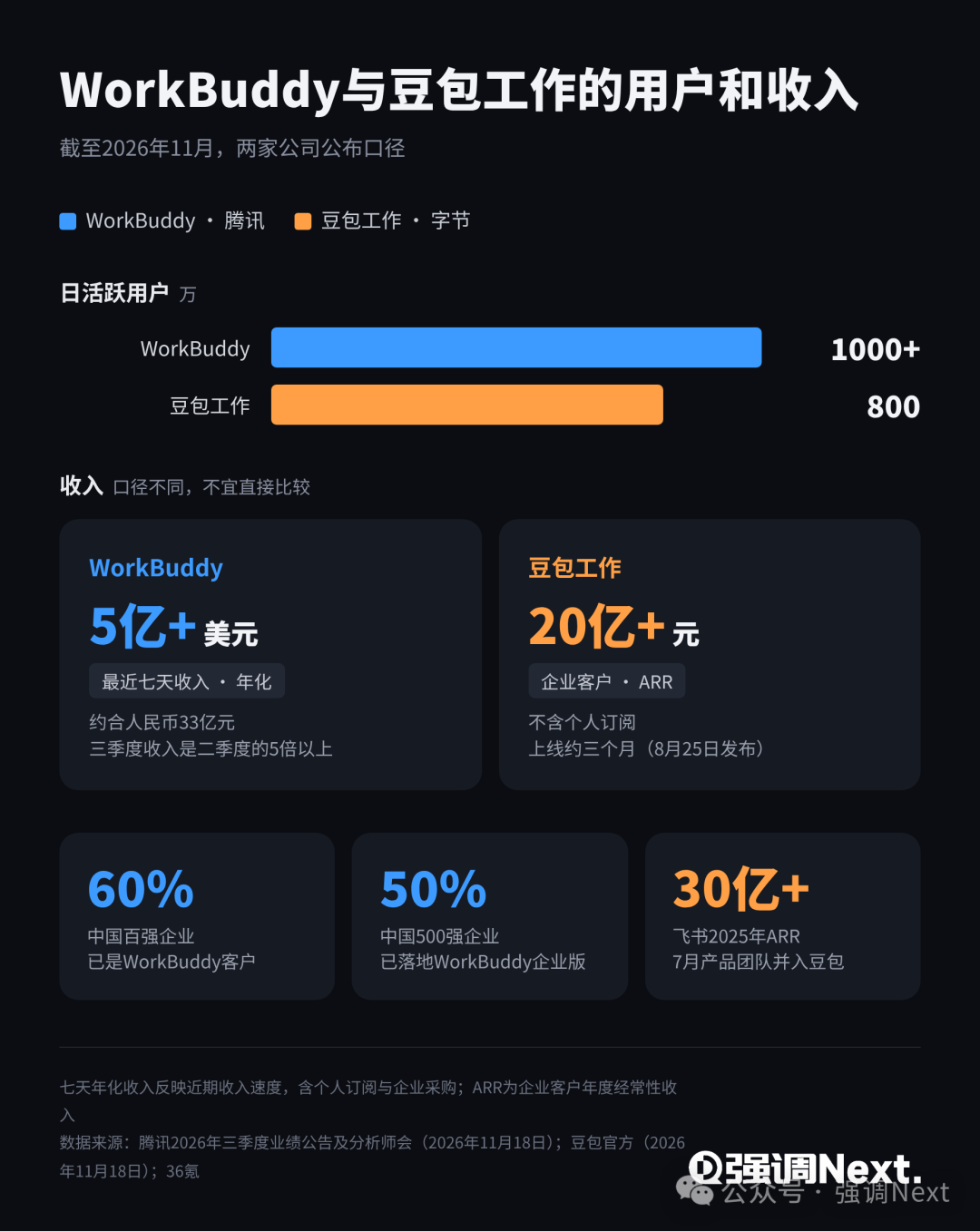
On the evening of November 18, Tencent released its third-quarter report, disclosing WorkBuddy's daily active users for the first time: over 10 million as of early November, with average daily Token consumption exceeding 100 trillion. At the analyst meeting that evening, Tencent President Liu Chiping also disclosed that WorkBuddy's revenue for the most recent seven days, annualized, exceeded 500 million USD—more than twice that of Tencent Meeting—and third-quarter revenue was more than five times that of the second quarter. The same evening, Doubao announced the results of Doubao Work: daily active users exceeded 8 million within three months of launch, and enterprise customer annual recurring revenue (ARR) surpassed 2 billion RMB. Tension between the two sides instantly escalated.
Half a year ago, the two companies' positions in AI applications were still clearly distinct: Doubao was the first AI application in China to surpass 300 million monthly active users, while Tencent Yuanbao was clearly lagging in the chat assistant competition. By September, on QuestMobile's AI-native app monthly active user rankings, the top three were still Doubao, Qwen, and DeepSeek, with Yuanbao not among them. On the office agent ranking in the same report, however, Tencent WorkBuddy topped the list.
For the same AI applications, the rankings of chat assistants and office agents are almost completely inverted. Behind this contrast, the monetization logic, competitive thresholds, and settlement gateways of AI applications have completely left the chat era behind.
Chat accumulates daily active users; work generates revenue
According to media reports, Doubao App's daily active users have long exceeded 200 million, but before the paid version launched in June this year, multiple media outlets disclosed that its daily revenue was less than 1 million RMB—equivalent to less than 400 million RMB annually, or less than 2 RMB per daily active user per year. By comparison, Doubao Work has only 8 million daily active users, yet it supports 2 billion RMB in enterprise ARR. The two sets of figures are from different periods and cannot be precisely converted, but the direction is unmistakable: where users are willing to pay is not in casual chat, but in getting things done.
Tencent's numbers make this direction even more direct. WorkBuddy has only one-twentieth of Doubao App's daily active users, yet its annualized revenue for the most recent seven days already exceeds 500 million USD, equivalent to about 3.3 billion RMB. Tencent explained that the fivefold revenue increase in the third quarter mainly came from an increase in paying users and initial adoption by enterprise customers.
ByteDance's moves over the past six months have all been about reallocating resources along this gap. In June, Doubao launched three paid tiers at 68 RMB, 199 RMB, and 500 RMB. At the end of July, the Feishu product team was merged into Doubao, and the sales team was merged into Volcano Engine. On August 25, Doubao Work was released. In September, LatePost reported that Doubao's general conversation team would be reduced, and quoted an employee describing Doubao as having become a "marginal product." Doubao PR head Liu Xing subsequently responded, saying this was only a division-of-labor adjustment involving fewer than 50 people, with 11 people affected, 3 of whom left, and some functions and personnel transferred to the transactions and Doubao Work teams. How many were cut is disputed; where they were moved is not: transactions and office work.
AI chat products cannot bring in money for two reasons.
The first is cost. The premise of the advertising model is that serving one more user costs almost nothing, but the inference cost of large models grows linearly with usage. The more active users are, the more the books lose.
The second is users' payment anchor. Chat provides answers, and answers are readily available in search engines and other free models, so users find it hard to pay for them separately. An office agent delivers a report, spreadsheet, or PPT that can be used directly, and the value can be mapped directly to human work hours, giving payment a reference point.
Tencent's wording in its financial report also illustrates this. In terms of daily active users, WorkBuddy has only one-twentieth of Doubao's. Tencent chose to describe it as "the largest AI application in China by Token consumption." Token volume measures inference scale, and in products charged by usage, it is much closer to revenue than daily active users. Tencent put the revenue figures out that evening precisely to cement this relationship.
The path most familiar to China's internet over the past two decades was to first build daily active users for free, then monetize through advertising. That path no longer works for AI chat products. What determines the commercial ceiling of an AI application is not daily active users, but how much priced work it can complete for users.
Tencent leads in office agents without being bound by its own models
Tencent lags in AI chat assistants but leads in office agents, and the two product lines' dependence on in-house models is completely different.
When WorkBuddy launched in March this year, Hunyuan was not in China's first tier, and Tencent did not bet WorkBuddy on Hunyuan. So from day one, WorkBuddy was compatible with OpenClaw's skill ecosystem, and the domestic version can freely switch among Hunyuan, DeepSeek, GLM, Kimi, and MiniMax. Tencent President Liu Chiping said at the second-quarter earnings call that Hunyuan would be one of WorkBuddy's core models, but not the only one. At the third-quarter call, he also admitted that previous investment in Yuanbao had not met expectations and that spending on Yuanbao had been reduced.
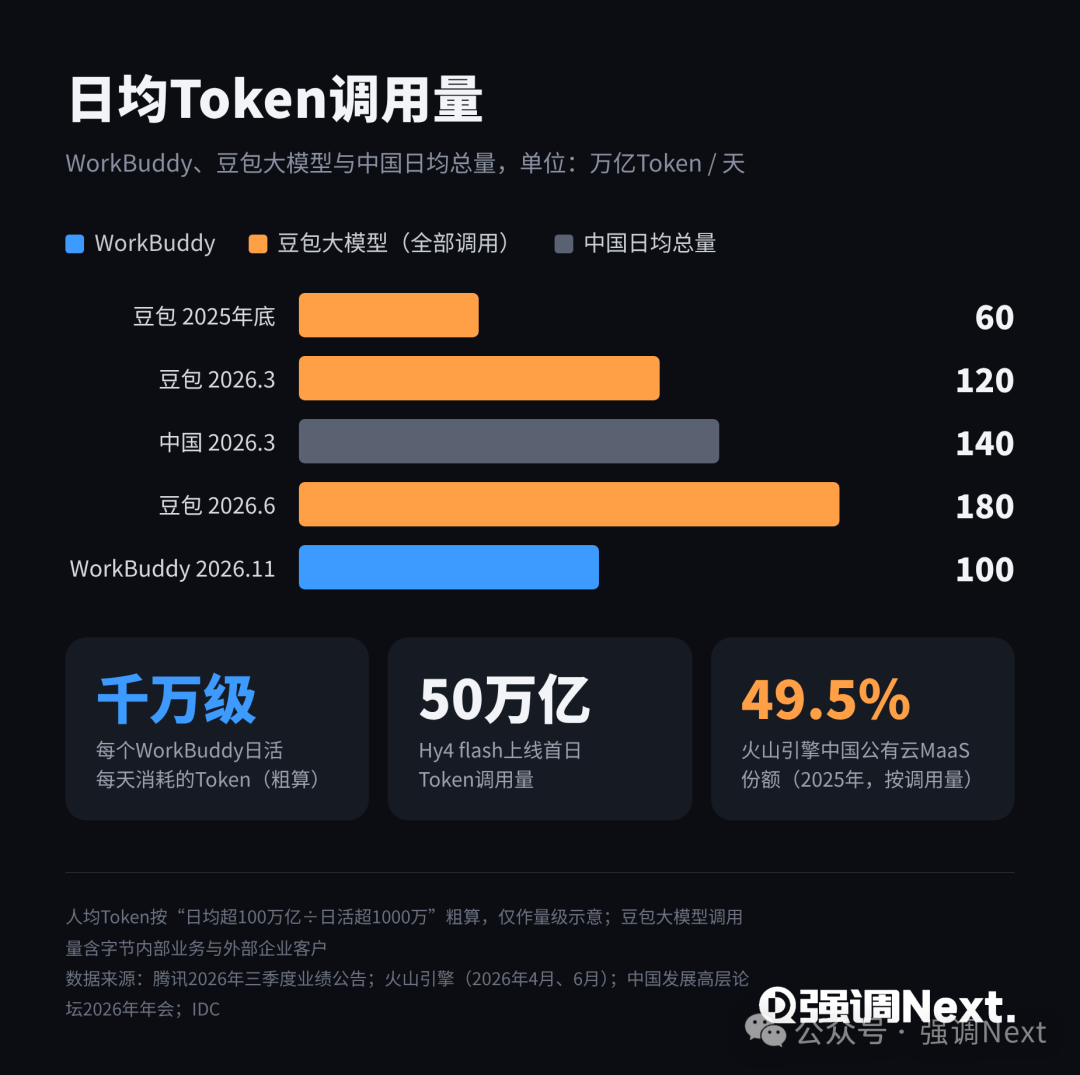
ByteDance's situation is the opposite. In IDC's statistics for China's public cloud MaaS market in 2025, Volcano Engine held a 49.5% share by call volume, and the Doubao large model was the most-called model in China, so Doubao Work naturally focused on in-house models when it launched. It was not until October 29 that Doubao Work opened third-party models to teams and enterprise customers. On November 12 it expanded to all users, with Kimi K3.1 Pro, GLM 5.3, and DeepSeek V4.1 Flash entering the selectable list, with quota consumption multipliers noted beside them.
The company with the largest domestic model business put competitors' models into its own flagship application—equivalent to admitting that in office scenarios, users want choice. Whether an office agent can finish the work depends on task decomposition, tool invocation, skill libraries, and whether it can connect to local files and enterprise systems.
WorkBuddy completed more than 100 major version updates in the eight months since launch, listed more than 200,000 Skills on the platform, and cumulatively processed 9 billion task requests. In October it also integrated with WeCom, so employees can invoke it directly from the contacts and sidebar. These accumulations have little to do with model rankings; they rely on engineering and distribution.
The experience of chat products is highly dependent on a single model, and Yuanbao did not catch up on that path. WorkBuddy's competitiveness comes from integrating multiple models, tools, and work entry points.
At the application layer, model rankings can no longer determine the standings. Tencent emphasized that Hy4 flash's per-task cost is about one-twentieth that of Hy4, and its call volume within WorkBuddy on the first day of launch was 10 times that of Hy4 preview on its first day. The first item on Doubao Work's model list is "Auto (small free quota)," with the system allocating models according to task scale. The number-one task of in-house models within their own applications has become driving down the cost of each task.
Models can be swapped, but computing power cannot: platforms compete for the settlement gateway
Models can be swapped at will, but someone must supply the computing power.
Based on a rough calculation from the two figures Tencent disclosed, each WorkBuddy daily active user consumes Tokens on the order of tens of millions per day. Behind one task are dozens of rounds of model calls, each of which must process an ever-growing context, much of which is repeatedly read in. WorkBuddy alone consumes 100 trillion Tokens per day—more than half of the total call volume of the Doubao large model in June this year (180 trillion), and close to the national daily average in March this year (140 trillion).
Who bears this computing power? Tencent gave a clear ranking at its second-quarter earnings call: the first priority for capital expenditure is training Hunyuan, and the second priority is providing inference computing power to support Hunyuan, DeepSeek, and other third-party models connected to WorkBuddy. When Doubao Work's enterprise customers call third-party models, they also do not need to separately purchase from model vendors; the cost is deducted directly from purchased AI points.
This at least shows that the platform holds the user relationship and the settlement gateway: users choose models on the platform, pay according to multipliers set by the platform, and the money goes into the platform's account first. For companies like Moonshot AI, Zhipu, and MiniMax, being listed on big tech's office agents can bring considerable call volume, but they are no longer facing individual developers; they are facing major customers who hold end users. For models that cannot differentiate on capability, bargaining power will tilt all the way toward the platform.
The threshold for this business has therefore been raised very high.
In the third quarter, Tencent's capital expenditure was 81.4 billion RMB, 6.3 times that of the same period last year, and capital expenditure payments on a cash flow statement basis were 65.1 billion RMB; free cash flow was negative 69.1 billion RMB, mainly dragged down by large prepayments for computing power procurement, and excluding this part it was positive 16.9 billion RMB, with the balance shifting from net cash of 58.2 billion RMB to net debt of 13.7 billion RMB.
Under Tencent's "excluding new AI products" basis, Non-IFRS operating profit was 83.3 billion RMB, while the actual value was 68.07 billion RMB; the group of new AI products including Hunyuan, Yuanbao, CodeBuddy, WorkBuddy, and Xiaowei had a combined impact of about 15.2 billion RMB. Only a few big tech companies with their own clouds and chip reserves can continuously supply computing power at the scale of 100 trillion Tokens per day. It will become increasingly difficult for startups building general-purpose office agents independently to compete on cost at this scale.
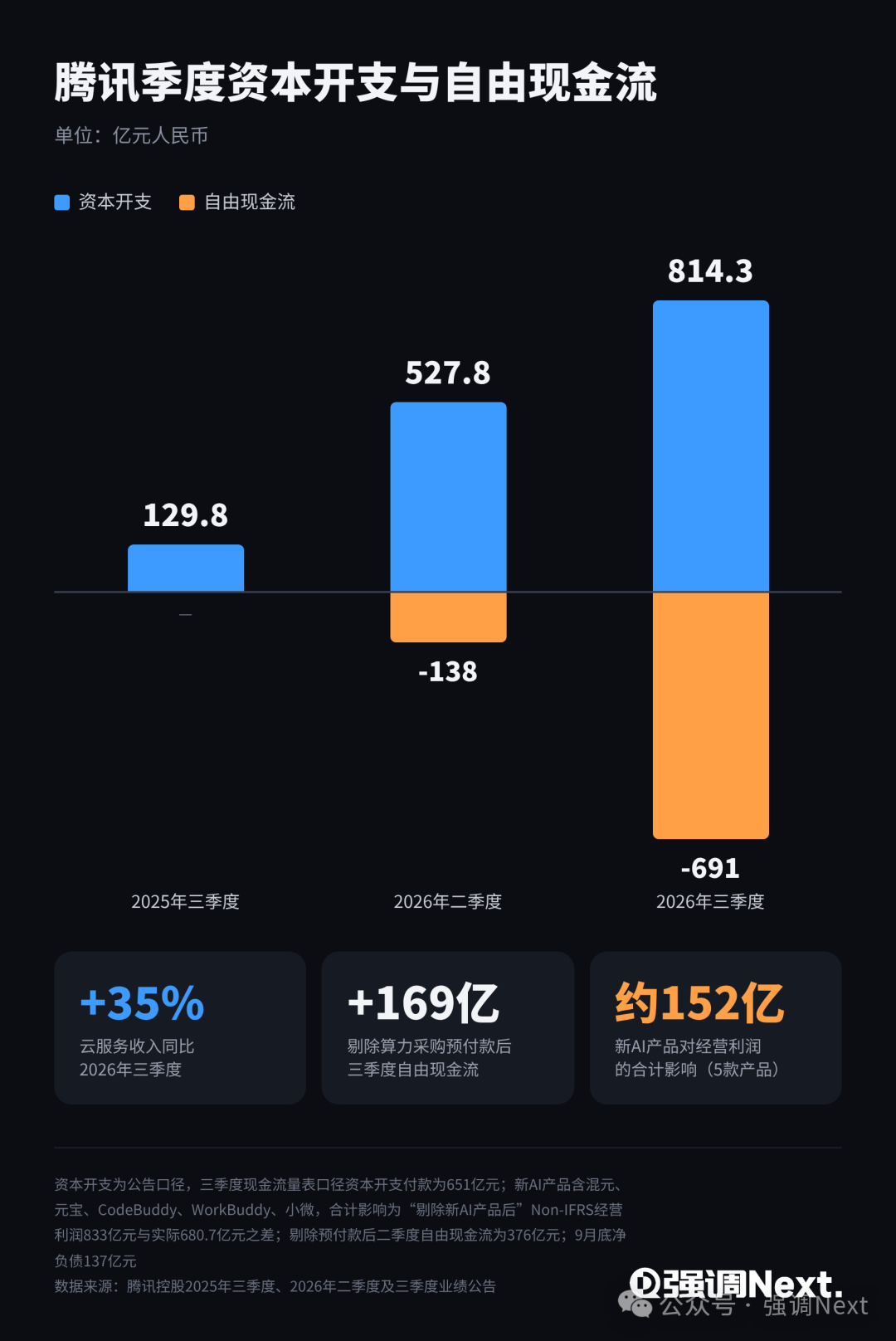
The other side of the money has also produced results. In the third quarter, Tencent Cloud revenue grew 35% year on year, and the financial report listed WorkBuddy, MaaS, and GPU leasing together as drivers, with MaaS revenue growing more than twofold quarter on quarter. Tencent's chief strategy officer previously said that Tencent can monetize by selling Tokens through WorkBuddy. Tencent Cloud's growth logic has therefore changed: in the past it sold computing power to enterprises, and now it also sells Tokens directly to end users through an application.
After daily active users, secure sustained budgets
Both companies have already given revenue signals, but on different bases. WorkBuddy's "seven-day annualized" figure reflects recent revenue speed, including both individual subscriptions and enterprise purchases; Doubao Work's ARR counts only enterprise customers' recurring revenue. The two numbers cannot be directly ranked, but viewed together, they show the two companies moving toward the middle from opposite ends.
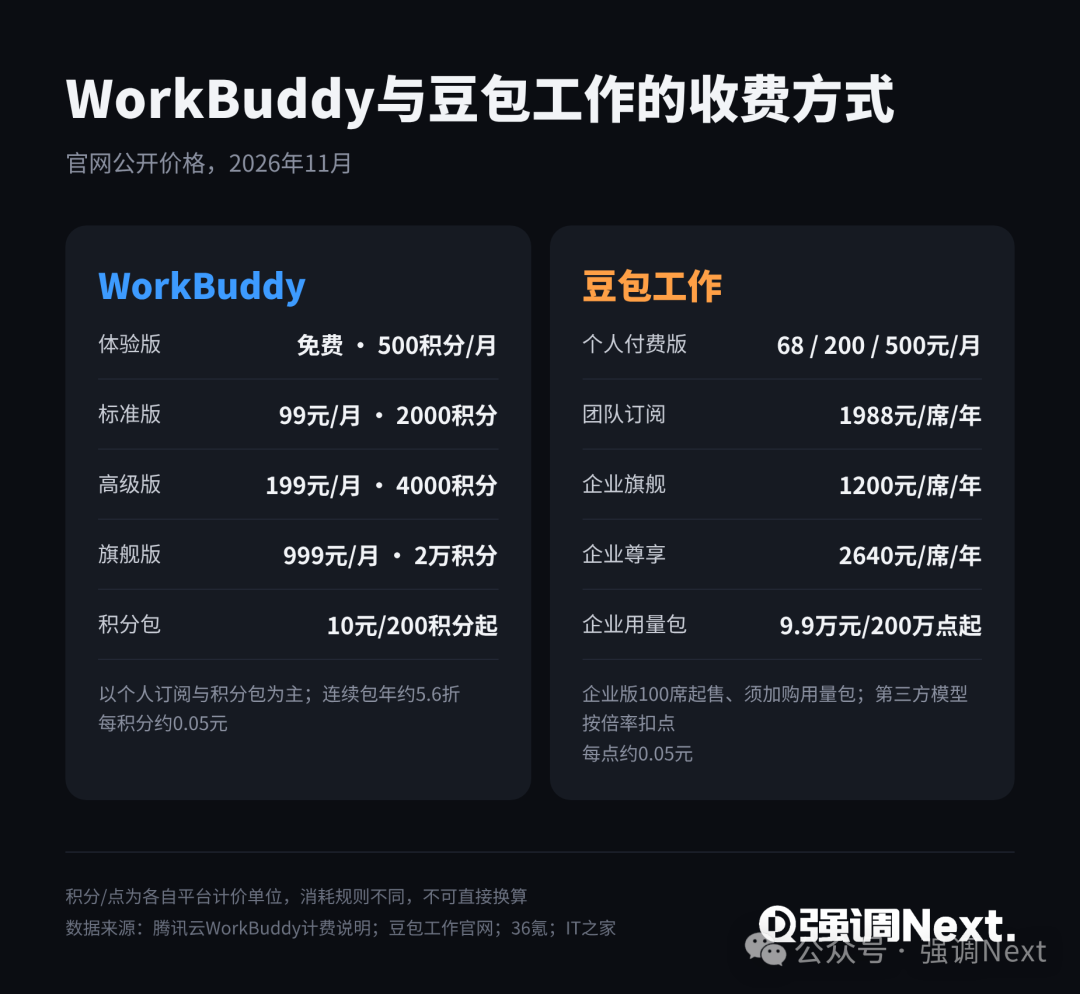
WorkBuddy's user structure skews individual. The personal version has three monthly tiers at 99 RMB, 199 RMB, and 999 RMB, and also offers a small 10 RMB 200-point pack that non-members can buy. A large number of professionals paying out of their own pockets for AI tools for work is a new phenomenon in the Chinese market, where willingness to pay for personal software has traditionally been low.
Progress on the enterprise side is also faster than outsiders think: since the enterprise version was released in June, 60% of China's top 100 enterprises have become WorkBuddy customers. Tencent's desktop entry point is also large: in September, WeCom's PC monthly active users were 20.302 million, 1.6 times DingTalk's and more than 10 times Feishu's.
What Tencent needs to solve next is the efficiency of converting personal use into enterprise purchasing. The Buddy One workspace launched at the end of October integrates documents, meetings, ima, and cloud drive with a unified account and points pool, which is exactly about pulling individual users into organizational accounts.
ByteDance's situation is the reverse. In September, Feishu's PC monthly active users were only 1.935 million—a small entry point—but it has a sales team capable of signing annual enterprise contracts: Feishu's ARR exceeded 3 billion RMB in 2025, revenue growth in the first half of this year was 2.5 times that of the same period last year, and more than 90% of new customers also purchased AI products.
Doubao Work's enterprise subscription starts at 100 seats, at 1,200 RMB or 2,640 RMB per seat per year, plus an AI usage package starting at 99,000 RMB. This 2 billion RMB is largely conversion from Feishu customers and Volcano Engine's sales system. ByteDance's separate disclosure of 8 million daily active users this time is also meant to show that Doubao Work's users do not come only from Feishu.
Alibaba stands alone among the three in not disclosing daily active users or revenue figures. Qwen Office operates through DingTalk, and its 2.0 release on November 9 emphasizes multi-user and Agent collaboration, placing its bets on organizational workflows—individual daily active users are simply not the metric it cares to highlight.
The way enterprises pay for AI is shifting from "per-seat subscriptions" to "usage-based quotas." Doubao Work's enterprise edition already requires prepaid shared credits, and reports suggest it will ultimately bill entirely by Token consumption. WorkBuddy's enterprise edition similarly pairs seat quotas with shared usage bundles. Under seat-based billing, budget growth hinges on headcount; under usage-based billing, it hinges on how much work enterprises delegate to AI. Whoever controls the enterprise admin console and the shared quota pool determines where that budget goes.
Tencent is advancing from individual users toward enterprises, while ByteDance is moving from enterprise customers toward individuals—and these two paths will ultimately converge at the enterprise AI quota pool. Users are already willing to pay for work to be done, but for this business to scale, the cost of 100 trillion Tokens per day must be offset by sustained payments.
Data sources: Tencent Holdings' Q3 2026 results announcement and analyst call; Tencent's Q2 2026 earnings call; Doubao's official announcement on November 18; Volcano Engine data disclosed in April and June 2026; QuestMobile's Q3 2026 AI application market report; official pricing descriptions for Doubao Work and WorkBuddy; public reports from 21st Century Business Herald, IT Home, 36Kr, Jiemian News, PingWest, and others. Note: WorkBuddy's single-quarter inference cost is a rough estimate based on public data and assumed unit prices, intended for magnitude reference only.
- END -
-
NetEase Q3 Revenue Hits 27.9 Billion Yuan: Evergreen IPs Anchor Growth as Diverse New Titles Build Momentum
-
US Launches Surprise Investigation into Mercedes-Benz—Is the Real Issue Its Two Chinese Shareholders?
-
![]()
Chinese Home Appliances: A Bold Push Overseas
-
![]()
AI Needs a "Call Button"
-
![]()
Consumers Have Fallen Out of Love with Tesla—So Why Are Automakers Still Copying Its Homework?
-
![]()
Auto Braking Leader's Performance Keeps Rising, Spends Over 1.1 Billion Yuan on M&A
-
Two-Wheel Drive Plus LiDAR: GAC Trumpchi Yue 7 Smart Driving Edition Lowers the Bar Again—How Many Extra Sales Can It Deliver?
-
Li Yanhong and Baidu May Finally Be About to Catch the "Last Train" of AI