Alibaba: A Chinese Version of the "Google" Dream Shattered by the Chip Crisis?
 11/20 2026
 524
After being strangled by high-end chips and watching its stock price take a sharp correction, Alibaba released its FY27 Q2 results on the evening of the 19th. Judging by this quarter's financials alone, performance is quite solid, with basically no major flaws.
AI cloud growth continued to accelerate and margins improved markedly; the e-commerce segment stabilized its growth and recovered profitability as food delivery losses narrowed; even the newly spun-off AI lab and applications segment saw revenue accelerate while losses narrowed.
But the trouble is that the market isn't focused on the present. What it cares about is whether Alibaba Cloud and the AI application businesses can still sustain the strong growth expected if computing power becomes scarce down the road. The market is pricing in a valuation downgrade on weakening forward expectations, not the quality of current results.
1. Overall performance: revenue in line with expectations, profit nearly 10% ahead
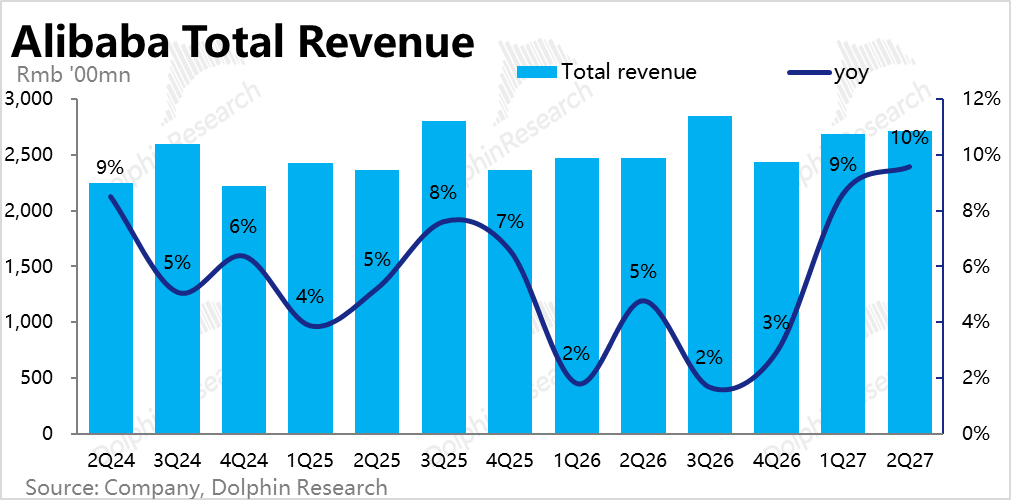
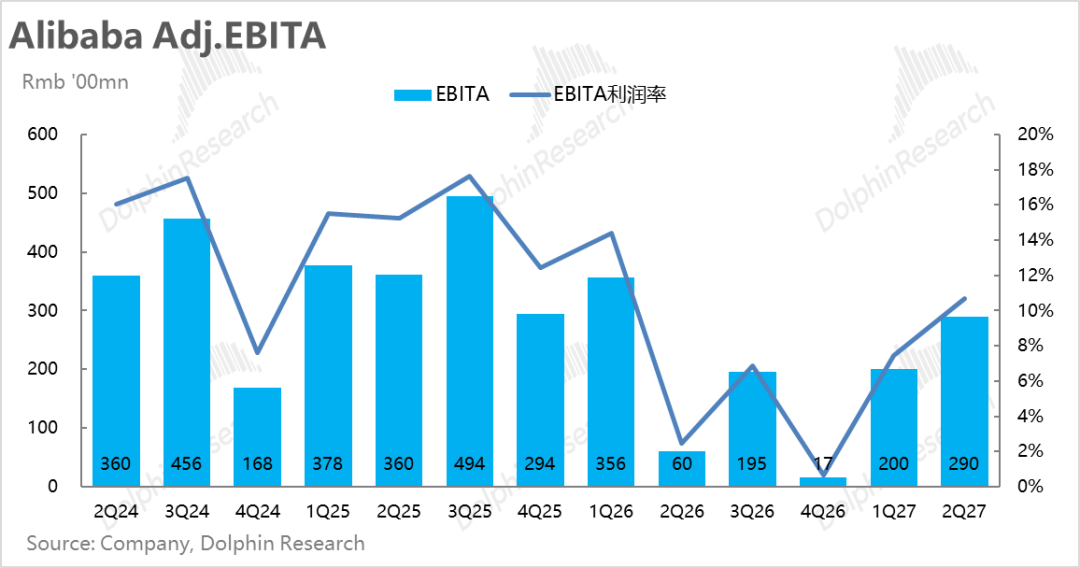
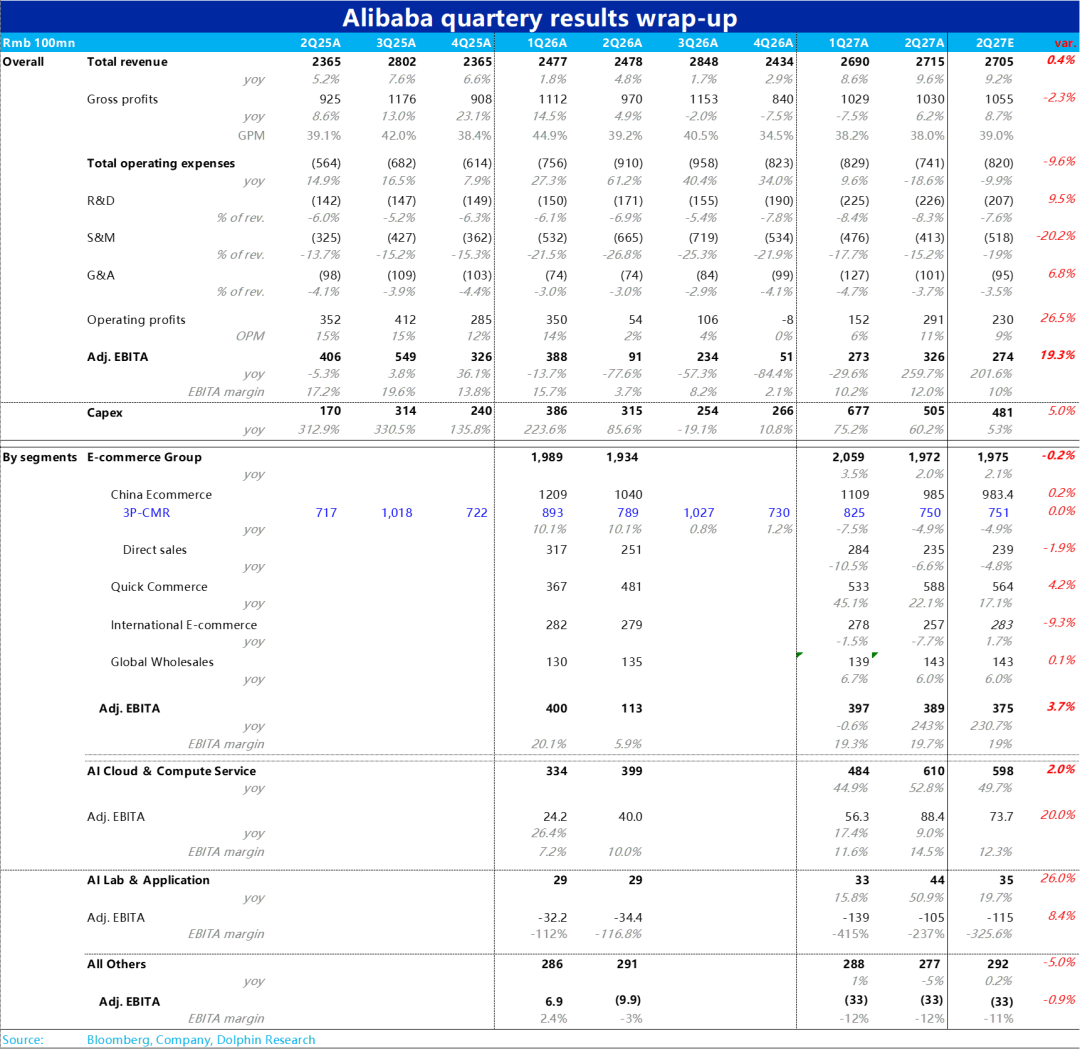
This quarter Alibaba's total revenue came in at RMB 271.5 billion, up 9.6% year-on-year, basically in line with major bank expectations. Adjusted EBITA was RMB 32.6 billion, with clear improvement both year-on-year and quarter-on-quarter, nearly 10% above major bank expectations. You could say growth is steady and improving, while profit has recovered significantly.
Looking at where expectations were beaten, the main source was the cloud segment. Alibaba's EBITA came in about RMB 1.5 billion above major bank expectations, while profits in other major segments were broadly in line.
2. AI cloud: growth continued to accelerate, margins improved markedly
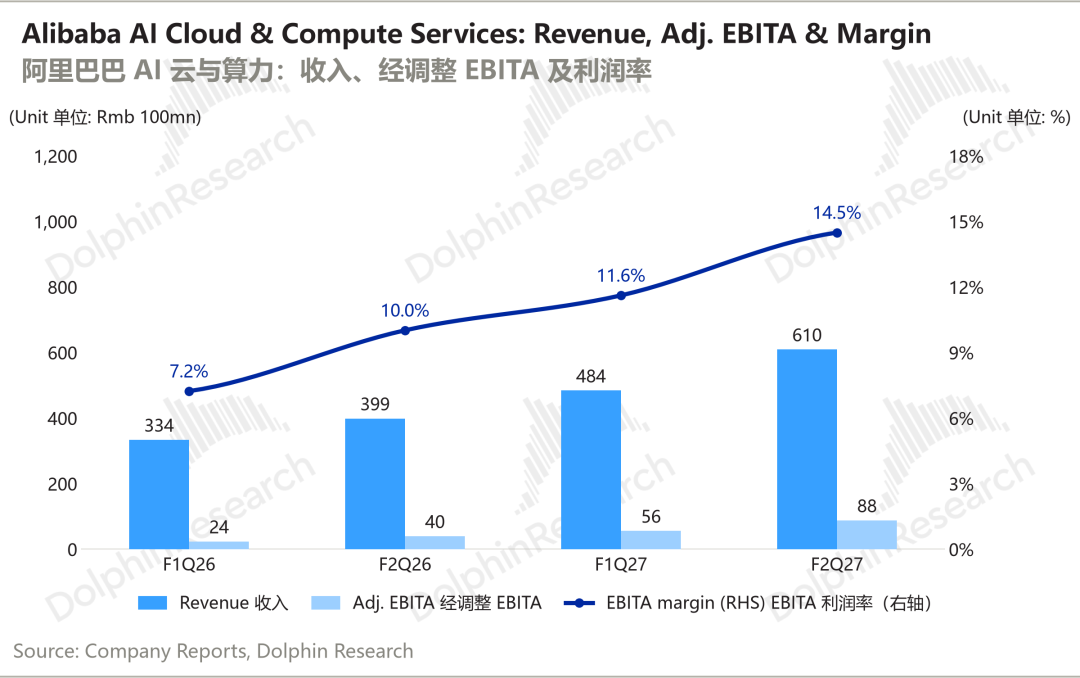
AI cloud and computing power revenue this quarter was RMB 61 billion, up 53% year-on-year, continuing to accelerate sharply from last quarter's 45% and landing at the upper end of major bank growth expectations. At the same time, EBITA margin reached 14.5%, up nearly 3pct quarter-on-quarter, well above major bank expectations of about 12%–12.5%.
Were it not for the threat of being choked on computing power, the cloud segment would actually be in its strongest performance cycle in years, with revenue continuing to accelerate while margins fast approach the 20% target.
By segment, external commercialization revenue growth was stronger this quarter, up 64% year-on-year. Within that, AI-related product revenue had already reached RMB 17.9 billion, accounting for nearly 30% of total cloud revenue, and still holding triple-digit year-on-year growth for consecutive periods.
What's more, for the first time Alibaba broke out revenue for computing equipment (including T-Head), which reached RMB 10 billion this quarter.
On the earnings call, management attributed the rise in cloud margins to three factors: a higher share of high-margin products in recurring revenue; price increases brought on by the global computing power shortage; and economies of scale.
3. Domestic e-commerce: CMR decline stabilized, profit recovered as food delivery losses narrowed
In the broad e-commerce segment, the core indicator CMR was about 5% nominally year-on-year. Still negative growth, yes, but at least the decline has narrowed (from 7.5% last quarter) and is in line with major bank expectations; after excluding the revenue offset caused by the new merchant cooperation plan, actual comparable growth was about +1%, consistent with last quarter.
Although absolute growth in the far-field e-commerce business remains quite weak, at least it has stabilized for now and hasn't deteriorated further. Looking ahead, management said the consumption environment in the December quarter remains under pressure, and quarter-to-date core operating indicators are tracking the national trend of online physical retail, with necessities outperforming discretionary goods.
By segment, flash purchase business revenue grew about 22% year-on-year, above market expectations, indirectly confirming that monetization of the food delivery business is improving.
As for self-operated retail revenue, it shrank year-on-year but the decline narrowed (from -10% to -7%).
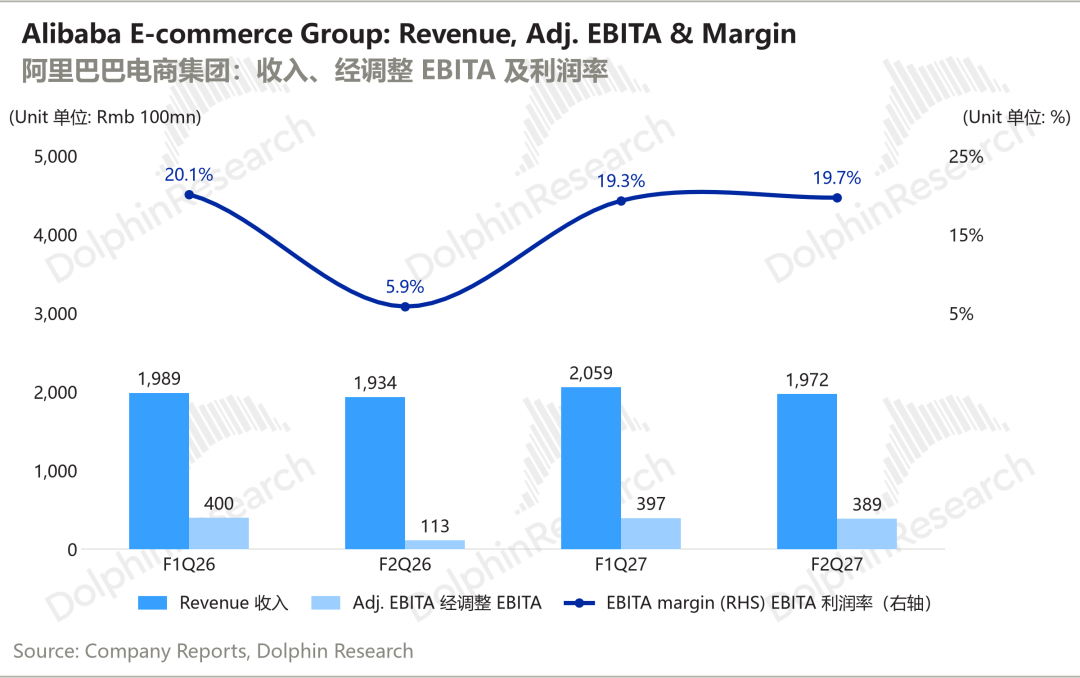
On profit, Alibaba E-commerce Group's adjusted EBITA (excluding equity incentives) was RMB 38.9 billion, 3.4 times last year's profit for the same period, basically in line with major bank expectations. The company said this was mainly due to improved unit economics in food delivery and steady growth in far-field e-commerce.
According to the company, far-field e-commerce profit this quarter was broadly flat year-on-year, while overseas business slightly narrowed losses, implying that the flash purchase business lost about RMB 9.5 billion this quarter, broadly in line with market expectations. Although the absolute loss narrowed not that much from last quarter (RMB 10–11 billion), this quarter was the summer peak in order volume, so per-order UE still improved considerably.
Management added on the earnings call: in the September quarter, GTV of online non-food categories in instant retail grew more than 40% year-on-year, and self-operated front warehouses expanded rapidly; food delivery UE improved as expected, share remained stable, and average order value continued to rise.
4. AI lab and applications: revenue accelerated, losses narrowed
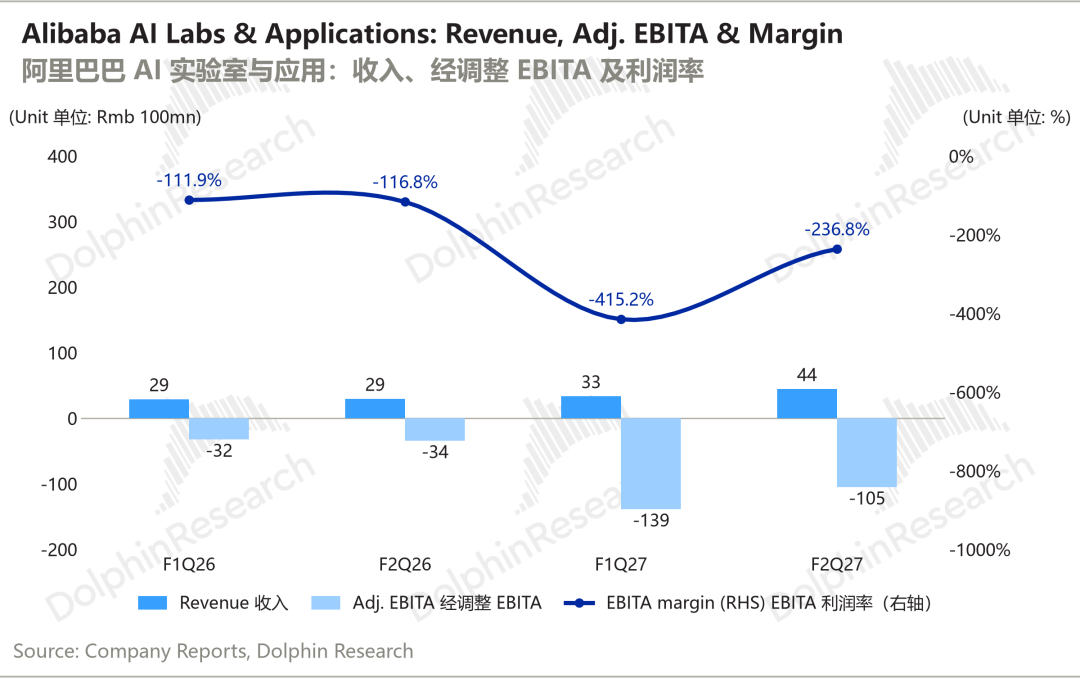
The new AI lab segment, mainly consisting of foundation model R&D and Qwen applications on both the 2B and 2C sides, had revenue of RMB 4.4 billion this quarter, up 51% year-on-year, significantly accelerating from about 16% last quarter and notably better than major bank expectations; at the same time, losses were RMB 10.5 billion, also narrower than last quarter's RMB 13.9 billion. Accelerating revenue growth alongside narrowing losses is a pretty good performance trend.
The company said revenue growth mainly came from rising enterprise demand for agent products; the quarter-on-quarter narrowing of losses came from improvements in both model training efficiency and Qwen App marketing spending efficiency.
5. Capex remains elevated, free cash flow still negative but outflow narrowed
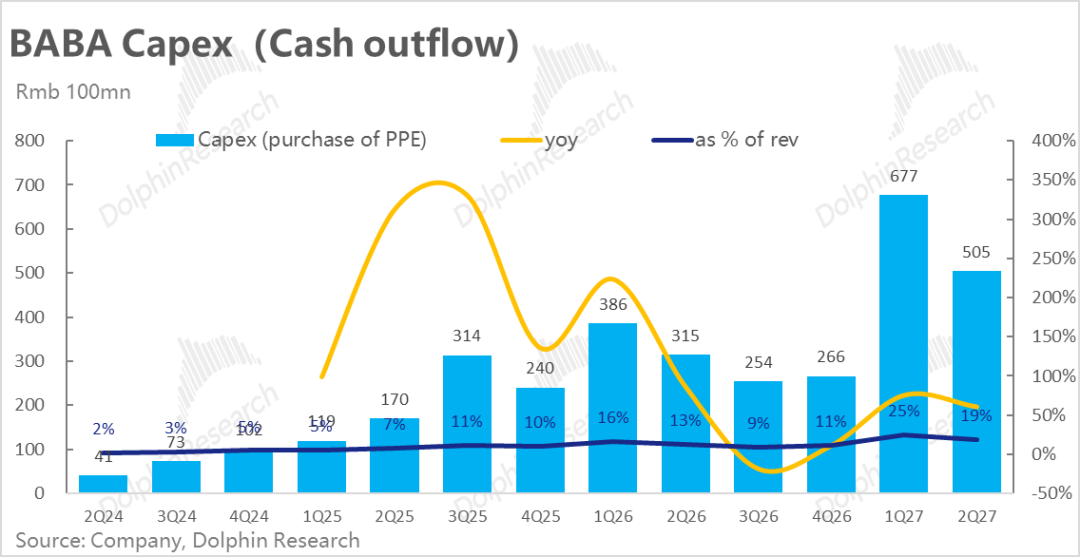
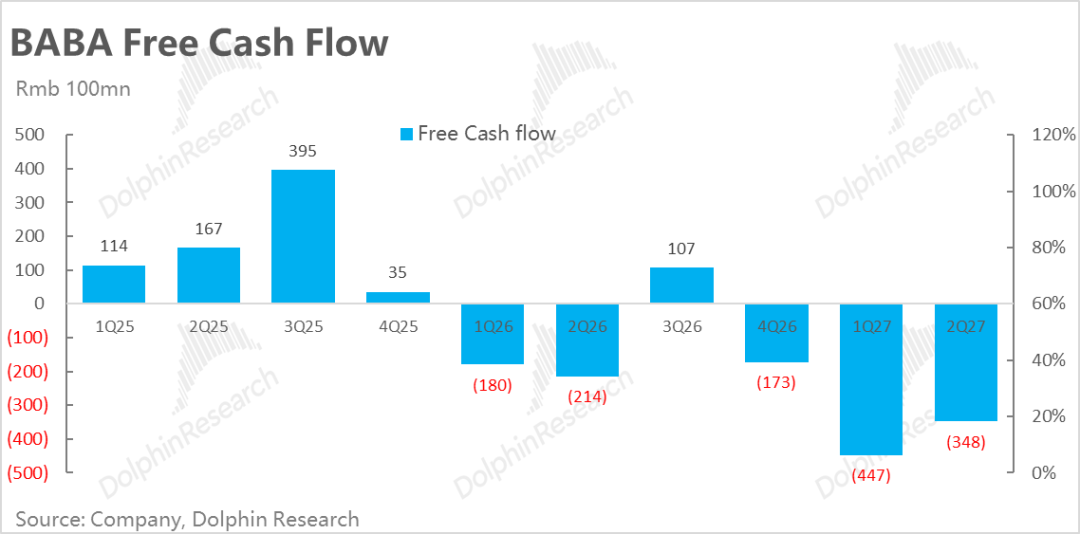
Capex this quarter was RMB 50.5 billion, still at a high level, but lower than last quarter's RMB 67.7 billion and also below most major bank expectations. Operating cash flow was RMB 15.7 billion, and free cash flow was about negative RMB 34.5 billion. Although still negative, it too narrowed from last quarter.
Overall, although the company's cash flow still faces considerable pressure under still-elevated capex, it has eased marginally. In the current market environment where companies are not favored for "spending recklessly," a decline in capex is not a bad thing.
Management cautioned last quarter not to extrapolate linearly, and on this quarter's call also confirmed that the quarter-on-quarter pullback in capex mainly reflected fluctuations in the procurement cycle. Looking ahead, management said 2027–28 will be the most aggressive investment phase (ramp-up of in-house chips), and expects overall cash flow to turn positive in the second half of 2028.
6. Other businesses: international e-commerce dragged down by EU customs fines
Among other businesses, international e-commerce revenue this quarter was RMB 25.7 billion, up 8% year-on-year, mainly dragged down by higher EU customs taxes—though fortunately losses continued to narrow.
Global wholesale revenue was RMB 14.3 billion, up 6% year-on-year, broadly consistent with last quarter's growth and market expectations, a stable showing.
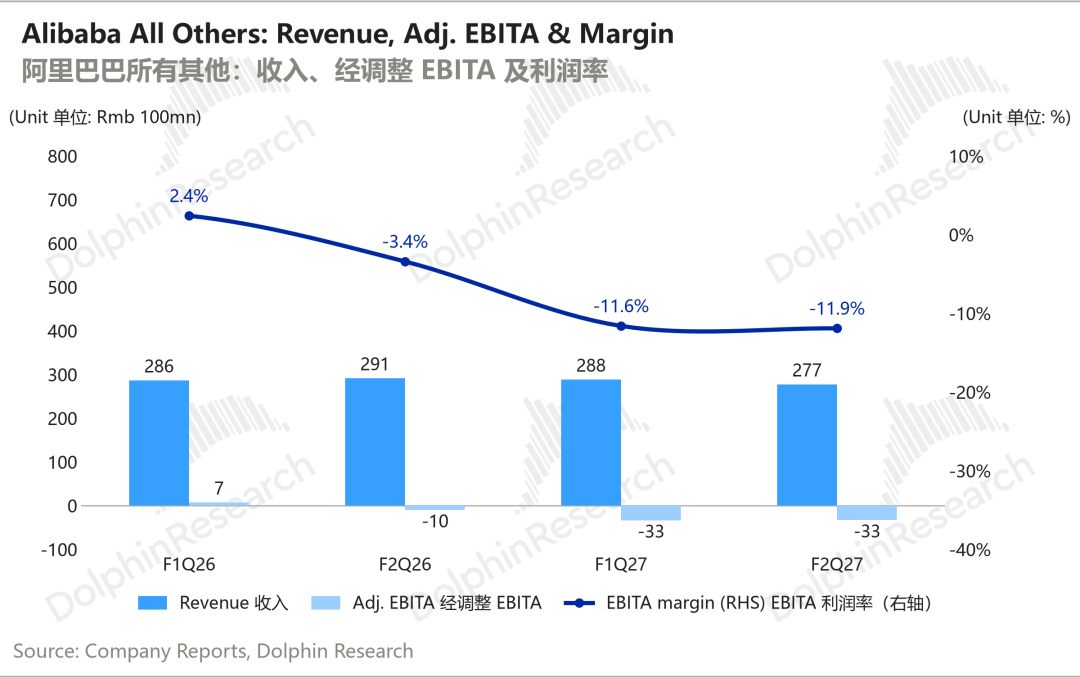
As for the other business segment including Cainiao, Amap and a range of businesses, revenue was RMB 27.7 billion, up 5% year-on-year, mainly dragged down by lower Cainiao revenue; losses were about RMB 3.3 billion, also broadly flat from last quarter. At least losses did not expand further—neither good nor bad.
7. Gross profit and expenses: gross margin edged down, marketing expenses fell sharply
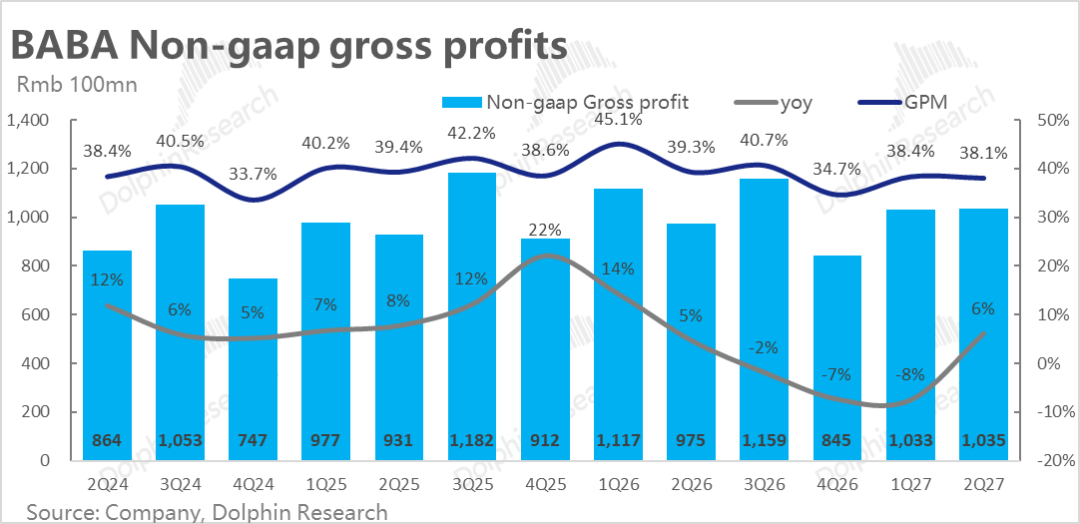
On costs and expenses, gross margin this quarter was 38.0%, down about 1.2pct year-on-year, mainly due to a higher revenue share from cloud and technology businesses, as well as the revenue offset from the new merchant cooperation plan.
Selling expenses were RMB 41.3 billion, contracting significantly both year-on-year and quarter-on-quarter, with the expense ratio down nearly 3pct from last quarter, corresponding to narrower spending on food delivery and AI applications, as well as a change in accounting presentation whereby some subsidies were reclassified from selling expenses to revenue offsets.
R&D was RMB 22.6 billion, up about 32% year-on-year, not surprising given the company's continued increase in investment in AI and other technologies.
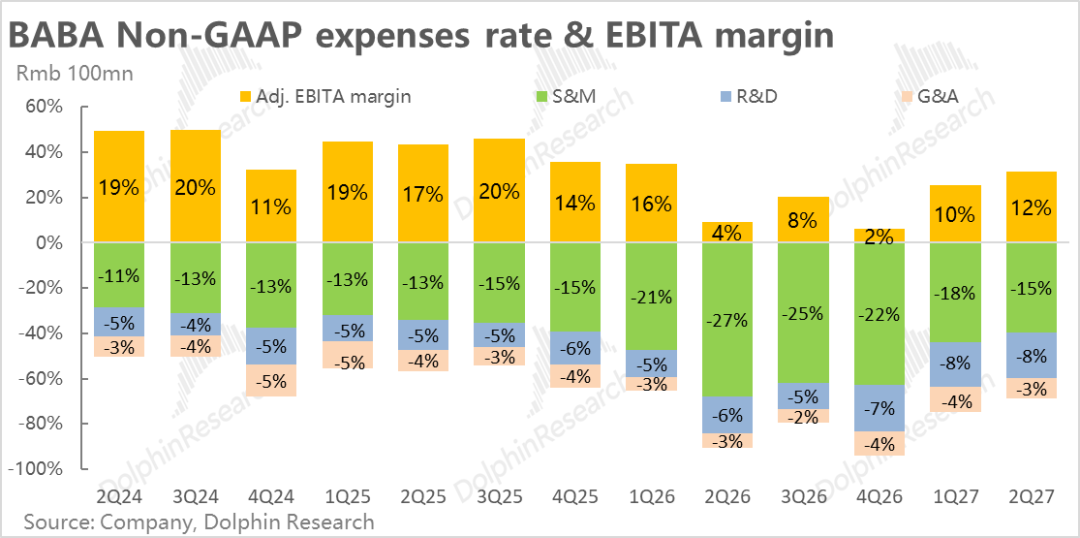
8. Overview of important financial report information
Dolphin Research view:
1. This quarter's results have no obvious shortcomings, but dark clouds lie ahead
Judging this quarter alone, Alibaba's performance is quite good, with basically no major flaws.
On the AI side, cloud growth and profit continued to rise, and the newly spun-off AI lab and applications also showed revenue growth and narrowing losses;
On the e-commerce side, CMR growth has stabilized, and with food delivery losses narrowing plus traditional far-field e-commerce profit stabilizing, the e-commerce segment's profit is recovering.
However, this quarter's results are not what the market is most focused on. More important is the outlook ahead, and there are considerable challenges on both main lines—e-commerce and cloud/AI:
(1) Cloud and AI: chips choked, both growth and valuation face downgrades
Since the outlook for the broad e-commerce business is not particularly good, Alibaba's biggest current driver of performance and valuation lies in cloud and AI. Recently, the two major bills—Remote Access and AI Overwatch—have basically blocked the possibility of domestic companies using US chips, putting the currently booming cloud and AI businesses at great risk of "being unable to cook a meal without rice," with a cliff-like decline in growth.
On this point, before the earnings report, Dolphin wrote a separate in-depth analysis discussing the computing power supply Alibaba may lose under the new rules and how much impact Alibaba Cloud's growth will suffer. The detailed analysis can be found in the article published on the Longbridge app, "Aftermath of Jensen Huang's Exit: Remote Computing Power Blocked, Can Alibaba Cloud Still Sustain High Growth?"
The key points are as follows:
a. After the new plan takes effect, the computing power supply Alibaba has may be 19%–27% lower than previously planned, with the biggest impact within calendar year 2027. The company will face a choice between protecting internal model self-development and external commercialization revenue. Later, starting in 2029, as domestic chip output ramps up, most of the lost computing power can be covered.
b. Starting in 2027, T-Head and other domestic chips will account for the vast majority of Alibaba's incremental computing power, with the total rising from about 1.4GW at the end of calendar year 2026 to 9.5GW by 2030.
c. Assuming the company prioritizes internal computing power use, and depending on whether the new rules fully take effect in April or September, Alibaba Cloud's external revenue growth in calendar year 2027 may be cut from the previously expected 50%+ to only 20%–35%. Growth in calendar year 2028 would then fall to around 35%–40%.
d. Even if internal R&D is prioritized, because B-series and other high-performance GPUs can no longer be obtained, the evolution and iteration of top domestic models is still very likely to be affected.
Two key variables will determine how this ultimately plays out: when and with what intensity the new US rules are enforced; and whether the production capacity and performance of domestic chips can ramp up fast enough to make up for the gap left by lost US chips.
On the earnings call, management first confirmed Dolphin's expectation of prioritizing internal supply for training: after 2027, incremental computing power will mainly be in-house chips, and will first satisfy the company's own model training, followed by important customers.
But management's statement was somewhat more optimistic: they expect next year's cloud revenue growth target may fall to 30%–45% (still under evaluation, and it is unclear whether this refers to external revenue). Since our assumptions are relatively pessimistic (80% of Alibaba Cloud's overseas computing power would be cut), it is not surprising that company guidance is more optimistic. And after domestic computing power volume ramps up in calendar year 2028, growth may return to above 50%;
They maintained the long-term target: external cloud revenue of USD 100 billion by 2030, with margin reaching above 20%.
That said, management probably cannot accurately grasp the subsequent actual situation at present, and will still need to observe how things develop.
(2) E-commerce: drags have passed, but the growth center has shifted lower
The two major drags weighing on Alibaba's e-commerce business over the past year have essentially cleared: food delivery losses are continuing to narrow, and the dual pressures on far-field e-commerce—the high base effect from last year's national subsidies and the impact of increased monetization—have largely been absorbed on both fronts. This is also the core reason why CMR decline stabilized this quarter and e-commerce segment profit recovered.
Looking ahead, however, the problem shifts from the company's own issues to an "unsolvable" industry problem. Recently, social retail sales have become increasingly weak, and the growth of online physical retail is also poor: in October, social retail sales grew only +0.4% year-on-year, while the single-month growth rate of online physical goods retail sales had already approached zero growth in September, and in October it even turned to a year-on-year decline of 3.6%.
Moreover, whether from the prospect of AI capabilities greatly improving and replacing part of the workforce becoming increasingly clear, or from companies having to "tighten their belts" due to high Capex expenditures, Dolphin believes that the impact of AI on employment and corporate employee consumption may still be only in its initial stage.
Based on the above two points, Dolphin believes that the growth center of domestic pan-e-commerce should still be biased downward. For Alibaba, the performance of its pan-e-commerce business is more about stabilizing, and it is hard to say there will be obvious improvement again.
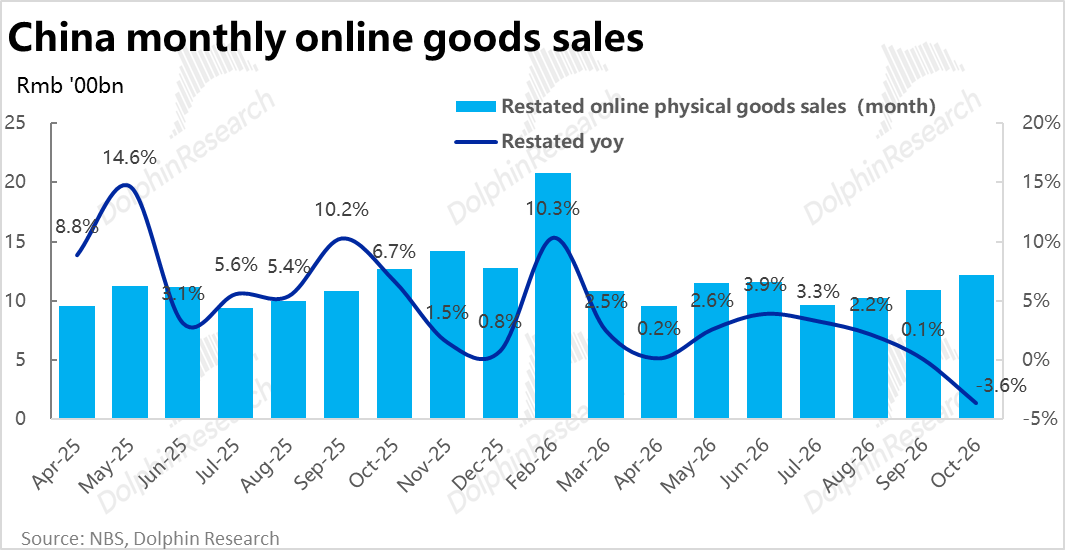
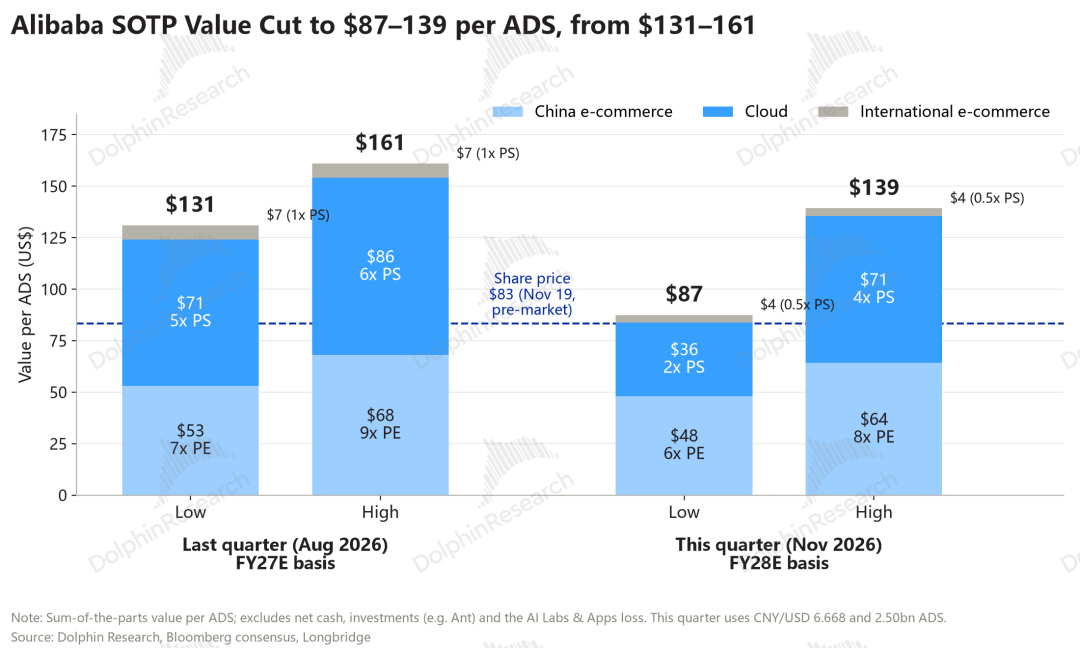
2. Valuation calculation: now close to the lower bound of the neutral range
Dolphin continues to use the SOTP valuation method, switching the valuation year to FY28. First, for the Alibaba e-commerce group, considering the downward shift in the growth center of domestic e-commerce mentioned above, we expect that in FY28 the EBITA profit of far-field e-commerce (the original China e-commerce business excluding instant retail) will decline by about 1.5% year-on-year, to about RMB 191 billion;
instant retail losses, following management's "halving every year" pace, will narrow to about RMB 20 billion, totaling about RMB 134 billion in profit after tax.
As for the Alibaba Cloud segment, we continue to use the baseline scenario of the new regulations taking effect from our previous in-depth analysis, rather than management's more optimistic guidance: FY28 revenue after the new regulations will be about RMB 298 billion, a year-on-year increase of about 23%.
Considering the step-down in growth and the uncertainty of computing power supply, the valuation multiple for the cloud business has been significantly lowered compared with last quarter.
From a valuation perspective, even under our assumptions that are more pessimistic than management's, Alibaba has now fully reflected the possible impact of a computing power shortage.
However, after all, how the situation will unfold is still unclear, and our assumptions also depend on T-Head and other domestic chips being able to provide considerable production capacity, but at present overseas foundry capacity including HBM and Samsung, TSMC, and others is likely to be limited as well.
Whether the domestic chip production capacity originally expected can truly materialize also involves considerable uncertainty. For greater safety, it is still better to wait until such unpredictable policy risks settle before making a decision.
- END -
// Reprint authorization
This article is an original article by Dolphin Research. Authorization is required for reprinting.
// Disclaimer and general disclosure notice
This report is intended only for general comprehensive data use, aimed at general reading and data reference for users of Dolphin Research and its affiliates, and does not consider the specific investment objectives, investment product preferences, risk tolerance, financial condition, and special needs of any person receiving this report. Investors must consult an independent professional adviser before making investments based on this report. Anyone who makes investment decisions due to the use of or reference to the content or information mentioned in this report must bear the risk themselves. Dolphin Research shall not be liable for any direct or indirect liability or loss that may arise from the use of the data contained in this report. The information and data contained in this report are based on publicly available materials and are for reference only. Dolphin Research strives for but does not guarantee the reliability, accuracy, and completeness of the relevant information and data.
The information mentioned or views expressed in this report shall not, in any jurisdiction, be treated as or regarded as an offer to sell securities or an invitation to buy or sell securities, nor do they constitute advice, solicitation, or recommendation regarding the relevant securities or related financial instruments. The information, tools, and materials contained in this report are not intended or planned to be distributed to citizens or residents of any jurisdiction where the distribution, publication, provision, or use of the relevant information, tools, and materials would conflict with applicable laws or regulations, or would cause Dolphin Research and/or its subsidiaries or affiliates to be required to comply with any registration or licensing requirements in that jurisdiction.
This report reflects only the personal views, opinions, and analytical methods of the relevant creators, and does not represent the position of Dolphin Research and/or its affiliates.
This report is produced by Dolphin Research, and the copyright belongs solely to Dolphin Research. Without the prior written consent of Dolphin Research, no institution or individual may (i) produce, copy, reproduce, reprint, forward, or otherwise create any form of copies or reproductions in any way, and/or (ii) directly or indirectly redistribute or transfer them to other unauthorized persons. Dolphin Research reserves all related rights.
-
![]()
AI in This Year: The Apps That Fell
-
What Pinduoduo Left Unsaid on Its Earnings Call
-
![]()
Full Capacity Orders: This Optics Company's Revenue Hits 88.44 Million Yuan in First Ten Months
-
![]()
Personnel Change: Sun Gaofei, Independent Director of Zhongguangxue, Resigns
-
MoJie Technology Makes Its APEC Debut Following 600 Million Yuan Financing: A Full-Chain Optical Layout
-
![]()
Tencent: The Biggest Earner Takes the Hardest Fall
-
![]()
Seedance vs. MiniMax vs. Qwen: 3 Rounds of Continuous Edits — Which One Is More Usable?
-
![]()
Smart Glasses Offline Experience Stores—Why Can't They Get Off the Ground?