Seedance vs. MiniMax vs. Qwen: 3 Rounds of Continuous Edits — Which One Is More Usable?
 11/20 2026
 530
AI image generation models have been buzzing again lately.
On November 9, ByteDance released Seedream 5.5; on November 10, MiniMax launched H3-Image and open-sourced its model weights. Together with Alibaba's previously launched Qwen-Image-3.0-Pro, several popular models happened to arrive at the same time.
AI image generation raises a very practical question: Is the image well generated? Are there errors in the specified text? Is the style right? And if, for local modifications and repeated generation attempts, the model ends up redrawing the entire image, that is actually quite a headache.
So in this test, we put the three companies head to head, tested five painting styles separately, and then used the generated images for three rounds of continuous modifications, focusing on observing the local adjustment capabilities of the three.
01 Five Rounds of Image Generation: Each Has Its Own Style
The three participating in the test are: MiniMax's H3-Image, using the MiniMax Code client; ByteDance's Seedream 5.5, using Doubao's AI creation entry; and Alibaba's Qwen-Image-3.0-Pro, using the Qianwen AI platform.
All three used the same basic scene requirement: a girl in a red raincoat standing at the entrance of a convenience store on a rainy night, holding a bag of milk in her hand. After that, they were separately asked to generate five styles: realistic photography, children's illustration, blind box figure, cyberpunk, and flat illustration. Each round started a new conversation, and after the prompt was sent, no additional corrections or supplements were made. Platform settings were based on defaults and actual usage conditions.
In addition, in the prompts for the blind box figure and cyberpunk rounds, I additionally required the specified text "Convenience Store Convenience Store" to appear in the image.
First round: realistic photography
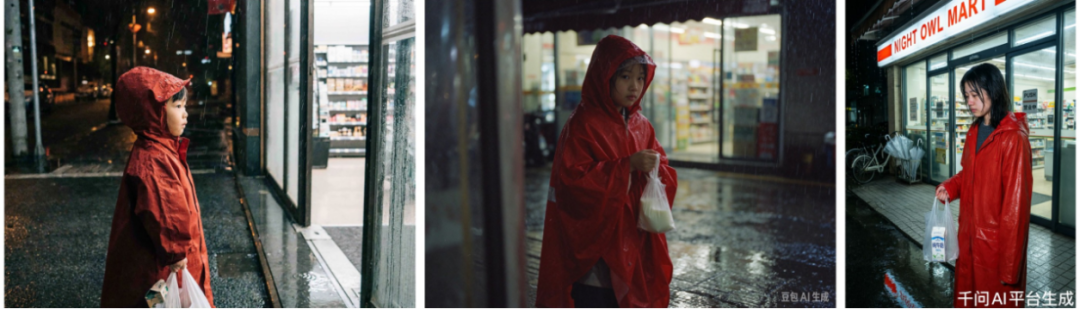
In this round I preferred H3's result. The girl and the convenience store were both rendered quite naturally, and the overall look was like a photo casually taken on a rainy-night street — and this one was a 4K output.
Doubao's image focused more on the character, with obvious background blur; Qianwen used a vertical composition, including both the character and the store sign, but its aspect ratio was different from the other two.
Second round: children's illustration
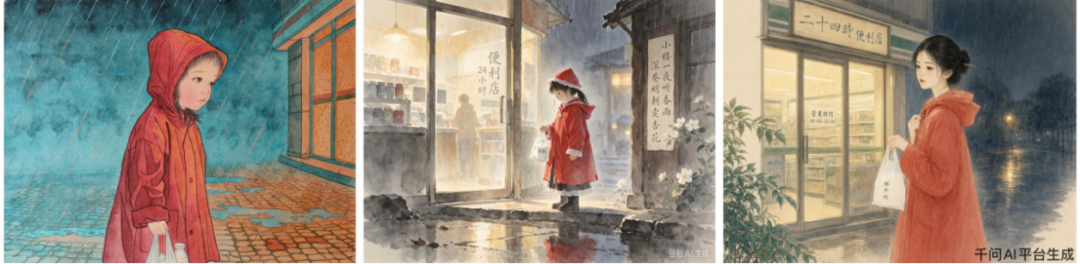
In this round Doubao drew with a strong picture-book feel. The rain, lights, and convenience store environment were all quite rich, and this was one I personally liked more.
H3's image was relatively simple, more like a hand-drawn illustration, but part of the convenience store was cropped out, and the scene was handled somewhat perfunctorily. Qianwen's image had a fairly obvious Chinese-style flavor, with very detailed rendering, but it was somewhat distant from the ordinary children's picture-book feel I originally wanted.
Third round: blind box figure
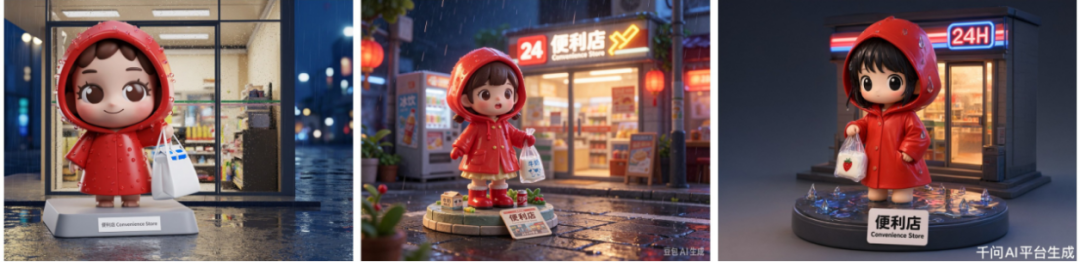
In the blind box round, all three achieved the character figure effect.
Doubao's image was the richest, with the base, store background, and surrounding display elements all fairly complete; H3 was overall more concise; Qianwen highlighted the character itself more, with the big eyes and red raincoat quite eye-catching, and it also added a strawberry pattern to the milk bag.
The required "Convenience Store Convenience Store" sign text in this round was also fully presented by all three. There was no particularly obvious winner or loser; it mainly depended on which presentation style one personally liked.
Fourth round: cyberpunk
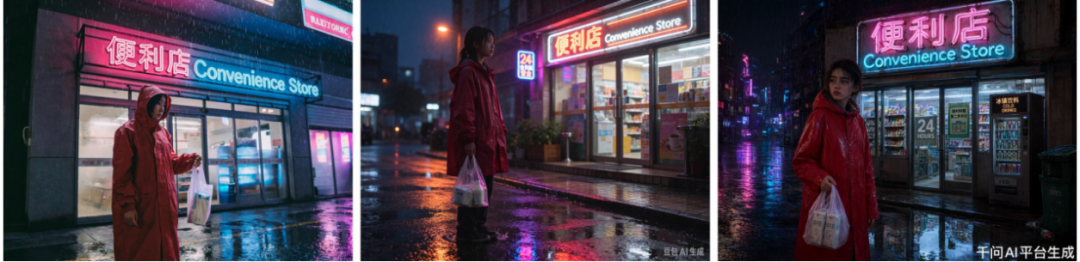
I found this round the most interesting.
H3's image was more like a neon scene on a rainy-night street, and the relationship between the character and the convenience store was quite natural. Doubao drew the store interior and surrounding environment very richly, and it was also a very complete rainy-night street scene.
Qianwen's image had the strongest futuristic city atmosphere, with pink-blue neon, wet streets, and dense signage all very evocative, and the Chinese and English text on the signs was all written correctly. If looking only at visual effect, this one was indeed eye-catching, and personally this was my favorite.
Fifth round: flat illustration
In the final round, H3's image was the simplest, with relatively clean color blocks and lines, and it was closer to the flat illustration I wanted.
Doubao and Qianwen both added more light, shadow, and detail, making the images richer, but they also looked more like commercial illustrations with a three-dimensional feel. Doubao's image even directly drew the convenience store as a real-life FamilyMart, with the brand name and advertising slogan on the sign, which was somewhat superfluous.
After five rounds, I did not feel that any one was clearly ahead every time. H3 was relatively well-behaved, Doubao liked to make the image richer, and Qianwen sometimes produced unexpected effects.
However, image generation is only the first step. What really made me want to continue comparing was the image editing that followed.
02 Continuous Image Editing: The Gap Shows
For this image editing test, I directly used the cyberpunk image from the fourth round to continue operating, without re-uploading the image. Then I made three requests in succession:
1. Replace the milk bag in the girl's hand with an umbrella.
2. Change the red raincoat to yellow.
3. Add glowing "24 hour" text to the convenience store sign.
I did not add other explanations after each step, nor did I regenerate the prompt for the entire image. I just watched whether they could continue modifying based on the original image according to the requirements.
First, Doubao.

All three requirements were completed.
Step one, replace with an umbrella: the milk bag became an umbrella, and the girl's position, the convenience store, the rainy night, and the water reflections on the ground were all preserved.
Step two, change the raincoat: red became yellow, and there were no obvious changes elsewhere in the image.
Step three, add text: glowing "24 hour" text appeared on the sign. The position was slightly crowded, pressed above the original sign, but the original sign content was not damaged.
As far as the editing itself is concerned, Doubao really did change only what was requested in these three rounds.
This also corresponds to the multi-round editing capability emphasized when Seedream 5.5 was released. The official demonstration once showed continuous editing for 100 rounds while trying to keep non-edited areas unchanged. We did not run 100 rounds, but at least in these three rounds of testing, its performance passed.
Next, H3.

H3 also completed the three modifications.
In step one, the milk bag was replaced with a closed umbrella, and the girl, storefront, and red raincoat were all preserved. In step two, the raincoat was changed to yellow, and the umbrella did not disappear. In step three, glowing "24 hour" neon text appeared on the sign, positioned below the original sign without covering the original text.
The key is that these three steps were continuous: the third step was modified based on the image with the yellow raincoat, not redrawn from scratch each time. From composition and character position to the rainy-night atmosphere, there was no obvious drift across the three rounds.
Finally, I enlarged the sign area of the original 4K image to check, and the original text was still clear and complete. This time H3 output in 4K, and after continuous modifications, the image details were also preserved quite well.
Finally, Qianwen.
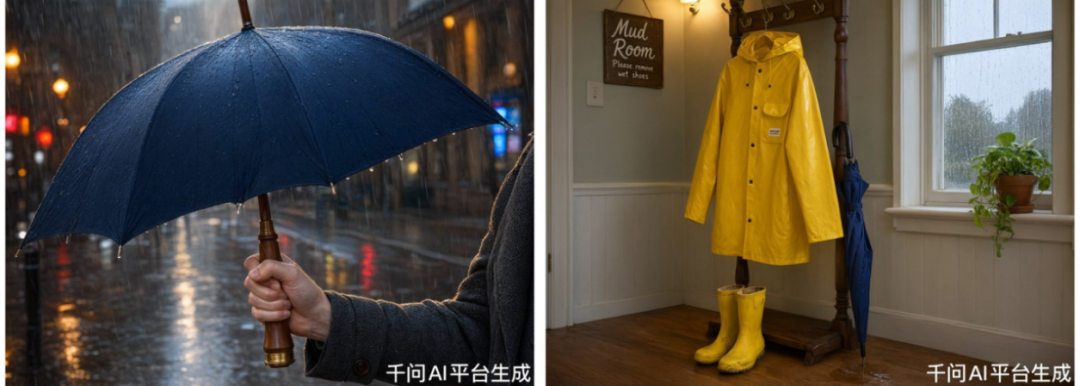
Qianwen directly made me lose my composure.
The first time I asked it to replace the milk bag with an umbrella, the result it gave directly became a close-up of an umbrella, and the original girl and convenience store scene were not preserved.
The second time I asked it to change the red raincoat to yellow, the image then became a corridor and a coat rack, already having little to do with the original rainy-night convenience store.
At this point I directly gave up on the third round.
In continuous image editing within the same conversation, in this test it was unable to complete modifications to the original image. Compared with the other two, the gap was very obvious.
03 Several Other Small Findings
Besides the images and image editing, there are several details worth mentioning in this test.
First, prompt processing. Both H3 and Qianwen automatically expand prompts before generation. Qianwen's interface has this switch, enabled by default. This does not count as cheating; platform capabilities are part of the test in the first place.
In terms of aspect ratio, I tried both methods with Doubao: selecting 4:3 in the configuration before generation, and all five rounds of output were stable; writing the ratio into the prompt and running it again also produced normal images. It could handle both configuration and prompt paths.
Qianwen and H3 really did change according to the ratio in the prompt. Qianwen changed the canvas back, and H3 even proactively explained the reason for parameter adjustments.
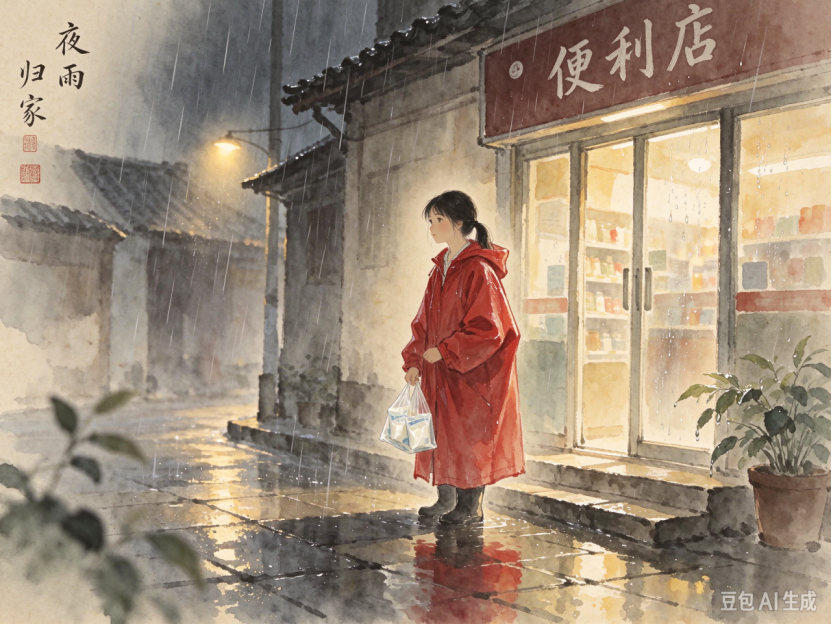
There were also differences in output specifications. H3 was 4K output throughout, while the other two produced noticeably smaller image sizes, though there were no problems when enlarging to check details.
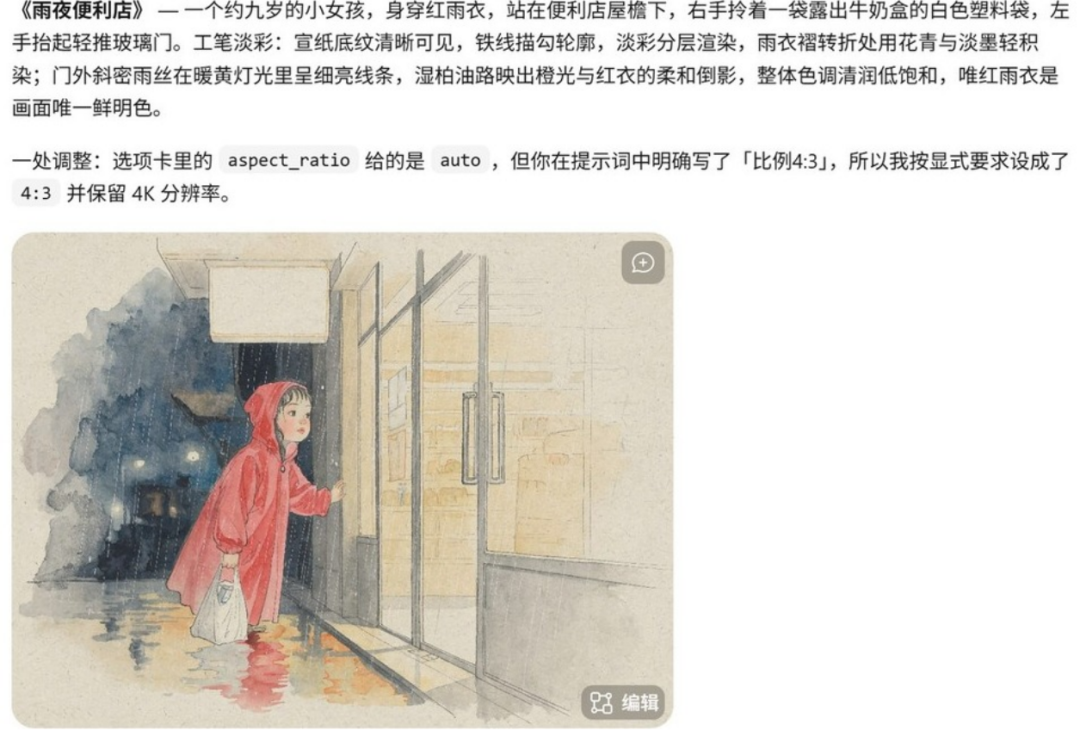
Qianwen's platform also supports generating multiple images at once. Size and number can be set in the input box, and up to 6 images can be generated directly at one time. In this test each company only ran one image per round, so this feature was not used, but for people who want to pick from several images at once, this feature is very practical.
Second, generation speed. Doubao mostly produced images in just over ten seconds this time, Qianwen took about one minute, and H3 approached one and a half minutes in some tests. However, this was only my experience during this test; actual speed will also be affected by tasks and platform status.
Finally, watermarks. Images generated by Doubao and Qianwen had platform watermarks, while H3 did not this time.
04 A Few Thoughts
In this test, all three had decent image generation results, and the differences were more in image style and detail handling.
But if the generated image still needs repeated modifications afterward, H3 and Doubao were clearly more reassuring to me this time. Qianwen's image generation had highlights, but its continuous image editing did not meet expectations.
If I were to find a suitable scenario for each of the three: for frequent continuous image modifications, Doubao and H3 were both relatively reliable this time; for clear requirements on aspect ratio, clarity, and prompt execution, H3 had more advantages; for mainly generating single images with basically no need for subsequent modifications, Qianwen also performed well.
Of course, this was just a small test I did with the same set of prompts. But for me, AI drawing is not only about whether the first image can be drawn beautifully; whether it can continue to be modified according to my ideas is equally important.
-
![]()
AI in This Year: The Apps That Fell
-
What Pinduoduo Left Unsaid on Its Earnings Call
-
![]()
Full Capacity Orders: This Optics Company's Revenue Hits 88.44 Million Yuan in First Ten Months
-
![]()
Personnel Change: Sun Gaofei, Independent Director of Zhongguangxue, Resigns
-
MoJie Technology Makes Its APEC Debut Following 600 Million Yuan Financing: A Full-Chain Optical Layout
-
![]()
Tencent: The Biggest Earner Takes the Hardest Fall
-
![]()
Seedance vs. MiniMax vs. Qwen: 3 Rounds of Continuous Edits — Which One Is More Usable?
-
![]()
Smart Glasses Offline Experience Stores—Why Can't They Get Off the Ground?