AI Has Its Sights on Your Wallet | Juchao
 11/20 2026
 574
Editor | Yang Xuran
AI is starting to reach into the most sensitive corners of ordinary people's lives: how much is left on the bank card, how many bills are due next month, and where that money will ultimately go.
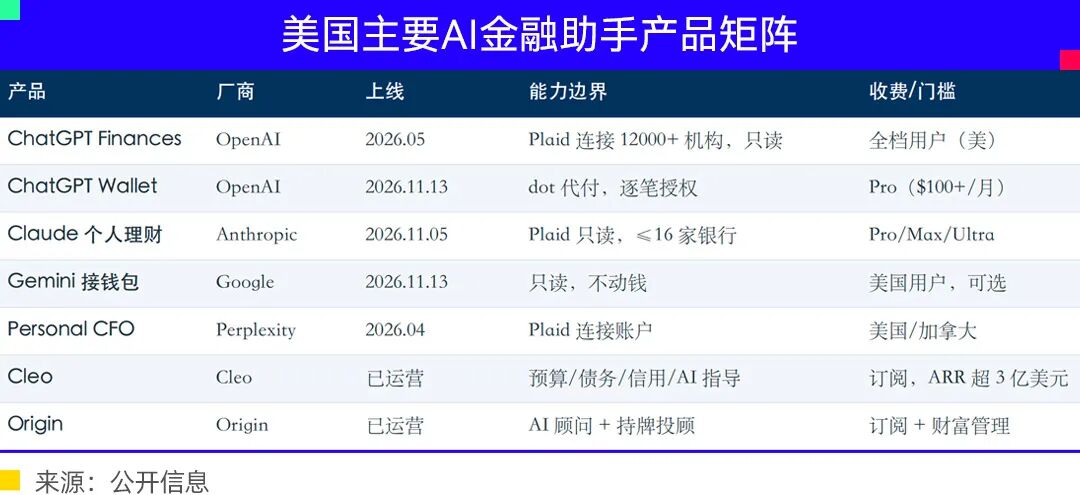
In early November, Anthropic launched a beta version of Claude for personal finance. Soon after, OpenAI followed with ChatGPT Wallet. The former helps users view their accounts by linking them, while the latter already lets agents complete shopping payments once the user confirms.
The two serve different functions, but they are competing for the same kind of trust—the trust that dares to hand money over to AI.
Once people are willing to let AI understand their income, debts, spending habits, and even investment needs, the companies behind AI become far more likely to shape people's everyday financial decisions.
This is, of course, also a market Chinese AI companies can hardly ignore. The problem is that once chat windows begin to connect to household savings, the questions the product must answer are no longer just whether the model is smart enough. Who provides these financial services, who makes the recommendations, who moves the funds, and who is accountable when problems arise will all become a series of complex issues.
This article is an in-depth value piece from the Juchao WAVE content team. Welcome to follow us on multiple platforms.

Action
A close look at the moves of the two leading U.S. AI companies reveals a very concrete starting point: helping users handle complex financial affairs scattered across different financial institutions.
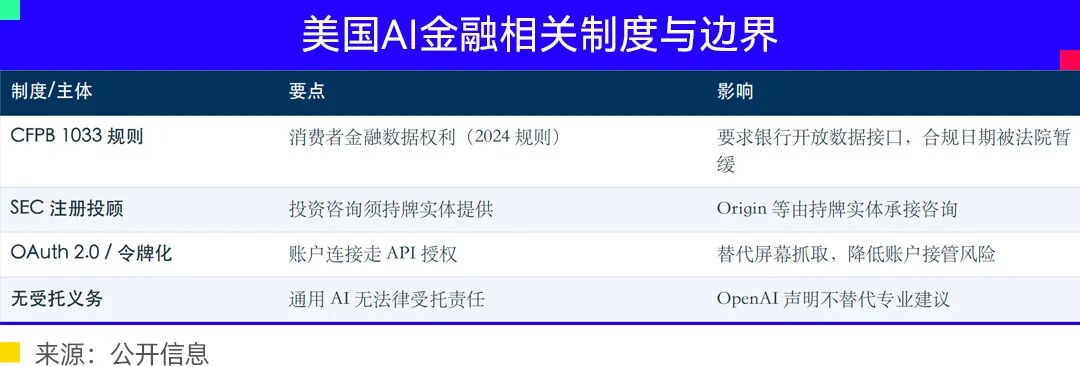
Some paid U.S. users of Claude can connect accounts via Plaid to aggregate balances, transactions, and pending bills, and to spot duplicate charges and anomalous fees. It currently has read-only permission and cannot transfer funds or execute investments; conversations in the personal finance section are not used for model training, and the section contains no ads or paid recommendations.
OpenAI, meanwhile, is exploring two paths at once. Finances is used to organize spending, assets, and debts, and likewise cannot trade on the user's behalf. The newly launched Wallet connects to payment networks and is first being opened to U.S. adult Pro users in dots; payment occurs only after users verify the product, amount, and bank card and pass security verification.
Viewing accounts, giving advice, and moving money are being split into different permissions. The two companies have not directly handed the entire household finance to a freely acting model, which means the whole matter is still at a relatively early stage.
This is related to the particularity of the U.S. market: a person's salary account, credit cards, loans, and investment accounts may belong to multiple institutions, and each platform can display only its own data, making things quite fragmented.
AI's opportunity lies in turning these complex and scattered bills into a more understandable household financial arrangement: which fees will still be deducted before payday, which subscriptions can be canceled to reduce spending, and what it would affect to set aside cash for a large purchase.
Ordinary people's anxiety about financial management is fully capable of supporting a paid business. Startup Cleo combines budgeting, debt management, credit services, and AI guidance into different subscriptions, and its website says annual recurring revenue has exceeded $300 million.
Another company, Origin, moves closer to wealth management. Its terms of service explicitly state that investment advice involved in its AI advisor and professional financial planning services is provided by its affiliated investment adviser entity registered with the U.S. Securities and Exchange Commission.
These two paths show that a personal finance assistant can make money either through user subscriptions or by entering the existing financial services system. Large model companies have huge user entry points and are striving for the most valuable position in this track: the user's first window for inquiries, where systematic service capabilities can be directly provided.
The United States also has clear regulatory boundaries of responsibility, though they will differ noticeably from China's specific circumstances.

Similarities and Differences
China's AI finance sector is not a blank space; the difference is more in how services are organized.
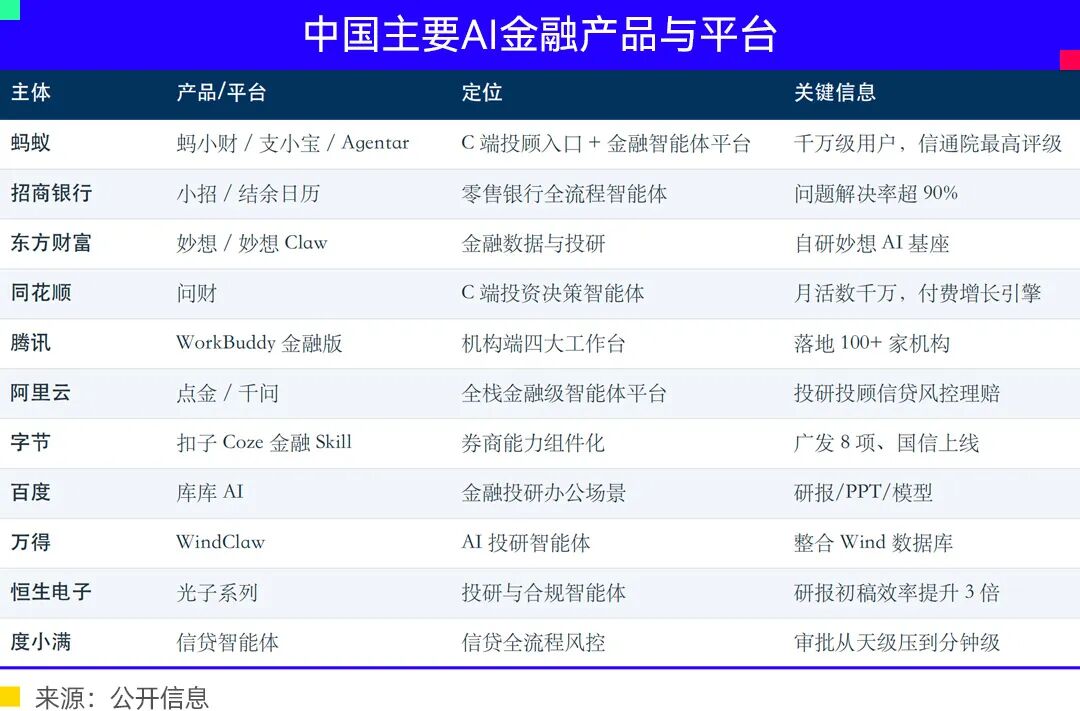
Ant Group's representative product is "Ma Xiaocai," which provides market interpretation, fund analysis, and other services, and emphasizes that professional services are provided by partner licensed institutions; China Merchants Bank has added a balance calendar, intelligent account retrieval, and "Xiao Zhao" intelligent services to its own app; East Money's "Miaoxiang" revolves around financial data, charts, and investment research analysis.
These cases point together to a more easily implementable path: financial platforms and institutions hold the accounts, products, and service relationships, and AI is embedded within them to help users understand and handle business. The difficulty for domestic general-purpose assistants lies in how to step beyond their original information service scope and legally enter financial business.
The first boundary is service qualification.
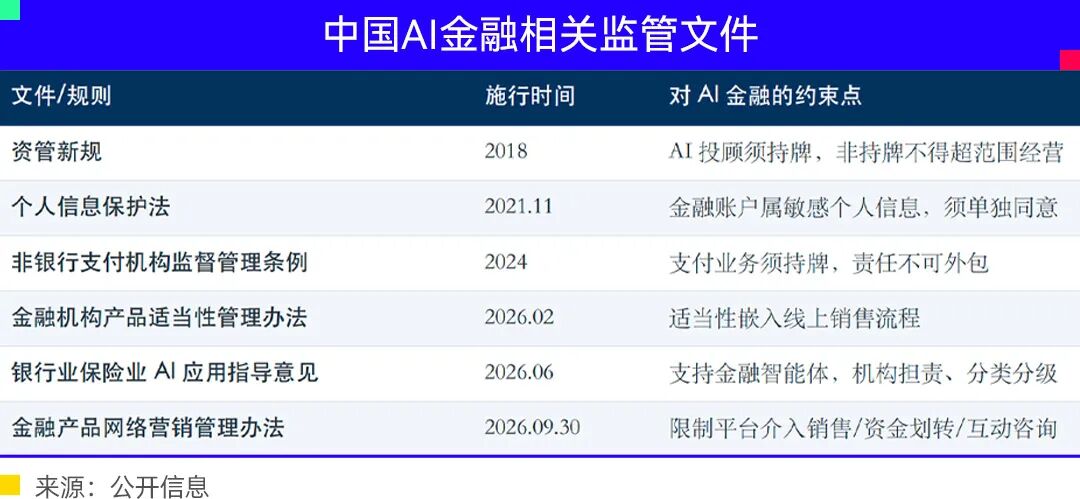
As early as 2018, the new asset management rules made clear that using artificial intelligence to conduct investment advisory business requires corresponding qualifications, and non-financial institutions may not use robo-advisory to operate beyond scope or conduct asset management in disguised form.
Conveying specific information about a fund to users and providing specific investment advice to a particular user involve different natures of business. A model can write out an allocation plan, but that does not mean the company operating the model is already qualified to operate the corresponding business. The high threshold of financial business has not disappeared for large models.
In addition, this year's new rules have also subjected technology companies' financial products directly to more new constraints.
The Measures for the Administration of Online Marketing of Financial Products, effective from September 30, require third-party platforms to conduct marketing only when entrusted by financial institutions in accordance with the law. Article 20 explicitly restricts platforms from improperly intervening in sales contracts, fund transfers, suitability assessments, and other links, and prohibits them from engaging in interactive consultations with consumers and investors regarding financial products.
For AI companies accustomed to connecting all services through conversation, this regulation is quite specific. If an assistant collects marketing fees from financial institutions and also explains and promotes specific products to users in chat, that amounts to deeper intervention in specific business.
The regulator's intent is clear: it is difficult for AI companies to handle the entire process of recommendation, consultation, and transaction merely through a cooperative entry point.
The second boundary is the protection of personal data.
The Personal Information Protection Law classifies financial accounts as sensitive personal information, requiring processing to have specific purposes and sufficient necessity, and to adopt strict protection measures; processing requires separate consent from users. In addition, if data is exported abroad, corresponding obligations must be fulfilled according to applicable rules.
Users wanting AI to understand them does not mean that key information such as bank statements can be handed unconditionally to any model. In practical application, the security boundary of users' financial data will be a complex issue.
What is more feasible to implement first in China is for institutions to provide services within the data they legally hold and the business they are permitted to conduct. For technology companies, building a reliable assistant for banks and large financial institutions is often more realistic than independently aggregating all bank accounts and directly operating household wealth management.
The third boundary is decision-making and execution.
The Measures for the Administration of Suitability of Financial Institution Products, effective in February this year, require applicable institutions to embed suitability management into online sales processes and match product risks with customers' tolerance.
When a user says "help me increase returns," that does not complete a risk tolerance assessment, nor does it clarify whether the money is needed for rent next month. The more convenient it is to assign tasks through chat, the more the system needs to fill in missing information rather than interpreting every nod from the user as "unlimited authorization."
Fund operations also have independent thresholds. The Regulations on the Supervision and Administration of Non-Bank Payment Institutions clarify the licensing requirements for payment business. AI can provide technical assistance within compliant interfaces and authorized scope, but the entity actually engaging in payment business still needs corresponding qualifications; accounts, verification, and transaction responsibilities cannot be erased by a chat interface.
With several boundaries superimposed, the form of China's AI financial products will inevitably differ. It can be foreseen that financial explanations and risk reminders aimed at the general public will become more widespread, while services involving specific products will be more concentrated within qualified institutions.
AI assistants guiding users' needs toward specific products, licensed institutions completing the corresponding business execution, and technology suppliers earning service revenue will be a more feasible and smoother commercial path.
This also changes the conditions of competition. The barriers to financial AI include not only models, but also user data obtained through compliance, financial qualifications, business systems, and the corresponding ability to bear responsibility.

Inevitability
Regulatory boundaries will affect the speed and order of AI's entry into finance, but it is very difficult to eliminate this demand.
The digitalization of banking and insurance and programmatic trading have already clearly demonstrated technology's ability to change financial work. Large models further lower the threshold for understanding complex information, allowing some services that previously required appointments, fees, or professional knowledge to reach ordinary households more frequently.
For users without many assets, wealth management may first mean avoiding unnecessary spending: understanding the total cost of a loan, knowing what exclusions a insurance policy has, and identifying whether the several funds one holds are highly overlapping.
If AI can consistently do these things that benefit users, its product value is equally real.
Chinese regulators are also leaving room for compliant applications. In June this year, the National Financial Regulatory Administration issued guiding opinions on the safe development and application of artificial intelligence in the banking and insurance industries, supporting exploration of financial agents while emphasizing that using institutions bear responsibility and strengthening classified and tiered management.
Improving the capabilities of financial assistants can both help users and potentially make the sale of financial products more efficient.
An AI that grasps income, debts, and sources of anxiety can remind users earlier to reduce unnecessary borrowing, and may also more accurately find the moment when he is willing to accept a certain loan. An answer that is friendly and personalized enough does not prove that it represents the user's interests; refusal is among the more valuable suggestions.
Charging users, collecting technical service fees from institutions, and earning revenue from product sales will create different incentives. Which part of this revenue a technology company wants to obtain is the ultimate judgment of its own positioning.
In addition, security needs to be implemented in verifiable links. Balances and bills must be traceable to original records, calculations must be completed by reliable systems, and the model is responsible for explanation; important operations retain explicit confirmation and permission limits; when errors occur, records can be found, execution can be stopped, and the responsible party can be determined.
These arrangements will make some operations seem less smooth, but they are also the prerequisite for ordinary people to dare to use it. A successful account connection and a family's years of confident use are two levels of product capability.
Judging from existing products and systems, leading U.S. general-purpose AI companies are more actively extending from user entry points into financial services, while China places more emphasis on having AI operate within licensed institutions and their responsibility systems. This is a difference in development paths and cannot be inferred to mean that the United States does not value safety, or that China naturally will not have risks.
Both approaches will ultimately need to address what the other side is missing—U.S. companies must prove that cross-account and cross-service convenience can remain consistently trustworthy, while Chinese institutions must truly transform compliance processes into services that are easy for users to navigate. Consumers need to spend less on unnecessary fees, avoid risks, and make more informed decisions; safety matters even more than efficiency.

Summary
AI companies' entry into user wallet management stems on the one hand from genuine user needs, and on the other from their own profit-driven development motives.
Different qualification and responsibility requirements apply to reading balances, recommending products, and operating funds. Even the most aggressive commercial institutions will recognize these distinctions.
In China, regulation is more likely to push technology companies to enter this market through partnerships rather than "handling" everything themselves and offloading risks onto users, the public, and the entire financial system.
Future competition in the financial sector will depend not only on how much AI can accomplish for users, but also on whether it can restrain the impulse to sell, preserve user choice, and bear due responsibility when errors occur. Gaining permissions is only the beginning; maintaining users' long-term trust will determine how far this business can go.
-
![]()
AI in This Year: The Apps That Fell
-
What Pinduoduo Left Unsaid on Its Earnings Call
-
![]()
Full Capacity Orders: This Optics Company's Revenue Hits 88.44 Million Yuan in First Ten Months
-
![]()
Personnel Change: Sun Gaofei, Independent Director of Zhongguangxue, Resigns
-
MoJie Technology Makes Its APEC Debut Following 600 Million Yuan Financing: A Full-Chain Optical Layout
-
![]()
Tencent: The Biggest Earner Takes the Hardest Fall
-
![]()
Seedance vs. MiniMax vs. Qwen: 3 Rounds of Continuous Edits — Which One Is More Usable?
-
![]()
Smart Glasses Offline Experience Stores—Why Can't They Get Off the Ground?