WorkBuddy, Qwen Office, and Doubao Work Lead Office Agent Usage, Report Finds — Part II of the China Office Agent Market User Research Report 2026
 11/25 2026
 362
Analysys recently released the China Office Agent Market User Research Report 2026, an in-depth study of office agent users. The study found that competition in China's office agent market has entered a stage where user penetration is concentrating toward the top, while no single player has yet secured a dominant position.
In its China Office Agent Market User Research Report 2026, Analysys defines "office agents" as agent products that use artificial intelligence as their core capability to deliver task automation, workflow orchestration, and information processing services to users in office settings.
The survey was distributed via online questionnaires to users who had used office agent products in the past three months. It yielded an effective sample of N=1,200, with the survey conducted in October 2026. Desktop users made up the majority of respondents, and the sample covered both active users and low-frequency trial users.
Analysys's main findings are as follows:
I. Product penetration and main product choice: Coverage is concentrating toward the top, with positioning differences shaping conversion
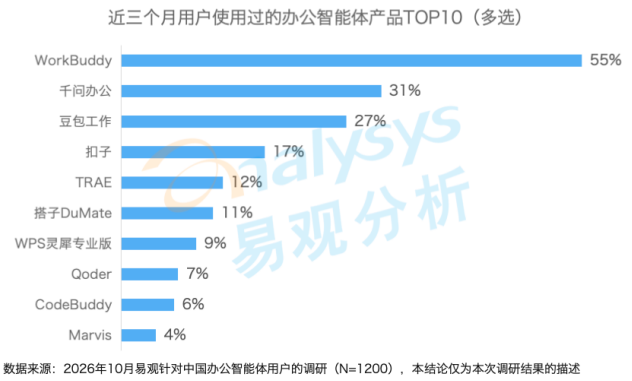
Figure 1 Top 10 office agent products used by users in the past three months (multiple choice)
Product penetration rate reflects each product's user coverage. According to the survey, users had used an average of more than two office agent products. WorkBuddy led with a penetration rate of 55%, its main advantages being full-scenario task delivery and ecosystem entry; the launch of enterprise edition products further extended its reach. Qwen Office and Doubao Work followed, while Coze ranked fourth on the strength of its developer ecosystem.
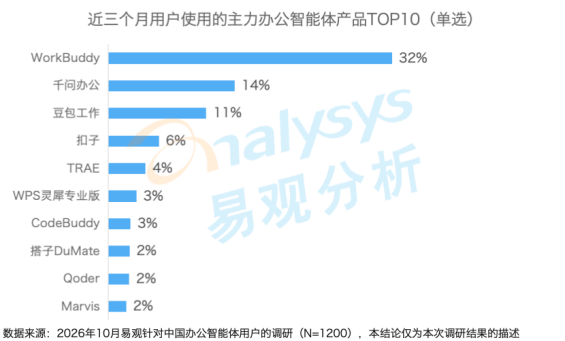
Figure 1 Top 10 main office agent products used by users in the past three months (single choice)
The main product is the one product users rely on most in their daily work, and its usage reflects a product's actual position in users' workflows.
Comparing user penetration rate with main product choice: among users who had used WorkBuddy, more than half had already made it their main product; for Qwen Office and Doubao Work, the conversion rate was about 40%. DuMate's main product choice rate was about 20%. This gap may stem from the paths through which users enter a product: connections rooted in existing office software ecosystems such as WeCom, DingTalk, and Feishu are more likely to foster stable usage. Among users of programming agent products such as TRAE, CodeBuddy, and Qoder, about 30% had made them their main product. These users arrived with clear development or automation needs, and usage quickly became a fixed habit. The scale is limited, but stickiness is relatively stable.
II. Differences in user job role distribution: Capability labels and ecosystem entry determine main product affiliation
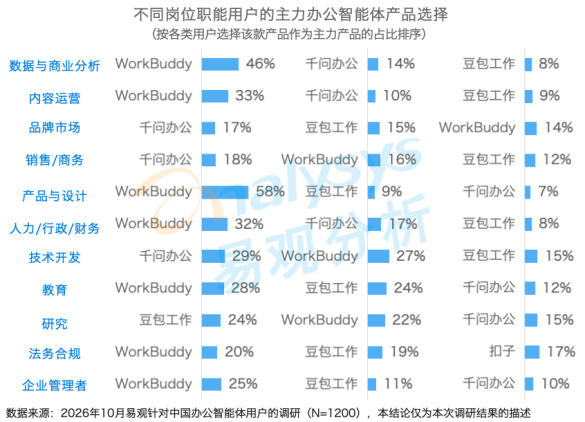
Figure 2 Main office agent product choices of users with different job functions
A product's capability labels in specific task types, together with its ecosystem entry advantages, determine the main product choices of users in different job functions. Users in data and business analysis, content operations, HR/administration/finance, education, and enterprise management all mainly used WorkBuddy as their primary product. Its full-scenario coverage provided stable support for the needs of various positions, with the highest concentration among product and design users; design and creative tasks may require multimodal processing capabilities, which may lead these users to settle quickly on a single product. Users in brand marketing, sales/business, and technical development mainly chose Qwen Office, matching the capabilities of the Qwen large model and its reputation in the e-commerce field. Doubao Work's broad reach through C-end entry points led relevant groups to convert earlier.
III. User choice motivations: Task delivery quality dominates, and habitual factors have yet to create lock-in
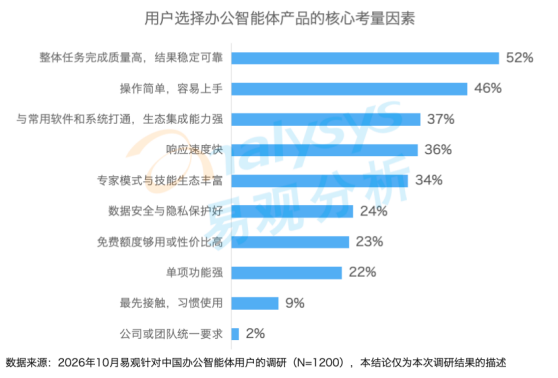
Figure 3 Core considerations for users when choosing office agent products
52% of users cited high overall task completion quality and stable, reliable results as the main reason for choosing their main product. Ease of operation and a short learning curve ranked second at 46%; onboarding cost remains a key variable for expanding the user base, and investment in lowering usage thresholds also affects main product competition. Ecosystem integration capability, response speed, richness of experts and skills, and security are also important factors users weigh when evaluating products. In addition, only 9% chose the product they had first encountered and were accustomed to using, reflecting that users' choice of main product is always grounded in the experience of full-process task delivery. The stable delivery performance of general office products will become a key factor in user choice.
IV. Product differences in motivation structure: Each product gathers user groups for different reasons
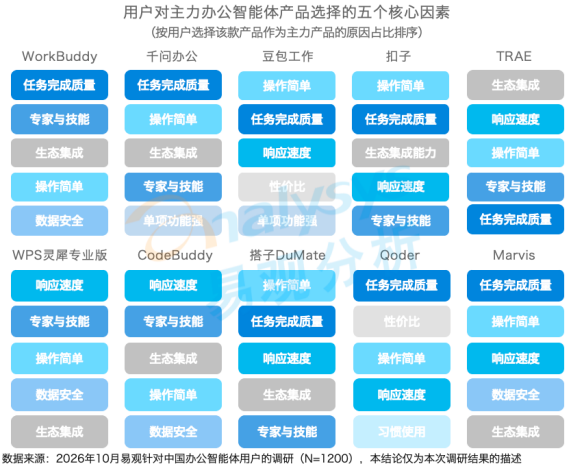
Figure 4 Core choice factors for office agent products (top five)
Users who choose different products as their main product differ clearly in the motivations they value, and each product gathers its own user groups for different reasons. Users with WorkBuddy as their main product placed greater importance on task quality, experts and skills, and ecosystem integration, while also valuing ease of use and security; their motivation structure was the most balanced. Users with Qwen Office as their main product showed a choice rationale that placed equal emphasis on delivery quality and functionality. For Doubao Work users, ease of operation ranked first, and its low onboarding threshold reflects its positioning among C-end users. Among programming products, TRAE and CodeBuddy users regarded ecosystem integration and response speed as important considerations; execution efficiency and the ability to connect with existing toolchains after being embedded in the development environment are the core factors drawing users to such products.
V. Product user stickiness: High-frequency usage has generally taken hold, higher for general office products than programming products
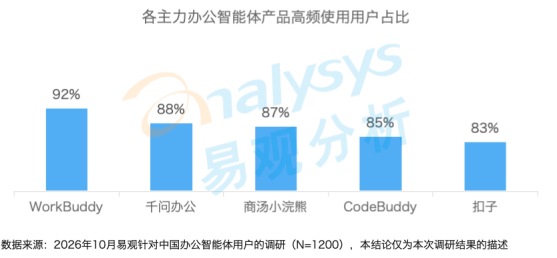
Figure 5 Proportion of high-frequency users of office agent products
High-frequency users are office agent users who use the product every day or three to four times per week. Examining main products alongside usage frequency reveals the stickiness quality of each product's bound users. According to the survey, all major products have developed a pattern of high-frequency usage. Among them, the proportion of high-frequency users with WorkBuddy as their main product reached 92%, and Qwen Office reached 88%; for both products, more than 40% of users used them every day. Main product status and high-frequency usage reinforce each other, and users have naturally integrated these products into their daily work rhythm. Stable delivery performance further encourages users to assign more tasks. In addition, although SenseTime Xiaohuanxiong was not at the forefront of main product penetration, users who had made it their main product immediately settled into a high-frequency rhythm. This may reflect a strong match between user needs and product characteristics, gaining a highly bound user group through execution capability in proprietary scenarios. Future expansion of its user base will depend on extending scenario capabilities to more tasks.
The proportion of high-frequency users for programming products is overall lower than that for general office products. Daily office tasks are generally spread evenly throughout the workday, whereas programming tasks mainly follow the rhythm of development work, reflecting differences in work rhythm; user stickiness naturally forms around each product's respective task form.
VI. Industry judgment: The competitive foundation has moved beyond usability, and the landscape is converging but not yet locked
Analysys believes that competition among office agent products has moved beyond usability and breadth of coverage, entering a stage of landscape convergence centered on task delivery quality.
◎ Coverage and main products are simultaneously concentrating toward the top. Users in the sample had used an average of more than two products, and multi-product trials have become the norm; the composition of the penetration rate TOP10 and the main product TOP10 is basically consistent. Leading general office agents rank at the forefront on both indicators, and faster product line integration and iteration constitute the current action logic of leading vendors.
◎ Conversion from penetration rate to main product status is not automatic. Main product choice depends on users' entry paths, capability labels, and degree of scenario matching: connections with existing office software ecosystems, reach through C-end entry points, and the immediate fixed habits brought by clear development needs correspond to different conversion levels; proprietary scenario products can form highly bound user groups even when penetration is not advantageous.
◎ The landscape has not yet locked. In terms of product choice factors, task delivery quality ranks first among choice motivations at 52%, while habitual factors account for only 9%. Users' choices are always grounded in the full-process task delivery experience; high-frequency usage has generally taken hold among major products, but the source of stickiness remains stable delivery performance rather than first-mover positioning or usage inertia.
◎ Capability differences are concentrating toward the back end of the link and ecosystem openness. Improvement demands focus on ecosystem integration, long-text and file processing, and result accuracy, corresponding to ecosystem integration capability, response speed, and richness of experts and skills among choice motivations. Whether a product can connect to existing software and system ecosystems, undertake complex long-horizon tasks, and produce truly reliable results constitutes the watershed among mainstream products now that the competitive foundation has moved beyond usability.
For complete data and conclusions on the product competitive landscape and user choices, please see Analysys's China Office Agent Market User Research Report 2026.
Analysys has released China Office Agent Market User Research 2026. Please stay tuned.
Research Notes
The industry analysis provided by Analysys is mainly based on industry macro data, end-user quarterly survey data, vendor historical data, and vendor quarterly business monitoring information, using Analysys's industry analysis model and combining market research, industry research, and vendor research methods. It mainly reflects the current market situation, trends, inflection points, and patterns, as well as vendors' development status.
Analysys believes that the data obtained through the above industry research methods fall within the generally acceptable error range for the industry and can accurately reflect industry trends and patterns of change.
The research results obtained through professional research methods are intended for decision-making reference. For vendors' actual data, please refer to the financial reports released by the vendors.
Copyright Statement
The third-party data and other information cited in this article by Analysys all come from public channels, and Analysys assumes no responsibility for them. Under no circumstances is this article for reference only and not to be used as any basis. The copyright of this article belongs to the publisher. Without authorization from Analysys, it is strictly prohibited to reprint, quote, or use in any way any content published by Analysys. When any media, website, or individual uses it after authorization, they shall quote the original text and indicate the source, and the analytical views shall be subject to the content officially released by Analysys. No form of deletion, addition, splicing, deduction, distortion, etc. is permitted. Analysys assumes no responsibility for any disputes arising from improper use and reserves the right to pursue liability against relevant responsible parties.
-
Why Are Listed Companies' Financial Reports Starting to Take Douyin E-commerce's Business Logic Seriously?
-
AI Steps on the Gas: A 167-Year-Old Cold Case Finally Hears an Echo
-
![]()
Short Dramas: Big Tech's Q3 Earnings Scapegoat or Lifeline?
-
![]()
Coating Material Selection: Four Critical Gates — Contrast, Absorption, Stress, and Process Window
-
![]()
Maishi Optoelectronics Completes IPO Coaching Acceptance Inspection, Securing 2 Billion Yuan in Financing This Year
-
Second Financing Round of the Year! Chengfeng Technology Secures Tens of Millions of Yuan in B+ Round
-
![]()
Why Can't Hongguo Swallow Bilibili?
-
![]()
The Day After Jensen Huang's Return: The Fed Pours Cold Water on the Rally