Why Can't Hongguo Swallow Bilibili?
 11/25 2026
 568

Bilibili has escaped the great Hongguo.
Author: He Jian
Editor: Wang Bin
Cover: Night of the Biohazard Outbreak
In an era when the great Hongguo devours all long-form video, Bilibili alone stands out as a bright spot.
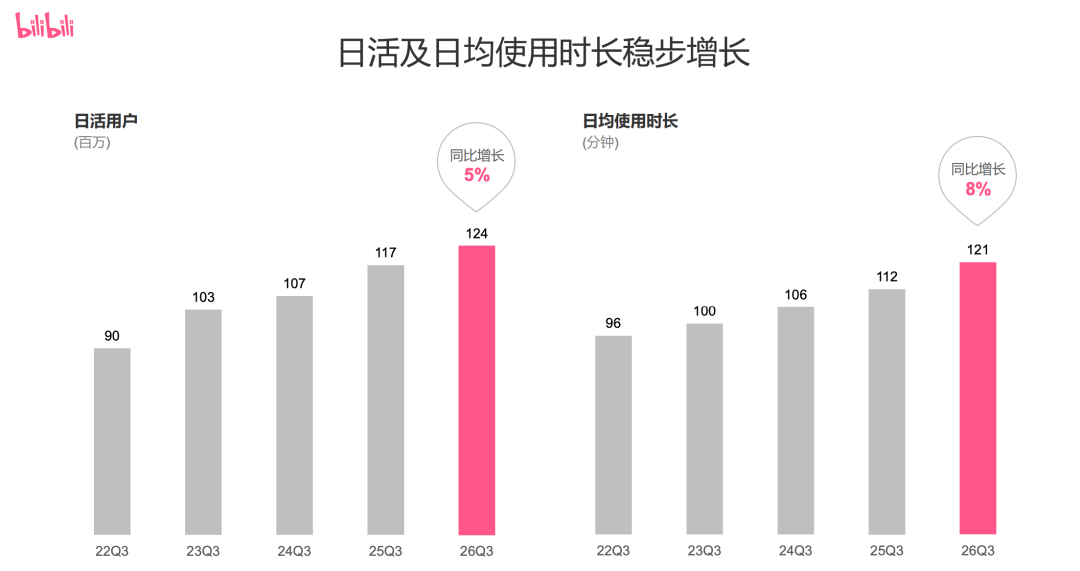
On November 24, Bilibili released its Q3 2026 financial report. In the quarter, Bilibili's daily active users reached 124 million, monthly active users reached 394 million, and average daily time spent per user reached 121 minutes—all three figures hitting record highs. This was also the first time Bilibili's average daily time spent per user exceeded two hours.
Bilibili financial report
At the start of last night's earnings call, even a Goldman Sachs analyst could not help asking: as more and more internet companies are hit by short dramas and short videos, how is Bilibili still able to keep growing?
Bilibili Chairman and CEO Chen Rui said that many people had asked him this year whether Bilibili had been affected by short dramas. "My answer is definitely no."
Chen Rui compared short-form content to potato chips and Bilibili's content to rice, saying that the two satisfy different needs of different users—a remark in which Chen seemed somewhat proud of his company's high-quality content, one being junk food and the other a quality staple.
At least judging from the financial report, Chen indeed has grounds to say so. Over the past three years, despite the rapid rise of short dramas, Bilibili's total user time spent has maintained double-digit annual growth. In the first half of this year, this figure grew 17% year-on-year, and in the third quarter it also grew 14%.
But for most of the past year or so, Bilibili's investors have clearly not been as optimistic as Chen Rui. Since the beginning of the year, Bilibili's US and Hong Kong stock prices have both fallen nearly 70% from their intra-year highs.
Over the past few months, several investment banks have successively lowered Bilibili's profit expectations and target prices. One reason is concern that even if Bilibili can retain users who do not watch short dramas, it may not retain advertisers who switch to short dramas.
The latest financial report has to some extent dispelled investors' concerns. In the third quarter, Bilibili's revenue was 8.32 billion yuan, up 8% year-on-year; adjusted net profit was 828 million yuan, up 5% year-on-year. Both figures were slightly better than market expectations. In the second half of the year, when advertisers generally tightened budgets, Bilibili's advertising revenue still maintained a 20% year-on-year growth rate.
At the close of US stocks this morning, Bilibili's share price rose 1.93%. After the Hong Kong market opened, Bilibili's share price surged more than 14% at one point during trading.
Hongguo survivor
Compared with long-video platforms, Bilibili was hardly affected by Hongguo's impact.
iQIYI, which released its Q3 financial report last week, saw its membership revenue in the quarter fall to its lowest level in nearly six years. Struggling to survive, iQIYI has had to cut self-produced content and hand more content to third parties, sharing revenue according to performance.
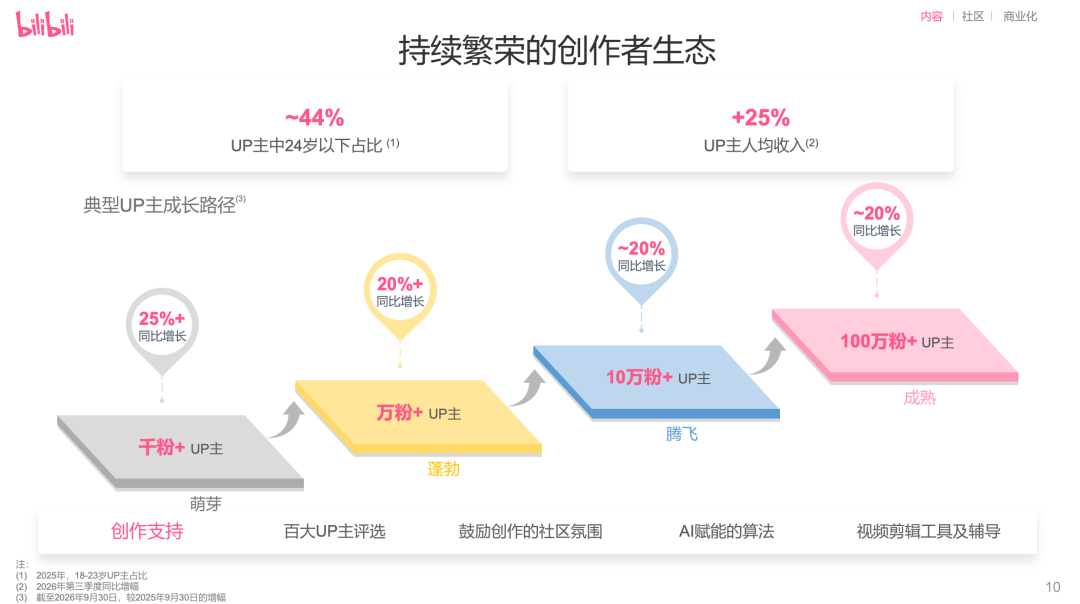
Bilibili's content supply, by contrast, is accelerating. In the third quarter, the number of daily active uploaders on Bilibili grew 10% year-on-year, average daily video submissions grew 36% year-on-year, and the number of uploaders with more than 1,000 followers grew more than 25% year-on-year. During the same period, the average income of Bilibili uploaders grew 25% year-on-year.
Bilibili financial report
It still comes down to differences in the platforms' underlying models. Unlike PGC platforms such as iQIYI, which mainly rely on dramas and movies to drive membership, Bilibili has always been in the PUGC business, with a large number of users themselves being content producers. The difference between the two is as great as that between Netflix and YouTube (though this is flattering to both iQIYI and Bilibili).
Bilibili once took a detour by learning from long-video platforms and producing its own content. Later it obviously wised up: rather than spending great effort on self-produced dramas, it is more cost-effective to let uploaders repost pirated content. For example, you can now find the hit variety show "Later Friends" on Bilibili, or Lee Chang-dong's Oscar-hopeful feature "Possible Love," and even in 4K HDR.
Chen Rui believes that short-form content and Bilibili target completely different user groups. Short-form content seeks to continuously attract attention, so it can only keep intensifying stimulation. Bilibili, by contrast, has always focused on high-quality content, and the most important thing about high-quality content is occupying users' minds and giving them a sense of gain.
Chen said that many Bilibili users do not watch short dramas at all. In his words, "Bilibili's users are the youngest, most active, best-educated, and most aesthetically discerning users in China."
Chen is very good at telling stories. On the earnings call, he even elevated the difference between the two to the level of "the beautiful spiritual needs of humanity," saying that "if everyone is full of hope for humanity's future, our business will definitely grow bigger and bigger." — Looking at the increasingly rampant Nailong and Big Fat Fish on Bilibili, perhaps there is no need to hold too high expectations for humanity's spiritual needs.
But in any case, Bilibili has indeed weathered this round of short-drama impact. Not only have user scale and time spent continued to grow, but even advertising revenue has not been greatly affected.
In the first three quarters of this year, Bilibili's advertising revenue totaled 8.81 billion yuan, up about 25% from the same period last year and close to the full-year total of last year. During the same period, iQIYI's advertising revenue fell about 2% year-on-year, only a little more than 40% of Bilibili's. In the second quarter of this year, Bilibili's advertising revenue also surpassed value-added service revenue, including livestreaming and premium membership, for the first time, becoming the company's largest source of revenue.
Compared with long-video platforms, some of Bilibili's advertising is more irreplaceable. Take the AI industry, which has risen rapidly over the past two years. For AI products, having a few uploaders spend half an hour demonstrating features may be more effective than inserting a few dozen seconds of advertising between short dramas. In the third quarter, Bilibili's advertising revenue from the AI industry grew nearly 95% year-on-year.
But Bilibili's advertising business is also not as easy as it was in the first half of the year. In the first three quarters of this year, Bilibili's advertising revenue grew 30%, 28%, and 20% year-on-year, respectively. After advertising became the company's largest revenue source in the second quarter, Bilibili's advertising revenue in the third quarter again fell below value-added service revenue.
Bilibili Vice Chairwoman and COO Li Ni said on the earnings call that advertisers generally tightened budgets in the second half of the year, and Bilibili's advertising growth came more from structural migration of overall industry budgets.
Faced with analysts' concerns about future growth in Bilibili's advertising revenue, Li Ni roughly repeated their previous talking points: the demographic dividend of Bilibili users aging, multi-screen advertising strategies, and advertising efficiency improvements brought by AI. Li Ni said they believe they will continue to outperform the industry's growth rate in the fourth quarter and next year and achieve advertising growth.
Investment banks are less optimistic. In its latest research report after the Q3 results, Citi affirmed the resilience of Bilibili's advertising business but still expected advertising revenue growth to slow further to 15% in the fourth quarter and cut Bilibili's profit forecasts for the next three years by 2% to 5%.
Macquarie is even more pessimistic. The bank previously argued that the rise of emerging content platforms such as Hongguo will lead to a reallocation of advertising budgets, and therefore cut Bilibili's advertising revenue forecasts for 2026 to 2028 by as much as 20%, and lowered Bilibili's Hong Kong and US stock target prices by 43%.
Chen still has to play Three Kingdoms
If the advertising business is excluded, Bilibili's revenue this year has actually hardly grown.
In the first three quarters of this year, Bilibili's value-added service revenue grew 4.2% year-on-year, gaming revenue fell 10.9% year-on-year, and IP derivatives and other revenue grew 5.3% year-on-year. The combined revenue of the three businesses was 14.92 billion yuan, even nearly 90 million yuan less than the same period last year.
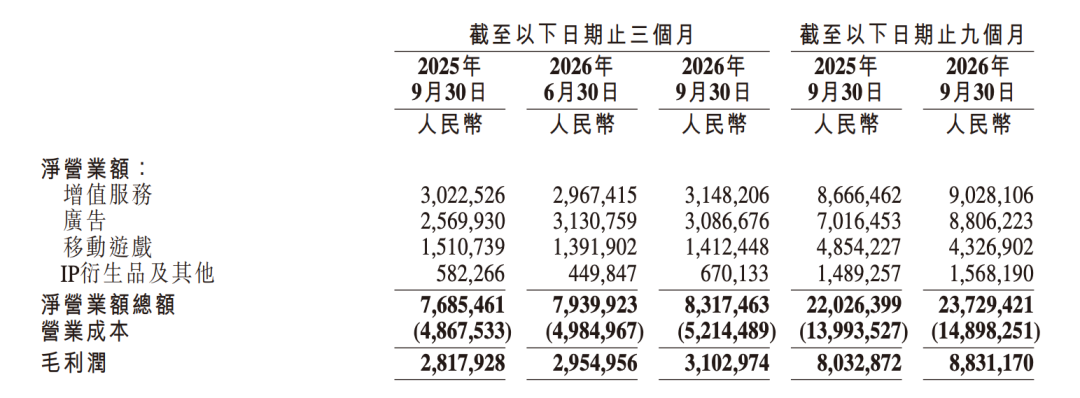
Bilibili financial report
Value-added services remain Bilibili's largest business, including livestreaming rewards, premium membership, and the charging business in which users pay uploaders. But over the past two years, growth in value-added services has continued to slow. In 2024, Bilibili's value-added service revenue grew 11% year-on-year, falling to 8% in 2025, and growing only about 4% in the first three quarters of this year.
The number of premium members has even begun to decline. As of the end of the third quarter of this year, Bilibili had 24.68 million premium members, down about 1 million from the end of the second quarter and about 700,000 from the same period last year. Although the user scale hit a record high, fewer users were willing to buy Bilibili premium memberships. Fortunately, the average revenue contributed by each premium member increased, and Bilibili's premium membership revenue in the third quarter still maintained year-on-year growth.
Among value-added services, the one that still maintains rapid growth is the charging business. In the third quarter, Bilibili's charging business revenue grew more than 40% year-on-year. Over the past two years, more and more uploaders have begun trying to make some videos available only to charging users, helping Bilibili obtain a share of paid revenue.
The bigger problem is still gaming.
"Three Kingdoms: The World in Motion," launched in the summer of 2024, was the biggest surprise for Bilibili's gaming business. In its first full quarter after launch, Bilibili's gaming revenue grew 84% year-on-year to 1.82 billion yuan, helping Bilibili achieve adjusted profitability in a single quarter for the first time.
But more than two years later, Bilibili has still not produced another "Three Kingdoms: The World in Motion." In the third quarter of this year, Bilibili's gaming revenue was 1.41 billion yuan, down 7% year-on-year, marking five consecutive quarters of year-on-year decline. Compared with two years ago, Bilibili's single-quarter gaming revenue has decreased by more than 400 million yuan.
Last year, Bilibili's self-developed "Escape from Duckov" achieved good results, ranking first in domestic indie game sales that year with about 3.8 million copies sold. But limited by the buy-to-play business model, this game may be unlikely to contribute revenue continuously like "Three Kingdoms: The World in Motion."
In September this year, Bilibili launched its first self-developed online game, "Shine! Lumi," which once climbed to second place on the iOS download chart in China. Chen Rui said the game's performance met the company's expectations for a casual game, with overseas markets currently contributing about 45% of revenue. He expects the game to become profitable next year.
Bilibili's greatest hopes next are still pinned on Three Kingdoms. On December 24 this year, Bilibili will launch another Three Kingdoms-themed strategy game, "Romance of the Three Kingdoms: The King's Way Under Heaven."
According to Chen Rui, "Three Kingdoms: The World in Motion" mainly targets younger strategy game players who prefer lighter gameplay, while "Romance of the Three Kingdoms: The King's Way Under Heaven" targets older players who have higher demands for strategy gameplay and more disposable income. In other words, it can attract more middle-aged groups with money and leisure, and revenue will also be better.
Next year is a big year for Bilibili's games. In addition to "Romance of the Three Kingdoms: The King's Way Under Heaven" launching at the end of the year, Bilibili also plans to launch "Ragnarok 3," a "Guild Wars" IP card game, and the self-developed "Three Kingdoms: Fire Phoenix Liaoyuan." The first China server test for "Ragnarok 3" has ended, and it is a key product for Bilibili next year. "Gaming revenue next year will definitely be better," Chen Rui said.

Bilibili gaming business
Another relatively fast-growing business is selling merchandise and holding exhibitions. In the third quarter, Bilibili's IP derivatives and other business revenue grew 15% year-on-year, mainly from IP derivative sales and offline events. But this business accounted for only 8% of Bilibili's total revenue, and in the first three quarters of this year it was only less than 80 million yuan more than last year.
The weak growth of businesses other than advertising means that if Bilibili wants to maintain the profit growth rate of the past two years, it must continue to find ways to cut costs and expenses.
But this room is also shrinking. In 2023, Bilibili's full-year gross margin was only 24.2%, rising to 32.7% in 2024 and further to 36.6% in 2025. In the three quarters of this year, Bilibili's gross margins were 37.1%, 37.2%, and 37.3%, respectively. Bilibili CFO Fan Xin expects the company's gross margin in the fourth quarter to be basically flat compared with the third quarter.
Meanwhile, Bilibili, which has just reached full-year profitability, has started to loosen its purse strings. In the third quarter of this year, the company's R&D expenses rose 11% year-on-year, driven largely by higher server depreciation costs. In September, Bilibili issued $700 million in convertible bonds, with part of the proceeds earmarked for expanding AI investment.
On the earnings call, Chen Rui said Bilibili's AI investment centers on three areas: video understanding, distribution, and creation. When analysts pressed him on the scale of AI spending planned for next year, Chen declined to give a specific figure.


Copyright owned by Shanshang. Reproduction prohibited without authorization.
-
Why Are Listed Companies' Financial Reports Starting to Take Douyin E-commerce's Business Logic Seriously?
-
AI Steps on the Gas: A 167-Year-Old Cold Case Finally Hears an Echo
-
![]()
Short Dramas: Big Tech's Q3 Earnings Scapegoat or Lifeline?
-
![]()
Coating Material Selection: Four Critical Gates — Contrast, Absorption, Stress, and Process Window
-
![]()
Maishi Optoelectronics Completes IPO Coaching Acceptance Inspection, Securing 2 Billion Yuan in Financing This Year
-
Second Financing Round of the Year! Chengfeng Technology Secures Tens of Millions of Yuan in B+ Round
-
![]()
Why Can't Hongguo Swallow Bilibili?
-
![]()
The Day After Jensen Huang's Return: The Fed Pours Cold Water on the Rally